Synthesis of Sentences – Class 10 English Grammar Complete Question Answers and Solutions | ASSEB / SEBA
Class 10 English Grammar – Synthesis of Sentences Complete Question Answers and Exam Solutions (ASSEB / SEBA Assam)
The sixth highly important topic in the Class 10 English Grammar syllabus is the ‘Synthesis of Sentences’ (also known as Combining Sentences). For the upcoming HSLC 2027 examination, the complete notes, rules, and question answers for this topic have been prepared according to the new ASSEB (Assam State School Education Board) syllabus and the latest National Education Policy (NEP) blueprint. This special collection includes detailed explanations on how to combine sentences, along with a comprehensive solution of Previous Years’ Board Exam Questions (PYQ). At Ospin Academy, these grammar solutions are provided in a simple, accurate, and completely exam-oriented manner.
Synthesis of Sentences involves combining two or more simple sentences into one new Simple, Compound, or Complex sentence without altering the core meaning. This requires a strong understanding of conjunctions, participles, infinitives, and relative clauses. Mastering this section is crucial not only for scoring full marks in the grammar portion but also for writing high-quality essays and long answers. Our Question Bank covers all the basic rules and includes advanced board-level exercises and probable questions to ensure 100% preparation for the students.
What you will learn and get from this grammar section:
- Clear rules for combining sentences using Participles, Infinitives, Nouns or Phrases in Apposition.
- Techniques to form Compound sentences using coordinating conjunctions (and, but, or, so).
- Methods to construct Complex sentences using noun, adjective, and adverb clauses.
- Extensive practice exercises on ‘Combine the following pairs of sentences’ matching the exact board exam pattern.
Special Features by Ospin Academy for HSLC 2027 Exam:
- Complete Grammar Question Bank prepared based on the latest ASSEB blueprint for HSLC 2027.
- Detailed solutions for the Previous 10 Years’ ‘Synthesis of Sentences’ Questions (PYQ 2015-2026) and 27 Districts Pre-Board Exam Papers.
- 100% accurate, high-quality notes written in simple English for easy memorization.
- Specially designed PDF format for last-minute quick revision before the exams.
- A curated list of 100% common board suggestions and expected grammar exercises.
Ospin Academy offers this specialized course keeping in mind the academic growth of the students. Start your HSLC 2027 preparation now and step towards securing the highest marks in the English subject.
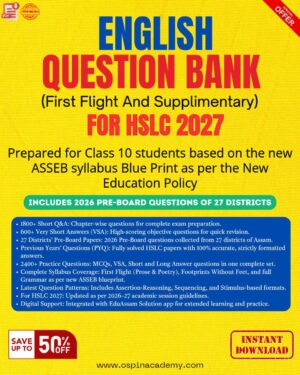
Class 10 English Question Bank ASSEB HSLC 2027 | Complete Chapter-wise Solutions PDF
Save Up To 50% OFF – Instant Download!
(For ASSEB, HSLC 2027)
Get the ultimate preparation toolkit for Class 10 English (First Flight & Supplementary) with this comprehensive Question Bank PDF.
Includes 2400+ practice questions, 2026 Pre-Board Papers from 27 Districts, Solved PYQs, and Complete Grammar updated as per the new ASSEB syllabus Blueprint and New Education Policy.
Perfect for mastering Assertion-Reasoning, Sequencing, and scoring top marks in HSLC 2027!
 Class 10th English
Synthesis of Sentences
HSLC Board Previous Year Synthesis of Sentences
1. “He behaved as if he were a mad man. Identify the type of adverb clause represented by the underlined part. {2026}
(A) Adverb clause of time.
(B) Adverb clause of place.
(C) Adverb clause of manner.
(D) Adverb clause of condition.”
Answer: C
2. “Join the sentences given below using a relative clause. {2026}
The man cheated me. I trusted him.”
Answer: The man whom I trusted cheated me.
3. Select the correct combination of sentence for the given sentences. He has no strength. He has no intelligence. {2025}
(A) He has neither strength and no either intelligence.
(B) He has no strength and either no intelligence.
(C) He has neither strength nor intelligence.
(D) He has neither strength and intelligence.
Answer: C
4. Read the two statements And choose the correct option: {2024}
Statement 1: We have to be careful and alert.
Statement 2: Is that so: but why?
(A) Statement 1 is imperative and Statement 2 is exclamatory
(B) Statement 1 is assertive and Statement 2 is interrogative
(C) Both Statement 1 and Statement 2 are assertive
(D) Both Statement 1 and Statement 2 are interrogative
Answer: B
5. Do as directed for the following: {2025}
I often go to Mumbai, Mumbai is the commercial capital of India.
(Join the sentences using a relative pronoun.)
Answer: I often go to Mumbai, which is the commercial capital of India.
6. I signed my name where father told me to do.{2024}
Identify the type of adverb clause represented by the underlined part.
(A) Adverb clause of place
(B) Adverb clause of manner
(C) Adverb clause of condition
(D) Adverb clause of time
Answer: A
7. Combine the following sentences: {2022}
(A) He is not sincere. He is not honest.
Answer: He is neither sincere nor honest.
(B) The earth moves round the sun. Everybody knows it.
Answer: Everybody knows that the earth moves round the sun.
8. Combine the following sentences: {2020}
(A) Where has he gone? Do you know it?
Answer: Do you know where he has gone?
(B) I finished the work. I was taking rest.
Answer: I was taking rest after I finished the work.
9. Combine the following sentences: {2019}
(A) The earth is round. We can prove it.
Answer: We can prove that the earth is round.
(B) Where does he live? Do you know it?
Answer: Do you know where he lives?
10. Combine the following sentences: {2018}
(A) The boy is not brave. The boy is not intelligent.
Answer: The boy is neither brave nor intelligent.
(B) The man created the trouble. The man was arrested.
Answer: The man who created the trouble was arrested.
11. Combine the following sentences: {2017}
(A) Man is mortal. Everybody knows this.
Answer: Everybody knows that man is mortal.
(B) Walk fast. You will miss the train.
Answer: If you do not walk fast, you will miss the train.
12. Combine the following sentences: {2016}
(A) The moon is round. It has been proved.
Answer: It has been proved that the moon is round.
(B) Where does he live? Do you know it?
Answer: Do you know where he lives?
13. Combine the following sentences: {2015}
(A) I have lost the pen. You gave it to me.
Answer: I have lost the pen which you gave to me.
(B) Health is very important. It must not be neglected.
Answer: Health, which is very important, must not be neglected.
Common Pre-Board Report Synthesis of Sentences (2025–26)
1. Select the correct combination of sentences for the given sentences: Dhaniram is very rich. He can bear this expenditure. {Baksa}
(A) Dhaniram is enough rich to bear this expenditure.
(B) Dhaniram is not only rich to bear this expenditure.
(C) Dhaniram is rich enough to bear this expenditure.
(D) Dhaniram is rich enough and bear this expenditure.
Answer: C
2. Select the correct combination of sentence for the given sentences. {Bongaigaon}
The teacher entered the class. The students became silent.
(A) When the students became silent, the teacher entered the class.
(B) Entering the class, the students became silent.
(C) The students became silent because the teacher entered the class.
(D) The teacher entered the class although students became silent.
Answer: C
3. Rabindranath Tagore was a great poet and wrote Gitanjali. Combine the sentences using appositive – {Charaideo}
(A) Rabindranath Tagore was a great poet and wrote Gitanjali.
(B) Rabindranath Tagore, a great poet, wrote Gitanjali.
(C) Rabindranath Tagore wrote Gitanjali, who was a great poet.
(D) Rabindranath Tagore wrote Gitanjali because he was a great poet.
Answer: B
4. “I know her mother.” The complex form of the sentence is {Dhubri}
(A) I know that she has a mother.
(B) I know who is her mother.
(C) I know who her mother is.
(D) She has a mother and I know that.
Answer: C
5. Identify the correctly synthesized sentence of the following two sentences. “Where has he gone? Do you know it?” {Golaghat}
(A) Do you know where has he gone?
(B) Do you know where he has gone?
(C) Do you know and where he has gone?
(D) Where he has gone you know it?
Answer: B
6. Choose the correct simple sentence combination of the following two sentences from the options given below. Farmers use modern methods of cultivation. They wish to produce more food grains. {Hailakandi}
(A) Farmers use modern methods of cultivation to produce more food grains
(B) Farmers use modern methods of cultivation and wish to produce more food grains
(C) Farmers use modern methods of cultivation because they wish to produce more food grains
(D) Farmers use modern methods of cultivation wishing to produce more food grains.
Answer: A
7. Select the correct combination of sentences for the given sentences: She was very tired. She could not sleep. {Jorhat}
(A) She could not sleep because she was very tired
(B) She was very tired, but she could sleep.
(C) She was very tired, so she slept.
(D) Although she was very tired, she slept.
Answer: A
8. He finished his homework. He went out to play. (Combine sentences) {Kamrup M}
(A) He went out to play and finished his homework.
(B) He finished his homework and gone out to play.
(C) He had finished his homework he went to play.
(D) Having finished his homework, he went out to play.
Answer: D
9. He helps me. I will help him. (Combine sentences) {Kamrup M}
(A) If he helps me, I help him.
(B) If he helps me, I will help him.
(C) If he will help me, I help him.
(D) I will help him if he will help me.
Answer: B
10. I know what his intention is. Choose the sentence that replaces the underlined clause correctly : {Kokrajhar}
(A) I know what is his intention.
(B) I know his intention is what.
(C) I know his intention
(D) What is his intention I know
Answer: C
11. The tourists visited Kaziranga with a view to …… Complete the sentence choosing the right option : {Kokrajhar}
(A) See the rhinoceros.
(B) Seeing the rhinoceros.
(C) Be seen the rhinoceros
(D) Saw the rhinoceros.
Answer: B
12. Choose the correct option of combined sentence of the following sentences: The teacher entered the class. The students stood up. {Lakhimpur}
(A) The students stood up although the teacher entered.
(B) The teacher entered the class for the students to stand.
(C) As soon as the teacher entered the class, the students stood up.
(D) The teacher entered and the students stood up because of her.
Answer: C
13. Select the correct combination of sentence for the given sentences. You press this key. You can then start the machine. {Majuli}
(A) You can start the machine by pressing this key.
(B) You can start the machine with pressing this key.
(C) You can start the machine through pressing this key.
(D) You can start the machine to pressing this key.
Answer: A
14. I will attend the function if you come with me. {Morigaon}
(A) Adverb clause of time.
(B) Adverb clause of condition.
(C) Adverb clause of Manner.
(D) Adverb clause of place.
Answer: B
15. She is very weak in mathematics. She can not solve a simple sum.(Combine into a single sentence). {Sibsagar}
(A) She is so weak in mathematics if she can not solve a simple sum.
(B) She is too weak in mathematics that she can not solve a simple sum.
(C) She is too weak in mathematics if she can not solve a simple sum.
(D) She is so weak in mathematics that she can not solve a simple sum.
Answer: D
16. Where does he take dinner ? Do you know about it ?(Combine into a single sentence). {Sibsagar}
(A) Do you know where he take dinner ?
(B) Do you know where does he take dinner ?
(C) Do you know where he takes dinner ?
(D) Do you know where does he takes dinner ?
Answer: C
17. Select the correct combination of sentence for the given sentences: Walk fast. You will miss the train. {Sribhumi}
(A) You will miss the train walk fast.
(B) Unless you walk fast you will miss the train.
(C) You walk fast you will miss the train.
(D) You have to miss the train walk fast.
Answer: B
18. Combine the following sentence. Man is mortal. Every body knows it. {SSM}
(A) Man is mortal every body know that.
(B) Man is mortal It is every body knows.
(C) That man is mortal everybody know.
(D) Every body knows that man is mortal.
Answer: D
Short Questions
1. It was not yesterday. We could not play. (Combine the sentences using absolute phrase) {Bajali}
Answer: It not being yesterday, we could not play.
2. Work hard to win. (Turn into a compound sentence) {Bajali}
Answer: Work hard and you will win.
3. He opened the door and went away. (Make it simple sentence) {Baksa}
Answer: Opening the door, he went away.
4. Combine the following pairs of sentences into a single sentence: {Barpeta}
(a) Walk fast. You will miss the train.
(b) The woman is not sincere. She is not honest.
Answer:
(a) Walk fast or you will miss the train.
(b) The woman is neither sincere nor honest.
5. He was innocent. He wanted to prove it. (Combine the pair of sentences into one sentence) {Bongaigaon}
Answer: He wanted to prove his innocence.
6. My father is a businessman. He has an expensive car. (Combine the two sentences into a single one using a relative pronoun) {Cachar}
Answer: My father, who is a businessman, has an expensive car.
7. Where has he gone? Do you know it? (Combine into a single sentence) {Darrang}
Answer: Do you know where he has gone?
8. Though he was old, he was energetic. (Write as a compound sentence) {Hojai}
Answer: He was old, but he was energetic.
9. Identify the adverb clause in the following sentence: “I went home because I was tired.” {Lakhimpur}
Answer: because I was tired
10. She was ill. She went to school. (Join the sentences using a conjunction) {Majuli}
Answer: Although she was ill, she went to school.
11. He is a man of method, I know it. (Combine in to a single sentence) {Morigaon}
Answer: I know that he is a man of method.
12. He saw the tiger. He started to run away. (Combine using participle) {Nalbari}
Answer: Seeing the tiger, he started to run away.
13. He is a man of method, I know it. (Combine in to a single sentence) {Sibsagar}
Answer: I know that he is a man of method.
14. He gave me a book. The book was new. (combine the sentence into a single one) {Sonitpur}
Answer: He gave me a new book.
15. He does not know how to write. He does not know how to read. (Join the two sentences using ‘neither…… nor’) {Sribhumi}
Answer: He knows neither how to write nor how to read.
16. He is too weak to walk. (Turn into complex sentence) {SSM}
Answer: He is so weak that he cannot walk.
Class 10 English Grammar (Synthesis of Sentences) – Frequently Asked Questions (FAQs)
 Class 10th English
Synthesis of Sentences
HSLC Board Previous Year Synthesis of Sentences
1. “He behaved as if he were a mad man. Identify the type of adverb clause represented by the underlined part. {2026}
(A) Adverb clause of time.
(B) Adverb clause of place.
(C) Adverb clause of manner.
(D) Adverb clause of condition.”
Answer: C
2. “Join the sentences given below using a relative clause. {2026}
The man cheated me. I trusted him.”
Answer: The man whom I trusted cheated me.
3. Select the correct combination of sentence for the given sentences. He has no strength. He has no intelligence. {2025}
(A) He has neither strength and no either intelligence.
(B) He has no strength and either no intelligence.
(C) He has neither strength nor intelligence.
(D) He has neither strength and intelligence.
Answer: C
4. Read the two statements And choose the correct option: {2024}
Statement 1: We have to be careful and alert.
Statement 2: Is that so: but why?
(A) Statement 1 is imperative and Statement 2 is exclamatory
(B) Statement 1 is assertive and Statement 2 is interrogative
(C) Both Statement 1 and Statement 2 are assertive
(D) Both Statement 1 and Statement 2 are interrogative
Answer: B
5. Do as directed for the following: {2025}
I often go to Mumbai, Mumbai is the commercial capital of India.
(Join the sentences using a relative pronoun.)
Answer: I often go to Mumbai, which is the commercial capital of India.
6. I signed my name where father told me to do.{2024}
Identify the type of adverb clause represented by the underlined part.
(A) Adverb clause of place
(B) Adverb clause of manner
(C) Adverb clause of condition
(D) Adverb clause of time
Answer: A
7. Combine the following sentences: {2022}
(A) He is not sincere. He is not honest.
Answer: He is neither sincere nor honest.
(B) The earth moves round the sun. Everybody knows it.
Answer: Everybody knows that the earth moves round the sun.
8. Combine the following sentences: {2020}
(A) Where has he gone? Do you know it?
Answer: Do you know where he has gone?
(B) I finished the work. I was taking rest.
Answer: I was taking rest after I finished the work.
9. Combine the following sentences: {2019}
(A) The earth is round. We can prove it.
Answer: We can prove that the earth is round.
(B) Where does he live? Do you know it?
Answer: Do you know where he lives?
10. Combine the following sentences: {2018}
(A) The boy is not brave. The boy is not intelligent.
Answer: The boy is neither brave nor intelligent.
(B) The man created the trouble. The man was arrested.
Answer: The man who created the trouble was arrested.
11. Combine the following sentences: {2017}
(A) Man is mortal. Everybody knows this.
Answer: Everybody knows that man is mortal.
(B) Walk fast. You will miss the train.
Answer: If you do not walk fast, you will miss the train.
12. Combine the following sentences: {2016}
(A) The moon is round. It has been proved.
Answer: It has been proved that the moon is round.
(B) Where does he live? Do you know it?
Answer: Do you know where he lives?
13. Combine the following sentences: {2015}
(A) I have lost the pen. You gave it to me.
Answer: I have lost the pen which you gave to me.
(B) Health is very important. It must not be neglected.
Answer: Health, which is very important, must not be neglected.
Common Pre-Board Report Synthesis of Sentences (2025–26)
1. Select the correct combination of sentences for the given sentences: Dhaniram is very rich. He can bear this expenditure. {Baksa}
(A) Dhaniram is enough rich to bear this expenditure.
(B) Dhaniram is not only rich to bear this expenditure.
(C) Dhaniram is rich enough to bear this expenditure.
(D) Dhaniram is rich enough and bear this expenditure.
Answer: C
2. Select the correct combination of sentence for the given sentences. {Bongaigaon}
The teacher entered the class. The students became silent.
(A) When the students became silent, the teacher entered the class.
(B) Entering the class, the students became silent.
(C) The students became silent because the teacher entered the class.
(D) The teacher entered the class although students became silent.
Answer: C
3. Rabindranath Tagore was a great poet and wrote Gitanjali. Combine the sentences using appositive – {Charaideo}
(A) Rabindranath Tagore was a great poet and wrote Gitanjali.
(B) Rabindranath Tagore, a great poet, wrote Gitanjali.
(C) Rabindranath Tagore wrote Gitanjali, who was a great poet.
(D) Rabindranath Tagore wrote Gitanjali because he was a great poet.
Answer: B
4. “I know her mother.” The complex form of the sentence is {Dhubri}
(A) I know that she has a mother.
(B) I know who is her mother.
(C) I know who her mother is.
(D) She has a mother and I know that.
Answer: C
5. Identify the correctly synthesized sentence of the following two sentences. “Where has he gone? Do you know it?” {Golaghat}
(A) Do you know where has he gone?
(B) Do you know where he has gone?
(C) Do you know and where he has gone?
(D) Where he has gone you know it?
Answer: B
6. Choose the correct simple sentence combination of the following two sentences from the options given below. Farmers use modern methods of cultivation. They wish to produce more food grains. {Hailakandi}
(A) Farmers use modern methods of cultivation to produce more food grains
(B) Farmers use modern methods of cultivation and wish to produce more food grains
(C) Farmers use modern methods of cultivation because they wish to produce more food grains
(D) Farmers use modern methods of cultivation wishing to produce more food grains.
Answer: A
7. Select the correct combination of sentences for the given sentences: She was very tired. She could not sleep. {Jorhat}
(A) She could not sleep because she was very tired
(B) She was very tired, but she could sleep.
(C) She was very tired, so she slept.
(D) Although she was very tired, she slept.
Answer: A
8. He finished his homework. He went out to play. (Combine sentences) {Kamrup M}
(A) He went out to play and finished his homework.
(B) He finished his homework and gone out to play.
(C) He had finished his homework he went to play.
(D) Having finished his homework, he went out to play.
Answer: D
9. He helps me. I will help him. (Combine sentences) {Kamrup M}
(A) If he helps me, I help him.
(B) If he helps me, I will help him.
(C) If he will help me, I help him.
(D) I will help him if he will help me.
Answer: B
10. I know what his intention is. Choose the sentence that replaces the underlined clause correctly : {Kokrajhar}
(A) I know what is his intention.
(B) I know his intention is what.
(C) I know his intention
(D) What is his intention I know
Answer: C
11. The tourists visited Kaziranga with a view to …… Complete the sentence choosing the right option : {Kokrajhar}
(A) See the rhinoceros.
(B) Seeing the rhinoceros.
(C) Be seen the rhinoceros
(D) Saw the rhinoceros.
Answer: B
12. Choose the correct option of combined sentence of the following sentences: The teacher entered the class. The students stood up. {Lakhimpur}
(A) The students stood up although the teacher entered.
(B) The teacher entered the class for the students to stand.
(C) As soon as the teacher entered the class, the students stood up.
(D) The teacher entered and the students stood up because of her.
Answer: C
13. Select the correct combination of sentence for the given sentences. You press this key. You can then start the machine. {Majuli}
(A) You can start the machine by pressing this key.
(B) You can start the machine with pressing this key.
(C) You can start the machine through pressing this key.
(D) You can start the machine to pressing this key.
Answer: A
14. I will attend the function if you come with me. {Morigaon}
(A) Adverb clause of time.
(B) Adverb clause of condition.
(C) Adverb clause of Manner.
(D) Adverb clause of place.
Answer: B
15. She is very weak in mathematics. She can not solve a simple sum.(Combine into a single sentence). {Sibsagar}
(A) She is so weak in mathematics if she can not solve a simple sum.
(B) She is too weak in mathematics that she can not solve a simple sum.
(C) She is too weak in mathematics if she can not solve a simple sum.
(D) She is so weak in mathematics that she can not solve a simple sum.
Answer: D
16. Where does he take dinner ? Do you know about it ?(Combine into a single sentence). {Sibsagar}
(A) Do you know where he take dinner ?
(B) Do you know where does he take dinner ?
(C) Do you know where he takes dinner ?
(D) Do you know where does he takes dinner ?
Answer: C
17. Select the correct combination of sentence for the given sentences: Walk fast. You will miss the train. {Sribhumi}
(A) You will miss the train walk fast.
(B) Unless you walk fast you will miss the train.
(C) You walk fast you will miss the train.
(D) You have to miss the train walk fast.
Answer: B
18. Combine the following sentence. Man is mortal. Every body knows it. {SSM}
(A) Man is mortal every body know that.
(B) Man is mortal It is every body knows.
(C) That man is mortal everybody know.
(D) Every body knows that man is mortal.
Answer: D
Short Questions
1. It was not yesterday. We could not play. (Combine the sentences using absolute phrase) {Bajali}
Answer: It not being yesterday, we could not play.
2. Work hard to win. (Turn into a compound sentence) {Bajali}
Answer: Work hard and you will win.
3. He opened the door and went away. (Make it simple sentence) {Baksa}
Answer: Opening the door, he went away.
4. Combine the following pairs of sentences into a single sentence: {Barpeta}
(a) Walk fast. You will miss the train.
(b) The woman is not sincere. She is not honest.
Answer:
(a) Walk fast or you will miss the train.
(b) The woman is neither sincere nor honest.
5. He was innocent. He wanted to prove it. (Combine the pair of sentences into one sentence) {Bongaigaon}
Answer: He wanted to prove his innocence.
6. My father is a businessman. He has an expensive car. (Combine the two sentences into a single one using a relative pronoun) {Cachar}
Answer: My father, who is a businessman, has an expensive car.
7. Where has he gone? Do you know it? (Combine into a single sentence) {Darrang}
Answer: Do you know where he has gone?
8. Though he was old, he was energetic. (Write as a compound sentence) {Hojai}
Answer: He was old, but he was energetic.
9. Identify the adverb clause in the following sentence: “I went home because I was tired.” {Lakhimpur}
Answer: because I was tired
10. She was ill. She went to school. (Join the sentences using a conjunction) {Majuli}
Answer: Although she was ill, she went to school.
11. He is a man of method, I know it. (Combine in to a single sentence) {Morigaon}
Answer: I know that he is a man of method.
12. He saw the tiger. He started to run away. (Combine using participle) {Nalbari}
Answer: Seeing the tiger, he started to run away.
13. He is a man of method, I know it. (Combine in to a single sentence) {Sibsagar}
Answer: I know that he is a man of method.
14. He gave me a book. The book was new. (combine the sentence into a single one) {Sonitpur}
Answer: He gave me a new book.
15. He does not know how to write. He does not know how to read. (Join the two sentences using ‘neither…… nor’) {Sribhumi}
Answer: He knows neither how to write nor how to read.
16. He is too weak to walk. (Turn into complex sentence) {SSM}
Answer: He is so weak that he cannot walk.