Class 10 Social Science Chapter 1 – Partition of Bengal and Swadeshi Movement Complete Question Answer | ASSEB / SEBA
Class 10 Social Science (History) Chapter 1 – Partition of Bengal and Swadeshi Movement Complete Question Answers and Exam Solutions (ASSEB / SEBA Assam – English Medium)
The first chapter of the Class 10 Social Science History section, ‘Partition of Bengal and Swadeshi Movement’, is a foundational chapter detailing a critical phase of India’s freedom struggle. For the upcoming HSLC 2027 exams, complete question answers (Class 10 Social Science Chapter 1 Question Answer) have been prepared based on the New ASSEB (Assam State School Education Board) Syllabus 2026-27 and the latest exam blueprint. This comprehensive collection includes in-text Very Short Answers (VSA), Short Questions, Long Answers, and detailed solutions to Previous Years’ Board Exam Questions (PYQ). At Ospin Academy, these solutions are curated to be highly accurate and fully exam-oriented.
This chapter provides an in-depth look at Lord Curzon’s plan to partition Bengal, the underlying political motives, the subsequent anti-partition protests, and the rise of the Swadeshi Movement, including its impact on national education and indigenous industries. Memorizing the historical events and dates of this chapter is vital for matriculation candidates. Our Question Bank goes beyond textbook exercises by covering Extra Board Questions and Answers that are highly likely to appear in the exam, ensuring 100% preparation for students.
What you will learn and get from this chapter:
- A detailed analysis of the background of the Partition of Bengal (1905) and Lord Curzon’s true intentions.
- Insights into the programs of the Swadeshi Movement, the development of National Education, and the role of the Indian National Congress.
- Flawless answers for 1-mark very short (VSA objective type) and 2-3 marks short questions perfectly structured for board exams.
- Easy-to-understand and standard solutions for 4-5 marks long questions.
- Pattern analysis of frequently asked objective questions (MCQs) and key dates relevant to the matric exam.
Special benefits from Ospin Academy for HSLC 2027 Exam:
- Complete Social Science Question Bank prepared in strict accordance with the latest ASSEB blueprint for HSLC 2027.
- Full solutions of Previous 10 Years’ Questions (PYQ) as well as Pre-Board exam question papers from various districts of Assam.
- 100% accurate, high-quality notes (Class 10 History Notes) written in simple English to help students grasp concepts quickly.
- Specially compiled PDF format (PDF Download) for quick last-minute revision before the board examination.
- An exclusive collection of 100% Common Board Suggestion questions guaranteed to boost your confidence.
Kickstart your HSLC 2027 exam preparation today and step forward to achieve the Highest Marks in Social Science.
Class 10 Social Science Question Bank ASSEB HSLC 2027 | English Medium Chapter-wise Solutions PDF
 Class 10: Social Science
Partition of Bengal and Swadeshi Movement
HSLC English PYQs (2024–2026): Important MCQs with Answers
1. Lord Curzon initiated the scheme of separation of Bengal in order to – {2026}
(i) Break-down harmony between Hindus and Muslims.
(ii) To ease the process of governance in a decentralized way.
(iii) Not to repeat any challenges like the Sepoy Mutiny of 1857 due to greater size of their (British) Administration.
(A) (i), (ii), (iii) are correct.
(B) (i), (ii) are correct.
(C) (ii), (iii) are correct.
(D) only (ii) is correct.
Answer: B
2. Two statements are given in the question below as Assertion (A) and Reason (R). Read the statements and choose the correct option. {2026}
Assertion (A) : The Swadeshi movement crossed the boundaries of Bengal and took a form of an all Indian movement.
Reason (R) : The people of Maharashtra, South India, North-east India supported this movement.
(A) Both (A) and (R) true and (R) is the correct explanation of (A).
(B) (A) is true, but (R) is false.
(C) Both (A) and (R) are true, but (R) is not the correct explanation of (A).
(D) (A) is false, but (R) is true.
Answer: A
3. On which date in 1905 did the partition of Bengal come into force ? {2026}
(A) 1st September
(B) 19th July
(C) 16th October
(D) 2nd February
Answer: C
4. The aim of Bangia Kala Sangsad (1907) was {2026}
(A) Building foundation of Indian fine arts with the influence of western art.
(B) Building foundation of western fine arts in India.
(C) Building a better cultural foundation by practicing pure Indian fine arts free from western influences.
(D) Building foundation of Indian technology free from western influences.
Answer: C
5. Who among the following edited a magazine Vande Mataram during Swadeshi Movement in India? {2025}
(A) Arabinda Ghose
(A) Krishna Kumar Mitra
(C) Surendranath Banerjee
(D) Kumudini Mishra
Answer: A
6. Two statements are given in the question below as Assertion (A) and Reason (R). Read the statements and choose the correct option. {2025}
Assertion (A): The Swadeshi Movement in India aimed to promote indigenous goods and reduce dependency on British products.
Reason (R): The Swadeshi Movement primarily aimed to protest against British taxes and government loans.
(A) Both (A) and (R) are true, and (R) is the correct explanation of (A).
(B) (A) is true, but (R) is false.
(C) Both (A) and (R) are true, but (R) is not the correct explanation of (A).
(D) (A) is false, but (R) is true.
Answer: B
7. Which of the following statements are true about the Partition of Bengal in 1905. {2025}
(i) It resulted in the second important political upheaval in India after the 1857 Revolt.
(ii) It was executed to suppress the growing national consciousness in Bengal.
(iii) Shillong was made Assam. The capital of Eastern Bengal and 7
(iv) It led to the Swadeshi Movement.
(A) (i), (ii), (iv)
(B) (i), (iii),(iv)
(C) (ii), (iii), (iv)
(D) (i), (ii), (iii), (iv)
Answer: A
8. “The United Bengal is a big force, the partition will destroy this big unity.” Whose quote was this? {2024}
(A) Secretary of State for India, Herbert Risley
(B) Lord Curzon
(C) William Ward)
(D) Lord William Bantinck
(D) (i), (ii), (iii), (iv)
Answer: A
Assam’s Various District Pre‑Board (2025–26) MCQs With Answers
1. Through the treaty of Allahabad, the East India company gained political authority over which of the following places : {Bajali}
(A) Bengal, Berar, Odisha
(B) East Bengal, West Bengal, Orissa
(C) Orissa, West Bengal, Bihar
(D) Bengal, Bihar, Oriss
Answer: D
2. Match the following: – {Bajali}
Newspapers/Magazines
(A) Sandhya
(B) The Dawn
(C) Supravat
(D) Vande Mataram
Involved person/Secretary
(i) Kumudini Mitra
(ii) Arvind Ghos
(iii) Brahmabandhab Upadhyaya
(iv) Satish Chandra Mukhopadhya
(A) A – i, B – ii, C-iii, D – iv
(B) A – ii, B – i, C – iv, D – iii
(C) A – iii, B – iv, C – i, D – ii
(D) A – iv, B – iii, C -ii, D – i
Answer: C
3. Choose the correct of the following sentences: {Bajali}
(i) Initially the Swadeshi movement was limited to boycotting foreign goods and indigenous ones.
(ii) On the day of the partion Bengal came into effect, Robindranath Tagore led a procession, tying rakhi threds on Muslims including moulvis.
(iii) Students vowed to walk barefoot to school untill the partition of Bengal was annulled as per the directive of the student Samgram Samiti.
(iv) Ananda Mohan Bose laid the foundation stone of the Federation Hall as a symbol of the Unity and heritage of the Bengal.
(A) i, ii, iii, iv
(B) iii, iv
(C) i, iv
(D) ii, iii, iv
Answer: A
4. “The Bengal women are the most obstinate and most dangerous antagonist of the English.”
In which newspaper published from London did this statement about the bravery of the women of Bengal during the Swadeshi Movement appear? {Bajali}
(A) London Times
(B) Daily Times
(C) London Telegraph
(D) Daily Telegraph
Answer: D
5. The tenure of Lord Nathaniel Curzon- {Baksa}
(A) 1805-1811
(B) 1899 – 1905
(C) 1879 – 1885
(D) 1905 – 1911
Answer: B
6. Match Part ‘A’ with Part ‘B’ and get the correct answer: {Baksa}
Part-A
(A) Abanindranath Tagore
(B) Satishchandra Mukhopadhyay.
(C) Sarala Devi Choudhurini
(D) Prafulla Roy
Part- B
(i) The Dawn
(ii) Bengal chemical
(iii) Banga Mata
(iv) Bharati
(A) (A)-(iii), (B)-(i), (C)-(iv), (D)-(ii)
(B) (A)-(iv), (B)-(iii), (C)-(ii), (D)-(i)
(C) (A)-(iii), (B)-(iv), (C)-(i), (D)-(ii)
(D) (A)-(ii), (B)-(iv), (C)-(i), (D)-(ii)
Answer: A
7. “Boycotting means patriotism and essence of patriotism is the non co-operation with the British in all respects.” Who said this? {Barpeta}
(A) Bankim Chandra Chatterjee
(B) Rabindra Nath Tagore
(C) Arbinda Ghosh
(D) Mahatma Gandhi
Answer: C
8. When did the unification of Bengal take place. {Biswanath}
(A) 10 March 1912
(B) 12 April 1919
(C) 12 December 1911
(D) 8 January 1913
Answer: C
9. Match the following and choose the correct answer. {Biswanath}
a. Surendranath Banerjee
b. Krishna Kumar Mitra
c. Bhupendranath Dutta
d. Brahmabandhab Upadhya
(i) Sanjibani
(ii) Yugantar
(iii) Bengali
(iv) Sandhya
(A) a – iii, b – i, c – ii, d – iv
(B) a – i, b – ii, c – iii, d – iv
(C) a – iii, b – iv, c – i, d – ii
(D) a – ii, b – i, c – iii, d – iv
Answer: A
10. Choose the correct answer of the following question: {Bongaigaon}
Assertion (A) The partition of Bengal is known as the second important political upheaval in India after the sepoy mutiny in 1857.
Reason (R) Partition of Bengal Created mass agitation among the people of Bengal.
(A) (A) is true, (R) is false
(B) (A) is false (R) is true
(C) Both (A) and (R) are true; and (R) is the correct explanation of (A)
(D) Both (A) and (R) are true; but (R) is not the correct explanation of (A)
Answer: C
11. Which of the following statements are true about the contribution of Swadeshi Movement {Bongaigaon}
(i) The Swadeshi Movement was able to give the Indias a Political Knowledge regarding mass movement.
(ii) Lord Carzon had published the four points scheme of Bengal.
(iii) The Indian got the Privilege to demand for Swaraj through the Swadeshi Movement.
(iv) The Swadeshi movement also gave birth to armed movement.
(A) (i) and (ii)
(B) (ii) and (iii)
(C) (i), (iii) and (iv)
(D) (ii), (iii) and (iv)
Answer: C
12. Which of the following decisions were announced in the Royal proclamation of Delhi on 12th December,1911? {Bongaigaon}
(i) Reunification of Bengal
(ii) Shifting of the capital of India from Calcutta to Delhi
(iii) The capital of Assam was again shifted to Shillong
(iv) The administration of Assam came under the chief Commissioner.
(A) (i), (ii)
(B) (iii), (iv)
(C) (i), (ii), (iv)
(D) (i), (ii), (iii), (iv)
Answer: D
13. “The united Bengal is a big Force, the partition will destroy this big unity.” Whose quote was this? {Bongaigaon}
(A) Secretary of state for India, Hebert Risley
(B) Lord Curzon
(C) William Ward
(D) Lord William Bentinek
Answer: A
14. Who created the new province of ‘Eastern Bengal and Assam’? {Cachar}
(A) John Bamfylde Fuller
(B) Andrew Frazer
(C) Lord Dalhousie
(D) Lord Curzon
Answer: D
15. Two statements are given below as Assertion (A) and Reason (R). Consider the statements and choose the correct option: {Darrang}
Assertion (A): National Education Council was formed during the Swadeshi movement.
Reason (R): The British colonial government established educational institutions for nationalists.
(A) Both A and R are true and R is the correct explanation of A
(B) Both A and R are true but R is not the correct explanation of A
(C) A is true, R is false
(D) R is true, A is false
Answer: C
16. The following events are listed chronologically by year and date. Choose the correct one. {Darrang}
(i) Annulment of Bengal Partition Act
(ii) Formation of National Education Council
(iii) Bengal Partition Act came into effect
(iv) Formation of Muslim League
(A) (iii), (ii), (iv), (i)
(B) (i), (ii), (iii), (iv)
(C) (ii), (i), (iii), (iv)
(D) (iv), (iii), (ii), (i)
Answer: A
17. Match the following and choose the correct answer: {Darrang}
(i) Partition of Bengal
(ii) Regulating Act
(iii) Muslim League
(iv) Morley Minto Reforms Act
a) 1909
b) 1906
c) 1905
d) 1773
(A) (i) – (d), (ii) – (c), (iii) – (b), (iv) – (a)
(B) (i) – (c), (ii) – (d), (iii) – (b), (iv) – (a)
(C) (i) – (a), (ii) – (b), (iii) – (c), (iv) – (d)
(D) (i) – (c), (ii) – (a), (iii) – (d), (iv) – (b)
Answer: B
18. Match the following and choose the correct answer: {Darrang}
(i) Rabindranath Tagore
(ii) Mukunda Das
(iii) Bankim Chandra Chattopadhyay
(iv) Aurobindo Ghosh
a) “Boycott means patriotism and the meaning of patriotism is total non-cooperation with the English”
b) Vande Mataram Sujalang ……. Sufalang………
c) ‘Yadi tor dak shune keu na ase ….
d) Hey Banga Janani …….. Swarna Prasabini…… bilati achar tyajite koriba ….
(A) (i) – (b), (ii) – (c), (iii) – (b), (iv) – (d)
(B) (i) – (c), (ii) – (d), (iii) – (b), (iv) – (a)
(C) (i) – (d), (ii) – (a), (iii) – (d), (iv) – (c)
(D) (i) – (a), (ii) – (b), (iii) – (c), (iv) – (b)
Answer: B
19. Which was the first national struggle at the all-India level against British rule? {Darrang}
(A) Sepoy Mutiny
(B) Swadeshi Movement
(C) Civil Disobedience Movement
(D) Quit India Movement
Answer: B
20. Two ladies played important role in Swadeshi Movement are – {Dhubri}
(A) Laxmi Bai and Bhubaneshwari Devi
(B) Sarala Devi and Nibedita
(C) Sarajani Naidu and Nibedita
(D) Annie Besant and Mother Teresa
Answer: B
21. During the Swadeshi Movement, ‘Samarth Vidyalay’ was established in- {Goalpara}
(A) Assam
(B) Patna
(C) Maharastra
(D) Gujrat
Answer: C
22. The British Government annulled the partition of plan of Bengal by holding a Darbar at Delhi – {Goalpara}
(A) 20 July, 1905
(B) 12 December, 1911
(C) 13 December, 1912
(D) 15 August, 1915
Answer: B
23. Assertion (A): The development of Indian industries can be largely attributed to Swadesi Movement. {Goalpara}
Reason (R): The Swadesi Movement encouraged indigenous institutions and industries by boycotting foreign goods and arousing.
Which is the correct option?
(A) (A) is true, (R) is false.
(B) (A) is false, (R) is true.
(C) Both (A) and (R) are true, (R) is the correct explanation of (A).
(D) Both (A) and (R) are true but (R) is not the correct explanation of(A).
Answer: C
24. “Boycotting means patriotism and the essence of patriotism in the non co-operation with the British in all respects”. The speaker of the statement is {Goalpara}
(A) Rabindra Tagore
(B) Arbinda Ghosh
(C) Khirod Prasad
(D) Girish Ghose
Answer: B
25. Consider the following statements about the rise of national education at the backdrop of Swadeshi movement and choose the correct answer. {Hailakandi}
i) Satish Ch.Mukherjee named the university of Calcutta as the ‘house of slaves’-
ii) Rabindranath Tagore established Banga Jatiya Vidalaya in 1905
iii) During Swadeshi movement all together 62 primary schools were established
iv) Under the leadership of Rashbihari Bose National Education Council was formed on 15th March 1906
(A) i) and ii)
(B) i) ii) iii)
(C) iii) and iv)
(D) i), ii), iii), iv)
Answer: A
26. Match the following and choose the correct option: {Hailakandi}
Column – A
1.Su Prabhat
2.Banga Mata
3.Japani Bir
4.Sabbas Bangali
Column – B
i) Amrit Lal Bose
ii) Swarna kumari Devi
iii) Abanindra Nath Tagore
iv) Kumudini Misra
(A) 1-iv, 2-iii, 3-ii, 4-i
(B) 1-ii, 2-i, 3-iii, 4-iv
(C) 1-1, 2-ii, 3-ii, 4-iv
(D) 1-iii, 2-iv, 3-i, 4-ii
Answer: A
27. The official British reason for the Partition of Bengal was “administrative convenience.”However, historians argue the real motive was “political.” {Hailakandi}
Which of the following statement best supports this historical interpretation?
(A) Bengal had a population of 80 million, making it too large to govern.
(B) The British wanted to develop the neglected eastern part of Bengal.
(C) The partition was designed to create a rift between the Hindu and Muslim populations to weaken the nationalist movement.
(D) It was intended to move the capital from Calcutta to a more central location.
Answer: C
28. Assertion (A): The swadeshi Movement in India aimed to promote indigenous goods and reduce dependency on British Products. {Jorhat}
Reason (R): The swadeshi Movement primarly aimed to protest against British taxes and government loans.
(A) Both (A) and (R) are true, and R is the correct explanation of A.
(B) Both (A) and (R) are true, But R is not the correct explanation of (A)
(C) (A) is true, (R) is false.
(D) (A) is false, (R) is true.
Answer: C
29. The person who was not involved in Partition of Bengal? {Kamrup R}
(A) Robert Clive
(B) Lord Curzon
(C) Herbert Risley
(D) Andrew Fraser
Answer: A
30. ______ was founded by Abdul Halim Ghaznabi in Lal Bazar. {Kamrup R}
(A) United Bengal Stores
(B) Lakhmi Bhandar
(C) Indian Stores
(D) Bangalakshmi Cotton mill
Answer: A
31. Bengal was unified in the year- {Kokrajhar}
(A) 1908
(B) 1910
(C) 1911
(D) 1912
Answer: c
32. The magazine “Vande Matram” was edited by- {Kokrajhar}
(A) Bankim Chandra Chattopadhay
(B) Rabindra Nath Tagore
(C) Rajanikanta Sen
(D) Arabinda Ghosh
Answer: D
33. Which of the following song was not associated with the Swadesshi Movement? {Kokrajhar}
(A) Jana-Gana-Mana
(B) Vande Matram
(C) Hey Banga Janani, Swarna Prasabini
(D) Bangalir Pran, Bangalir Mon, Ek Houk He Bhagaban
Answer: A
34. Match the following and choose the correct option: {Kokrajhar}
(a) Bengali
(b) Sanjibani
(c) The Dawn
(d) Yugantar
(i) Satish Chandra Mukherjee
(ii) Krishna Kumar Mitra
(iii) Bhupendra Dutta
(iv) Surendranath Banerjee
Answer: a-iv, b-ii, c-i, d-iii
35. Match the following and select the correct option: {Lakhimpur}
(i) Sanjibani
(ii) Su Prabhat
(iii) The Don
(iv) Yugantar
(a) Kumudini Mitra
(b) Satish Ch. Mukharjee
(c) Krishna Kr. Mitra
(d) Bhupendra Nath Dutta
(A) (i) – c, (ii) – a (iii) – b (iv) – d
(B) (i) – a, (ii) – c (iii) – d (iv) – b
(C) (i) – b, (ii) – c (iii) – a (iv) – d
(D) (i) – c, (ii) – b (iii) – d (iv) – a
Answer: A
36. Assertion (A): Swadeshi movement was anulled in year 1911 by British Govt. {Lakhimpur}
Reason (R): Anullment shows the defeat and discontenment of the British Government
(A) (A) is true, but (R) is false.
(B) (A) is false but (R) is true.
(C) Both (A) and (R) are true and (R) is the correct explantion of (A).
(D) Both (A) and (R) are true but (R) not the correct explanation of (A)
Answer: B
37. At the time of Partition of Bengal, the Vicroy was- {Lakhimpur}
(A) Lord Carzon
(B) Robert Clive
(C) Lord Nath Brook
(D) R. H.Keating
Answer: A
38. The National Education Council was formed on March 11, 1906 in- {Majuli}
(A) Delhi
(B) Bombay
(C) Madras
(D) Calcutta
Answer: D
39. ‘Lakshmi Bhandar’ was established by- {Majuli}
(A) Sarala Devi
(B) Krishna Bihari Sen
(C) Acharya Prafulla Roy
(D) Nilratan Sarkar
Answer: A
40. Assertion (A): The Swadeshi Movement has largely gained credit for the development of Indian industries. {Morigaon}
Reason (R): The Swadeshi Movement boycotted foreign goods and encouraged indigenous institutions and industries.
A. (A) is true but (R) is false
B. (A) is false but (R) is true
C. Both (A) and (R) are true and (R) is the correct explanation of (A).
D. Both (A) and (R) are false but (R) is not the correct explanation of (A).
Answer: C
41. Which two officers specially assisted Lord Curzon during the Partition of Bengal in 1905? {Morigaon}
A. Andrew Fraser and RH Keatinge
B. Robert Clive and Dalhousie
C. Robert Clive and Bamfylde
D. Andrew Fraser and John Bamfylde
Answer: D
42. The Swadeshi movement is considered a successful and comprehensive movement because {Morigaon}
i. Its direct impact was seen all over India.
ii. This movement kept the people of Bengal agitated.
iii. In reality it was an economic movement.
iv. In fact it was a political movement.
(A) i, ii, iii
(B) ii, iii, iv
(C) i, iii, iv
(D) i, ii, iv
Answer: D
43. Who was the author of this song “Yadi tor dak shune keu na ase tobe ekla chalo re”? {Morigaon}
(A) Abanindranath Tagore
(B) Rabindranath Tagore
(C) Rajanikanta Sen
(D) Amarendra Nath Dutta
Answer: B
44. Who painted the famous picture “Banga Mata” during the partition of Bengal in 1905? {Morigaon}
(A) Rabindranath Tagore
(B) Rajanikanta Sen
(C) Abanindranath Tagore
(D) Bhupendra Nath Dutta
Answer: C
45. Which of the following actions showed the economic benefit of the ‘Swadeshi Movement”? {Nagaon}
(A) Burning British goods
(B) Pomotion of national education
(C) Writing various patriotic songs.
(D) Increase in sale of Indian Goods.
Answer: D
46. The areas under Eastern Bengal and Assam were – {Nagaon}
(A) Rajshahi, Dhaka, Bengal Province, Assam
(B) Chattagram, Dhaka, Rajshahi, Assam
(C) Rajshahi, Dhaka, Chattagram, Bengal Province
(D) Chattagram, Assam, Chota Nagpur, Calcutta
Answer: B
47. Who drew the above picture? {Nagaon}
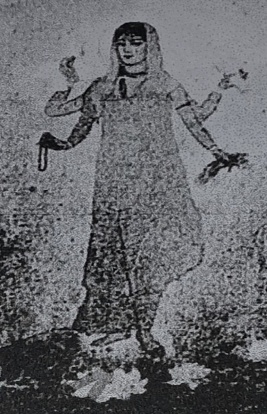
(A) Rabindranath Tagore
(B) sister Nibedita
(C) Abanindranath Thakur
(D) Krishna Kumar Mitra
Answer: C
48. Observe the following data and choose the correct answer – {Nagaon}
i) Krishna Kumar Mitra wrote the play “Palashir Prayachitra”.
ii) Girish Ghosh wrote the paly ‘Siraj-ud-daula’.
iii) Swarna Kumari Devi wrote the play ‘Mir Kasim’.
iv) Amritlal Basu wrote the play “Sabbash Bengali”.
(A) (i) and (iv) are correct
(B) (i), (ii) and (iii) are correct
(C) (ii) and (iii) are correct
(D) (ii) and (iv) are correct
Answer: D
49. Which British Viceroy helped in the formation of Muslim League in 1906. {Nagaon}
(A) Lord Curzon
(B) Lord Mintu
(C) Lord Ripn
(D) Lord Cornwallis
Answer: B
50. The partition of Bengal scheme was implemented on – {Nalbari}
(A) 2 February, 1905
(B) 19 July, 1905
(C) 16 October, 1905
(D) 1 September, 1905
Answer: C
51. In the perspective of the following books and their authors, find out the variance – {Nalbari}
(A) Joy Sangeet-Pramathnath Ray choudhury
(B) Japani Bir-Swarna Kumari Devi
(C) Nabya Bharat-Amarendra Nath Dutta
(D) Bangalakhmir Bratakatha – Ramendra Sundar Trivedi
Answer: C
52. On the basis of the information given in (a) and (r), choose the right answer – {Nalbari}
Assertion (a): The British Government wanted to create communal divisions between Hindus and Muslims through the partition of Bengal.
Reason (r): Increasing Political Consciousness in Bengal threatened the British colonialism in India.
(A) (a) is correct, (r) is incorrect
(B) (a) is incorrect, (r) is correct
(C) Both (a) and (r) are correct and (r) is the correct explanation of (a)
(D) Both (a) and (r) are correct, but (r) is not the correct explanation of (a)
Answer: C
53. Match the following National industries with the year of establishment and choose the correct option. {Nalbari}
(a) Swadeshi Bhandar
(b) Indian Stores
(c) Lakshi Bhandar
(d) United Bengal srores
(i) 1906
(ii) 1897
(iii) 1905
(iv) 1903
(A) a → iv, b → i, c → ii, d → iii
(B) a → ii, b → iii, c → iv, d → i
(C) a → ii, b → iii, c → i, d → iv
(D) a → iii, b → ii, c → iv, d → i
Answer: B
54. How did the Swadeshi movement contribute to the decline of British trade dominance in India? {Sibsagar}
(A) It led to the direct removal of British trade restrictions.
(B) It encouraged the growth of indigenous industries and reduced dependency on British goods.
(C) It facilitated the creation of trade agreements between India and foreign nations.
(D) It failed to affect British trade policies and had little impact.
Answer: B
55. Which of the following decisions were announced in the Royal proclamation of Delhi on 12th December, 1911? {Sibsagar}
(i) Reunification of Bengal
(ii) Shifting of the capital of India from Calcutta to Delhi
(iii) The administration of Assam came under the chief commissioner.
(iv) The capital of Assam was again shifted to Shillong
(A) i, ii.
(B) iii, iv.
(C) i, ii, iv.
(D) i, ii, iii, iv
Answer: D
56. Which of the following statement is not true about Sarala Devi Choudhurini? {Sibsagar}
(A) She was one of the prominent female leader of Swadeshi movement.
(B) She started various festivals like ‘Birastami Brat, Pratapaditya utsav, Udayaditya utsav, Byayam samitee and trained the boys and girls on Wrestling, Stick play etc games.
(C) She Edited a magazine named ‘Bharati’
(D) She was actively associated with youngman’s Hindu union, Vivekananda society, Dawn society and Anusilan sammitee etc.
Answer: D
57. Match the following and choose the correct answer: {Sibsagar}
(i) Abanindranath Thakur
(ii) Satish Chandra Mukhopadhyay
(iii) Abdul Halim Gajnabi
(iv) Nilratan Sarkar
(a) Bangalakshmi Cotton Mill
(b) Bangiya Kala Sangsad
(c) The Dawn
(d) United Bengal Stores
(A) i (b), ii (c), iii (d), iv (a)
(B) i (d), ii (a), iii (c), iv (b)
(C) i (b), ii (c), iii (a), iv (d)
(D) i (d), ii (a), iii (b), iv (c)
Answer: A
58. The partition of Bengal took place during the reign of which viceroy? {Sonitpur}
(A) Edufajor
(B) Lord Nathaniel Curzon
(C) Lord Minto
(D) Lord Canning
Answer: B
59. Two statements as assertion (a) and reason (r) are given below. Read them and choose the correct option. {Sonitpur}
Assertion (a):The swadeshi movement aimed to increase the production of local goods and reduce dependency on british made goods.
Reason (r):The swadeshi movement mainly aimed to protest against taxes and government credits.
(A) (A) and (R) both are correct and (r) explains (a)
(B) (a) is correct but (r) is incorrect.
(C) (a) and (r) both are true but (r) does not explain (a)
(D) (a) is incorrect but (r) is correct
Answer: B
60. Who among the following persons was the founder of ‘Bengal Chemicals’? {Sribhumi}
(A) Acharya Prafulla Chandra Roy
(B) Rabindra Nath Tagore
(C) Jagadish Basu
(D) Nilratan Sarkar
Answer: A
61. Which of the following statements are true about the partition of Bengal in 1905? {Sribhumi}
i) It resulted in the second important political upheaval in India after the 1857 Revolt.
ii) It was executed to suppress the growing national consciousness in Bengal.
iii) Shillong was made the capital of Eastern Bengal and Assam.
iv) It led to the Swadeshi Movement.
(A) i), ii), iv)
(B) i), iii), iv)
(C) ii), iii), iv)
(D) i), ii), iii), iv)
Answer: A
62. When was the institution named National Education Council (Jatiya Siksha Parishad) established in Bengal? {Sribhumi}
(A) 10 March, 1905
(B) 23 May, 1905
(C) 13 May, 1906
(D) 11 March, 1906
Answer: D
63. According to programme of Partition of Bengal, which of the following region is not included in Bengal province? {Sribhumi}
(A) Bihar
(B) Orissa
(C) Chattagram
(D) Chotanagpur
Answer: C
64. Two statements are given in the question below as Assertion (A) and Reason (R). Read the statements and choose the correct option: {Salmara}
Assertion (A) The swadeshi movement marked the beginning of organized economic nationalism in India.
Reason (R) The movement emphasized the revival of domestic industries and traditional crafts.
(A) (A) is true, (R) is false
(B) (A) is false, (R) is true
(C) Both (A) and (R) are true, and (R) is thecorrect explanation of (A)
(D) Both (A) and (R) are true, but (R) is not the correct explanation of (A)
Answer: C
65. The persons involved in partition of Bengal was- {Salmara}
i. Lord Curzon
ii. Andrew Fraser
iii. Herbert Risley
iv. Bamfylede Fuller
(A) i, ii, iii
(B) ii, iii, iv
(C) i, iii, iv
(D) i, ii, iii, iv
Answer: D
66. Assertion (A)- The partition of Bengal is the first remarkable event in Indian political history. {Tamulpur}
Reason (R)-Centering around this partition, the entire country was united and it ushered in a new era in the national consciousness in the minds of the Indians.
Which is the correct concept-
(A) Assertion (A) and reason (R) both are correct and (R) is the correct explanation of (A).
(B) Assertion (A) and reason (R) both are correct and (R) is not the correct explanation of (A).
(C) Assertion (A) is correct and reason (R) is incorrect.
(D) Assertion (A) is incorrect and reason (R) is correct.
Answer: D
67. The person who presided over the. “Anti-Circular Society” was- {Udalguri}
(A) Aswini Kumar Ghosh
(B) Mahatma Gandhi
(C) Rabindranath Tagore
(D) Sarala Devi Chaudhuri
Answer: C
68. “Bengali women are the most dangerous and indomitable for the English.” This sentence published in the ‘Daily Telegraph’ of London is associated with which of the following movements? {Udalguri}
(A) Civil Disobedience Movement
(B) Swadeshi Movement
(C) Quit India Movement
(D) Individual Satyagraha
Answer: B
69. Which of the following statements are true in the context of the Morley-Minto Reforms Act, 1909? {Udalguri}
(I) Muslims got the facility of separate electorate.
(II) This reform act was enacted during the tenure of Viceroy Lord Curzon.
(III) This reform act was enacted as per the promise of Viceroy Lord Minto
(IV) The British Government took the religious difference and disagreement between Hindus and Muslims as a political advantage
(A) I, II, III
(B) I, II, IV.
(C) I, III, IV
(D) II, III, Iv
Answer: C
Probable Multiple Choice Questions with Answers for HSLC 2027
1. When was the proposal for the partition of Bengal first introduced in the British Parliament?
(A) December 1903
(B) January 1904
(C) July 1905
(D) October 1905
Answer: A
2. Who was the first Lieutenant Governor of the newly formed province of ‘Eastern Bengal and Assam’?
(A) Lord Curzon
(B) Sir Andrew Fraser
(C) John Bamfylde Fuller
(D) Herbert Risley
Answer: C
3. Who laid the foundation stone of the ‘Federal Hall’ (Milan Bhavan) during the Swadeshi Movement?
(A) Rabindranath Tagore
(B) Ananda Mohan Bose
(C) Surendranath Banerjee
(D) Aurobindo Ghosh
Answer: B
4. Who proposed to observe ‘Arandhan’ (fasting/no cooking) across Bengal on the day of the partition?
(A) Ramendra Sundar Trivedi
(B) Bankim Chandra Chattopadhyay
(C) Sarala Devi Chaudhurani
(D) Krishna Kumar Mitra
Answer: A
5. When was the Carlyle Circular issued?
(A) 22 October 1905
(B) 16 October 1905
(C) 11 March 1906
(D) 15 August 1906
Answer: A
6. Through which of the following magazines did Krishna Kumar Mitra first call for the boycott of British goods?
(A) Yugantar
(B) Bengalee
(C) Bande Mataram
(D) Sanjivani
Answer: D
7. When was the ‘Dawn Society’ established?
(A) 1897
(B) 1902
(C) 1905
(D) 1906
Answer: B
8. Where was the Muslim League formed in 1906?
(A) Lahore
(B) Aligarh
(C) Dhaka
(D) Calcutta
Answer: C
9. Where was the capital of the newly formed province of ‘Eastern Bengal and Assam’ established?
(A) Shillong
(B) Guwahati
(C) Dhaka
(D) Chittagong
Answer: C
10. Who was the main architect behind the establishment of the ‘Banga Kala Samsad’ (Bengal Art Council) during the Swadeshi Movement?
(A) Nandalal Bose
(B) Abanindranath Tagore
(C) Rabindranath Tagore
(D) Aurobindo Ghosh
Answer: B
11. Who propagated nationalism in Maharashtra through the ‘Shivaji Utsav’ and ‘Ganapati Utsav’ during the partition of Bengal?
(A) Lala Lajpat Rai
(B) Bal Gangadhar Tilak
(C) Bipin Chandra Pal
(D) Gopal Krishna Gokhale
Answer: B
12. Which of the following books was authored by Sarala Devi Chaudhurani?
(A) Navya Bharat
(B) Jibaner Jharapata
(C) Bangalakshmir Bratakatha
(D) Japani Bir
Answer: B
13. Who formed the ‘Anti-Circular Society’ to unite the students in Bengal during the Swadeshi Movement?
(A) Sachindra Prasad Bose
(B) Satish Chandra Mukherjee
(C) Rashbehari Bose
(D) Surendranath Banerjee
Answer: A
14. Who was the first Principal of the ‘Bengal National College’?
(A) Rabindranath Tagore
(B) Aurobindo Ghosh
(C) Brahmabandhab Upadhyay
(D) Acharya Prafulla Chandra Ray
Answer: B
15. Who formed the ‘Swadeshi Sewak Sangha’ in Assam during the Swadeshi Movement?
(A) Tarun Ram Phukan
(B) Nabin Chandra Bardoloi
(C) Ambikagiri Raichoudhury
(D) Padmanath Gohain Barua
Answer: C
16. Who was appointed as the Viceroy of India succeeding Lord Curzon?
(A) Lord Hardinge
(B) Lord Minto
(C) Lord Ripon
(D) Lord Dalhousie
Answer: B
17. What was the name of the movement that grew in Andhra Pradesh under the influence of the Swadeshi Movement?
(A) Non-Cooperation Movement
(B) Bande Mataram Movement
(C) Home Rule Movement
(D) Quit India Movement
Answer: B
18. When did the British government enact the ‘Rowlatt Act’ which was an indirect attempt to suppress the extremist trend of the Swadeshi Movement?
(A) 1909
(B) 1911
(C) 1914
(D) 1919
Answer: D
19. From which novel of Bankim Chandra Chattopadhyay is the song ‘Bande Mataram’ taken?
(A) Kapalkundala
(B) Bishabriksha
(C) Anandamath
(D) Durgeshnandini
Answer: C
20. What was the primary objective of observing ‘Rakhi Bandhan’ under the leadership of Rabindranath Tagore on 16 October 1905?
(A) To boycott foreign goods
(B) To intimidate the British government
(C) To maintain a sense of brotherhood between Hindus and Muslims
(D) To set up new industries
Answer: C
21. Which person was specifically associated with the famous nationalist newspaper ‘Yugantar’?
(A) Bhupendranath Datta
(B) Krishna Kumar Mitra
(C) Surendranath Banerjee
(D) Brahmabandhab Upadhyay
Answer: A
22. Who is the author of the play ‘Palashir Prayaschitta’ written in the backdrop of the Swadeshi Movement?
(A) Girish Ghosh
(B) Kshirod Prasad Vidyabinod
(C) Amritlal Basu
(D) Amarendranath Datta
Answer: B
23. When was the ‘Indian Society of Oriental Art’ established?
(A) 1905
(B) 1906
(C) 1907
(D) 1908
Answer: C
24. Who was the Secretary of State for India during the partition of Bengal?
(A) John Morley
(B) Herbert Risley
(C) Lord Curzon
(D) Lord Cranborne
Answer: A
25. In which of the following books is the first economic analysis of the Swadeshi Movement found?
(A) Poverty and Un-British Rule in India
(B) Anandamath
(C) Bartaman Bharat
(D) Prachya O Paschatya
Answer: A
26. How many secondary schools were established under the ‘National Council of Education’ formed in March 1906?
(A) 40
(B) 60
(C) 65
(D) 75
Answer: B
27. Who was the Viceroy of India when the partition of Bengal was annulled in 1911?
(A) Lord Minto
(B) Lord Curzon
(C) Lord Hardinge
(D) Lord Chelmsford
Answer: C
28. Which of the following leaders played a significant role in Punjab in spreading the message of the Swadeshi Movement outside Bengal?
(A) Lala Lajpat Rai
(B) Syed Haider Raza
(C) Chidambaram Pillai
(D) Bal Gangadhar Tilak
Answer: A
29. The famous imagery named ‘Banga Mata’ later became more popular by what name?
(A) Durga Mata
(B) Kali Mata
(C) Bharat Mata
(D) Swadeshi Mata
Answer: C
30. Which of the following is considered a direct political consequence of the partition of Bengal?
(A) The formation of the Indian National Congress
(B) The birth of the Muslim League
(C) The outbreak of the Sepoy Mutiny
(D) The Quit India Movement
Answer: B
31. Read the following statements and select the correct option:
(i) Sir Andrew Fraser assisted Lord Curzon in favor of the partition of Bengal.
(ii) According to the partition plan, the Bengali-speaking people were on the verge of becoming a minority in the new province.
(iii) The British claimed that the partition of Bengal was done solely for administrative convenience.
(A) Only (i) and (ii) are correct
(B) Only (ii) and (iii) are correct
(C) Only (i) and (iii) are correct
(D) All (i), (ii), and (iii) are correct
Answer: D
32. Among the following pairs of newspapers and their editors, which one is incorrect?
(A) Bengalee – Surendranath Banerjee
(B) Sanjivani – Krishna Kumar Mitra
(C) Yugantar – Aurobindo Ghosh
(D) Sandhya – Brahmabandhab Upadhyay
Answer: C
33. Which of the following statements regarding the participation of women in the Swadeshi Movement is incorrect?
(A) Women came out of their homes for the first time and participated in the public movement.
(B) Women boycotted foreign bangles and clothing.
(C) Sarala Devi Chaudhurani gave weapons training to women for armed rebellion.
(D) Sister Nivedita awakened the Swadeshi consciousness among women.
Answer: C
34. When was the proposal for the partition of Bengal officially published in 1905?
(A) 19 July
(B) 20 July
(C) 7 August
(D) 16 October
Answer: B
35. Who presided over the Calcutta Congress Session in 1906, where the demand for ‘Swaraj’ was raised for the first time?
(A) Gopal Krishna Gokhale
(B) Dadabhai Naoroji
(C) Rashbehari Ghosh
(D) Bal Gangadhar Tilak
Answer: B
36. Consider the following statements and select the correct answer:
(i) The Swadeshi Movement laid the foundation of indigenous industries in Bengal.
(ii) Acharya Prafulla Chandra Ray established ‘Bengal Chemicals’.
(iii) Nilratan Sircar established the ‘National Soap Factory’.
(A) (i) and (ii) are correct
(B) (ii) and (iii) are correct
(C) (i) and (iii) are correct
(D) All are correct
Answer: D
37. For which of the following reasons was the British government compelled to annul the partition of Bengal?
(A) Due to the outbreak of the First World War
(B) Due to the intense pressure of the Swadeshi Movement and its adverse impact on the British economy
(C) Because the Muslim League demanded the annulment of the partition
(D) Because Mahatma Gandhi went on a hunger strike
Answer: B
38. Match Part A with Part B and select the correct option:
Part A:
(a) Chabbas Bangali
(b) Mirkasim
(c) Siraj-ud-Daulah
Part B:
(i) Girish Ghosh
(ii) Amritlal Basu
(iii) Kshirod Prasad Vidyabinod
(A) (a)-ii, (b)-iii, (c)-i
(B) (a)-i, (b)-ii, (c)-iii
(C) (a)-iii, (b)-i, (c)-ii
(D) (a)-ii, (b)-i, (c)-iii
Answer: A
39. What was the main reason for the formation of the ‘National Council of Education’ during the Swadeshi Movement?
(A) To open a new university as an equivalent to British educational institutions.
(B) To provide education to students who had left government educational institutions in protest against the Carlyle Circular.
(C) To exclusively spread technical education.
(D) To grant recognition to Indian languages.
Answer: B
40. What was the most controversial aspect of the Morley-Minto Reforms (Indian Councils Act 1909) that further encouraged the communal politics of the partition of Bengal?
(A) Granting provincial autonomy
(B) Provision of separate electorates for Muslims
(C) Shifting of the capital of India to Delhi
(D) Annulment of the partition of Bengal
Answer: B
41. Assertion (A): Lord Curzon partitioned Bengal on the pretext of administrative convenience.
Reason (R): In reality, his objective was to weaken the growing nationalist forces in Bengal and to create a divide between Hindus and Muslims.
(A) Both (A) and (R) are true, and (R) is the correct explanation of (A).
(B) Both (A) and (R) are true, but (R) is not the correct explanation of (A).
(C) (A) is true, but (R) is false.
(D) (A) is false, but (R) is true.
Answer: A
42. Assertion (A): The Swadeshi Movement caused considerable damage to the Indian textile industry.
Reason (R): People started buying more of the cheap cloth coming from Manchester.
(A) Both (A) and (R) are true, and (R) is the correct explanation of (A).
(B) Both (A) and (R) are true, but (R) is not the correct explanation of (A).
(C) (A) is true, but (R) is false.
(D) Both (A) and (R) are false.
Answer: D
43. Assertion (A): Rabindranath Tagore composed the song ‘Amar Sonar Bangla’ during the Swadeshi Movement.
Reason (R): This song evoked feelings of patriotism and unity in the minds of the people of Bengal.
(A) Both (A) and (R) are true, and (R) is the correct explanation of (A).
(B) Both (A) and (R) are true, but (R) is not the correct explanation of (A).
(C) (A) is true, but (R) is false.
(D) (A) is false, but (R) is true.
Answer: A
44. Assertion (A): The British government was forced to revoke the partition of Bengal in 1911.
Reason (R): The British government was terrified as a result of the formation of the Muslim League in 1906.
(A) Both (A) and (R) are true, and (R) is the correct explanation of (A).
(B) Both (A) and (R) are true, but (R) is not the correct explanation of (A).
(C) (A) is true, but (R) is false.
(D) (A) is false, but (R) is true.
Answer: C
45. Assertion (A): The Swadeshi Movement was not confined merely to the political sphere; it also created a cultural awakening.
Reason (R): During this period, there was an unprecedented development in literature, songs, drama, and painting.
(A) Both (A) and (R) are true, and (R) is the correct explanation of (A).
(B) Both (A) and (R) are true, but (R) is not the correct explanation of (A).
(C) (A) is true, but (R) is false.
(D) (A) is false, but (R) is true.
Answer: A
46. Assertion (A): The Swadeshi Movement had absolutely no impact in Assam.
Reason (R): The people of Assam gave full support to British rule.
(A) Both (A) and (R) are true, and (R) is the correct explanation of (A).
(B) Both (A) and (R) are true, but (R) is not the correct explanation of (A).
(C) (A) is true, but (R) is false.
(D) Both (A) and (R) are false.
Answer: D
47. Assertion (A): The role of the student community was extremely significant during the Swadeshi Movement.
Reason (R): Students picketed in front of foreign shops and boycotted government educational institutions.
(A) Both (A) and (R) are true, and (R) is the correct explanation of (A).
(B) Both (A) and (R) are true, but (R) is not the correct explanation of (A).
(C) (A) is true, but (R) is false.
(D) (A) is false, but (R) is true.
Answer: A
48. Assertion (A): The partition of Bengal planted the seed of communal politics in India.
Reason (R): The British were able to convince the Muslims that the new province would bring about their educational and economic development.
(A) Both (A) and (R) are true, and (R) is the correct explanation of (A).
(B) Both (A) and (R) are true, but (R) is not the correct explanation of (A).
(C) (A) is true, but (R) is false.
(D) (A) is false, but (R) is true.
Answer: A
49. Assertion (A): Sister Nivedita actively participated in the Swadeshi Movement.
Reason (R): She was a close advisor to Lord Curzon.
(A) Both (A) and (R) are true, and (R) is the correct explanation of (A).
(B) Both (A) and (R) are true, but (R) is not the correct explanation of (A).
(C) (A) is true, but (R) is false.
(D) (A) is false, but (R) is true.
Answer: C
50. Assertion (A): At the Delhi Durbar in 1911, the decision was taken to shift the capital of India from Calcutta to Delhi.
Reason (R): It had become necessary to move the British administration away from the constantly increasing revolutionary activities in Calcutta.
(A) Both (A) and (R) are true, and (R) is the correct explanation of (A).
(B) Both (A) and (R) are true, but (R) is not the correct explanation of (A).
(C) (A) is true, but (R) is false.
(D) (A) is false, but (R) is true.
Answer: A
HSLC PYQs (2016–2026): Important 2/3 Marks Short Questions
HSLC PYQs (2016–2026): Important 2‑ and 3‑Mark Short Questions
1. Write in brief about the contribution of Sister Nibedita in Swadeshi Movement. {2026}
2. Briefly discuss the role of the Indian National Congress against the Partition of Bengal. {2022}
3. What did the Swadeshi Movement take place in India? What was its contribution to the rise of national industry? {2020}
4. Write briefly the contribution of women in the Swadeshi Movement in India. {2020}
5. What was the ‘Partition of Bengal’? Mention its two important consequences. {2020}
6. What were the anti-movement measures taken by the British to dominate the Swadeshi Movement? Did the British get support from the leaders of the movement? {2019}
7. What were the initial programmes of the Swadeshi Movement? {2019}
8. Discuss three contributions of the Swadeshi Movement.
{2019}
9. Write briefly how the national industries of Bengal developed during the Swadeshi Movement. {2018}
10. Briefly describe the role of women in the Swadeshi Movement. {2018}
11. What were the first point of the Four Point Programme on the Partition of Bengal declared by Lord Curzon? {2018}
12. What were the initial programmes of the agitation of the Partition of Bengal? {2017}
13. What were the anti-movement measures taken by the British to dominate the Swadeshi Movement? {2017}
14. Mention three main geographical regions of Bengal annexed to the province ‘East Bengal and Assam’ created after the Partition of Bengal. {2017}
15. What were the initial programmes of agitation of the Partition of Bengal? {2016}
HSLC PYQs (2016–2026): Important 4/5 Marks Long Questions
HSLC PYQs (2016–2026): Important 2‑ and 3‑Mark Short Questions
1. Briefly describe four contributions of the Swadeshi Movement. {2024}
2. Briefly discuss the contribution of the Swadeshi Movement towards national education. {2022}

District Pre Board (2025–26): Important 2 Marks Short Questions
1. Write two decisions which were announced in the Royal proclamation of Delhi on 12th December, 1911 ? {Bajali}
2. ‘The Swadeshi Movement was not just about boycotting British goods’- Justify this statement with two arguments. {Jorhat}
3. Lord Carzon declared– “administration and exploitation will go hand in hand.” How the Indians replied to this statement? {Kamrup M}
4. How did the national industries develop during Swadeshi movement? Explain in short. {Kokrajhar}
5. What was the real motive of Lord Carzon? {Kokrajhar}
6. “Boycotting means patriotism and the essence of patriotism is the non co-operation with the British in all aspects.” Who is the speaker of this quote? What did the agitators decide to boycott during Swadeshi Movement inspiring by this quote? {Nalbari}
7. “The united Bengal is a big force, the partition will destroy this big unity.” So, the hidden purpose behind the partition of Bengal was to decimate the Hindu-Muslim unity. Mention two steps taken by British for the Expansion of communal sentiment in Bengal? {Sibsagar}
8. How was Margaret Elizabeth Noble directly involved in inspiring and protecting women and youth during the Swadeshi Movement? {Udalguri}
9. The following table gives some characteristics of the population. Study the table and answer the questions. {Udalguri}
|
Population Characteristics |
Assam (Percentage) |
Bihar (Percentage) |
|---|---|---|
|
(i) Literacy Rate |
73.25 |
42.40 |
|
(ii) Sex ratio (Number of females per 1000 males) |
932 |
620 |
|
(iii) Rural Population |
78.90 |
82.40 |
|
(iv) Urban Population |
21.10 |
17.60 |
(a) Which state has a higher literacy rate?
(b) What is the effect on the sex ratio if the literacy rate is high?
District Pre Board (2025–26): Important 3 Marks Long Questions
10. “Swadeshi movement is considered a successful and mass movement.” Give your opinion in support of this statement. {Barpeta}
11. What was “Partition of Bengal”? Mention its two important consequences. {Bongaigaon}
12. Satishchandra Mukherjee called the University of Calcutta as the house of slaves (Golam Khana). {Goalpara}
Based on it answer the following:
(i) Whom did Mukherjee refer to as ‘slaves’?
(ii) Why were they called ‘slaves’?
13. To what extent did the boycott of British goods and the promotion of indigenous industries such as textile industry, banks, various small shops challenge the British economy and foster a spirit of self reliance in India? {Hailakandi}
14. What do you mean by Swadeshi Movement? Mention two contributions of the Swadeshi Movement. {Sribhumi}
15. Among the various consequence of the swadeshi movement, which one do you consider the most important and what is the main reason for considering it important? {Salmara}
District Pre Board (2025–26): Important 4/5 Marks Long Questions
16. Briefly describe how the Muslim League was established as a result of the Swadeshi Movement. {Baksa}
17. How did the national industries develop during the Swadeshi Movement. {Baksa}
18. Describe the main objectives of Lord Curzon in partitioning Bengal in 1905. {Biswanath}
19. Discuss the contribution of Swadeshi movement towards national education. {Biswanath}
20. “Boy cotting means patriotism.” Explain this statement in relation to the Swadeshi Movement. {Cachar}
21. In the background of Swadeshi Movement how the mentality for self development grew in Bangal and it brought a positive and congenial atmosphere for the establishment of national industries ? {Dhubri}
22. What were first point of the four point programme on Partition of Bengal declared by Lord Carzon ? {Dhubri}
23. Explain briefly how the Swadeshi Movement encouraged the use of indigenous goods and the spread of national education. {Kamrup R}
24. Briefly write about three contribution of Swhdeshi movement ? {Lakhimpur}
25. Women’s participation increased significantly during the swadeshi movement. Evaluate how this result changed the nature of the movement. {Sonitpur}
26. What kind of role did Asom Kisan Ambikagiri Raichoudhury play in the Swadeshi Movement? Was he able to make this movement successful? {Udalguri}
27. In the Indian Freedom Struggle, Mahatma Gandhi adopted the path of Satyagraha with non-violence as a weapon, while Netaji Subhas Chandra Bose actively participated in the country’s independence with armed struggle. Assuming you are a citizen during the freedom struggle, which person would you support to make the country independent? Give your opinion. {Udalguri}
Some Important Most Probable 2 Marks Questions for HSLC 2027
1. What was the Carlyle Circular?
2. What do you think was the real political motive behind Lord Curzon’s partition of Bengal? Write two reasons.
3. What were the two main objectives of the ‘Dawn Society’ established in 1905?
4. What was the symbolic significance of the ‘Rakhi Bandhan’ festival during the Swadeshi Movement?
5. Mention two steps taken by Ambikagiri Raichoudhury in spreading the Swadeshi Movement in Assam.
6. What is the historical significance of the meeting held at the Calcutta Town Hall on 7 August 1905?
7. Write the names of two influential plays and their authors written in the backdrop of the Swadeshi Movement.
8. Why was the ‘Anti-Circular Society’ formed?
9. Write the names of two indigenous industries (Swadeshi Industries) that grew during the period of the Swadeshi Movement.
10. What were the two main decisions taken at the Delhi Durbar in 1911 during the reign of Lord Hardinge?
Some Important Most Probable 3 Mark Questions for HSLC 2027
11. What kind of repressive policies did the British government adopt against the students to suppress the Swadeshi Movement? Explain briefly.
12. How did the newspapers of Bengal help in shaping public opinion during the period of the Swadeshi Movement? Explain with examples of three newspapers.
13. Analyze the significance of the Calcutta Session of the Indian National Congress in 1906.
14. What kind of changes occurred in the world of Indian painting under the influence of the Swadeshi Movement? Write mentioning the contribution of Abanindranath Tagore.
15. ‘The partition of Bengal planted the seed of communalism in India.’ – Provide three arguments in support of this statement.
16. The Swadeshi Movement was not merely confined to the boycott of British goods; it was also a symbol of self-reliance. Analyze this statement.
17. How did the student community of Assam respond to the Swadeshi Movement? Discuss briefly.
18. What was the role of the British Viceroy Lord Minto behind the formation of the Muslim League?
19. Write briefly about the contribution of Sister Nivedita to the Swadeshi Movement.
20. What was the main principle of the ‘Morley-Minto Reforms Act’ of 1909 introduced by the British with the aim of reducing the intensity of the Swadeshi Movement, and what was its impact?
Some Important Most Probable 4 Mark Questions for HSLC 2027
21. “The Swadeshi Movement created a renaissance in the Indian education system.” – Analyze this statement based on the formation and activities of the National Council of Education.
22. How did the Swadeshi Movement, which grew against the partition of Bengal, become recognized as a strong foundation for India’s freedom struggle in subsequent times? Discuss in detail.
23. What administrative arguments did Lord Curzon present in favor of the partition of Bengal? Why did the Indian nationalist leaders reject those arguments?
24. Discuss the economic impact of the Swadeshi Movement in detail. What was its impact on indigenous industries and foreign trade?
25. Evaluate the role of the Swadeshi Movement in the awakening of women in Indian society. Write about the contribution of a few notable women during this period.
26. Suppose you are a nationalist student leader in 1905. How would you unite the student community opposing the Carlyle Circular, and what would your protest program be? Offer your opinion.
27. How did the literature created in Bengal during the period of the Swadeshi Movement (songs, poems, essays) ignite the fire of patriotism in the minds of the common people? Discuss with examples.
28. What were the economic and political interests of the British behind incorporating Assam in the formation of the ‘Eastern Bengal and Assam’ province in the Bengal partition plan?
29. What do you think were the main reasons for the failure or gradual weakening of the Swadeshi Movement? Analyze four reasons.
30. “The annulment of the partition of Bengal was a moral defeat for British imperialism.” – Judge the rationality of this statement based on the circumstances of 1911 and the decisions of the Delhi Durbar.