Madam Rides the Bus – Class 10 English Chapter 5 Complete Question Answers and Solutions | ASSEB / SEBA
Class 10 English Chapter 5 – Madam Rides the Bus Complete Question Answers and Exam Solutions (ASSEB / SEBA Assam)
The fifth chapter of the Class 10 English ‘First Flight’ textbook, ‘Madam Rides the Bus’ written by Vallikkannan, is a highly important chapter. For the upcoming HSLC 2027 examination, the complete question answers for this chapter have been prepared based on the new ASSEB (Assam State School Education Board) syllabus and the latest National Education Policy (NEP) blueprint. This special collection includes Very Short Answers (VSA / MCQ), Short Questions, Long Answers, and grammar sections, along with a detailed solution of Previous Years’ Board Exam Questions (PYQ). At Ospin Academy, these solutions are provided in a simple, accurate, and completely exam-oriented manner.
This chapter is a sensitive and engaging story about an eight-year-old girl named Valliammai (Valli). It beautifully narrates her meticulous planning for her very first bus ride out of her village to the nearest town. The story captures her fascinating journey, her innocent curiosity, and her sudden, sobering realization of the mystery of life and death when she sees a dead cow. It is essential for HSLC candidates to understand the core theme, character development, and significance of this lesson. Our Question Bank covers not only the textbook exercises but also includes extra probable board questions and answers to ensure 100% preparation for the students.
What you will learn and get from this chapter:
- Detailed analysis of Valli’s character, her careful planning, and her transformative bus journey.
- Word meanings, perfect answers for 1-mark objective (VSA) and 2-3 marks short questions.
- Easy and standard solutions for 4-5 marks long descriptive questions.
- Textual grammar, vocabulary exercises, and correct sentence structures.
- Pattern analysis of frequently asked board questions and solutions to the latest MCQ models.
Special Features by Ospin Academy for HSLC 2027 Exam:
- Complete Question Bank prepared based on the latest ASSEB blueprint for HSLC 2027.
- Detailed solutions for the Previous 10 Years’ Questions (PYQ) and 27 Districts Pre-Board Exam Papers (2026).
- 100% accurate, high-quality notes written in simple English for easy memorization.
- Specially designed PDF format for last-minute quick revision before the exams.
- A curated list of 100% common board suggestions and expected questions from this chapter.
Ospin Academy offers this specialized course keeping in mind the academic growth of the students. Start your HSLC 2027 preparation now and step towards securing the highest marks in the English subject.
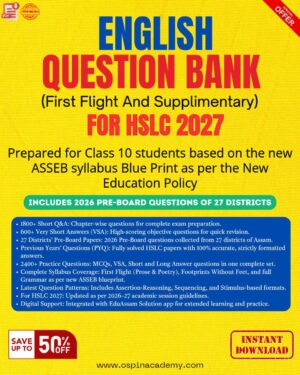
Class 10 English Question Bank ASSEB HSLC 2027 | Complete Chapter-wise Solutions PDF
Save Up To 50% OFF – Instant Download!
(For ASSEB, HSLC 2027)
Get the ultimate preparation toolkit for Class 10 English (First Flight & Supplementary) with this comprehensive Question Bank PDF.
Includes 2400+ practice questions, 2026 Pre-Board Papers from 27 Districts, Solved PYQs, and Complete Grammar updated as per the new ASSEB syllabus Blueprint and New Education Policy.
Perfect for mastering Assertion-Reasoning, Sequencing, and scoring top marks in HSLC 2027!
 Class 10th English
Madam Rides the Bus
HSLC Board Previous Year MCQs with Answers
1. “‘There’s nobody here who’s a child.’ Who said this? {2026}
(A) The elderly woman
(B) The conductor
(C) Valli
(D) A fellow passenger”
Answer: C
2. “Oh, please don’t be angry with me, my fine madam,’ he said. ‘Here, have a seat right up there in front. Everybody move aside please – make way for madam.’ What can you tell about the tone of the conductor from the text ? {2026}
(A) He was being humorous.
(B) He was being sarcastic.
(C) He was trying to console Valli.
(D) He was making fun of Valli.”
Answer: A
3. “Choose the reason that justifies the statement about Valli’s character from ‘Madam Rides the Bus’ by Vallikkannan, Valli was an independent and courageous girl. {2026}
(A) Valli did not want anyone to interfere in her journey.
(B) Valli did not like to mix up with other passengers on the bus.
(C) Valli liked watching out of the window and standing on the seat.
(D) Valli saved money all by herself and travelled alone to the town.”
Answer: D
4. Read the two statements given below with reference to Madam Rides the Bus and choose the correct option that follows: {2025}
Statement I – Valli had many playmates of her age in her neighbourhood.
Statement II – Valli gained many new unusual experiences by watching the street.
(A) Statement I is true and Statement II is false.
(B) Statement I is false and Statement II is true.
(C) Both Statement I and Statement II are true.
(D) Both Statement I and Statement II are false.
Answer: B
5. “On and on went her thoughts as she calculated and recalculated, planned and replanned.” {2024}
What was the planning about?
(A) It was about planning a birthday plan
(B) It was about a bus ride
(C) It was about a picnic
(D) It was About a school event
Answer: B
6. Read the following Statements with reference to ‘Madam Rides the Bus’ and choose the correct option: {2024}
Statement 1: Valli loved standing at her front door.
Statement 2: Her playmates were of her age.
(A) Statement 1 is true and Statement 2 is false
(B) Statement 1 is false and Statement 2 is true
(C) Both Statement 1 and Statement 2 are true
(D) Both Statement 1 and Statement 2 are false
Answer: A
7. Despite having a strong desire, what did Valli resist in the fair to save for the bus fare. {2023}
(A) Merry go round
(B) Ribbons
(C) Snakes
(D) Lollipops
Answer: A
8. For Valli, the most fascinating things to watch was- {2023}
(A) Cows grazing in the field.
(B) Children playing in the street.
(C) The bus that travelled between her village and the nearest town.
(D) The bullock-carts on the village street.
Answer: C
Common Pre-Board MCQs (2025–26) with Answers
1. Choose the correct antonym for the underlined word in the sentence below: “She had thriftily saved whatever stray coins came her way”. {Bajali}
(A) Economically
(B) Profoundly
(C) Carefully
(D) Profusely
Answer: D
2. Read the following statements with reference to ‘Madam Rides the Bus’ and choose the correct option: {Bajali}
Statement 1: Valli’s curiosity led her ride on the bus.
Statement 2: Valli made her bus journey in haphazardness.
(A) Statement 1 is true and 2 is false
(B) Statement 1 is false and 2 is true
(C) Both the statements 1 and 2 are true
(D) Both the statements 1 and 2 are false
Answer: A
3. “It’ll be my treat and not yours anything”. What does it tell you about Valli when she refused to accept the conductor’s treat? {Baksa}
(A) Responsible
(B) Stubborn
(C) Rude
(D) Disrespectful
Answer: A
4. Assertion (A) : The story “Madam Rides the Bus” teaches that true growth comes from experiences, not just words.
Reason (R) : Valli’s emotional change was possible only because of what she saw and felt. {Barpeta}
(A) Both A and R are true, and R is the correct explanation of A.
(B) Both A and R are true, but R is not the correct explanation of A.
(C) A is true, but R is false.
(D) A is false, but R is true.
Answer: A
5. Why did not Valli get off the bus at the city? {Barpeta}
(A) She was afraid of strangers.
(B) She only wanted to experience the bus ride.
(C) She did not have enough money.
(D) The conductor stopped her.
Answer: B
6. Statement 1 (S1) : Valli’s enthusiasm faded by the end of the bus journey as she refused to look out the window any longer.
Statement 2 (S2) : The sight of the dead cow horrified her, and she experienced the fear of death for the first time. {Barpeta}
(A) Both S1 and S2 are false.
(B) Both S1 and S2 are true.
(C) Only S1 is correct.
(D) S1 is true, but S2 is false.
Answer: B
7. What does the line “gradually a tiny wish crept into her head and grew there” mean? {Bongaigaon}
(A) The wish developed in her head over a period of time.
(B) The wish was a feeling of wanting to prove her strength.
(C) The wish was planted in her head by someone’s suggestion.
(D) The wish was small and was overpowered by a sense of doubt.
Answer: A
8. Valli did not get off the bus at the town because— {Cachar}
(A) she did not have enough money to buy something.
(B) she was not interested to see the town
(C) she was afraid to have a look at the sights of the town.
(D) she was afraid of the bus conductor
Answer: C
9. Select the correct option for (i) and (ii) {Cachar}
i) Valli found the elderly woman repulsive.
ii) The woman had large piercings in her ears, wore ugly ear rings and was chewing betelnut.
(A) (i) is True, (ii) is False
(B) (i) is False, (ii) is True
(C) (ii) is the cause of (i)
(D) Both (i) and (ii) are False
Answer: C
10. Match the character with their roles in the story Madam Rides the Bus. {Charaideo}
Column A / Column B
P. Valli / a. The one who is amused by Valli
Q. The bus conductor / b. Takes the bus ride with excitement
R. Valli’s mother / c. concerned about Valli’s safety
S. The passengers / d. Helps Valli in her journey
(i) P – b , Q – d , R – c , S – a
(ii) P – b , Q – c , R – d , S – a
(iii) P – c , Q – a , R – b , S – d
(iv) P – d , Q – a , R – b , S – c
Answer: i
11. Read the following statements and choose the correct option. {Charaideo}
Statement 1 : Valli loved standing at the front door
Statement 2 : Her playmates were of her age
(i) Statement 1 is true but Statement 2 is false
(ii) Statement 1 is false but Statement 2 is true
(iii) Both statement 1 and statement 2 are true
(iv) Both statement 1 and statement 2 are false
Answer: i
12. What does the tiger’s “quiet rage” indicate? {Charaideo}
(i) Its anger and frustration
(ii) Its happiness
(iii) Its fear
(iv) Its sadness
Answer: i
13. What memory haunted Valli on her way back to the Village? {Darrang}
(A) the elderly lady
(B) the bus conductor
(C) the dead cow
(D) the beautiful scenery
Answer: C
14. “And yet look how she pokes her nose into our conversation, just as though she were a grown lady”. The underlined part means – {Darrang}
(A) to smell our presence
(B) to take interest in something that does not concern her
(C) to take herself away from other people
(D) to overhear other’s conversation
Answer: B
15. “It was the slack time of day, and there were only six or seven passengers on the bus.” ‘Slack time’ here means {Darrang}
(A) a time when there is not much work
(B) a time when people are in a rush
(C) a time when there are not many vehicles on the street
(D) a time when people return home from work
Answer: A
16. Which word was used by Valli and her friends as a slang expression for disapproval? {Darrang}
(A) Okay! Okay!
(B) Yeah! Yeah!
(C) Shame! shame!
(D) proud! proud!
Answer: D
17. “And away she went, running straight for home.” When Valli entered her house, her mother’s reaction on seeing her suggests that she {Darrang}
(A) was more interested in her conversation
(B) knew Valli had done something naughty
(C) liked Valli’s spirit of adventure
(D) had been looking for Valli
Answer: A
18. Which of the following about Valli is not true {Dhubri}
(A) She was eight years old.
(B) She gathered sixty rupees for her bus journey.
(C) She enjoyed her bus ride while going to town.
(D) She didn’t like being called “madam”.
Answer: B
19. From the lesson “Madam Rides the Bus” we come to know that the conductor was a– {Dhubri}
(A) Fun loving person.
(B) Cunning person.
(C) Harsh person.
(D) Both a and b.
Answer: A
20. “I can get on by myself.” The underlined word is a– {Dhubri}
(A) Reflexive pronoun
(B) Intensive pronoun
(C) Personal pronoun
(D) Reciprocal pronoun
Answer: A
21. Among the friends of Valli the words “Proud! Proud!” were used to– {Dhubri}
(A) Express gratitude to someone.
(B) Thank someone.
(C) Make someone comfortable.
(D) Disapprove someone.
Answer: D
22. Pick out the statement that shows Valli as a sensible girl. {Golaghat}
(A) Valli didn’t accept the conductor’s offer to buy her a drink.
(B) Valli didn’t buy any peppermints or toys
(C) Valli travelled to town during her mother’s nap time.
(D) Valli stood up on the seat of the bus.
Answer: B
23. According to the prose piece ” Madam Rides the Bus “, Valli gathered information about the bus journey- {Golaghat}
(i) By listening to the conversations of her neighbours and regular passengers.
(ii) By going through bus schedules published in daily newspapers.
(iii) By questioning the people who she thought knew about the bus journey.
(iv) By overhearing her friends’ conversation who travelled by the same bus.
(A) i and iv
(B) i and iii
(C) ii and iii
(D) ii and iv
Answer: B
24. With reference to the given passage (about Valli seeing the cow), choose the word having the same meaning as young one of a cow {Golaghat}
(A) Calf
(B) Fawn
(C) Kitten
(D) Piglet
Answer: A
25. According to the passage, the driver sounded the horn because {Golaghat}
(A) He wanted to warn the pedestrians
(B) He wanted to pass another vehicle
(C) He wanted to drive away the young cow
(D) He wanted to give pleasure to the passengers
Answer: C
26. Why was Valli eager to ride the bus to the town?{Hailakandi}
(A) She wanted to visit her relatives
(B) She was curious to see the outside world beyond her villagė
(C) She needed to buy gifts for her mother
(D) She wanted to gram around the town.
Answer: B
27. If Valli had accepted the bus conductor’s offer to buy her a drink, how would this most likely have changed the theme of the story?{Hailakandi}
(A) It would highlight her dependence on adults
(B) It would weaken her sense of independence and self-respect
(C) It would make the journey more exciting and joyful
(D) It would have no effect on the story’s message
Answer: B
28. Read the following statements with reference to “Madam Rides the Bus” and choose the correct option.{Hojai}
Statement-I: Valli at once decided to ride the bus.
Statement-II: Valli was fascinated by the bus that travelled from her village to the nearest town.
(A) Statement-I is true and Statement-II is false.
(B) Statement-I is false and Statement-II is true.
(C) Both Statement-I and Statement-II are true.
(D) Both Statement-I and Statement-II are false.
Answer: B
29. “On and on went her thoughts as she calculated and re-calculated, planned and re-planned”. (Hint: ‘Madam Rides the Bus’) What was the planning about? {Hojai}
(A) It was about a birthday party.
(B) It was about a bus ride.
(C) It was about a picnic.
(D) It was about a school event.
Answer: B
30. Arrange the sentences in the correct sequence, from the story, “Madam Rides the Bus”. {Hojai}
(P) Valli saw a young cow lying dead by the roadside.
(Q) She took another thirty paise from her pocket and handed the coins to the conductor.
(R) There was a girl named Valliammai who was called Valli for short.
(S) “May we start now, madam?” the conductor asked smiling.
(A) PQRS
(B) QPSR
(C) RQOS
(D) RSQP
Answer: D
31. “Valli would stare wistfully at people who got on or off the bus.” What is the meaning of ‘wistfully’? {Jorhat}
(A) Carefully
(B) Willingly
(C) Fearfully
(D) Longingly
Answer: D
32. “Valli would stare wistfully at the people who got on and off the bus”-What is the meaning of “wistfully”? {Kamrup M}
(A) fearfully
(B) carefully
(C) willingly
(D) longingly
Answer: D
33. Who translated the story, ‘Madam Rides the Bus’ from Tamil? {Kamrup M}
(A) R.K. Laxman
(B) Vallikannan
(C) K.S. Sundaram
(D) R.K. Narayan
Answer: C
34. Read the following statement in reference to “Madam Rides A Bus” and choose the correct option:{ Kamrup M}
Statement 1: Valli’s strongest desire was to ride the bus to the nearest town.
Statement 2: On reaching the town in the bus, Valli refused the conductor’s offer of a free treat because she was rude.
(A) Statement 1 is true and Statement 2 is false.
(B) Statement 1 is false and Statement 2 is true.
(C) Both Statement 1 and Statement 2 are ture.
(D) Both Statement 1 and Statement 2 are false.
Answer: A
35. “Oh, why don’t you mind your own business,” said Valli. But she laughed all the same. Valli told the conductor to mind his own business and as well. This shows that -{Kokrajhar}
(A) Valli was not really bothered
(B) Valli didn’t like the conductor speaking about her
(C) Valli disliked what the conductor said but was amused
(D) Valli was impressed with what the conductor said
Answer: C
36. Why do you think the old woman kept on asking Valli questions -{Kokrajhar}
(A) Due to anxiety about Valli travelling alone.
(B) Out of curiosity and concern for Valli.
(C) Due to her interest in Valli’s life.
(D) Due to her habit
Answer: A
37. ‘It was the slack time of the day’ -the underlined phrase refers to -{Kokrajhar}
(A) A spare time
(B) A time when there is not much work
(C) A time full of activity
(D) A vacation time
Answer: B
38. Put the following events in the order they happened with reference to the chapter “Madam Rides the bus”: {Lakhimpur}
1. Valli refused to accept the conductor’s treat.
2. The conductor jokingly called her ‘Madam’.
3. Valli got into the bus confidently.
4. The bus started moving towards the town.
(A) 3-2-4-1
(B) 2-3-1-4
(C) 3-4-2-1
(D) 4-3-2-1
Answer: A
39. Why did Valli clapped her hands with glee? Write with reference to Madam Rides the Bus. {Udalguri}
(A) There were many people in the bus
(B) Valli saw a big building through the bus window
(C) Everybody loved Valli in the bus
(D) Valli saw a young cow, tail high in the air, running in the middle of the road.
Answer: D
40. What was the bus fare from Valli’s village to town? Write with reference to Madam Rides the Bus. {Udalguri}
(A) 10 paise
(B) 20 paise
(C) 30 paise
(D) 50 paise
Answer: C
41. Valli refused to take help from fellow passengers because she wanted to maintain her sense of ___ and ___ throughout the journey. {Majuli}
(A) pride, adventure
(B) independence, maturity
(C) fear, caution
(D) anger, disappointment
Answer: B
42. The conductor called Valli “Madam” because – {Majuli}
(A) she behaved confidently
(B) She looked older
(C) She demanded respect
(D) She scolded the conductor
Answer: A
43. Who translated the Story ‘Madam Rides the Bus’ from Tamil language? {Majuli}
(A) K S Sundaram
(B) Arup kumar Dutta
(C) R.K Laxman
(D) Vallikannan
Answer: A
44. Put the following events in the order they happened with reference to the chapter “Madam Rides the bus”: {Lakhimpur}
1. Valli refused to accept the conductor’s treat.
2. The conductor jokingly called her ‘Madam’.
3. Valli got into the bus confidently.
4. The bus started moving towards the town.
(A) 3-2-4-1
(B) 2-3-1-4
(C) 3-4-2-1
(D) 4-3-2-1
Answer: A
45. Why was Valliammai resisting her temptation to buy peppermints, toys and balloons? {Udalguri}
(A) To buy something more valuable
(B) To save sixty paise to have the bus ride
(C) Because Valliammai did not have money
(D) Because Valli’s mother did not allow her to buy peppermints, toys and balloons
Answer: B
46. Give the meaning of the word ‘resolutely’ given in the passage. {Udalguri}
(A) halfheartedly
(B) lazily
(C) determinedly
(D) casually
Answer: C
47. Who translated the story “Madam rides the bus” from Tamil to English. {Tamulpur}
(A) R.K. Laxman
(B) K.S. Sundaram
(C) R.S. Suderam
(D) K.R. Laxman
Answer: B
48. What is the word that valli and her friends use as a slang expression of disapproval. {Tamulpur}
(A) Fare
(B) Pound
(C) Madam
(D) Repulsive
Answer: [Proud! proud!] (Note: Correct option not listed in question)
49. How frequently did the bus operate? {Tamulpur}
(A) Once in an hour
(B) Twice in an hour
(C) Once in a day
(D) Twice in a day
Answer: A
50. Which word in the passage means same as “never-ending”. {Tamulpur}
(A) Unending
(B) fascinating
(C) sight
(D) Travelled
Answer: A
51. What was the source of unending Joy for valli? {Tamulpur}
(A) The bus making sound while passing through the street.
(B) The sight of the bus filled each time with a new set of passengers.
(C) The sight of the bus in colourful paintings.
(D) All the above.
Answer: B
52. Find a word in the passage which is the antonym for “sorrow”. {Tamulpur}
(A) back
(B) Joy
(C) fascinating
(D) sight
Answer: B
53. What was the most fascinating thing for valli? {Tamulpur}
(A) The bus that travelled between her village and the nearest town.
(B) Children playing in the street.
(C) to observe the things happening around.
(D) to watch the birds and squirrels.
Answer: A
54. Statement 1:- The aunt from the South street was real chatterbox, never closing her mouth once she started taking.
Statement 2:- Valli expressed as ‘oh, yes’ when her mother and the aunt was taking about the things the world outside. {SSM}
(A) Statement 1 is true and statement 2 is false.
(B) Statement 1 is false and statement 2 is true.
(C) Both statement 1 and statement 2 are true.
(D) Both statement 1 and statement 2 are false.
Answer: C
55. How does the conductor address valli? {SSM}
(A) As valli
(B) As vallimmai
(C) as kiddo
(D) As Madam.
Answer: D
56. The conductor’s repeated use of the word ‘madam’ shows ____ {Sribhumi}
(A) His respect for Valli.
(B) His way of teasing her playfully.
(C) His irritation towards her.
(D) His surprise at her knowledge.
Answer: B
57. Valli refused to get down from the bus at the town because – {Sribhumi}
(A) She was afraid of getting lost.
(B) She did not have enough money for the return ticket.
(C) She wanted the thrill of the ride, not sight seeing.
(D) The conductor did not allow her to get down from bus
Answer: C
58. When did valli make her bus journey to the town? {Sonitpur}
(A) One sunday morning
(B) One spring afternon
(C) One sunday afternoon
(D) One spring morning
Answer: B
59. Arrange the sentences in the correct sequence from the story “Madam rides the bus” {Sonitpur}
P) Valli saw a young cow lying dead by the roadside.
Q) She took another thirty paise from her pocket and handed the coins to the conductor.
R) There was a girl named vallimai who was called valli for short.
S) “May we start now Madam?” the conductor asked smiling.
(A) PQRS
(B) QPSR
(C) RQPS
(D) RSQP
Answer: D
60. Read the statements with reference to “Madam ride the bus” and choose the correct option. {Sonitpur}
Statement 1: An elderly man sat beside valli.
Statement 2: Valli was annoyed with the elderly man.
(A) Statement 1 is true and statement 2 is false.
(B) Statement 1 is false and statement 2 is true
(C) Both statement 1 and statement 2 are true
(D) Both statement 1 and statement 2 are false
Answer: D
61. Chronologically rearrange the sequence of events as directed in the story “Madam Rides the Bus”. {Sibsagar}
i. She enjoyed watching the scenery during the bus ride.
ii. Valli planned her bus journey secretly.
iii. When she entered her house she found her mother awake and talking to one of her aunts.
iv. The sight of a young cow lying dead by the roadside dampened her enthusiasm.
(A) ii, i, iv, iii.
(B) i, iv, iii, ii.
(C) i, iii, iv, ii.
(D) iv, iii, i, ii.
Answer: A
62. Why was Valli standing in the front doorway of her house? {Sibsagar}
(A) to meet the bus conductor.
(B) to watch what was happening in the street outside.
(C) to look at the young cow running very fast.
(D) to receive her playmates.
Answer: B
63. Statement i: Valli was a seven years old girl who wanted to ride a bus all alone.
Statement ii: She chose a time for her bus journey when there is not much work. {Sibsagar}
(A) Both statement i and statement ii are true.
(B) Statement i is true but statement ii is false.
(C) Statement i is false but statementii is true.
(D) Both statement i and statement ii are false.
Answer: C
64. “There’s nobody here who’s a child,” she said ___ haughtily. Fill in the blank with the correct option. {Nalbari}
(A) humbly
(B) politely
(C) respectfully
(D) proudly
Answer: D
65. Assertion (A): Valli did not buy toys or eat sweets in the town. {Nalbari}
Reason (R): She had no interest in wordly pleasures.
(A) Both (A) and (R) are true and (R) is the correct explanation of (A).
(B) Both (A) and (R) are true but (R) is not the correct explanation of (A).
(C) (A) is true but (R) is false.
(D) (A) is false but (R) is true.
Answer: C
66. Why did Valli keep on standing at the doorway? {Nalbari}
(A) to watch the happenings on the street outside.
(B) to look for the ice-cream vendor.
(C) to watch her friends playing.
(D) to get the fresh air.
Answer: A
67. Which word in the extract given means the same as ‘not very common’? {Nalbari}
(A) Front
(B) Elaborate
(C) Unusual
(D) Enjoyable
Answer: C
68. It is slack time of the day. Find out the meaning of Slack time – {Morigaon}
(A) A time when there is not much work.
(B) A time when people are in rush.
(C) A time when day break.
(D) A time when day ends.
Answer: A
69. Arrange the sentences from the story ‘Madam Rides the Bus’ in correct sequence : {Morigaon}
(P) Valli saw a young cow lying dead by the raodside.
(Q) She took another thirty paise from her pocket and handed the conductor.
(R) There was a girl named Valliammai.
(S) “May we start now, Madam?” – the conductor asked smiling.
(A) PQSR
(B) QPSR
(C) RQPS
(D) RSQP
Answer: D
50 Most Important Model MCQs for HSLC 2027
1. Read the following statements with reference to “Madam Rides the Bus” and choose the correct option:
Statement 1: Valli at once decided to ride the bus.
Statement 2: Valli was fascinated by the bus that travelled from her village to the nearest town.
(A) Statement 1 is true and Statement 2 is false.
(B) Statement 1 is false and Statement 2 is true.
(C) Both Statement 1 and Statement 2 are true.
(D) Both Statement 1 and Statement 2 are false.
Answer: B
2. Statement 1: Valli found the elderly woman repulsive.
Statement 2: The woman had large piercing in her ears, earrings and was chewing betel nut.
(A) Statement 2 is true and Statement 1 is false.
(B) Statement 1 is true and Statement 2 is false.
(C) Both Statement 1 and Statement 2 are false.
(D) Statement 2 is the cause for Statement 1.
Answer: D
3. Read the following statements with reference to “Madam Rides the Bus” written by Vallikkannan and choose the correct option.
Statement 1: Valli took her seat and an elderly woman sat beside her
Statement 2: The old woman was repulsive and the smell of the betel nut she was chewing disturbed Valli
(A) Statement 1 is true and Statement 2 is false
(B) Statement 1 is false and Statement 2 is true
(C) Both Statement 1 and Statement 2 are true
(D) Both Statement 1 and Statement 2 are false
Answer: C
4. What was the timing of the afternoon nap taken by Valli’s mother?
(A) 1 to 3
(B) 1 to 4
(C) 2 to 4
(D) 2 to 3
Answer: B
5. What is the word that Valli and her friends use as a slang expression of disapproval?
(A) Fare
(B) Proud
(C) Madam
(D) Repulsive
Answer: B
6. ‘A fortune’ to Valli was –
(A) Jewels
(B) Thirty paise
(C) Fifty paise
(D) Peppermints
Answer: B
7. “It was the slack time of the day”, the underlined phrase refers to –
(A) A spare time
(B) A time full of activity
(C) A time when there is not much work
(D) A vacation time
Answer: C
8. What would make Valli jealous?
(A) Her villagers travelling by the bus.
(B) Listening to the stories of her friend’s journey.
(C) Her aunt’s travelling by the bus.
(D) All of the above.
Answer: B
9. …… she also asked a few discreet questions here and there. What does the underlined word mean in “Madam Rides the Bus”?
(A) Easy
(B) Hard
(C) Careful
(D) Simple
Answer: C
10. Read the following statements with reference to ‘Madam Rides the Bus’ and choose the correct option:
Statement 1: Valliammai spent her favourite pastime in playing elaborate games.
Statement 2: The bus conductor was not a cheerful person.
(A) Statement 1 is true and Statement 2 is false.
(B) Statement 1 is false and Statement 2 is true.
(C) Both Statement 1 and Statement 2 are true.
(D) Both Statement 1 and Statement 2 are false.
Answer: D
11. How did Valli pick up small details about the bus journey?
(A) By listening carefully to the conversations of her neighbours and asking questions from friends.
(B) By listening carefully to the conversation of her neighbours and asking questions from her mother.
(C) By listening carefully to the conversation of her neighbours and asking questions here and there.
(D) By gathering information from internet and her close relatives.
Answer: C
12. The story ‘Madam Rides the Bus’ explores the theme of
(A) Childhood helplessness.
(B) Childhood anger.
(C) Childhood frailty.
(D) Childhood curiosity.
Answer: D
13. Statement 1: The town was 6 km away from Valli’s village.
Statement 2: The trip to the town took 45 minutes.
(A) Statement 1 is true but Statement 2 is false.
(B) Statement 1 is false but Statement 2 is true.
(C) Both Statement 1 and 2 are false.
(D) Both Statement 1 and 2 are true.
Answer: D
14. Gradually a tiny wish crept to her head and grew there:
What was the tiny wish?
(A) To watch outside what was happening
(B) To listen the gossips.
(C) To go for shopping in nearest town.
(D) To ride the bus.
Answer: D
15. In her Bus journey, Valli faced basically two problems. They are
(A) To collect the fare and to slip out the house secretly.
(B) To catch the bus and to ignore the conductor.
(C) To manage her mother and to catch the bus.
(D) To deal with the old lady and the conductor.
Answer: A
16. How did the conductor react when Valli firmly refused his offer of a free drink?
(A) He became very angry and yelled at her.
(B) He forced her to take it anyway.
(C) He shrugged, and they waited until it was time for the bus to begin the return journey.
(D) He complained to the other passengers about her arrogance.
Answer: C
17. Why didn’t Valli look out the window on her return journey?
(A) She was feeling motion sick.
(B) The memory of the dead cow haunted her, dampening her enthusiasm.
(C) It had grown dark, and she couldn’t see anything.
(D) The canvas blind had fallen down completely.
Answer: B
18. What physical feature of the dead cow is specifically mentioned that frightened Valli?
(A) Its broken horns
(B) Its fixed stare in its lifeless eyes
(C) The heavy chains around its neck
(D) Its missing tail
Answer: B
19. What specific time did Valli plan to take the bus from her village?
(A) The one-o’clock afternoon bus
(B) The two-o’clock afternoon bus
(C) The three-o’clock afternoon bus
(D) The early morning bus
Answer: A
20. According to Valli’s calculations, if she took the planned bus, at what time would she be back in her village?
(A) About two-forty-five
(B) Exactly three-thirty
(C) By four-fifteen
(D) Before sunset
Answer: A
21. Who was the aunt talking to Valli’s mother when Valli returned home?
(A) The aunt from North Street
(B) The aunt from South Street
(C) Valli’s grandmother
(D) A friendly neighbor
Answer: B
22. How is the aunt from South Street described in the text?
(A) A quiet and observant lady
(B) A real chatterbox who never closed her mouth
(C) A strict and angry woman
(D) A highly educated school teacher
Answer: B
23. “Yes, you’re right,” Valli said. “There are so many things in our midst and in the world outside.” Who was she agreeing with?
(A) The bus conductor
(B) The elderly man on the bus
(C) Her mother
(D) Her aunt
Answer: C
24. What did the aunt call Valli when she agreed with her mother’s statement about the outside world?
(A) A brilliant child
(B) A naughty kid
(C) A chit of a girl
(D) A grown lady
Answer: C
25. What was Valli doing when her aunt criticized her for poking her nose into adult conversations?
(A) She was arguing loudly.
(B) She was crying secretly.
(C) She smiled to herself.
(D) She walked out of the house.
Answer: C
26. Why didn’t Valli want her mother and aunt to understand her secret smile?
(A) Because they would punish her for smiling at elders.
(B) Because she didn’t want to share the joy of her secret, successful bus ride.
(C) Because her teeth were hurting.
(D) Because she was planning to run away.
Answer: B
27. What did the old woman on the bus ask Valli when she sat down?
(A) “Are you traveling alone, dear?”
(B) “Where is your mother, child?”
(C) “Do you have enough money for the fare?”
(D) “Are you going to school?”
Answer: A
28. How did Valli gather the small details about the bus journey over many days and months?
(A) By reading the local newspaper every day
(B) By listening to the conversations between her neighbors and regular bus users
(C) By following the bus on her bicycle
(D) By sneaking into the bus stand
Answer: B
29. What was the exact distance from Valli’s village to the town?
(A) Four miles
(B) Five miles
(C) Six miles
(D) Ten miles
Answer: C
30. How much time did the bus trip from the village to the town take one way?
(A) Thirty minutes
(B) Forty-five minutes
(C) One hour
(D) Ninety minutes
Answer: B
31. What did Valli have to do at the village fair to ensure she had enough money for the ride?
(A) She had to work at a tea stall.
(B) She had to resolutely stifle a strong desire to ride the merry-go-round.
(C) She had to sell her old toys.
(D) She had to beg her father for coins.
Answer: B
32. The bus seats were described as being:
(A) Hard and wooden
(B) Soft and luxurious
(C) Torn and dusty
(D) Covered in plastic
Answer: B
33. What did the conductor playfully do when Valli said she could get on by herself?
(A) He clapped his hands.
(B) He stepped back and saluted her.
(C) He stretched out a hand to help her, then joked about her being a “fine madam”.
(D) He blew his whistle loudly.
Answer: C
34. When the bus started, what caught Valli’s eye that made her devour everything with her eyes?
(A) The beautiful interior and the newness of the bus
(B) The people waiting outside
(C) The conductor’s uniform
(D) The old woman’s luggage
Answer: A
35. How did Valli justify paying the same fare as everyone else?
(A) By showing her student ID
(B) By stating she was eight years old, so she was not a child
(C) By asserting she had paid her thirty paise like everyone else
(D) By demanding the conductor treat her as an equal
Answer: C
36. Assertion (A): Valli stood up on the soft and luxurious seat of the bus.
Reason (R): A canvas blind cut off the lower part of her window, obstructing her view of the outside.
(A) Both Assertion (A) and Reason (R) are true, and (R) is the correct explanation of (A).
(B) Both Assertion (A) and Reason (R) are true, but (R) is not the correct explanation of (A).
(C) Assertion (A) is true, but Reason (R) is false.
(D) Assertion (A) is false, but Reason (R) is true.
Answer: A
37. Assertion (A): Valli found the elderly woman sitting beside her to be highly repulsive.
Reason (R): The woman was carrying a large basket of smelly fish on her lap.
(A) Both Assertion (A) and Reason (R) are true, and (R) is the correct explanation of (A).
(B) Both Assertion (A) and Reason (R) are true, but (R) is not the correct explanation of (A).
(C) Assertion (A) is true, but Reason (R) is false.
(D) Assertion (A) is false, but Reason (R) is true.
Answer: C
38. Assertion (A): The conductor offered to buy Valli a cold drink when they reached the town.
Reason (R): He was a kind, jolly fellow who was amused by Valli’s mature and independent behavior.
(A) Both Assertion (A) and Reason (R) are true, and (R) is the correct explanation of (A).
(B) Both Assertion (A) and Reason (R) are true, but (R) is not the correct explanation of (A).
(C) Assertion (A) is true, but Reason (R) is false.
(D) Assertion (A) is false, but Reason (R) is true.
Answer: A
39. Assertion (A): Valli was struck dumb with wonder when the bus reached the town.
Reason (R): The town had broad thoroughfares, big crowds, and glittering displays of clothes and merchandise in the shops.
(A) Both Assertion (A) and Reason (R) are true, and (R) is the correct explanation of (A).
(B) Both Assertion (A) and Reason (R) are true, but (R) is not the correct explanation of (A).
(C) Assertion (A) is true, but Reason (R) is false.
(D) Assertion (A) is false, but Reason (R) is true.
Answer: A
40. Assertion (A): On the return journey, Valli was no longer interested in looking out of the window.
Reason (R): She was exhausted from the long trip and had fallen asleep on her seat.
(A) Both Assertion (A) and Reason (R) are true, and (R) is the correct explanation of (A).
(B) Both Assertion (A) and Reason (R) are true, but (R) is not the correct explanation of (A).
(C) Assertion (A) is true, but Reason (R) is false.
(D) Assertion (A) is false, but Reason (R) is true.
Answer: C
41. Assertion (A): Valli’s mother and her aunt remained completely unaware of her adventurous bus journey.
Reason (R): Valli cleverly planned her trip so that she returned during her mother’s usual afternoon nap time.
(A) Both Assertion (A) and Reason (R) are true, and (R) is the correct explanation of (A).
(B) Both Assertion (A) and Reason (R) are true, but (R) is not the correct explanation of (A).
(C) Assertion (A) is true, but Reason (R) is false.
(D) Assertion (A) is false, but Reason (R) is true.
Answer: A
42. Assertion (A): Valli easily gathered the sixty paise required for the two-way bus fare.
Reason (R): Her father gave her a large pocket allowance every week.
(A) Both Assertion (A) and Reason (R) are true, and (R) is the correct explanation of (A).
(B) Both Assertion (A) and Reason (R) are true, but (R) is not the correct explanation of (A).
(C) Assertion (A) is true, but Reason (R) is false.
(D) Both Assertion (A) and Reason (R) are false.
Answer: D
43. Assertion (A): Valli was annoyed by the elderly man’s advice to sit down.
Reason (R): She felt insulted because she did not consider herself a child, having paid the full fare just like the adults.
(A) Both Assertion (A) and Reason (R) are true, and (R) is the correct explanation of (A).
(B) Both Assertion (A) and Reason (R) are true, but (R) is not the correct explanation of (A).
(C) Assertion (A) is true, but Reason (R) is false.
(D) Assertion (A) is false, but Reason (R) is true.
Answer: A
44. Assertion (A): The young cow ran faster right in front of the bus during the outward journey.
Reason (R): The loud honking of the bus horn frightened the animal, causing it to panic and gallop wildly.
(A) Both Assertion (A) and Reason (R) are true, and (R) is the correct explanation of (A).
(B) Both Assertion (A) and Reason (R) are true, but (R) is not the correct explanation of (A).
(C) Assertion (A) is true, but Reason (R) is false.
(D) Assertion (A) is false, but Reason (R) is true.
Answer: A
45. Assertion (A): Valli smiled to herself at the end of the story while listening to her mother and aunt.
Reason (R): She found her aunt’s large earrings to be very funny.
(A) Both Assertion (A) and Reason (R) are true, and (R) is the correct explanation of (A).
(B) Both Assertion (A) and Reason (R) are true, but (R) is not the correct explanation of (A).
(C) Assertion (A) is true, but Reason (R) is false.
(D) Assertion (A) is false, but Reason (R) is true.
Answer: C
46. What does the sudden death of the young cow symbolize in the context of Valli’s journey?
(A) The poor traffic conditions and reckless driving in Indian villages.
(B) An abrupt, harsh transition from the joyful innocence of childhood to the tragic, uncontrollable reality of the adult world.
(C) A punishment for Valli for leaving her home without her mother’s permission.
(D) A sign that Valli should never travel on a bus again.
Answer: B
47. How does the character of the bus conductor serve as a foil to Valli?
(A) He is extremely serious and angry, while Valli is constantly joking.
(B) He is lighthearted, accommodating, and amused, which sharply contrasts with Valli’s fiercely serious, independent, and rigid demeanor.
(C) He is ignorant about the town, while Valli knows everything about it.
(D) He acts like a child, while Valli is literally an adult.
Answer: B
48. Why does the author spend so much time describing Valli’s meticulous planning and financial sacrifices?
(A) To show that she was extremely greedy for money.
(B) To highlight her extraordinary determination, self-discipline, and maturity, proving she is capable of handling an adult journey.
(C) To pad the length of the story before the bus ride begins.
(D) To demonstrate that the bus fare was unreasonably high for village people.
Answer: B
49. What is the psychological significance of Valli’s firm refusal to accept a free drink from the conductor?
(A) She was afraid the drink was poisoned.
(B) She hated the taste of cold drinks.
(C) It demonstrates her strong sense of self-respect and boundary-setting; she refuses to be pitied, patronized, or treated as a dependent child.
(D) She wanted him to buy her a toy instead.
Answer: C
50. What does Valli’s “secret smile” at the end of the narrative ultimately represent?
(A) Her internal triumph and quiet possession of a profound adult experience that the actual adults in the room are completely blind to.
(B) Her amusement at how foolish her mother and aunt sound when they gossip.
(C) Her realization that the town was not as great as she thought it would be.
(D) Her happiness that she still had thirty paise left over from the trip.
Answer: A
SEBA HSLC Previous Year Questions (2/3 Marks)
1. “What did Valli tell the elderly man when he calls her a child ?” {2026}
2. Why does Valli refuse to look out of the window on her way back? {2025}
3. Read the passage and answer the questions that follow: {2025}
“It was a new bus, its outside painted a gleaming white with some green stripes along the sides. Inside, the overhead bars shone like silver. Directly in front of Valli, above the windshield, there was a beautiful clock. The seats were soft and luxurious.”
(i) Describe the inside of the bus.
(ii) Give the opposites of the words ‘soft’, ‘beautiful’.
4. How did Valli gather information about the bus journey? {2024}
5. What are the temptations that Valli had to resist to take the first journey by bus? {2024}
6. What kind of person was the bus conductor? How did he address Valli? {2023}
7. What did Valli see on her way that made her laugh? {2020}
8. Why did Valli find the old woman who sat beside her in the bus “absolutely repulsive”? {2020}
9. What was the distance from Valli’s village to the nearest town? What was the bus fare for a trip from Valli’s village to the town? {2019}
10. Give a description of the bus in which Valli travelled. {2019}
Common Pre-Board 2 Mark Questions (2025–26)
1. When does Valli’s mother nap? How does Valli generally use these napping hours? {Bajali}
2. Give a description of the dead cow in brief as mentioned in the above passage. {Bajali}
3. Give the synonym of the word ‘stare’ and the antonym the word ‘sadness’. {Bajali}
4. How did Valli save money to travel by bus? {Baksa}
5. How did Valli feel on seeing the dead cow? {Baksa}
6. What problems did Valli face during the planning phase of her bus ride? {Barpeta}
7. How did Valli gather information about the bus? {Bongaigaon}
8. Read the following sentence and answer the questions: “That’s why we want you to sit down, child.” {Bongaigaon}
(i) Who is the “child”?
(ii) Who are the “we”?
9. “Never mind”, she said, “I can get on by myself..! don’t have to help me. What idea do you get regarding the character of Valli from the above statement? {Cachar}
10. What does the story ‘Madam rides the Bus’ reveal about the protagonist character? {Charaideo}
11. Why didn’t Valli want to make friends with the elderly woman? {Darrang}
12. Which hour of the day did Valli decide for her bus ride? Why did she choose that hour? {Dhubri}
13. Why didn’t Valli want to make friendship with the elderly woman? {Golaghat}
14. Why did Valli find the bus journey both exciting and frightening in the chapter “Madam Rides the Bus” by Vallikkannan? {Hailakandi}
15. How did Valli gather information about the bus journey? {Hojai}
16. How did Valli’s wish of a bus ride come true? {Hojai}
17. Give a brief pen picture of the little girl Valli as described in Madam Rides the Bus.{ Jorhat}
18. Why does the conductor refer to Valli as ‘madam’? {Kamrup M}
19. How did Valli plan her first bus ride? {Kokrajhar}
20. Why did Valliammai wanted to have a bus ride? {Udalguri}
21. What did valli see on her way that made her laugh? {Tamulpur}
22. What precautions did Valli take before going on the bus ride? {Majuli}
23. How did valli save up money for her first journey? {SSM}
24. What was a source of unending joy for Valli? What was her overwhelming desire? {Sribhumi}
25. Why did valli refuse to look out of the window on her way back? {Sonitpur}
26. How did Valli ensure that her mother did not come to know about her bus ride? {Nalbari}
27. How did Valli save up money for her bus journey? {Morigaon}
28. What was Valli’s tiny wish? What was a source of unending joy for Valli? {Morigaon}