Class 10 Social Science Chapter 3 – Anti-British Uprisings and Peasant Revolts in Assam Complete Question Answer | ASSEB / SEBA
Class 10 Social Science (History) Chapter 3 – Anti-British Uprisings and Peasant Revolts in Assam Complete Question Answers and Exam Solutions (ASSEB / SEBA Assam – English Medium)
The third chapter of the Class 10 Social Science History syllabus, ‘Anti-British Uprisings and Peasant Revolts in Assam’, is of immense regional and historical importance. For the upcoming HSLC 2027 board examinations, we have prepared complete question answers (Class 10 Social Science Chapter 3 Question Answer) entirely based on the New ASSEB (Assam State School Education Board) Syllabus 2026-27 and the most recent exam blueprint. This comprehensive guide includes in-text Very Short Answers (VSA), Short Questions, Long Answers, and step-by-step solutions to Previous Years’ Board Exam Questions (PYQ). Ospin Academy guarantees that these notes are precise, authentic, and perfectly tailored for the exam.
This chapter vividly describes the Revolt of 1857 in Assam, the martyrdom of Maniram Dewan, and the fierce peasant uprisings of Phulaguri Dhawa, Rangia, Lachima, and Patharughat against the oppressive British taxation policies. Memorizing the causes, leaders, and consequences of these revolts is highly critical for matric students. Our Question Bank ensures that you practice not just the textbook exercises but also Extra Board Questions and Answers that are historically significant and frequently asked by examiners.
What you will learn and get from this chapter:
- A detailed understanding of the Revolt of 1857 in Assam and the pivotal role played by Maniram Dewan.
- Comprehensive insights into the agrarian crisis and major peasant revolts like Phulaguri Dhawa and the Battle of Patharughat.
- Flawless, point-based answers for 1-mark objective questions (VSA/MCQ) and 2-3 marks short reasoning questions.
- Standard, structured, and easy-to-memorize solutions for 4-5 marks long descriptive questions.
- Crucial historical dates, names of tribal leaders, and the socio-economic impacts of British revenue policies in Assam.
Special benefits from Ospin Academy for the HSLC 2027 Exam:
- A fully updated Chapter 3 Question Bank drafted strictly according to the new ASSEB blueprint for HSLC 2027.
- Complete and verified solutions of Previous 10 Years’ Questions (PYQ) along with Pre-Board papers from various districts of Assam.
- 100% accurate, high-quality study materials (Class 10 History Notes) written in simple English to boost student confidence.
- Easily accessible PDF format (PDF Download) optimized for smart, last-minute revision before the board exam.
- An expertly curated list of 100% Common Board Suggestion questions maximizing your chances of a perfect score.
Do not wait—kickstart your HSLC 2027 exam preparation today and secure the Highest Marks in Social Science with Ospin Academy’s trusted resources.

Class 10 Social Science Question Bank ASSEB HSLC 2027 | English Medium Chapter-wise Solutions PDF

Class 10: Social Science
Anti-British Rising and Peasant Revolts in Assam
HSLC English PYQs (2024–2026): Important MCQs with Answers
1. Find out the correct option from the following sequences of historical events in the order of old to new : {2026}
(A) Phulaguri Dhawa → The Peasant Revolt of Rangia → The Peasant Revolt of Patharughat → Raij Mel
(B) The Peasant Revolt of Patharughat → The Peasant Revolt of Rangia → Phulaguri Dhawa → Raij Mel
(C) Raij Mel → Phulaguri Dhawa → The Peasant Revolt of Patharughat→ The Peasant Revolt of Rangia
(D) Raij Mel → Phulaguri Dhawa → The Peasant Revolt of Rangia → Peasant Revolt of Patharughat
Answer: D
2. Identify the revolt from the characteristics mentioned below : {2026}
(i) The Commissioner of Assam, Hopkinson admitted that if soldiers from Tezpur and Gauhati, had not been brought to suppress the revolt, it would have kept on spreading.
(ii) The mechanism of this revolt was adopted by Mahatma Gandhi during Freedom struggle.
(iii) After this incident, as a result of trial Songbor Lalung was awarded life sentence.
(A) The Peasant Revolt of Rangia
(B) The Peasant Revolt of Lachima
(C) Phulaguri Dhawa
(D) The Peasant Revolt of Patharughat
Answer: C
3. What was the main cause of the anti-British rising in Assam in the early 19th century ? {2026}
(A) Territorial disputes
(B) Cultural conflict
(C) Economic exploitation
(D) Religious differences
Answer: C
4. Choose the correct option based on the follow-ing Assertion (A) and Reason (R): {2025}
Assertion (A): In the last decades of the 19th century, Assam witnessed a series of peasant revolts. olts
Reason (R): Peasants organized themselves through the Raijmels.
(A) (A) is true, but (R) is false.
(B) (A) is false, but (R) is true.
(C) Both (A) and (R) are true; and (R) is the correct explanation of (A).
(D) Both (A) and (R) are true; but (R) is not the correct explanation of (A).
Answer: D
5. According to Heramba Kanta Borpujari, several Brahmin Purohits of Upper Assam joined the 1857 Revolt. Which was the correct reason for it’? {2025}
(A) They supported the cause of Ahom aristoc-racy.
(B) They lost their jobs after the British annex-ation of Assam.
(C) The British took away their excess Lakheraj (revenue-free) lands.
(D) They wanted to free India from the British.
Answer: C
6. When was slavery banned in Assam? {2024}
(A) In 1929
(B) In 1843
(C) In 1856
(D) In 1870
Answer: B
7. The peasant revolt which took place in the year 1861 is: {2024}
(A) Peasant Revolt of Rangia
(B) Peasant Revolt of Lachima)
(C) Peasant Revolt of Patharughat
(D) Phulguri Dhawa
Answer: D
8. Who led the revolt of the ethnic tribes of North Cachar in 1881. {2024}
(A) Veer Tikendrajit
(B) Sambhudhan Phonglosa
(C) Ukiang Nongbah
(D) Raja Kulachandra
Answer: B
Assam’s Various District Pre‑Board (2025–26) MCQs With Answers
1. The rebellion that gave the Assamese aristocratic class a chance to establish the old Rajtantra under British rule. {Bajali}
(A) The Sepoy Mutiny of 1857
(B) Moamoria Rebellion
(C) The Jaiyantia Rebellion
(D) The North Cachar Rebellion
Answer: A
2. Who led the rebellion of North Cachar? {Bajali}
(A) Tikendrajit
(B) Shambhudhan phonglosa
(C) Moniram Dewan
(D) Ukiang Nangbah
Answer: B
3. Who were the two rebels sent to Andaman in 1858 in connection with the Sepoy Mutiny in 1857 ? {Bajali}
(A) Madhumalik Baruah and Kamala Baruah
(B) Dutiram Baruah and Mayaram Nazir
(C) Bahadur Gaonburha and Seth Formud Ali
(D) Piyali Baruah and Dutiram Baruah
Answer: C
4. Assertion (A) : Maniram Dewan’s attempt to rebellion in 1857 had a special connection with the Raijmel or Rajparial uprising. {Bajali}
Reason (R) : The aim of this Raijmel rebellion was to drive the British out of Assam, but its people’s intention was against feudal exploitation. The objectives of these two rebellions were not the same.
(A) (A) and (R) are correct and (R) is correct explanation of (A)
(B) (A) and (R) are correct but (R) is not correct explanation of (A)
(C) (A) is correct but (R) is incorrect
(D) (A) is incorrect but (R) is correct
Answer: D
5. Subsidary Alliance system was introduced by- {Baksa}
(A) Lord Dalhousie
(B) lord Ripon
(C) Lord Curzon
(D) Lord Wellesley
Answer: D
6. Tikendrajit was hanged {Baksa}
(i) For the crime of killing British officers.
(ii) For the crime of opposing British rule.
(A) (i) is correct and (ii) is incorrect.
(B) (i) and (ii) both are correct.
(C) (i) is incorrect and (ii) is correct.
(D) Both (i) and (ii) are incorrect.
Answer: B
7. The question gives two statements claim (A) and Reason (R). Read the statements and choose the correct option: {Baksa}
Claim (A): The prohibition of slavery system by the British Led to the uplift of the slaves and laboures of the home rulr
Reason (R): The British stopped slavery system in Assam in 1843
(A) Statement (A) is correct and Reason (R) is incorrect.
(B) (A) is incorrect, and (R) is correct.
(C) Both (A) and (R) are correct.
(D) Both (A) and (R) are incorrect.
Answer: B
8. Which Ahom prince was imprisoned in the special jail of Bardhaman? {Barpeta}
(A) Purandar Sigha
(B) Gomdhar Konwar
(C) Kandapeswar Singha
(D) Jogeswar Singha
Answer: C
9. When did the terrible famine in Orissa Occur? {Barpeta}
(A) 1773
(B) 1872
(C) 1866
(D) 1874
Answer: C
10. In which river the body of Lieutenant Singer was thrown by the peasants? {Barpeta}
(A) Kalang river
(B) Dikrang river
(C) Beki river
(D) Kapili river
Answer: A
11. Which period is known as company rule in Assam? {Barpeta}
(A) From 1775 to 1826
(B) From 1826 to 1935
(C) From 1826 to 1858
(D) From 1858 to 1947
Answer: C
12. Who among the following was not awarded a death sentence in the Phulguri Dhawa incident {Barpeta}
(A) Songbor Laulung
(B) Rongbor Deka
(C) Lakhan Deka
(D) Jati kalita
Answer: D
13. Evaluate the impact of the british land revenue policies on the agrarian economy of Assam. Which of the following statement is true? {Barpeta}
(A) The policies led to increased agricultural production and prosperity
(B) The policies resulted in the displacement of peasants and increased poverty
(C) The policies had a neutral impact on the agrarian economy
(D) The policies benifited only the British planters and officials
Answer: B
14. Who wrote the application to Maffat Mills against fixation of high land revenue from the Assamese peasant? {Barpeta}
(A) Maniram Dewan
(B) Piyali Barua
(C) Anandaram Baruah
(D) Anandaram Dhekial Phukan
Answer: D
15. What was the immediate cause of the Jaintia Revolt? {Barpeta}
(A) When community fishing was banned
(B) When collection of firewood was banned
(C) When the British implemented house tax
(D) Ban on previously used weapons
Answer: C
16. The peasant revolt in Assam in the 19th century were led by – {Biswanath}
(A) Political organizations
(B) Raj Mels
(C) Ethnic Community
(D) Royal families
Answer: B
17. Assertion (A): In Assam right from 1826, when the English rule was established, various political revolts were organised to end the foreign domination. {Biswanath}
Reason (R): After the revolt of Gomdhar konwar and Gadadhar in 1828-30, Assam also felt the impact of the pan Indian revolt in 1857.
(A) (A) is true but (R) is false.
(B) (A) is false but (R) is true.
(C) Both (A) and (R) are true and (R) is the correct explanation of (A)
(D) Both (A) and (R) are true but (R) is not the correct explanation
Answer: D
18. Arrange the following peasant revolts in the sequence they occurred first to last. {Biswanath}
(A) Lachima – Phulaguri Dhawa – Rangia – Patharughat.
(B) Patharughat – Rangia – Phulaguri Dhawa – Lachima.
(C) Phulaguri Dhawa – Rangia – Patharughat – Lachima.
(D) Phulaguri Dhawa – Rangia – Lachima – Patharughat.
Answer: D
19. Identify the places of peasant uprisings in Assam from the Map given below. {Bongaigaon}
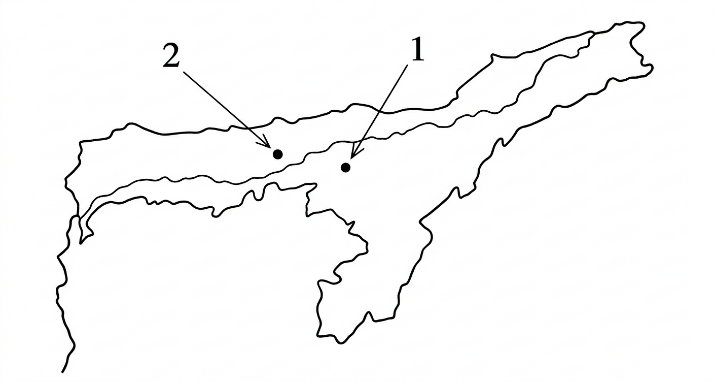
(A) 1. Patharughat 2. Phulaguri
(B) 1. Phulaguri 2. Patharughat
(C) 1. Rangiya 2. Phulaguri
Answer: B
20. (A) The new land revenue policy and the money economy of British Government created deep resentment among the Assamese common people. {Bongaigaon}
(R) At that time the villages in Assam were self sufficient and there was hardly any scope of earning money by selling the local produce
(A) (A) is true and (R) is false
(B) (A) is false and (R) is True
(C) (A) and (R) are True and (R) is correct explanation of (A)
(D) Both (A) and (R) are True but (R) is not correct explanation
Answer: C
21. Between whom was the treaty of Allahabad signed? {Bongaigaon}
(A) Between Shah Alam and Lord Curzon
(B) Between Shah Alam and Robert Clive
(C) Between Bahadur Shah and Lord Curzon
(D) Between Bahadur Shah and Robert Clive.
Answer: B
22. Match the following events and choose the correct answer – {Bongaigaon}
(i) Sepoy mutiny
(ii) Phulaguri Dhawa
(iii) The peasant Revolt of Rangia
(iv) Peasant Revolt of Patharughat
(a) 1894
(b) 1893
(c) 1861
(d) 1857
(A) (i) c, (ii) d, (iii) b, (iv) a
(B) (i) d, (ii) c, (iii) b, (iv) a
(C) (i) b, (ii) a, (iii) d, (iv) c
(D) (i) a, (ii) b, (iii) c, (iv) d
Answer: B
23. What was the main objective of the Phulaguri Dhawa of 1861? {Cachar}
(A) To protest against taxes on betel and paan.
(B) To demand freedom from British rule.
(C) To establish the rule of the Raij Mels.
(D) To oppose the zamindari system.
Answer: A
24. Fill in the blanks : {Cachar}
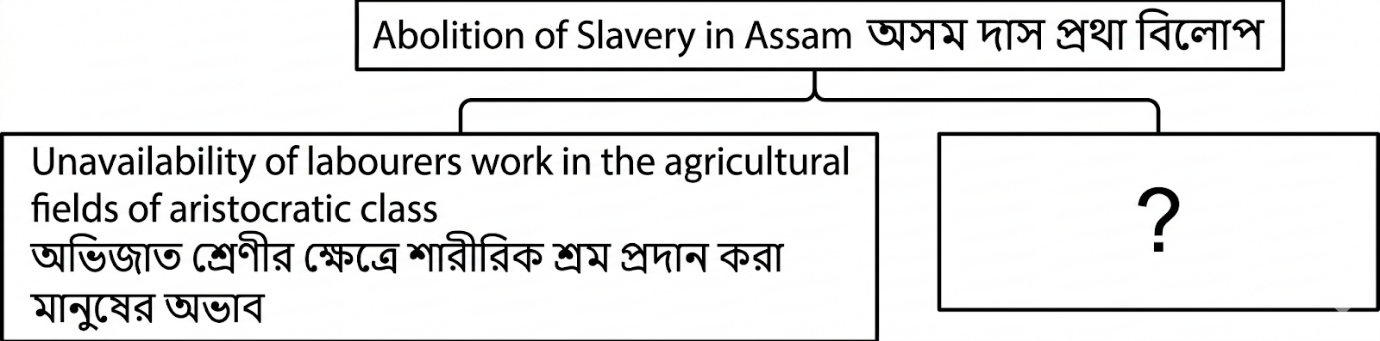
(A) Engagement of labourers in the tea gardens.
(B) Rise in land revenue.
(C) Deterioration of cottage industries
(D) Creation of free labourer class.
Answer: A
25. Assertion (A): Between 1854-70 there was a hundred percent rise in taxes in Assam. {Cachar}
Reason (R): The revolt of 1857 created economic deficit for the British government and they became concerned about stabilizing it.
(A) Assertion (A) is correct but Reason (R) is incorrect.
(B) Assertion (A) is incorrect but Reason (R) is correct.
(C) Both Assertion (A) and Reason (R) are correct and (R) correctly explains (A).
(D) Both Assertion (A) and Reason (R) are correct but (R) does not correctly explains (A).
Answer: C
26. Which district is Phulguri located at ? {Dhubri}
(A) Darrang
(B) Kamrup
(C) Nagaon
(D) Nalbari
Answer: C
27. Yandabo Treaty was signed between East India Company and {Dhubri}
(A) Mogal King
(B) Ahom King
(C) Kachari King
(D) Burma King
Answer: D
28. Assertation (A): The British annexation of Assam led to economic and political restructuring of the region. {Dhubri}
Reason (R): Modern education intruduced by the British helped to create a newly educated Assamese middle class which was inspired by patriotism and nationalist sentiments –
(A) A true R false
(B) A false R true
(C) Both A and R true, R is correct explanation of A.
(D) Both A and R true, but R is not correct explanation of A.
Answer: D
29. Choose the option that shows the correct relationship between Assertion and Reason: {Goalpara}
Assertion (A): Maniram Dewan was the leader of the 1857 revolt in Assam.
Reason (R): Maniram Dewan was a successful administrator.
(A) Both (A) and (R) are true and (R) is the correct explanation of (A).
(B) Both (A) and (R) are true but (R) is not the correct explanation of(A).
(C) (A) is true, but (R) is false.
(D) (A) is false, but (R) is true.
Answer: B
30. Who wrote an application to Moffat Mills saying that land rents were breaking the backs of the Assamese people? {Goalpara}
(A) Anandaram Baruah
(B) Anandaram Dhekial Phukan
(C) Maniram Dewan
(D) Gopinath Bordoloi
Answer: B
31. The revolutionarists of revolt of 1857 in India wanted to end “The British Rule in India forever”. They wanted to place one leader as Moghul Emperor, who was he? {Goalpara}
(A) Bahada Shah Zafar-II
(B) Nana Saheb
(C) Gani Khan Abdul Gafar Khan
(D) Mangal Pandey
Answer: A
32. Which periods is known as ‘Company Raj’ in Assam — {Goalpara}
(A) 1816-1826
(B) 1826-1858
(C) 1858-1868
(D) 1868-1878
Answer: B
33. In the context of 19th-century Assam, which of the following best describes the nature of a ‘Raijmel’? {Hailakandi}
(A) A traditional democratic village assembly that became a platform for collective protest against high taxes.
(B) A British-sponsored committee aimed at improving agricultural techniques.
(C) A formal military council appointed by the Ahom King to fight the British.
(D) A religious gathering focused solely on the reformation of the Satra institution.
Answer: A
34. Maniram Dewan was arrested in Calcutta and brought back to Jorhat for trial. He was subsequently found guilty of treason and hanged along with which other prominent rebel leader on February 26, 1858? {Hailakandi}
(A) Madhu Malik
(B) Bahadur Gaonburha
(C) Kandarpeswar Singha
(D) Piyoli Barua
Answer: D
35. Consider the following statements regarding the 1857 Revolt in Assam: {Hailakandi}
i) The revolt in Assam was a full-fledged mass movement, mirroring the scale of events in Meerut and Delhi.
ii) Maniram Dewan and Piyoli Barua were key figures leading the rebellion from Jorhat.
iii) The main participants were only the Ahom royalty and aristocracy.
iv) Post-1857, agrarian unrest, like the Phulaguri Uprising (1861), became significant.
(A) I,ii
(B) i, ii,iii
(C) ii,iv
(D) ii, iii,iv
Answer: C
36. Which of the following were important demands raised by Assamese peasants in the movement? {Jorhat}
i) Reduction of land revenue
ii) Abolition of landlord exploitation
iii) Complete independence from British rule
iv) Protection of tenant rights
(A) i, ii, iv
(B) i, ii, iii
(C) i, iii
(D) ii, iii
Answer: A
37. Which actions did the peasant of Patharughat take during the 1894 uprising? {Jorhat}
i) Organized peaceful protest against revenue hike
ii) Formed an armed focus against the British
iii) Held public meetings to oppose the new revenue policy.
iv) Submitted petitions to the British authorities.
(A) i, iii, iv
(B) ii, iii, iv
(C) i, ii
(D) ii, iii
Answer: A
38. Which of the following rebellions does the above figure represent? {Kamrup M}
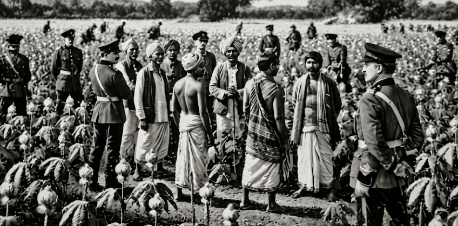
(A) Revolt of 1857
(B) Peasant Revolt of Patharughat
(C) Peasant Revolt of Rangia
(D) Phulaguri Dhawa
Answer: B
39. Who else was hanged with Maniram Dewan? {Kamrup R}
(A) Mayaram Nazir
(B) Dutiram Baruah
(C) Piyali Baruah
(D) Piyali Phukan
Answer: C
40. Match the following: {Kamrup R}
A) Jayantia Revolt
B) Uttar Kachar Revolt
C) Revolt of Manipur
D) Doctrine of lapse
i) Ukiang Nongbah
ii) Shambhudhan Kachari
iii) Tikendrajit
iv) Lord Wellesley
Options:
(A) A–i, B–ii, C–iii, D–iv
(B) A–ii, B–iii, C–iv, D–i
(C) A–iii, B–iv, C–i, D–ii
(D) A–iv, B–i, C–ii, D–iii
Answer: A
41. Which of the following statement is false? {Kamrup R}
(A) Phulguri Dhawa was the first battle of the peasant against the British.
(B) According to Non govt source, in the battle of Pothorughat 140 farmers were dead and 150 were injured.
(C) Ukiam Nonbah was hanged in Jowai by the British.
(D) The Rangia Peasant Revolt was held in 1895.
Answer: D
42. The Allahabaad treaty was signed in- {Kokrajhar}
(A) 1762AD
(B) 1765AD
(C) 1768AD
(D) 1773AD
Answer: B
43. Captain Holroyd was a- {Kokrajhar}
(A) Chief officer of Sibsagar district
(B) Chief commissioner of Assam
(C) Governor General of Fort William
(D) Chief justice of Calcutta High Court
Answer: A
44. Moffat Mills was a- {Kokrajhar}
(A) Chief commissioner of Assam
(B) Governor General of Fort William
(C) Chief justice of Calcutta High Court
(D) Chief officer of Sibsagar district
Answer: C
45. Cremation was banned in Assam- {Lakhimpur}
(A) 1840
(B) 1841
(C) 1843
(D) 1845
Answer: C
46. Assertion (A): The 1857 mutiny led to a major military uprising in Assam. {Lakhimpur}
Reason (R): This rebellion instilled the seeds of Anti-British awakening among the Assamese.
(A) Both (A) and (B) Correct
(B) Both (A) and (R) incorrect
(C) (A) correct, (R) incorrect
(D) (A) incorrect, (R) correct
Answer: D
47. The first peasant uprising in Assam – {Lakhimpur}
(A) Lachima Peasant uprising
(B) Paltrught Peasant uprising
(C) The Jaintia Rebellin
(D) Phulguri Dhaba
Answer: D
48. Moniram Dewan and Peoli Boruah were executed- {Lakhimpur}
(A) 26 Februay 1858
(B) 24 october, 1854
(C) 17 october, 1861
(D) 18 October, 1861
Answer: A
49. Assestion (A): The 1857 mutiny made the British Government Economically depresse(D) {Lakhimpur}
Reason (R): A lot of money was spent on suppression the rebellion
(A) (A) and (R) both correct and (R), is the correct explanation of (A)
(B) (A) and (R) both are correct, but (R) is not correct explanation of (A)
(C) (A) is correct but (R) is incorrect)
(D) (A) is incorrect but (R) is correct)
Answer: A
50. The Joyantia Rebellion in 1861 was led by- {Lakhimpur}
(A) Okiang Nangbahe
(B) Tikendrajit
(C) Raja Rajendra Singh
(D) Sambudhan Kachari
Answer: A
51. Assertion (A): In 1851 in some areas of Kamrup and Darrang, the condition was such that apart from the family valuables, parents were compelled to sell the own children for a handful of grains. {Nagaon}
Reason (R): In that time in upper Assam cholera and measles took an epidemic form.
(A) (A) is true but (R) is false
(B) (A) is false but (R) is ture
(C) Both (A) and (R) are true and (R) is not the correct explanation of (A)
(D) Both (A) and (R) are true and (R) is the correct explanation of (A)
Answer: C
52. Maniram Dewan and Piyali Baruah were hang till death on – {Nagaon}
(A) 26 February of 1858
(B) 24 February of 1846
(C) 26 February of 1862
(D) 24 February of 1826
Answer: A
53. When the Jayantia Kingdom went into the hands of the British from the Jayantia king Rajendra Singh? {Nagaon}
(A) 1820
(B) 1825
(C) 1830
(D) 1835
Answer: D
54. Who wrote the petition to Moffiat Mills against the imposition of increased land revenue from Assamese farmers {Nalbari}
(A) Maniram Dewan
(B) Anandaram Dhekiyal Phukan
(C) Anandaram Baruah
(D) Piyoli Phukan
Answer: B
55. On the basis of the information given in (A) and (R), choose the right answer: {Nalbari}
Assertion (A): The 1857 uprising was severely suppressed by the British government in Assam.
Reason (R): The rebels failed to keep their actions secret.
(A) (A) is correct, (R) is incorrect
(B) (A) is incorrect, (R) is correct
(C) Both (A) and (R) are correct and (R) is the correct explanation of (A)
(D) Both (A) and (R) are correct, but (R) is not the correct explanation of (A)
Answer: C
56. Which of the following order of historical events is in the right ascending order – {Nalbari}
(A) Manipur Rebellion → Jaintia Rebellion → Rangia Rebellion → Naga Rebellion
(B) Jaintia Rebellion → Naga Rebellion → Manipur Rebellion → Rangia Rebellion
(C) Naga Rebellion → Manipur Rebellion → Rangia Rebellion → Jaintia Rebellion
(D) Jaintia Rebellion → Rangia Rebellion → Naga Rebellion → Manipur Rebellion
Answer: B
57. Assertion (A): The Phulaguri Dhawa was not a major example of successful peaceful protests. {Sibsagar}
Reason (R): The Event involved violent actions rather than non-violent protests.
(A) Both A and R are true and R is the correct explanation of A.
(B) Both A and R are true but R is not a correct explanation of A.
(C) A is true R is false.
(D) A is false R is true.
Answer: A
58. Who wrote an application to Moffat Mills and pointed out that the land revenue fixed by the British was much more than what could be afforded by the peasants? {Sibsagar}
(A) Moniram Dewan
(B) Gomdhar Konwar
(C) Anandaram Dhekial Phukan
(D) Piyoli Phukon
Answer: C
59. Find out the correct option from the following sequences of historical Events in the order of old to new. {Sibsagar}
(A) Jaintia Revolt – North Cachar Revolt – The peasant Revolt of Rangia – The peasant Revolt of Lachima
(B) Jaintia Revolt – The peasant Revolt of Rangia – The peasant Revolt of Lachima – North Cachar Revolt
(C) North Cachar Revolt – Jaintia Revolt – The peasant Revolt of Rangia – The peasant Revolt of Lachima
(D) The peasant Revolt of Lachima – The peasant Revolt of Rangia – Jaintia Revolt – North Cachar Revolt
Answer: A
60. Who was the british officer killed by revolutionaries during phulaguri dhawa ? {Sonitpur}
(A) Lieutenant Singer
(B) Mac Cabe
(C) J.(D) Anderson
(D) Harbert Scott
Answer: A
61. If Maniram dewan had succeeded in his plan, what would have been the most likely outcome for Assam? {Sonitpur}
(A) Direct roll by the mughal empire
(B) Restoration of Ahorn Monarchy with Indian rulers.
(C) Complete independence from India
(D) French colonial control
Answer: B
62. Arrange the peasants movernents from first to last. {Sonitpur}
(A) Lachima – Phulaguri dhawa – Rangia – Patharughat
(B) Patharughat – Rangia – Phulaguri dhawa – Lachima
(C) Phulaguri dhawa – Rangia – Patharughat – Lachima
(D) Phulaguri dhawa – Rangia – Lachima – Patharughat
Answer: D
63. Arrange the historical events that took place in order. {Sribhumi}
a) Phulguri Dhawa
b) Peasant Revolt of Rangia
c) Peasant Revolt of Lachima
d) Peasant Revolt of Pathrughat
(A) a, b, c, d
(B) b, c, a, d
(C) a, b, d, c
(D) b, d, a, c
Answer: A
64. Assertion (A): Phulguri Dhawa was the first organised peasant revolt in Assam during British rule. {Sribhumi}
Reason (R) : The revolt began as a reaction to the imposition of taxes on Tamul-paan.
(A) Both A and R are true and R is the correct explanation of A.
(B) Both A and R are true but R is not the correct explanation of A.
(C) A is true but R is false
(D) A is false but R is true
Answer: C
65. “Lakhiraj Land” means {Sribhumi}
(A) Commercial land
(B) Forest land
(C) Tax-free land
(D) Grazing land
Answer: C
66. Who was the leader of Jaintia Revolt? {Sribhumi}
(A) U Kiang Nangbah
(B) Tikendrajit
(C) Lachit Barphukan
(D) Purandar Singha
Answer: A
67. Match years with incidents and find the correct answer. {Sribhumi}
a) 1843
b) 1857
c) 1861
d) 1894
i) Assam’s response to Sepoy Mutiny
ii) Pathrughat Revolt
iii) Abolition of Slavery
iv) Phulguri Peasant Revolt
(A) a-iii, b-i, c-ii, d-iv
(B) a-iv, b-iii, c-ii, d-i
(C) a-iii, b-iv, c-i, d-ii
(D) a-iii, b-i, c-iv, d-ii
Answer: D
68. The Underlying reason for the abolition of slavery in Assam by the British was- {Salmara}
(A) The lives of the Assamese slaves were very difficult.
(B) To fulfill the shortage of labour in newly opened tea plantations gardens.
(C) The Assamese elite people were comfortable.
(D) The British granted freedom to the slaves.
Answer: B
69. The period from____to____is known as Company Raj in Assam. {Salmara}
(A) 1228 to 1826
(B) 1757 to 1857
(C) 1826 to 1858
(D) 1757 to 1947
Answer: C
70. The Raij Mels were an intimate part of the Assamese rural life particularly in solving various problems right from the days of the Ahom monarchy down to the British rule. Choose the correct option below from the above sentence. {Salmara}
i. The peasant revolts in Assam in the 19th Century were led by the Raij Mels.
ii. Raij Mels were modern political organizations
iii. These Raij Mels did their best to make the peasants and other common people politically conscious.
(A) i, iii,
(B) i, ii,
(C) ii, iii,
(D) i, ii, iii,
Answer: A
71. Match the following and choose the correct answer: {Salmara}
i. The Naga Rebellion (A) Damant
ii. Revolt of Jayantia (B) Sambhudhan
iii. The Manipure Rebellion (C) Ukiyan Nabah
iv. The North Cachar Rebellion. (D) Tikendrajeet
(A) i-a, ii-d, iii-c, iv-b
(B) i-d, ii-c, iii-a, iv-b
(C) i-a, ii-c, iii-d, iv-b
(D) i-a, ii-c, iii-b, iv-d
Answer: C
72. Who introduced the “Subsidiary Alliance Policy”? {Udalguri}
(A) Lord Wellesley
(B) Lord Dalhousie
(C) Lord Curzon
(D) Lord Minto
Answer: a
73. Due to the sincere participation of the Lalung tribal community and Fishing community in the Phulaguri Peasant Rebellion, the movement gained mass support and strength. The Lalung people belong to which ethnic group? {Udalguri}
(A) Tiwa
(B) Dimasa Kachari
(C) Manipuri
(D) Bodo
Answer: A
Probable Multiple Choice Questions with Answers for HSLC 2027
1. In which year was slavery officially abolished in Assam by the British?
(A) 1826
(B) 1843
(C) 1858
(D) 1861
Answer: B
2. Who led the 1857 revolt against the British in Assam?
(A) Piyali Phukan
(B) Gomdhar Konwar
(C) Maniram Dewan
(D) Kushal Konwar
Answer: C
3. Along with Maniram Dewan, who else was hanged by the British on charges of treason?
(A) Dutiram Barua
(B) Piyali Barua
(C) Bahadur Gaonburha
(D) Madhu Mallick
Answer: B
4. What was the first popular peasant uprising in Assam against British economic exploitation?
(A) Rangiya Revolt
(B) Lachima Revolt
(C) Patharughat Revolt
(D) Phulaguri Dhawa
Answer: D
5. Who among the following led the Jaintia rebellion against the British in 1861?
(A) Tikendrajit
(B) Sambhudhan Kachari
(C) U Kiang Nongbah
(D) Rajendra Singha
Answer: C
6. The British officer who was killed by the angry peasants during the Phulaguri Dhawa was:
(A) J.(D) Anderson
(B) Lt. Singer
(C) J.R. McCabe
(D) Captain Holroyd
Answer: B
7. In which district of Assam did the Patharughat peasant uprising take place?
(A) Kamrup
(B) Nagaon
(C) Darrang
(D) Sibsagar
Answer: C
8. Who wrote a petition to A.J. Moffatt Mills protesting against the excessive land revenue assessment on the Assamese peasants?
(A) Anandaram Dhekial Phukan
(B) Maniram Dewan
(C) Haliram Dhekial Phukan
(D) Hemchandra Barua
Answer: A
9. Who was the leader of the North Cachar (Dimasa) rebellion in 1881?
(A) Tikendrajit
(B) U Kiang Nongbah
(C) Sambhudhan Kachari
(D) Tularam Senapati
Answer: C
10. The Ahom prince whom the rebels of 1857 wanted to place on the throne of Assam was:
(A) Purandar Singha
(B) Jogeswar Singha
(C) Gomdhar Konwar
(D) Kandarpeswar Singha
Answer: D
11. On what exact date were Maniram Dewan and Piyali Barua hanged in Jorhat?
(A) 26 February 1858
(B) 24 October 1857
(C) 18 October 1861
(D) 15 August 1858
Answer: A
12. The agrarian uprising of Rangiya took place in the year:
(A) 1861
(B) 1893
(C) 1894
(D) 1881
Answer: B
13. Who was the Deputy Commissioner of Darrang district during the Patharughat uprising?
(A) J.(D) Anderson
(B) Herbert Sconce
(C) J.R. McCabe
(D) Captain Welsh
Answer: A
14. The organization that played a pivotal role in uniting and leading the peasants during the uprisings in Assam was:
(A) Ryot Sabha
(B) Sarvajanik Sabha
(C) Raij Mel
(D) Assam Association
Answer: C
15. What was the primary reason behind the British decision to abolish slavery in Assam?
(A) To grant fundamental rights to the slaves
(B) To secure cheap laborers for the newly established tea gardens
(C) To destroy the Ahom aristocracy
(D) To fulfill the demands of the Indian National Congress
Answer: B
16. Which prominent leader from Manipur was hanged by the British for resisting their authority?
(A) Kulachandra
(B) Gambhir Singh
(C) Tikendrajit
(D) Chandrakirti
Answer: C
17. Which of the following British policies completely ruined the traditional cottage industries of Assam?
(A) Introduction of money economy
(B) Import of cheap machine-made foreign goods
(C) Imposition of stamp duties
(D) Abolition of the Paik system
Answer: B
18. Which Ahom leader was imprisoned in the Alipore Jail for his involvement in the 1857 revolt?
(A) Dutiram Barua
(B) Farmud Ali
(C) Kandarpeswar Singha
(D) Bahadur Gaonburha
Answer: C
19. The Lachima peasant uprising occurred in which present-day district?
(A) Kamrup
(B) Barpeta
(C) Nalbari
(D) Darrang
Answer: B
20. During the Company rule, the introduction of which tax severely affected the tribal population of the hill areas?
(A) Income Tax
(B) Grazing Tax
(C) House Tax
(D) Stamp Duty
Answer: C
21. Where was Maniram Dewan when the 1857 revolt broke out in Assam?
(A) Jorhat
(B) Sibsagar
(C) Delhi
(D) Calcutta
Answer: D
22. How did the British authorities discover the secret plans of the 1857 rebels in Assam?
(A) Maniram Dewan surrendered to the British
(B) Kandarpeswar Singha revealed the plot
(C) Letters written by Maniram Dewan were intercepted by the British police
(D) The sepoys refused to fight
Answer: C
23. The immediate cause of the Phulaguri Dhawa was the British government’s ban on the cultivation of:
(A) Tea
(B) Indigo
(C) Poppy (Opium)
(D) Cotton
Answer: C
24. Who was the Chief Commissioner of Assam during the peasant revolts of 1893-94?
(A) Sir William Ward
(B) Henry Hopkinson
(C) David Scott
(D) Thomas Campbell
Answer: A
25. The historical event “Patharughat Ran” (Battle of Patharughat) is often compared to which tragedy in Indian history?
(A) Chauri Chaura incident
(B) Jallianwala Bagh massacre
(C) Kakori conspiracy
(D) Black Hole tragedy
Answer: B
26. Arrange the following peasant revolts of Assam in correct chronological order (from earliest to latest):
(i) Lachima Uprising
(ii) Phulaguri Dhawa
(iii) Patharughat Uprising
(iv) Rangiya Uprising
(A) (ii) → (iv) → (i) → (iii)
(B) (ii) → (iv) → (iii) → (i)
(C) (iv) → (ii) → (i) → (iii)
(D) (i) → (ii) → (iii) → (iv)
Answer: A
27. Match the leaders in Column A with the tribal revolts in Column B and select the correct option:
Column A
(a) Tikendrajit
(b) U Kiang Nongbah
(c) Sambhudhan Kachari
Column B
(i) Jaintia Rebellion
(ii) North Cachar Rebellion
(iii) Manipur Rebellion
(A) (a)-iii, (b)-ii, (c)-i
(B) (a)-ii, (b)-i, (c)-iii
(C) (a)-iii, (b)-i, (c)-ii
(D) (a)-i, (b)-iii, (c)-ii
Answer: C
28. Which of the following is NOT a valid reason for the failure of the 1857 revolt in Assam?
(A) The number of rebels was very small.
(B) The rebels failed to maintain secrecy about their plans.
(C) The Assamese elite classes heavily supported the British forces.
(D) The rebels lacked access to sufficient arms and ammunition.
Answer: C
29. Consider the following statements regarding the ‘Raij Mel’ and select the correct option:
(i) It was a socio-political institution of the village elders.
(ii) It acted as a platform to organize protests against British taxation.
(iii) The British encouraged the formation of Raij Mels to collect revenue.
(A) Only (i) and (ii) are correct.
(B) Only (ii) and (iii) are correct.
(C) Only (i) and (iii) are correct.
(D) All (i), (ii), and (iii) are correct.
Answer: A
30. Why did the Assamese aristocracy strongly support the 1857 revolt?
(A) They wanted to establish a democratic government in Assam.
(B) They wanted to join the Indian National Congress.
(C) They had lost their previous administrative positions, privileges, and tax-free lands under British rule.
(D) They were forced to work as laborers in the tea gardens.
Answer: C
31. Match the British officers with the incidents they were involved in:
(a) Lt. Singer
(b) J.R. McCabe
(c) J.(D) Anderson
(i) Rangiya Uprising
(ii) Patharughat Uprising
(iii) Phulaguri Dhawa
(A) (a)-iii, (b)-ii, (c)-i
(B) (a)-iii, (b)-i, (c)-ii
(C) (a)-i, (b)-iii, (c)-ii
(D) (a)-ii, (b)-i, (c)-iii
Answer: B
32. What was the most devastating impact of the introduction of the ‘Money Economy’ by the British in Assam?
(A) It made the peasants wealthy and self-sufficient.
(B) It forced peasants to take loans from exploitative Marwari moneylenders to pay taxes in cash.
(C) It led to the rapid industrialization of Assam.
(D) It eliminated the barter system without causing any hardship.
Answer: B
33. Which of the following events occurred first during the British rule in Assam?
(A) The Phulaguri Dhawa
(B) The Jaintia Rebellion led by U Kiang Nongbah
(C) The execution of Maniram Dewan
(D) The abolition of slavery
Answer: D
34. Regarding the uprising in North Cachar, which of the following statements is true?
(A) It was led by the Ahom nobility.
(B) It was primarily a protest against the ban on opium.
(C) It was an armed rebellion led by Sambhudhan Kachari aiming to establish Kachari supremacy.
(D) It succeeded in driving the British out of the region permanently.
Answer: C
35. The rumor of the British imposing a tax on which items primarily fueled the peasant unrest leading up to the Phulaguri Dhawa?
(A) Tea and Coffee
(B) Betel nut (Pan-Tamul) and betel leaf
(C) Rice and Wheat
(D) Silk and Cotton
Answer: B
36. Choose the correct statement regarding the 1857 revolt in Assam:
(A) It was a massive armed conflict where thousands of British soldiers died.
(B) It was mostly a conspiracy formulated by the elite class that was crushed before taking the form of an armed struggle.
(C) It was heavily supported by the newly educated middle-class Assamese youths.
(D) It resulted in the restoration of Kandarpeswar Singha as the King of Assam.
Answer: B
37. What was the British government’s immediate response to the agrarian revolts in Assam in the late 19th century?
(A) They abolished all taxes immediately to appease the peasants.
(B) They invited the leaders of the Raij Mels for peaceful negotiations.
(C) They used brute military force, including lathi charges and open firing, to crush the rebellions.
(D) They granted independence to the affected districts.
Answer: C
38. Consider the following statements:
Statement 1: The British annexation of Assam improved the economic condition of the local artisans.
Statement 2: The British imported cheap machine-made goods, which led to the decline of indigenous cottage industries.
(A) Statement 1 is correct, and Statement 2 is incorrect.
(B) Statement 1 is incorrect, and Statement 2 is correct.
(C) Both statements are correct.
(D) Both statements are incorrect.
Answer: B
39. The British policy of annexing native states through the “Doctrine of Lapse” was formulated by:
(A) Lord Wellesley
(B) Lord Dalhousie
(C) Lord Curzon
(D) Lord Canning
Answer: B
40. Which of the following best describes the socio-economic situation of Assam prior to the peasant revolts of 1893-94?
(A) A period of high agricultural yield and prosperity.
(B) A period marked by tax reductions and government relief.
(C) A period of severe agrarian distress due to 100% enhancement of land revenue rates by the British.
(D) A period where agriculture was entirely replaced by tea plantation.
Answer: C
41. Assertion (A): The 1857 revolt in Assam ended in failure.
Reason (R): The rebel leaders failed to maintain the secrecy of their plans, and their letters were intercepted by the British.
(A) Both A and R are true, and R is the correct explanation of A.
(B) Both A and R are true, but R is not the correct explanation of A.
(C) A is true, but R is false.
(D) A is false, but R is true.
Answer: A
42. Assertion (A): The introduction of a money economy by the British severely impoverished the Assamese peasants.
Reason (R): The peasants found it extremely easy to sell their surplus agricultural products in the market to pay taxes in cash.
(A) Both A and R are true, and R is the correct explanation of A.
(B) Both A and R are true, but R is not the correct explanation of A.
(C) A is true, but R is false.
(D) A is false, but R is true.
Answer: C
43. Assertion (A): The Raij Mels played a crucial role as the organizational backbone of the peasant revolts in Assam.
Reason (R): The Raij Mels united the villagers, raised awareness against unjust taxes, and collectively decided to boycott revenue payments.
(A) Both A and R are true, and R is the correct explanation of A.
(B) Both A and R are true, but R is not the correct explanation of A.
(C) A is true, but R is false.
(D) A is false, but R is true.
Answer: A
44. Assertion (A): The British abolished the age-old practice of slavery in Assam in 1843.
Reason (R): The primary intention of the British was to grant fundamental human rights to the oppressed slaves.
(A) Both A and R are true, and R is the correct explanation of A.
(B) Both A and R are true, but R is not the correct explanation of A.
(C) A is true, but R is false.
(D) A is false, but R is true.
Answer: C
45. Assertion (A): The Phulaguri Dhawa was a completely peaceful and non-violent peasant demonstration.
Reason (R): During the protest, the angry peasants attacked and killed British officer Lt. Singer.
(A) Both A and R are true, and R is the correct explanation of A.
(B) Both A and R are true, but R is not the correct explanation of A.
(C) A is true, but R is false.
(D) A is false, but R is true.
Answer: D
46. Assertion (A): The Jaintia rebellion of 1861 was sparked by British economic interference.
Reason (R): The British government imposed new taxes such as the House Tax and Income Tax on the Jaintias, which they deeply resented.
(A) Both A and R are true, and R is the correct explanation of A.
(B) Both A and R are true, but R is not the correct explanation of A.
(C) A is true, but R is false.
(D) A is false, but R is true.
Answer: A
47. Assertion (A): The newly educated Assamese middle class strongly supported Maniram Dewan during the 1857 revolt.
Reason (R): The educated middle class believed that the British administration would bring modernity, education, and peace, and hence they opposed a return to Ahom monarchy.
(A) Both A and R are true, and R is the correct explanation of A.
(B) Both A and R are true, but R is not the correct explanation of A.
(C) A is true, but R is false.
(D) A is false, but R is true.
Answer: D
48. Assertion (A): The Patharughat uprising was ruthlessly suppressed by the British authorities.
Reason (R): The British forces opened unprovoked firing on an unarmed gathering of peasants, resulting in numerous deaths and injuries.
(A) Both A and R are true, and R is the correct explanation of A.
(B) Both A and R are true, but R is not the correct explanation of A.
(C) A is true, but R is false.
(D) A is false, but R is true.
Answer: A
49. Assertion (A): The anti-British uprisings in Manipur were a direct result of internal succession disputes combined with British interference.
Reason (R): The Chief Commissioner of Assam unlawfully intervened in the internal politics of Manipur, leading to a violent clash with Tikendrajit.
(A) Both A and R are true, and R is the correct explanation of A.
(B) Both A and R are true, but R is not the correct explanation of A.
(C) A is true, but R is false.
(D) A is false, but R is true.
Answer: A
50. Assertion (A): Despite failing to achieve immediate independence, the 1857 revolt in Assam holds immense historical significance.
Reason (R): It laid the foundation of anti-British consciousness and nationalism in Assam, inspiring future generations to fight against colonial rule.
(A) Both A and R are true, and R is the correct explanation of A.
(B) Both A and R are true, but R is not the correct explanation of A.
(C) A is true, but R is false.
(D) A is false, but R is true.
Answer: A
HSLC PYQs (2016–2026): Important 2/3 Marks Short Questions
HSLC PYQs (2016–2026): Important 2‑ and 3‑Mark Short Questions
1. Throw light on the revenue system introduced by the East India Company in Assam. {2022}
2. Write a note on the ‘Peasant Revolt of Patharighat. {2020}
3. Mention the impact of Revolt of 1857 in Assam. {2020}
4. Who led the Revolt of 1857 in Assam? {2023}
4. Write in brief about the role of ‘Raijmel’ (Peoples Assembly). {2022}
5 .Write the significance of jaintia Revlot against the British. {2020}
6. Discuss in brief he causes of the Revolt of 1857-58 in India and its impact on Assam. {2019}
7. Briefly discuss the importance of the revolt of 1857 in Assam.{2019)
8 .Discuss the importance of Phulguri Dhawa in history. {2019,17}
9. Give a brief account of the role of Maniram Dewan in the Revolt of 1857. {2018}
10. Write a brief note on the peasants’s Revolt of Raniga. {2018}
11 .In which year slavery was abolished in Assam? {2016}
12. Why was the Seopy Mutiny of 1857 failed in Assam Give Three reasons. {2016}
HSLC PYQs (2016–2026): Important 4/5 Marks Long Questions
HSLC PYQs (2016–2026): Important 2‑ and 3‑Mark Short Questions
1. A student of Class X became so emotional by reading about the failure of the Revolt of 1857 in Assam in her Social Science book that she wrote a drama. She named the drama “Successful Maniram Dewan”. Give your opinion on the appropriateness of the title of the drama. {2026}
2. Observe the given statistical data on the collection of revenue (in terms of rupees) by the British Government and answer the questions that follow: {2025}
|
Year → District ↓ |
1832–33 |
1842–43 |
1852–53 |
|
Kamrup |
1,10,181 |
2,52,991 |
2,95,996 |
|
Darrang |
41,506 |
1,35,454 |
1,57,795 |
|
Nagaon |
31,509 |
1,10,314 |
1,28,873 |
|
Sibsagar |
– |
80,843 |
1,14,463 |
|
Lakhimpur |
– |
34,780 |
46,553 |
(a) Compare the data between Kamrup and Darrang.
(b) What was the impact of the change on the peasants of Kamrup and Darrang?
3. Discuss the role of Maniram Dewan in the revolt of 1857-58 in Assam. {2024}
4. Discuss in brief the importance of the revolt of 1857 in Assam. {2023)
5. Write about the causes of the pitiable conditionof the peasants and the people who were engaged in cottage industries during the British rule in Assam.
{2018)
6. Write a brief’nble on the Jaintia Revolt against the British in 1850.
{2017)
7. Why did the rebellion of 1857-58 occur in Assam? {2017)
8. Discuss the reasons why the revolt of 1857-58 failed in Assam. {2017)

District Pre Board (2025–26): Important 2 Marks Short Questions
1. Do you think the revolt of 1857 had any positive impact on Assam? Justify your answer. {Kamrup M}
2. Explain three reasons why the Sepoy Mutiny was unsuccessful in Assam. {Kamrup R}
3. Why is the Phulguri Dhawa important in the history of Assam. {Kamrup R}
4. Mention two causes of the failure of the revolt of 1857 in Assam. {Kokrajhar}
5. Give a brief glimpse of the powerful position of the Rajmel (people’s assembly) from the time of Ahom rule to British rule. {Udalguri}
District Pre Board (2025–26): Important 3 Marks Long Questions
6. Discuss the role of Maniram Dewan in the revolt of 1857-58 in Assam. {Bajali}
7. What were the effects of Phulguri Dhawa on the history of Assam? {Bajali}
8. Describe how the condition of the Assamese peasants became miserable due to the introduction of the monetary economy in the British revenue system. {Barpeta}
9. Write the causes of the failure of the revolt of 1857. {Goalpara}
10. Study the given case and answer the following questions: {Hailakandi}
The peaceful protests and non-cooperation movement in Phulaguri escalated when the peasants, having collectively refused to pay taxes, confronted British officials. In October 1861, a British official named Lt. Singer attempted to disperse Raijmal; a scuffle broke out leading to the death of the official. The British responded with brutal force, brutally suppressing the uprising. Many farmers were killed, some were hanged, and others were deported to the Andaman Islands (“Koliapani”).
Questions:
(i) Was the Phulaguri Dhawa purely a non-violent protest? Justify your answer using information from the scenario.
(ii) What were the consequences of the Phulaguri Dhawa for the participating peasants?
11. What were the consequences of the Phulaguri Dhawa for the British administration in Assam? {Jorhat}
12. What is meant by anti-British awakening? In Assam how did this awakening develop? Give your opinion. {Lakhimpur}
13. State the reasons for the failure of the 1857 rebellion led by Maniram Dewan in Assam. {Lakhimpur}
14. Mention the main causes of the failure of the revolt of 1857 in Assam. {Morigaon}
15. Was the 1857 Mutiny successful in Assam? Give argument in support of your opinion. {Nalbari}
16. Write briefly on “The revolt of Patharughat”. {Sribhumi}
17. Describe how the condition of the Assamese peasants became miserable due to the introduction of the monetary economy in the British revenue system. {Barpeta}
District Pre Board (2025–26): Important 4/5 Marks Long Questions
18. After the suppression of the 1857 rebellion how did the British Government further harm the common people by collecting various taxes and rents to meet their deficit? Describe. {Baksa}
19. Discuss the rise of Peasants Revolt in Assam. {Biswanath}
20. Discuss the importance of the peasant uprising at Lachima. {Biswanath}
21. Who led the revolt of 1857 in Assam? Discuss the importance of the revolt of 1857 Assam. {Bongaigaon}
22. How did Tikendrajit singlehandedly lead the revolt of Manipur? {Cachar}
23. Discuss the reasons why the revolt of Moniram Dewan failed in Assam. {Dhubri}
24. Write a note on the revolt of Patharughat. {Dhubri}
25. Write a comparative note on the Revolt of 1857 and Phulaguri Dhawa of Assam. {Sibsagar}
26. Discuss the importance of revolt of 1857 in Assam. {Sonitpur}
27. Discuss what caused the revolt of 1857-58 to fail in Assam. {Sonitpur}
28. “A British officer was effective in suppressing the Rangia peasant revolt” – Discuss this with logical arguments. {Tamulpur}
29. Maniram Dewan’s 1857 revolt is an important chapter in Assam’s history. This revolt was for indigenous interests and personal rights. Highlight the causes of the revolt as indigenous, political and personal. {Udalguri}
30. Analyse the factors that contributed to the failure of the 1857 Revolt in Assam.
Or Briefly discuss the causes of the rebellion of 1857-58. {Jorhat}
31. 1857 is a year that needs special mention in the history of modern India It was in this year that the Indian soldier recruited into the British army declared mutiny and shook the foundations of the British rule in India {Salmara}
Answer the following questions based on the above statement:
(a) When did the 1857 rebellion begin? Who was said to be the king of Assam after this rebellion? 3
(b) What were the two regiments of the British army when the rebellion started in North India? 2
(c) Why is the year 1857 a particularly significant year in the history of modern India? 2
Some Important Most Probable 2 Marks Questions for HSLC 2027
1. Mention any two primary causes responsible for the failure of the 1857 revolt in Assam.
2. What was the ‘Raij Mel’? What was its basic function?
3. State two main reasons that led to the outbreak of the Phulaguri Dhawa in 1861.
4. Who was Kandarpeswar Singha? What was his proposed role in the 1857 revolt?
5. Mention any two new taxes imposed by the British that severely fueled peasant discontent in Assam.
6. What was the underlying economic motive of the British behind the abolition of slavery in Assam in 1843?
7. Identify the prominent leaders who spearheaded the Jaintia and North Cachar tribal rebellions respectively.
8. What was the immediate cause of the Jaintia Rebellion in 1861?
9. Write two tragic consequences of the Patharughat peasant uprising of 1894.
10. Give two reasons why the Assamese elite class (aristocracy) turned hostile towards the British administration prior to 1857.
Some Important Most Probable 3 Mark Questions for HSLC 2027
11. Briefly explain the crucial role played by Maniram Dewan in organizing the 1857 revolt in Assam.
12. How did the introduction of the ‘Money Economy’ by the British negatively affect the agrarian life of Assamese peasants?
13. Describe the circumstances and events that led to the death of British officer Lt. Singer during the Phulaguri Dhawa.
14. Discuss the organizational role of the ‘Raij Mels’ during the peasant revolts of Assam in the late 19th century.
15. Explain the historical significance of the 1857 revolt in Assam, despite its failure to overthrow British rule.
16. What were the specific grievances of the Jaintia tribal people that eventually led to a massive armed rebellion against the British?
17. Briefly discuss the key events of the Lachima peasant uprising of 1894.
18. Why is the Patharughat uprising often considered one of the most tragic and brutal episodes in the history of Assam?
19. Describe the anti-British uprising in Manipur in 1891 and state how it was suppressed.
20. Explain how the British land revenue policies and periodic tax hikes ruined the traditional agrarian economy of Assam in the 19th century.
Some Important Most Probable 4 Mark Questions for HSLC 2027
21. Critically analyze the organizational and strategic causes responsible for the failure of the 1857 revolt in Assam.
22. “The Phulaguri Dhawa was the first popular mass movement in Assam against British economic exploitation.” Justify this statement with historical facts.
28. Compare the nature of the 1857 revolt in Assam with the peasant uprisings of the 1890s. How did the leadership, mass participation, and objectives differ between the two?
29. Write a comprehensive note on the deteriorating socioeconomic condition of the Assamese peasants that culminated in a series of violent agrarian revolts between 1861 and 1894.
30. Imagine you are an impoverished peasant from Darrang district in 1894. Write a formal petition to the British Deputy Commissioner highlighting your grievances regarding the unjust 100% hike in land revenue and the oppressive tax collection methods.