
Class 8 Social Science Chapter 3 – Settlement – All Textual Solutions | ASSEB Assam (English Medium)
Class 8 Social Science Chapter 3 – Settlement Complete Textual Questions and Answers Solutions (ASSEB / SEBA Assam – English Medium)
Chapter 3 ‘Settlement’ from the Geography section of the Class 8 Social Science curriculum is a crucial lesson for students. Based on the new ASSEB (Assam State School Education Board) curriculum and the latest guidelines of the National Education Policy (NEP), comprehensive textual question answers for this chapter have been prepared. This special collection includes Very Short Answer (VSA) questions, Short Answer questions, Long Answer questions, and detailed textbook solutions. At Ospin Academy, these solutions are presented in a simple, accurate, and fully exam-oriented format.
The lesson ‘Settlement’ introduces students to the concept of human settlements, how early humans transitioned from a nomadic lifestyle to permanent settlements, and the environmental factors that determine the location and growth of settlements. Understanding the core themes, definitions, and significance of this chapter is highly essential for school examinations. Our textual solutions cover not only the textbook exercise questions but also extra important questions and answers that may appear in the exams, ensuring students can prepare thoroughly.
What you will learn and get from these textual solutions:
- Detailed understanding of the origin of human settlements and the transition from temporary to permanent habitats.
- Flawless answers for 1-mark Very Short Answer (VSA objective type) questions and 2-3 mark short questions suitable for exams.
- Standard and easy-to-understand solutions for 4-5 mark long answer questions explaining the geographical factors influencing settlements.
- Clear explanations of basic concepts related to site, situation, and the utility of water, fertile soil, and topography in establishing settlements.
- Important chapter-end questions along with solutions for the latest pattern Multiple Choice Questions (MCQs) according to the new syllabus structure.
Key features of Ospin Academy’s questions and answers:
- Complete textual solutions prepared strictly according to the latest ASSEB new syllabus.
- 100% accurate, high-quality notes written in simple English language making it easy for students to memorize and understand (Class 8 Social Science Notes).
- Concise and straightforward answers specially curated for quick revision before examinations.
- A special compilation of extra important exam-oriented questions from the Settlement chapter.
Keeping in mind the academic enhancement of students, Ospin Academy provides these premium textual solutions. Start your preparation today and head towards scoring maximum marks in your Social Science subject.

Class 8 Social Science (English Medium) PDF Solutions 2026-27 | SCERT Assam
Download Class 8 Social Science (English Medium) PDF with chapter-wise MCQs, textbook answers, and extra questions for SCERT Assam 2025-26.
Class 8 Social Science
Chapter – 16 (Ospin Academy)
Settlement
|
Exercise |
|---|
1. Fill in the blank.
(a) Man started to live permanently in the same place with the beginning of _____________.
Ans: Settlement.
(b) On the basis of ____________ availability of the villagers enjoy a lots of advantages.
Ans: Water.
(c) The settlement pattern that develop along a road, railway line or river is called ____________ a settlement.
Ans Linear.
(d) At present, there are ___________ number of villages in Assam.
Ans: Many.
2. Choose the correct answer.
(a) Trade and commerce/industry/agriculture is the main occupation in a rural settlement.
Ans: Agriculture.
(b) Density of population is kms/more/equal in a rural settlement than in on when settlement.
Ans: Less.
(c) About 70/80/60 percent people in India live in the villages.
Ans: 70.
(d) When a settlement is clustered in some place, it is gr/nucleated/dispersed publish.
Ans:Nucleated.
3. Give an answer: (in 4 or 5 sentences).
(a) Why do you think man settled permanently in a place?
(i) Ans: Humans began living a settled life to avoid wandering for food.
They began living near sources of food water are mentioned below:
(ii) Agriculture: The discovery and development of farming allowed humans to grow their own food rather than relying solely on hunting and gathering. This created a stable and predictable food supply.
(iii) Resource Availability: Settling in areas with abundant natural resources like water, fertile soil, and favourable climate made it easier to sustain larger populations.
(iv) Surplus Production: With agriculture, people could produce food surpluses, which led to the ability to store food and support larger communities.
(b) Discuss the main characteristics of rural settlement
Ans: The main characteristic of rural settlement are mentioned below:
(i) Main occupation of the inhabitants is agriculture.
(ii) Settlement is thin and dispersed.
(iii) Houses are of traditional type.
(iv) Transport system is not convenient.
(v) Fewer numbers of vehicles.
(c) State how Nucleated settlement develops.
Ans: Nucleated settlements are towns where buildings are close together, often clustered around a central point. Villages that are situated by a water supply often grow into towns, for instance Taffs Well, or Ffynnon Taf in south Wales. Nucleated settlements also develop higher up a slope to avoid flooding.
(d) Write briefly about the main occupation of people living in an urban sendenser.
Ans: Urban settlement is also known as municipal settlement. It means a town. Education enhances human intelligence and capability. Such empowered people starts industry and trade by utilising various resources apart from practising agriculture. As a result, some people previously engaged in cultivation, animal husbandry, fishing etc. get into industry, trade and commerce, etc. In this way, agrarian settlement transforms into industry based settlement. Based on industry, trade and commerce, transport, etc. markets develop in such places and finally towns are created. This implies that trade and commerce, industry and craft, jobs in educational institutions, offices, etc. become the primary occupation of people living in towns. In this way, the town dwellers belong to the secondary, tertiary and quaternary activities.
(e) Discuss the relation between rural and urban settlement.
Ans: Although many differences exist between rural and urban settlement, there is a strong bondage too. It has been already mentioned that towns have borne out of villages. But this may not be true in all cases. There are certain towns that have been newly created in a planned manner.
Normally, trade and commerce connects villages with the towns. Moreover, the service sector too confirms this connectivity. The villagers supply their agricultural products to the towns and the towns provide the village with manufactured commodities and other services. Services such as banking, postal service, insurance, education also connect the villages with the townsPeople from villages move to towns regularly for various works and return by purchasing necessary items available in the towns. Nowadays, a new trend has developed within this rural urban linkage with the advent of cellular phone, internet and various other media of publicity.
4. Write short notes differences.
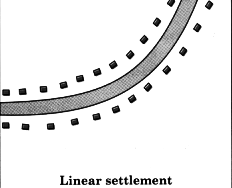
(a) Linear settlement.
Ans: Linear or ribbon settlements consist of structures that are built in a line, usually along a major transport route such as a road. Dispersed or scattered settlements occur mostly in rural areas. Buildings are spaced across a wide area and usually consist of farms.
(b) Square pattern settlements.
Ans: A settlement pattern is the distribution of human activities across the landscape and the spatial relationship between these activities. Access to the complete content on Oxford Reference requires a subscription or purchase.
(c) Upland settlements.
Ans: Uplands are land areas lying above the elevation where flooding generally occurs, areas found beyond riparian zones. Uplands represent the vast majority of land area in the Northern Colorado Plateau Network (NCPN), and include rock outcrops, badlands, shrublands, grasslands, woodlands, and forests.
5. Write the differences.
(a) Rural and urban settlement.
Ans: Rural settlements are the situations where people settle on the outskirts of cities and towns. Usually characterised by large landscapes and alleys. The distribution pattern of buildings and houses in a particular geographic region is referred to as a settlement pattern.
Rural settlements in India are broadly classified as clustered, agglomerated or nucleated; semi-clustered or fragmented; helmeted, dispersed or isolated. Clustered settlements are mainly found in fertile alluvial plains and in the North-Eastern states.
(b) Linear and nucleated settlement.
Ans: Nucleated settlements are ones where the houses are grouped closely together, often around a central feature like a church, pub or village green. New settlements that are planned often have a nucleated pattern.
(c) Upland and lowland settlement.
Ans: Upland areas are high above sea level. They are often (but not always) mountainous. They usually consist of igneous. rocks, and experience lower temperatures, high rainfall, and are windy. Lowland areas are not very high above sea level.
6. Draw a sketch map of your village or town (only a portion of the town) and show the various physical features such as rivers, hills, ponds etc. (if any) and the man-made features.
Ans: Do yourself.
7. Write what are the facilities/difficulties you have noticed in your village/town.
Ans: The facilities/difficulties you have noticed in your village/town are:
Facilities.
(i) Education: Availability of primary and secondary schools; sometimes colleges and vocational training centres.
(ii) Healthcare: Presence of clinics, primary health centres, or hospitals providing medical services.
(iii) Transportation: Roads, public transport options like buses or local trains, and sometimes airports in larger towns.
Difficulties.
(i) Employment: Limited job opportunities, leading to migration to urban areas.
(ii) Environmental Issues: Problems like deforestation, soil erosion, or water pollution.
(iii) Economic Challenges: Lower income levels, dependence on agriculture with fluctuating yields.
