Class 8 Social Science Chapter 4 – Settlement: Rural and Urban Life – All Textual Solutions | ASSEB Assam (English Medium)
Class 8 Social Science Chapter 4 – Settlement: Rural and Urban Life Complete Textual Questions and Answers Solutions (ASSEB / SEBA Assam – English Medium)
Chapter 4 ‘Settlement: Rural and Urban Life’ from the Geography section of the Class 8 Social Science curriculum is a crucial lesson for students. Based on the new ASSEB (Assam State School Education Board) curriculum and the latest guidelines of the National Education Policy (NEP), comprehensive textual question answers for this chapter have been prepared. This special collection includes Very Short Answer (VSA) questions, Short Answer questions, Long Answer questions, and detailed textbook solutions. At Ospin Academy, these solutions are presented in a simple, accurate, and fully exam-oriented format.
The lesson ‘Settlement: Rural and Urban Life’ provides an in-depth comparative study of living patterns, occupational structures, and environmental conditions in villages and cities. It highlights the challenges and characteristics of both rural and urban settlements, including rural-to-urban migration. Understanding the core themes, definitions, and significance of this chapter is highly essential for school examinations. Our textual solutions cover not only the textbook exercise questions but also extra important questions and answers that may appear in the exams, ensuring students can prepare thoroughly.
What you will learn and get from these textual solutions:
- Detailed understanding of the distinct characteristics of rural settlements (agriculture-based) and urban settlements (industry and service-based).
- Flawless answers for 1-mark Very Short Answer (VSA objective type) questions and 2-3 mark short questions suitable for exams.
- Standard and easy-to-understand solutions for 4-5 mark long answer questions comparing rural and urban lifestyles.
- Clear explanations of key concepts such as urbanization, migration push and pull factors, civic amenities, and smart city developments.
- Important chapter-end questions along with solutions for the latest pattern Multiple Choice Questions (MCQs) according to the new syllabus structure.
Key features of Ospin Academy’s questions and answers:
- Complete textual solutions prepared strictly according to the latest ASSEB new syllabus.
- 100% accurate, high-quality notes written in simple English language making it easy for students to memorize and understand (Class 8 Social Science Notes).
- Concise and straightforward answers specially curated for quick revision before examinations.
- A special compilation of extra important exam-oriented questions from the Settlement: Rural and Urban Life chapter.
Keeping in mind the academic enhancement of students, Ospin Academy provides these premium textual solutions. Start your preparation today and head towards scoring maximum marks in your Social Science subject.

Class 8 Social Science (English Medium) PDF Solutions 2026-27 | SCERT Assam
Download Class 8 Social Science (English Medium) PDF with chapter-wise MCQs, textbook answers, and extra questions for SCERT Assam 2025-26.
Class 8 Social Science
Chapter – 4 (Ospin Academy)
Settlement: Rural and Urban life
|
Exercise |
|---|
1. Write answers:
(a) Settlement can be divided into how many types?
Ans: Settlement can be divided into 2 types.
(b) What percent of people in the rural areas are involved in agriculture?
Ans: About 58% of people in rural areas in India are involved in agriculture.
(c) What type of activity is basically associated with the central part of a town?
Ans: The central part of a town is basically associated with commercial activities.
(d) Into how many categories can Indian towns be divided on the basis of period of development?
Ans: Indian towns can be divided into three categories on the basis of period of development: ancient, mediaeval, and modern.
(e) What should be the minimum population of a town in India as per census department?
Ans: The minimum population of a town in India as per the census department should be 5,000.
(f) Name the only city in Assam being administered by Municipal Corporation.
Ans: The minimum population of a town in India as per the census department should be 5,000.
2. Write true or false.
(a) Density is more in rural settlement than in urban settlement.
Ans: False.
(b) Majority of the people in rural settlements are service holders.
Ans: False.
(c) New Delhi is an administrative town.
Ans: False.
(d) Agra is situated by the side of a river.
Ans: True.
(e) Silchar is situated on the bank of the river Barak.
Ans: True.
3. Write short answers.
(a) Occupations in rural areas.
Ans: Occupations in rural areas are mentioned below:
(i) Agriculture: Farming of crops and livestock rearing.
(ii) Animal Husbandry: Rearing and management of animals for dairy, meat, or other products.
(iii) Forestry: Management and harvesting of forest resources.
(iv) Fishing: In areas near water bodies, fishing is a common occupation.
(v) Handicrafts and Cottage Industries: Production of handicrafts and goods like pottery, weaving, and carpentry.
(b) Advantages of urban settlement.
(c) What are the reasons for the dense pattern settlement in towns?
Ans: The reasons for the dense pattern settlement in towns are mentioned below:
(i) Social Interaction and Community Life: Dense settlements promote social interaction, community cohesion, and cultural exchange, which are attractive aspects of urban life.
(ii) Infrastructure and Services: Availability of utilities like water supply, electricity, sanitation, and public services (such as schools and hospitals) are more efficiently provided in densely settled areas.
(iii) Land Use Planning: Zoning regulations and urban planning policies can encourage or mandate densification to optimise land use and infrastructure investments.
(d) What is a Megalopolis?
Ans: A Megalopolis refers to a vast, continuous urban region formed by the merging of multiple large cities and their surrounding suburbs and metropolitan areas.
4. Prepare two separate tables citing advantages and problems of towns.
Ans: Two separate tables citing advantages and problems of towns are mentioned below:
Advantages of Towns
|
Advantages |
Description |
|---|---|
|
Economic Opportunities |
Towns offer diverse job opportunities in industries, services, and commerce, attracting a wide range of skills and fostering economic growth. |
|
Infrastructure |
Towns generally have better infrastructure compared to rural areas, including roads, utilities, healthcare facilities, and educational institutions. |
|
Social and Cultural Amenities |
Towns provide access to cultural activities, recreational facilities, entertainment venues, and diverse communities, enhancing quality of life. |
Problems of Towns
|
Problems |
Description |
|---|---|
|
Overcrowding and High Density |
Towns often face issues of overcrowding, leading to high population density, congestion, and pressure on infrastructure and services. |
|
Housing Affordability |
High demand for housing in towns can result in inflated property prices, making it difficult for lower-income groups to afford suitable accommodation. |
|
Traffic Congestion |
Increased vehicular traffic in towns can lead to traffic congestion, longer commute times, air pollution, and road safety concerns. |
5. With the help of an atlas name any ten towns of Assam and mention the districts in which they are situated.
Ans: Ten towns of Assam along with the districts in which they are situated:
(i) Guwahati – Kamrup Metropolitan District.
(ii) Dibrugarh – Dibrugarh District.
(iii) Jorhat – Jorhat District.
(iv) Silchar – Cachar District.
(v) Tezpur – Sonitpur District.
(vi) Nagaon – Nagaon District.
(vii) Tinsukia – Tinsukia District.
(viii) Goalpara – Goalpara District.
(ix) Barpeta – Barpeta District.
(x) Hailakandi – Hailakandi District.
6. Record the educational qualifications and occupations of the members of ten families residing in your locality and prepare a detailed report.
Ans: Do yourself.
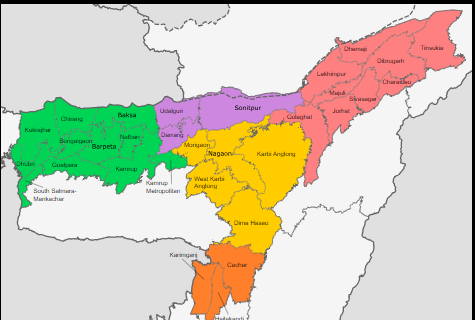
7. Identify the location of newly announced districts by looking at the map of Assam.
Ans: