
Class 8 Science Chapter 8 – Chemical Effects of Electric Current – All Textual Solutions | ASSEB Assam (English Medium)
Class 8 Science Chapter 8 – Chemical Effects of Electric Current Complete Textual Questions and Answers (ASSEB / SEBA Assam – English Medium)
Chapter 8 of the Class 8 Science curriculum, ‘Chemical Effects of Electric Current’, is an excellent chapter that links the principles of electricity with chemical reactions. These complete textual question-answer solutions (Class 8 Science Chapter 8 Textual Solutions) have been meticulously prepared based on the latest guidelines of the new ASSEB (Assam State School Education Board) syllabus and the National Education Policy (NEP). This comprehensive compilation includes textbook-based Very Short Answers (VSA), Short Questions, Long Answers, detailed explanations, and key scientific definitions. Ospin Academy provides these solutions in a simple, accurate, and completely exam-oriented format.
The chapter ‘Chemical Effects of Electric Current’ provides an in-depth understanding of how electrical energy passes through various liquids. It explores good and poor conductors of electricity (such as tap water vs. distilled water), the use of LEDs and magnetic testers to detect weak currents, and the chemical changes that occur when a current passes through a conducting solution (electrodes, gas bubbles, and metal deposits). A major highlight of the chapter is the process of electroplating and its widespread industrial applications, such as chromium plating on car parts and rust prevention. It is essential for students to thoroughly grasp these core concepts. Our textual solutions not only cover all the standard textbook exercises but also include important additional exam-oriented questions to ensure robust preparation.
What you will learn and get from these textual solutions:
- Clear explanations of electrical conductivity in liquids, distinguishing between conducting solutions (acids, bases, salts) and non-conductors.
- Accurate, point-wise answers for 1-mark objective questions (VSA) and 2-3 mark short textual questions.
- Standard and easy-to-understand explanations for descriptive questions, such as the step-by-step process of electroplating copper onto an electrode.
- Complete coverage of end-of-chapter exercises, fill-in-the-blanks, give-reason questions, and practical applications of chemical effects.
- Extra important questions aligned with the new syllabus structure alongside standard MCQ solutions.
Exclusive features of Ospin Academy’s solutions:
- Fully textbook-based answers formulated strictly according to the latest ASSEB new syllabus guidelines.
- 100% accurate, high-quality notes written in simple English language for effortless memorization and understanding.
- Concise summaries and targeted answers specifically designed for quick revision before examinations.
- A curated selection of highly probable extra questions to give students a competitive edge.
Committed to the academic excellence of students, Ospin Academy offers these high-quality textual solutions. Start your preparation today to master the concepts of Science and achieve top scores in your upcoming examinations.

Class 8 Science (English Medium) PDF Solutions 2026-27 | SCERT Assam
Get the Class 8 Science (English Medium) PDF with detailed solutions, MCQs, and extra practice questions for SCERT Assam 2025-26.
Class 8 Science
Chapter – 8 Ospin Academy
Chemical Effects Of Electric Current
TEXTBOOK EXERCISES
Q. 1. Fill in the blanks:
(a) Most liquids that conduct electricity are solutions of _________ and __________.
Ans. acids and bases.
(b) The passage of an electric current through a solution causes ________ effect.
Ans. chemical.
(c) If you pass current through copper sulphate solution, copper gets deposited on the plate connected to the_____ terminal of the battery.
Ans. negative.
(d) The process of depositing a layer of any desired metal on another metallic object, by means of electricity, is called.
Ans. electroplating.
Q. 2. When the free ends of a tester are dipped into a solution, the magnetic needle shows deflection. Can you explain the reason?
Ans. The deflection of magnetic needle shows that the solution is a good conductor.
Q. 3. Name three liquids, which when tested in the manner shown in figure 14.11 may cause the magnetic needle to direct.

Ans. (i) Vinegar.
(ii) Lemon juice.
(iii) Common salt solution.
Q. 4. The bulb does not glow in the setup shown in figure 14.12. List the possible reasons. Explain your answer.
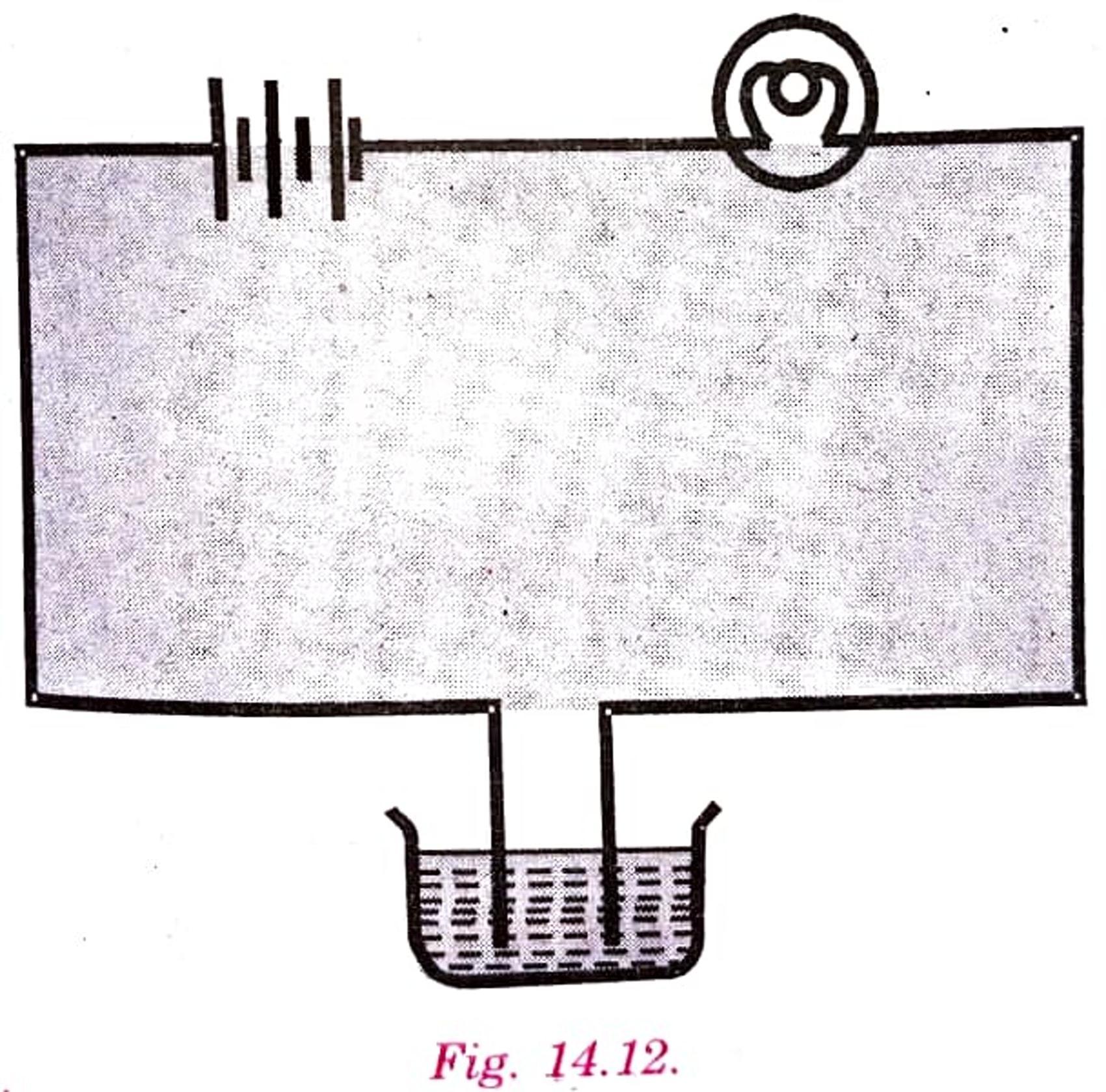
Ans. It is possible that:
(i) The connections of wires in the circuit may be loose.
(ii) The bulb may be fused.
(iii) The battery may be dead (all used up)
(iv) The liquid may be a poor conductor (non-conductor) of electricity.
Q. 5. A tester is used to check the conduction of electricity through two liquids, labeled A and B. It is found that the bulb of the tester glows brightly for liquid A while it glows very dimly for liquid B. You would conclude that:
(i) liquid A is a better conductor than liquid B.
(ii) liquid B is a better conductor than liquid A.
(iii) both liquids are equally conducting.
(iv) conducting properties of liquid cannot be compared in this manner.
Ans. (i) liquid A is a better conductor than liquid B.
Q. 6. Does pure water conduct electricity? If not, what can we do to make it conducting?
Ans. Some salt can be added to it to make it a conductor.
Q. 7. In case of fire, before the firemen use the water hoses, they shut off the main electrical supply for the area. Explain why they do this.
Ans. Water is a good conductor of electric current. So, the firemen shut off the electric supply before spraying water to save themselves and other people from electrocution.
Q. 8. A child staying in the coastal region tests the drinking water and also the seawater with his tester. He finds that the compass needle deflects more in the case of seawater. Can you explain the reason?
Ans. Sea water contains a large amount of dissolved salts in it. Due to the presence of a large amount of dissolved salt in it, sea water is a much better conductor of electricity than drinking water which contains only a small amount of dissolved salts in it. The greater electric current passing through sea water produces stronger magnetic field in wire and hence deflects the compass needle more.
Q. 9. Is it safe for the electrician to carry out electrical repairs outdoors during heavy downpour? Explain.
Ans. No, it is highly dangerous to carry on electric repairs in water, as water is a good conductor of electricity. It can cause electrocution.
Q. 10. Paheli had heard that rainwater is as good as distilled water. So she collected some rainwater in a clean glass tumbler and tested it using a tester. To her surprise she found that the compass needle showed deflection. What could be the reasons?
Ans. While it rains, the raindrops get mixed with the suspended particles of the air. So, they do not remain pure. It becomes the mixture of salts and other impurities thus shows conduction of electricity.
Q. 11. Prepare a list of objects around you that are electroplated.
Ans. Following objects around us are electroplated, rims of cycles, doorhandles, taps, showers, metallic pens, artificial jewellery, utensils, metallic almirahs, buckles of clothes and belts etc.
Q. 12. The process that you saw in Activity 14.7 is used for purification of copper. A thin plate of pure copper and a thick rod of impure copper are used as electrodes. Copper from impure rod is sought to be transferred to the thin copper plate. Which electrode should be attached to the positive terminal of the battery and why?
Ans. Thick rod of impure copper is to be attached to positive terminal of battery as pure copper moves to electrode connected to negative terminal of the battery.
