
Class 8 Science Chapter 1 – Crop Production and Management – All Textual Solutions | ASSEB Assam (English Medium)
Class 8 Science Chapter 1 – Crop Production and Management Complete Textual Questions and Answers (ASSEB / SEBA Assam – English Medium)
Chapter 1 of the Class 8 Science curriculum, ‘Crop Production and Management’, is a highly fundamental chapter for students. These complete textual question-answer solutions (Class 8 Science Chapter 1 Textual Solutions) have been meticulously prepared based on the latest guidelines of the new ASSEB (Assam State School Education Board) syllabus and the National Education Policy (NEP). This comprehensive compilation includes textbook-based Very Short Answers (VSA), Short Questions, Long Answers, explanations, and key definitions. Ospin Academy provides these solutions in a simple, accurate, and completely exam-oriented format.
The chapter ‘Crop Production and Management’ provides an in-depth understanding of agricultural practices, including preparation of soil, sowing, adding manure and fertilizers, irrigation, protection from weeds, harvesting, and storage. It is essential for students to thoroughly grasp the core concepts, terminology, and practical applications outlined in this lesson. Our textual solutions not only cover all the standard textbook exercises but also include important additional exam-oriented questions to ensure robust preparation.
What you will learn and get from these textual solutions:
- Clear explanations of basic agricultural practices, Kharif and Rabi crops, and essential tools used in farming.
- Accurate, point-wise answers for 1-mark objective questions (VSA) and 2-3 mark short textual questions.
- Standard and easy-to-understand explanations for 4-5 mark long descriptive questions, such as the differences between manures and fertilizers, and modern methods of irrigation.
- Complete coverage of end-of-chapter exercises, fill-in-the-blanks, matching questions, and definitions.
- Extra important questions aligned with the new syllabus structure alongside standard MCQ solutions.
Exclusive features of Ospin Academy’s solutions:
- Fully textbook-based answers formulated strictly according to the latest ASSEB new syllabus guidelines.
- 100% accurate, high-quality notes written in simple English language for effortless memorization and understanding.
- Concise summaries and targeted answers specifically designed for quick revision before examinations.
- A curated selection of highly probable extra questions to give students a competitive edge.
Committed to the academic excellence of students, Ospin Academy offers these high-quality textual solutions. Start your preparation today to master the concepts of Science and achieve top scores in your upcoming examinations.

Class 8 Science (English Medium) PDF Solutions 2026-27 | SCERT Assam
Get the Class 8 Science (English Medium) PDF with detailed solutions, MCQs, and extra practice questions for SCERT Assam 2025-26.
Class 8 Science
Chapter – 1 Ospin Academy
Crop Production and Management
TEXTBOOK EXERCISES
Q. 1. Select the correct word from the following list and fill in the blanks:
Float, water, crop nutrients, preparation.
(a) The same kind of plants grown and cultivated on a large scale at a place is called ___________.
Ans: Crop.
(b) The first step before growing crops is _________of the soil.
Ans: Prepartion.
(c) Damaged seeds would _________ on top of the water.
Ans: Float.
(d) For growing of crop, sufficient sunlight and _________ and _________ from the soil are essential.
Ans: Water, nutrients.
Q. 2. Match items in column A with those in column B:
|
(A) |
(B) |
|---|---|
|
(i) Kharif crops |
(a) Food for cattle |
|
(ii) Rabi crops |
(b) Urea and super phosphate |
|
(iii) Chemical fertilizers |
(c) Animal excreta, cow dung,urine and plant waste |
|
(iv) Organic manure |
(d) Wheat, gram, pea |
|
(e) Paddy and maize |
Ans.
|
(A) |
(B) |
|---|---|
|
(i) Kharif crops |
(e) Paddy and maize |
|
(ii) Rabi crops |
(d) Wheat, gram, pea |
|
(iii) Chemical fertilizers |
(b) Urea and super phosphate |
|
(iv) Organic manure |
(c) Animal excreta, cow dung,urine and plant waste |
Q. 3. Give two examples of each:
(a) Kharif Crop.
Ans: Paddy and maize.
(a) Rabi Crop.
Ans: Wheat and gram.
Q. 4. Write a paragraph in your own words on each of the following:
(a) Preparation of soil.
Ans: Preparation of soil: It involves three steps.
(i) Ploughing (Tilling): The ploughing of the soil is done using various types of ploughs made of wood or iron. These ploughs are either bullock drawn or tractor driven, They turn the soil upside down. These days ploughing is done by cultivator.
(ii) Crumb Crushing: While ploughing a field, l big pieces of soil called crumbs are formed. Wooden planks are used to crush these crumbs.
(iii) Levelling: Woden or iron levellers are used to do levelling of the soil after crushing the crumbs.
(b) Sowing.
Ans: Sowing: Sowing can be done in the following two ways:
(i) broadcasting. and
(ii) using a seed drill.
(i) Broad-Casting: In this method, seeds are scattered by hand. This method does not ensure a uniform distribution of seeds and requires a lot of time and manual labour.
(ii) Seed drill: Seed drill is a tool used for sowing seeds. The traditional seed drill has a funnel-shaped opening through which the seeds are inserted into the drill. The seeds pass through two to three pipes and are sown in rows. These days, seed drills are driven by tractors. Seed drills ensure that seeds get distributed uniformly and save both time and labour.
(c) Weeding.
Ans: Weeding: The process of removing weeds is called weeding. It may be done in the following two ways:
Manual Weeding: Manual weeding is the removal of weeds by uprooting them manually or cutting them close to the ground with a khurpi or trowel. This is done during tilling of the land.
Using Weedicides: Weedicides are chemicals used to kill weeds. The chemicals are diluted with water and sprayed over the fields, 2, 4-D and metolachlor are examples of weedicides.
(d) Threshing.
Ans: Threshing: It is the process of removal of the edible parts of grain from the scaly, inedible chaff that surrounds it.
One method of threshing is by beating the grain on the threshing floor. Another traditional method of threshing is to make bullocks or buffaloes walk in circle on the grain on a hard surface. However, in developed areas, it is now mostly done by a combine harvester.
Q. 5. Explain how fertilizers are different from manure.
Ans.
|
Manure |
Fertilizer |
|---|---|
|
1. A manure is a natural substance obtained by the decomposition of animal wastes like cow dung, human waste and plant residues. |
1. A fertilizer is a salt or an organic compound. |
|
2. A manure is not very rich in essential plant nutrients like plant nutrients like nitrogen, phosphorus and potassium. |
2. Fertilizers are very rich in plant nutrients like nitrogen, phosphorus and potassium. |
|
3. A manure provides a lot of organic matter like humus to the soil. |
3. A fertilizer does not provide any humus to the soil. |
|
4. A manure is absorbed slowly by the plants because it is not much soluble in water. |
4. Being soluble in water, a fertilizer is readily absorbed by the plants. |
Q. 6. What is irrigation? Describe two methods of irrigation which conserve water.
Ans. Irrigation: The process of supplying water to crop-plants in the fields is called irrigation.
Methods of irrigation which conserve water:
(i) Sprinkler System: In this method, a net work of pipes is attached to main line. Each pipe has a rotating sprinkler nozzle attached. Water pumped through the main pipeline escapes these nozzles at high speed and under high pressure and is sprayed all over the crops. It prevents wastage of water, especially if the soil is sandy.
(ii) Drip System: In this method, water falls drop by drop near the roots of the plants. This method is used in areas where water is scarce. It is one of the best techniques for watering fruit plants, gardens and trees without wasting water.
Q. 7. If wheat is sown in the Kharif season, what would happen? Discuss.
Ans. Wheat crop does not require much water to grow, so wheat would not grow in kharif season. The seeds would get destroyed in excess water due to the rainy season.
Q. 8. Explain how soil gets affected by the continuous plantation of crops in a field.
Ans. If we sow continuously in a field, then the lacking of nutrients takes place in the soil. The field becomes infertile. It does not give any time to soil to replenish the nutrients. Thus the soil is unable to sustain any further healthy and good crop.
Q. 9. What are weeds? How can we control them?
Ans. The unwanted plants or wild plants which grow along with a cultivated crop are called weeds.
The various methods of controlling weeds are as follows:
(i) Removal of weeds by pulling them out with hand: Weeds can be removed from the crop fields just by pulling them up with hands. When we pull the weeds, they get uprooted from the field. These uprooted weeds can then be thrown away.
(ii) Removal of weeds by using a Trowel (Khurpa): Weeds can be removed by digging or cutting them close to the ground from time to time with the help of trowel (or khurpa).
(iii) Using Weedicides: Weedicides are chemicals used to kill weeds. The chemicals are diluted with water and sprayed over the the fields. 2, 4-D and metalachlor are examples of weedicides.
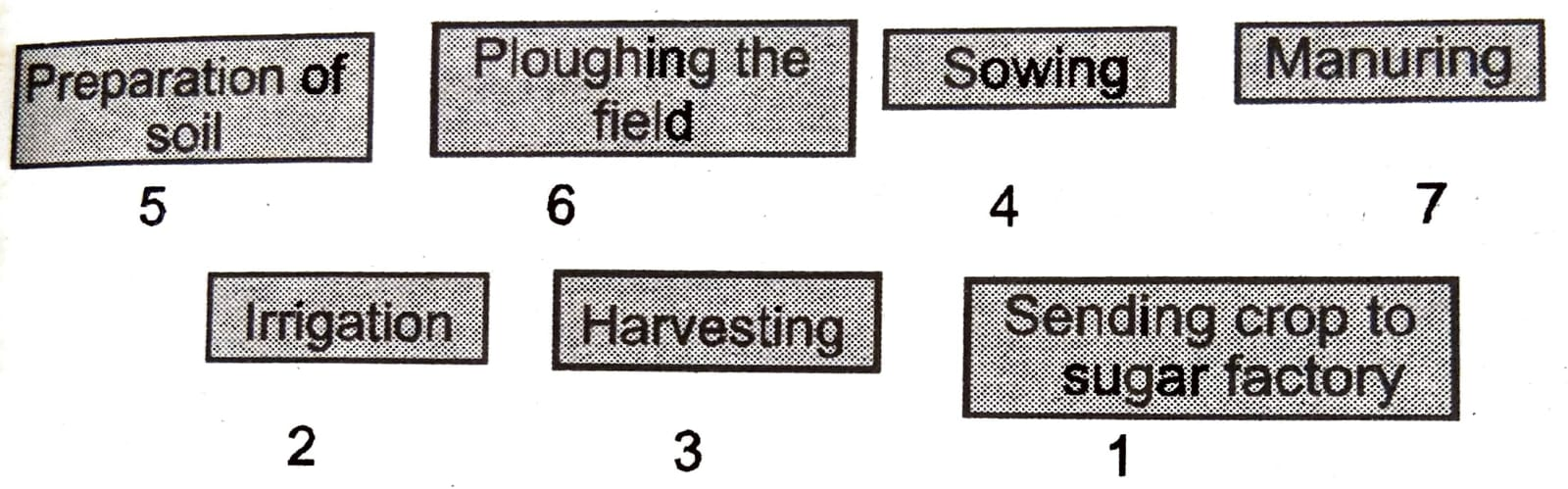
Q. 10. Arrange the following boxes in proper order to make a flow chart of sugarcane crop production:

Ans.

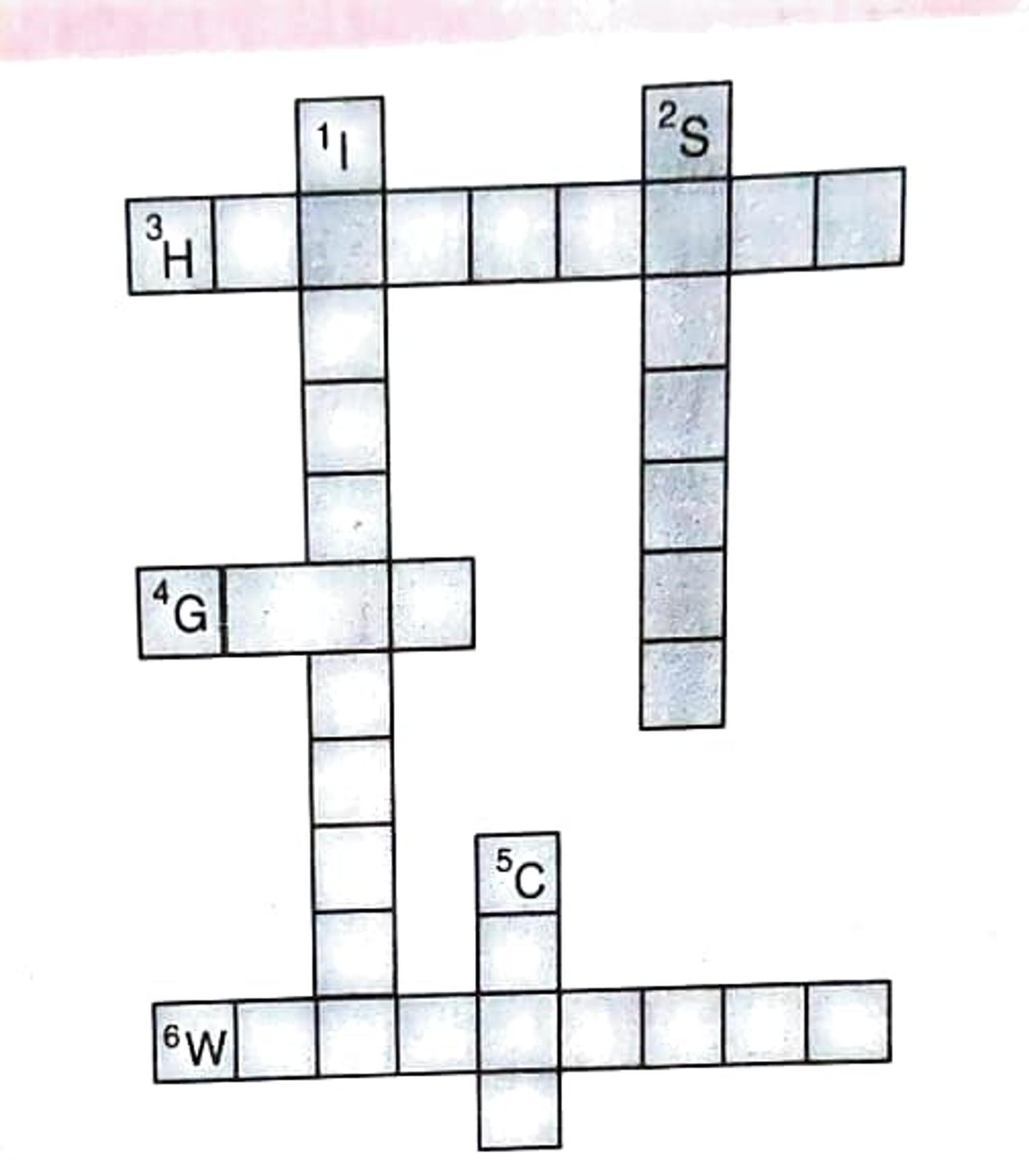
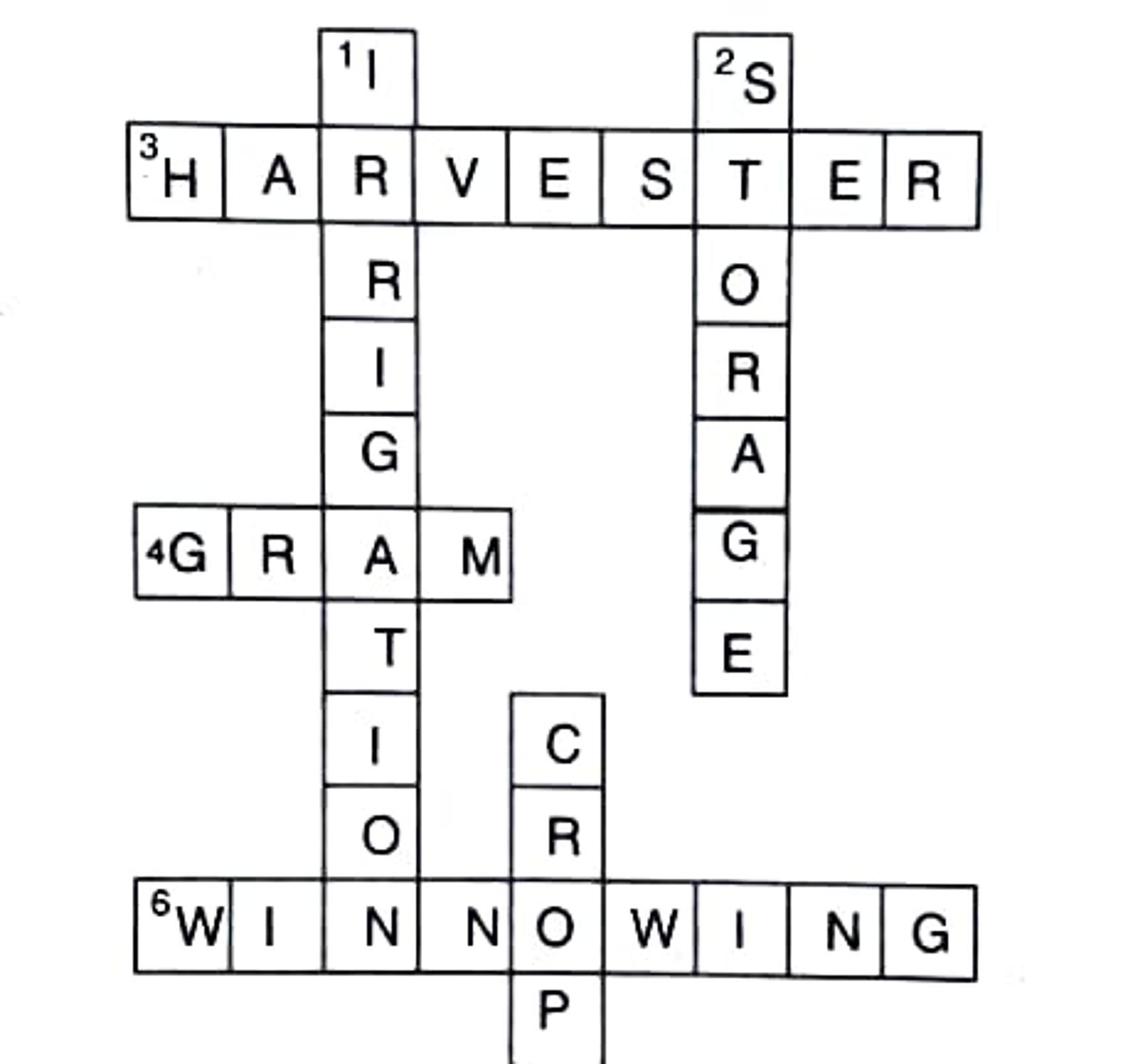
Q. 11. Complete the following word puzzle with the help of clues given below:
Down:
1. Providing water to the crops.
2. Crops grains have to be kept for a long time in proper conditions.
5. Certain plants of the same kind grown on a large scale.
Across:
3. A machine used for cutting the matured crops.
4. A rabi crop that is also one of the pulses.
6. A process of separating the grain from chaff.
Ans.
Class 8 Science Chapter 1 – Crop Production and Management FAQs
Get Free NCERT PDFs
If you want to download free PDFs of any chapter, click the link below and join our WhatsApp group:
Class 8 Science
Chapter – 1 Ospin Academy
Crop Production and Management
TEXTBOOK EXERCISES
Q. 1. Select the correct word from the following list and fill in the blanks:
Float, water, crop nutrients, preparation.
(a) The same kind of plants grown and cultivated on a large scale at a place is called ___________.
Ans: Crop.
(b) The first step before growing crops is _________of the soil.
Ans: Prepartion.
(c) Damaged seeds would _________ on top of the water.
Ans: Float.
(d) For growing of crop, sufficient sunlight and _________ and _________ from the soil are essential.
Ans: Water, nutrients.
Q. 2. Match items in column A with those in column B:
|
(A) |
(B) |
|---|---|
|
(i) Kharif crops |
(a) Food for cattle |
|
(ii) Rabi crops |
(b) Urea and super phosphate |
|
(iii) Chemical fertilizers |
(c) Animal excreta, cow dung,urine and plant waste |
|
(iv) Organic manure |
(d) Wheat, gram, pea |
|
(e) Paddy and maize |
Ans.
|
(A) |
(B) |
|---|---|
|
(i) Kharif crops |
(e) Paddy and maize |
|
(ii) Rabi crops |
(d) Wheat, gram, pea |
|
(iii) Chemical fertilizers |
(b) Urea and super phosphate |
|
(iv) Organic manure |
(c) Animal excreta, cow dung,urine and plant waste |
Q. 3. Give two examples of each:
(a) Kharif Crop.
Ans: Paddy and maize.
(a) Rabi Crop.
Ans: Wheat and gram.
Q. 4. Write a paragraph in your own words on each of the following:
(a) Preparation of soil.
Ans: Preparation of soil: It involves three steps.
(i) Ploughing (Tilling): The ploughing of the soil is done using various types of ploughs made of wood or iron. These ploughs are either bullock drawn or tractor driven, They turn the soil upside down. These days ploughing is done by cultivator.
(ii) Crumb Crushing: While ploughing a field, l big pieces of soil called crumbs are formed. Wooden planks are used to crush these crumbs.
(iii) Levelling: Woden or iron levellers are used to do levelling of the soil after crushing the crumbs.
(b) Sowing.
Ans: Sowing: Sowing can be done in the following two ways:
(i) broadcasting. and
(ii) using a seed drill.
(i) Broad-Casting: In this method, seeds are scattered by hand. This method does not ensure a uniform distribution of seeds and requires a lot of time and manual labour.
(ii) Seed drill: Seed drill is a tool used for sowing seeds. The traditional seed drill has a funnel-shaped opening through which the seeds are inserted into the drill. The seeds pass through two to three pipes and are sown in rows. These days, seed drills are driven by tractors. Seed drills ensure that seeds get distributed uniformly and save both time and labour.
(c) Weeding.
Ans: Weeding: The process of removing weeds is called weeding. It may be done in the following two ways:
Manual Weeding: Manual weeding is the removal of weeds by uprooting them manually or cutting them close to the ground with a khurpi or trowel. This is done during tilling of the land.
Using Weedicides: Weedicides are chemicals used to kill weeds. The chemicals are diluted with water and sprayed over the fields, 2, 4-D and metolachlor are examples of weedicides.
(d) Threshing.
Ans: Threshing: It is the process of removal of the edible parts of grain from the scaly, inedible chaff that surrounds it.
One method of threshing is by beating the grain on the threshing floor. Another traditional method of threshing is to make bullocks or buffaloes walk in circle on the grain on a hard surface. However, in developed areas, it is now mostly done by a combine harvester.
Q. 5. Explain how fertilizers are different from manure.
Ans.
|
Manure |
Fertilizer |
|---|---|
|
1. A manure is a natural substance obtained by the decomposition of animal wastes like cow dung, human waste and plant residues. |
1. A fertilizer is a salt or an organic compound. |
|
2. A manure is not very rich in essential plant nutrients like plant nutrients like nitrogen, phosphorus and potassium. |
2. Fertilizers are very rich in plant nutrients like nitrogen, phosphorus and potassium. |
|
3. A manure provides a lot of organic matter like humus to the soil. |
3. A fertilizer does not provide any humus to the soil. |
|
4. A manure is absorbed slowly by the plants because it is not much soluble in water. |
4. Being soluble in water, a fertilizer is readily absorbed by the plants. |
Q. 6. What is irrigation? Describe two methods of irrigation which conserve water.
Ans. Irrigation: The process of supplying water to crop-plants in the fields is called irrigation.
Methods of irrigation which conserve water:
(i) Sprinkler System: In this method, a net work of pipes is attached to main line. Each pipe has a rotating sprinkler nozzle attached. Water pumped through the main pipeline escapes these nozzles at high speed and under high pressure and is sprayed all over the crops. It prevents wastage of water, especially if the soil is sandy.
(ii) Drip System: In this method, water falls drop by drop near the roots of the plants. This method is used in areas where water is scarce. It is one of the best techniques for watering fruit plants, gardens and trees without wasting water.
Q. 7. If wheat is sown in the Kharif season, what would happen? Discuss.
Ans. Wheat crop does not require much water to grow, so wheat would not grow in kharif season. The seeds would get destroyed in excess water due to the rainy season.
Q. 8. Explain how soil gets affected by the continuous plantation of crops in a field.
Ans. If we sow continuously in a field, then the lacking of nutrients takes place in the soil. The field becomes infertile. It does not give any time to soil to replenish the nutrients. Thus the soil is unable to sustain any further healthy and good crop.
Q. 9. What are weeds? How can we control them?
Ans. The unwanted plants or wild plants which grow along with a cultivated crop are called weeds.
The various methods of controlling weeds are as follows:
(i) Removal of weeds by pulling them out with hand: Weeds can be removed from the crop fields just by pulling them up with hands. When we pull the weeds, they get uprooted from the field. These uprooted weeds can then be thrown away.
(ii) Removal of weeds by using a Trowel (Khurpa): Weeds can be removed by digging or cutting them close to the ground from time to time with the help of trowel (or khurpa).
(iii) Using Weedicides: Weedicides are chemicals used to kill weeds. The chemicals are diluted with water and sprayed over the the fields. 2, 4-D and metalachlor are examples of weedicides.
Q. 10. Arrange the following boxes in proper order to make a flow chart of sugarcane crop production:

Ans.
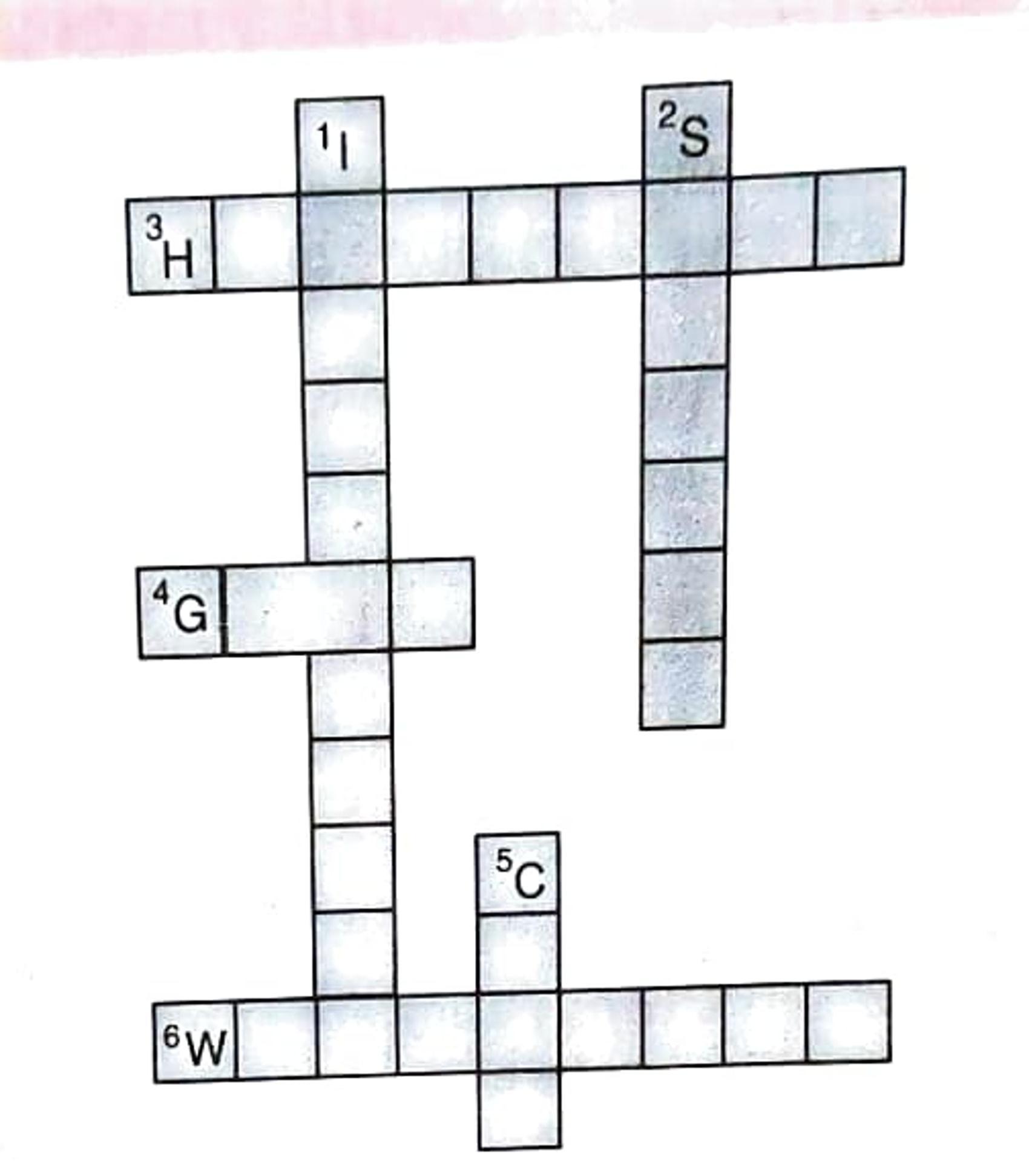
Q. 11. Complete the following word puzzle with the help of clues given below:
Down:
1. Providing water to the crops.
2. Crops grains have to be kept for a long time in proper conditions.
5. Certain plants of the same kind grown on a large scale.
Across:
3. A machine used for cutting the matured crops.
4. A rabi crop that is also one of the pulses.
6. A process of separating the grain from chaff.
Ans.

