Class 7 Science Chapter 2 Electricity Electrical Circuit and Their Components Solutions | ASSEB Assam | English Medium
Class 7 Science (Amar Bijan) Chapter 2 – Electricity Electrical Circuit and Their Components Complete Textual Question Answers and Solutions (ASSEB Assam – English Medium)
The second chapter of the Class 7 Science (English Medium) syllabus, ‘Electricity Electrical Circuit and Their Components,’ is a fascinating and highly scoring topic for students. Based on the new ASSEB (Assam State School Education Board) guidelines and the latest National Education Policy (NEP) framework according to the current syllabus, we have prepared comprehensive textual question answers for this chapter. This special guide includes very short answers (VSA), short questions, long descriptive answers, multiple-choice questions (MCQs), and additional questions. Brought to you by Ospin Academy, these solutions are accurate, easy to understand, and highly exam-oriented.
In ‘Electricity Electrical Circuit and Their Components’, students delve into the practical applications of electricity, including the standard symbols used for electrical components, the heating effect of electric current (like in fuses and heaters), and the magnetic effect of electric current (electromagnets). Understanding how to draw and interpret circuit diagrams is crucial for exam preparation. Our textual solutions not only cover the textbook exercises but also provide extra important questions and MCQs to ensure students have a thorough grasp of the topic.
What you will learn and get from these textual solutions:
- Clear explanations of electrical components and their standard symbols.
- 1-mark objective questions (VSA), MCQs, and detailed 2-3 mark short questions tailored for exams.
- Step-by-step explanations for 4-5 mark long questions, including the working of electric bells and electromagnets.
- A wide range of additional questions and MCQs specifically designed according to the new syllabus pattern.
- Comprehensive insights into the heating and magnetic effects of electric current, explained in simple English.
Special Features of Ospin Academy’s Notes:
- Prepared strictly according to the new ASSEB syllabus and current educational guidelines.
- 100% accurate and written in simple, easy-to-memorize English (Class 7 Science Notes).
- Includes quick revision notes and simplified circuit diagrams, highly beneficial for last-minute exam preparation.
- Exclusive compilation of extra important questions and MCQs to maximize your scores.
Aiming for academic excellence, Ospin Academy provides these comprehensive textual solutions to aid students in their studies. Start your preparation today and secure the highest marks in Class 7 Science.

Class 7 Science (English Medium) PDF Solutions 2026-27 | SEBA Assam
Get Class 7 Science Solutions (SEBA Assam) in a PDF format, covering Part I & II with chapter-wise answers, MCQs, and explanations. Perfect for exam preparation and concept clarity.
Out of stock
SCERT Assam, Class 7: Science
Electricity Electrical Circuit and Their Components
1. Darken the circle of correct answer.
(i) Which one of the following will allow electric current to pass through it?
(a) Matchstick
(b) Plastic comb
(c) Eraser
(d) Iron nail
Answer: (d)
(ii) What is the name of the device that is used to either break or complete an electric circuit?
(a) Conductor
(b) Switch
(c) Current
(d) Terminal
Answer: (b)
(iii) Which of the following is an insulator?
(a) Copper
(b) Mercury
(c) Glass
(d) Gold
Answer: (c)
(iv) Which metal is used to make the filament of the bulb?
(a) Lead
(b) Gold
(c) Copper
(d) Tungsten
Answer: (d)
(v) What is the name of the circuit when the switch in an electric circuit is in the ‘OFF’ position?
(a) Closed circuit
(b) Short circuit
(c) Open circuit
(d) None of these
Answer: (c)
(vi) What is the name of the circuit when the switch in an electric circuit is in the ‘On’ position?
(a) Short circuit
(b) Closed circuit
(c) Open circuit
(d) None of these
Answer: (b)
2. Fill in the blanks
(i) The combination of two or more cells is called a ________.
Answer: battery
(ii) Our body is a ________ of electricity.
Answer: conductor
(iii) An electric cell has ________ terminals.
Answer: two
(iv) Electricity will only flow in an ________ circuit.
Answer: closed
(v) Materials that allow electricity to pass through them are called
Answer: conductors
(vi) Materials that do not allow electricity to pass through them are
called ________.
Answer: insulators
(vii) The thin wire that produces light after glowing in the centre of
the bulb is known as ________.
Answer: filament
(viii) Electric ________ is a path along which electricity flows.
Answer: circuit
(ix) A ________ is a device used to determine whether a substance is a
conductor or an insulator of electricity.
Answer: tester
3. State whether the following statements are true (T) or false (F).
(i) The metal cap in an electric cell is the positive terminal.
Answer: True
(ii) A circuit diagram uses standard symbols for electric components.
Answer: True
(iii) A group of battery is called a cell.
Answer: False
(iv) Insulators allow electric current to pass through them.
Answer: False
(v) An electric bulb has one terminal.
Answer: False
(vi) A circuit in which the path of electric current is broken is called an open circuit.
Answer: True
(vii) Plastic is a good conductor of electricity.
Answer: False
4. Match the following
|
Column-I |
Column-II |
|
(i) An electric cell |
(a) It is a simple device that either completes the circuit or breaks it. |
|
(ii) An electric switch |
(b) Device which converts chemical energy into electrical energy. |
|
(iii) Closed circuit |
(c) Thin wire in a light bulb that emits light. |
|
(iv) Filament |
(d) Circuit in which the path of electric current is complete or closed. |
Answer: (i) – (b), (ii) – (a), (iii) – (d), (iv) – (c)
5. In Fig. 2.21 (a & b) (চিত্ৰ 2.21 a আৰু b ত —) 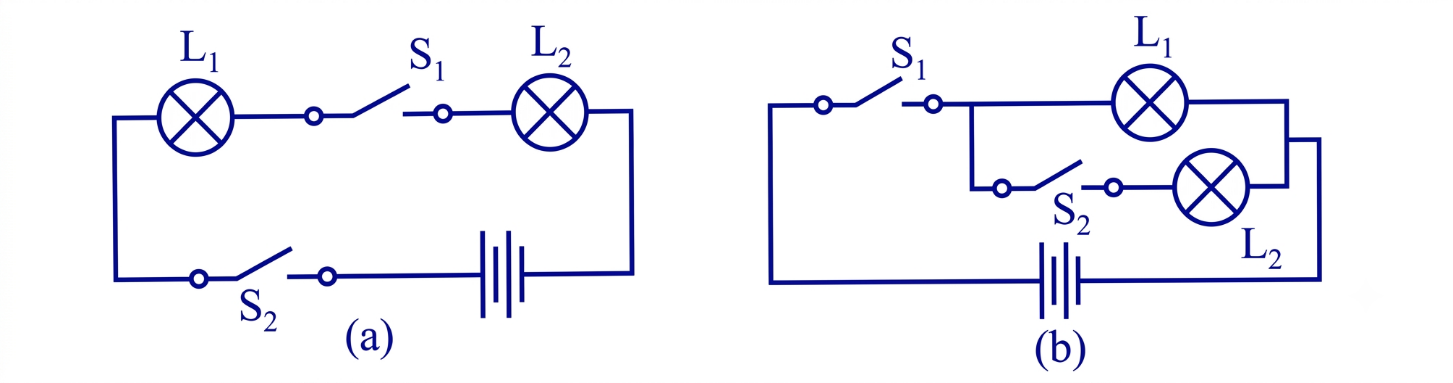
(i) If S1 is in ‘ON’ position, S2 is in ‘OFF’ position, which lamp(s) will glow?
(ii) If S1 is in ‘OFF’ position, S2 is in ‘ON’ position, which lamp(s) will glow?
(iii) If S1 and S2 both are in ‘ON’ position, which lamp(s) will glow?
(iv) If both S1 and S2 are in ‘OFF’ position, which lamp(s) will glow?
Answer:
(i) (a) Both bulbs will remain off.
(b) Only bulb L1 will light up.
(ii) (a) Neither of the bulbs will illuminate.
(b) Neither of the bulbs will illuminate.
(iii) (a) Both bulbs will light up.
(b) Both bulbs will light up.
(iv) (a) None of the bulbs will glow.
(b) None of the bulbs will glow.
6. Doithan has made the circuit as shown in Fig 2.22. Even after keeping the switch ‘ON’, the lamp does not glow. What can be the possible reasons for this faulty operation?
Answer: The potential causes for the circuit’s failure to operate could be:
(i) The filament of the electric bulb might be broken (fused).
(ii) There might be a loose connection among the wires in the circuit.
(iii) The energy of the batteries (cells) may have been completely depleted. 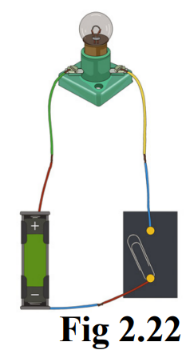
7. In Fig 2.23, in which case(s) the lamp will not glow when the switch
is closed? 
Answer: (c)
8. Suggest a method to identify the two terminals of a battery if ‘+’
and ‘-‘ symbols are not earmarked in this battery.
Answer: To identify the terminals, attach two distinct wires to each terminal of the unlabelled battery. Take an LED, which has known positive and negative legs. Connect the free end of one wire to the LED’s positive leg and the other wire to its negative leg. If the LED illuminates, the battery terminal linked to the LED’s positive leg is the positive terminal (+), and the remaining one is the negative terminal (-).
9. An LED requires two cells in series to glow. Chitralekha made
the circuit as shown in Fig 2.24. Will the lamp glow? If not, draw the circuit
for correct connections.
Answer: No, the lamp will not light up with this arrangement. 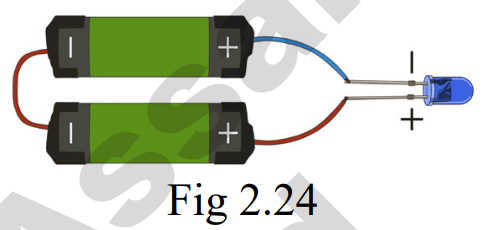
10. Find what is wrong in the given circuits. Draw simple labelled diagrams to show how each circuit can be corrected. 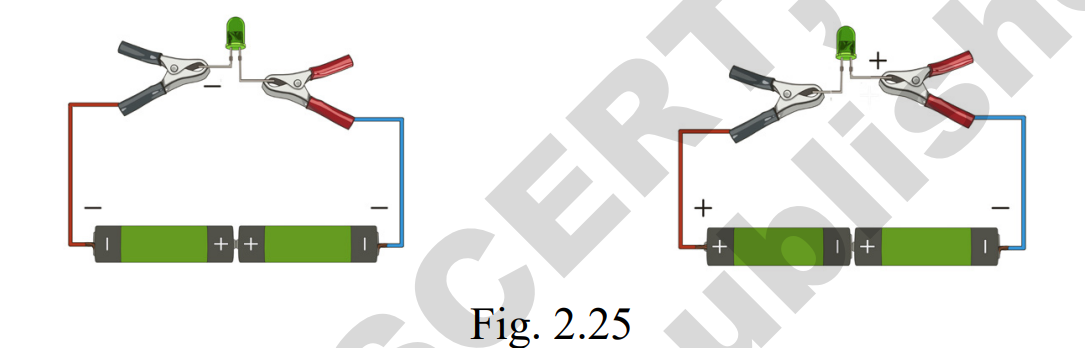
Answer:
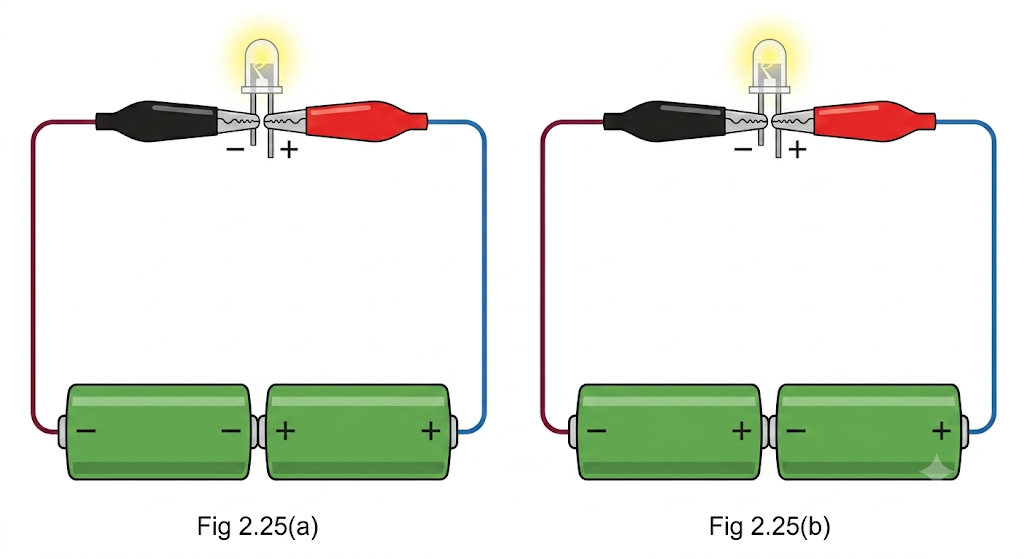
The error in the first circuit is the incorrect alignment of the cells; the positive terminals are joined together instead of connecting the positive of one to the negative of the other. In the second circuit, the wiring is reversed at the LED; the negative leg is erroneously connected as if it were the positive leg.
11. Why do electricians wear rubber gloves while repairing a switch in your home?
Answer: Electricians utilize rubber gloves during repairs because rubber acts as an excellent electrical insulator. This protective layer ensures that electric current from live wires cannot travel through their hands and into their bodies, thereby preventing dangerous electric shocks.
12. How is electricity dangerous even though it is useful? Have a
group discussion on this topic.
Answer: While electricity powers our modern world, it poses significant risks because the human body is an excellent conductor of electricity. If an individual accidentally touches an exposed live wire or a faulty appliance within a household circuit, the electrical current will pass directly through their body. This sudden surge of current can result in severe burns, internal injuries, cardiac arrest, or even instant electrocution and death.
Multiple Choice Questions (MCQs)
1. Which of the following components provides the source of electrical energy in a simple circuit?
(A) Switch
(B) Electric cell
(C) Bulb
(D) Wire।
Answer: (B)
2. What defines a closed circuit?
(A) A circuit where the switch is broken
(B) A circuit with no connecting wires
(C) A continuous path for the current to flow
(D) A circuit without a power source
Answer: (C)
3. The thin, glowing wire inside an electric bulb is called a:
(A) Terminal
(B) Conductor
(C) Filament
(D) Insulator
Answer: (C)
4. Which of these materials is a good conductor of electricity?
(A) Wood
(B) Rubber
(C) Aluminium
(D) Plastic
Answer: (C)
5. An electric switch primarily functions to:
(A) Generate electricity
(B) Consume electricity
(C) Either make or break the circuit
(D) Protect the bulb from breaking
Answer: (C)
6. What does an LED stand for?
(A) Light Energy Device
(B) Light Emitting Diode
(C) Low Energy Diode
(D) Long Electrical Device
Answer: (B)
7. In a standard battery connection, the positive terminal of one cell should be connected to the:
(A) Positive terminal of the next cell
(B) Negative terminal of the next cell
(C) Metal casing
(D) Ground wire
Answer: (B)
8. Which of the following is NOT an insulator?
(A) Glass
(B) Air
(C) Silver
(D) Paper
Answer: (C)
9. The metal cap on the top of a standard dry cell represents the:
(A) Positive terminal
(B) Negative terminal
(C) Neutral terminal
(D) Ground terminal
Answer: (A)
10. A tester is used by electricians to:
(A) Measure the length of a wire
(B) Check if current is flowing through a wire
(C) Cut thick rubber cables
(D) Clean the switchboard
Answer: (B)
11. If the filament of a bulb breaks, what happens to the circuit?
(A) It becomes a short circuit
(B) It remains a closed circuit
(C) It becomes an open circuit
(D) The battery explodes
Answer: (C)
12. What material is commonly used to insulate electrical wires?
(A) Copper
(B) Plastic
(C) Iron
(D) Silver
Answer: (B)
13. How many terminals does a standard electric bulb have?
(A) One
(B) Two
(C) Three
(D) Four
Answer: (B)
14. The human body is a:
(A) Poor conductor of electricity
(B) Good conductor of electricity
(C) Perfect insulator
(D) Source of electricity
Answer: (B)
15. An arrangement of two or more cells joined end-to-end is properly termed a:
(A) Generator
(B) Battery
(C) Transformer
(D) Resistor
Answer: (B)
16. Tungsten is chosen for bulb filaments because:
(A) It is very cheap
(B) It has a very low melting point
(C) It glows brightly and has a high melting point
(D) It is an insulator
Answer: (C)
17. When a switch is in the ‘ON’ position, the gap in the circuit is:
(A) Expanded
(B) Bridged or closed
(C) Disconnected
(D) Filled with air
Answer: (B)
18. Which of these is an essential safety requirement when handling live wires?
(A) Wearing rubber gloves
(B) Standing on a metal stool
(C) Using wet hands
(D) Wearing metallic rings
Answer: (A)
19. The flat metallic base of an electric cell is the:
(A) Positive terminal
(B) Negative terminal
(C) Central core
(D) Filament connection
Answer: (B)
20. Electrical wires are mostly made of copper because copper is:
(A) An excellent electrical insulator
(B) Lighter than aluminium
(C) A highly efficient conductor of electricity
(D) Magnetic
Answer: (C)
Long Questions with Answers
1. Explain the fundamental difference between an open circuit and a closed circuit.
Answer: A closed circuit is a complete, unbroken path that allows electrical current to flow continuously from the source, through the components, and back again, enabling a device like a bulb to function. Conversely, an open circuit has a break or gap in the connection—often caused by an ‘OFF’ switch or a broken wire—which stops the flow of current, preventing the bulb from glowing.
2. Describe the structure and function of an electric cell.
Answer: An electric cell is a small, portable power source that converts stored chemical energy into electrical energy. Structurally, a standard dry cell features a metal cap at the top representing the positive terminal, and a flat metallic base at the bottom serving as the negative terminal. When connected in a closed circuit, the chemicals inside react to push an electric current through the wires.
3. Why are electrical wires typically made of copper but covered with plastic?
Answer: Electrical wires use a copper core because copper is an excellent conductor with low resistance, allowing electricity to flow efficiently with minimal energy loss. They are encased in plastic because plastic is a strong insulator; it prevents the electric current from leaking out, protecting users from shocks and stopping short circuits when wires touch each other.
4. What role does a filament play in an electric bulb, and what happens if it breaks?
Answer: The filament is a very thin, coiled wire, typically made of tungsten, located inside the bulb. When electric current flows through it, the filament heats up tremendously and glows, producing light. If the delicate filament breaks or melts (fuses), the electrical path is broken, converting it into an open circuit, and the bulb ceases to produce light.
5. How can you test if a specific material is an electrical conductor or an insulator?
Answer: You can build a simple continuity tester using a cell, a small bulb, and some connecting wires, leaving a gap between two wire ends. By inserting the material in questions into the gap, you close the physical circuit. If the bulb lights up, the material allows current to pass and is a conductor; if it remains dark, the material is an insulator.
6. Explain the function of an electric switch in a household lighting circuit.
Answer: An electric switch acts as a controllable bridge within a circuit. When the switch is moved to the ‘ON’ position, it closes the gap in the wiring, allowing continuous current to reach the lightbulb and illuminate it. Moving it to the ‘OFF’ position breaks the connection, stopping the current flow and turning the light off safely without disconnecting any wires manually.
7. Why is it dangerous to operate electrical appliances with wet hands?
Answer: Pure water is an insulator, but tap water or moisture on our hands contains dissolved salts and impurities, making it an excellent electrical conductor. Operating switches or appliances with wet hands creates a highly conductive path for electricity to bypass the appliance’s plastic casing and flow directly into the human body, potentially causing a lethal electric shock.
8. In a flashlight, how must two or more cells be arranged to ensure it works correctly?
Answer: To ensure a flashlight operates, multiple cells must be arranged in a series configuration to form a battery. This means they must be placed end-to-end sequentially, with the positive terminal (the metal cap) of one cell firmly touching the negative terminal (the flat base) of the adjacent cell, ensuring a smooth, unidirectional flow of voltage.
9. What is a short circuit, and why is it considered hazardous?
Answer: A short circuit occurs when bare conductive wires (like positive and negative wires) touch each other directly, creating a path with virtually zero resistance. This causes a massive, uncontrolled surge of electrical current to flow instantly, which can rapidly overheat the wires, melt insulation, damage power sources, and potentially spark devastating electrical fires.
10. Discuss the importance of standard symbols in drawing electrical circuit diagrams.
Answer: Standard symbols are universally recognized graphic representations used in circuit diagrams instead of drawing realistic pictures of bulbs or batteries. They simplify the schematic, making it quick to draw, easy to read, and universally understandable for engineers and electricians worldwide, preventing misinterpretations during the design and repair of electrical systems.
11. Differentiate between conductors and insulators, providing two examples of each.
Answer: Conductors are materials with a molecular structure that allows negatively charged electrons to move freely, thus permitting the easy flow of electric current. Examples include copper and iron. Insulators have tightly bound electrons that resist movement, thereby blocking the flow of electricity. Examples include rubber and glass.
12. If a simple circuit containing a battery, switch, and LED is correctly wired but the LED doesn’t light up, list three possible causes.
Answer: If the wiring is correct but the LED fails to illuminate, three likely culprits exist: First, the batteries might be exhausted or completely discharged. Second, the LED itself could be blown or defective. Third, the connections at the terminals or switch might be too loose, preventing a solid electrical contact needed for current flow.
13. How does the position of the switch affect the continuous flow of current?
Answer: The position of the switch dictates the physical continuity of the conductive path. In the ‘ON’ position, metallic contacts within the switch touch, bridging the gap and allowing current to circulate unimpeded. In the ‘OFF’ position, the contacts are separated by an air gap; since air is an insulator, the current flow is immediately halted.
14. What precautions should be taken to prevent battery drain when an electronic device is not in use for an extended period?
Answer: To preserve battery life during long periods of non-use, it is highly recommended to physically remove the dry cells from the battery compartment of the device. Even when switched off, some devices can draw minute amounts of phantom current, and leaving cells inside can also lead to corrosive chemical leaks that might permanently damage the internal contacts.
15. Describe how a circuit diagram helps in troubleshooting electrical problems.
Answer: A circuit diagram acts as a logical map of the electrical system, displaying exactly how components like power sources, switches, and loads are interconnected using standard symbols. By tracing the theoretical path of current on the diagram, technicians can quickly isolate faulty sections, identify where breaks or shorts might have occurred, and safely implement repairs.