
Class 8 Science Chapter 15 – Some Natural Phenomena – All Textual Solutions | ASSEB Assam (English Medium)
Class 8 Science Chapter 15 – Some Natural Phenomena Complete Textual Questions and Answers (ASSEB / SEBA Assam – English Medium)
Chapter 15 of the Class 8 Science curriculum, ‘Some Natural Phenomena’, is a fascinating lesson that explains the science behind two powerful and destructive natural events: Lightning and Earthquakes. These complete textual question-answer solutions (Class 8 Science Chapter 15 Textual Solutions) have been meticulously prepared based on the latest guidelines of the new ASSEB (Assam State School Education Board) syllabus and the National Education Policy (NEP). Ospin Academy provides these solutions in a clear, accurate, and completely exam-oriented format.
The chapter ‘Some Natural Phenomena’ provides a scientific understanding of static electricity, charging by rubbing, and the transfer of charge. Students will learn about the gold-leaf electroscope, the process of lightning as an electric discharge between clouds and the earth, and the vital function of lightning conductors. Furthermore, the lesson delves into the causes of earthquakes, the Richter scale, and essential safety measures to take during these natural disasters. It is essential for students to thoroughly grasp these core concepts for both safety awareness and academic success. Our textual solutions cover all standard textbook exercises and include additional important questions to ensure robust preparation.
What you will learn and get from these textual solutions:
- Detailed explanations of charging by rubbing and the interaction between like and unlike charges.
- Accurate, point-wise answers for 1-mark objective questions (VSA) and 2-3 mark short textual questions regarding lightning safety.
- Standard and easy-to-understand explanations for descriptive questions, such as how a lightning conductor protects a building.
- Complete coverage of end-of-chapter exercises, fill-in-the-blanks, true/false questions, and definitions of seismic zones and fault zones.
- Safety precautions to be followed during an earthquake whether you are indoors or outdoors.
- Extra important questions aligned with the new syllabus structure alongside standard MCQ solutions.
Exclusive features of Ospin Academy’s solutions:
- Fully textbook-based answers formulated strictly according to the latest ASSEB new syllabus guidelines.
- 100% accurate, high-quality notes written in simple English language for effortless memorization.
- Concise summaries and targeted answers specifically designed for quick revision before examinations.
- Practical safety tips and scientific explanations to help students relate the chapter to real-life occurrences.
Committed to the academic excellence of students, Ospin Academy offers these high-quality textual solutions. Start your preparation today to master the concepts of Science and achieve top scores in your upcoming examinations.

Class 8 Science (English Medium) PDF Solutions 2026-27 | SCERT Assam
Get the Class 8 Science (English Medium) PDF with detailed solutions, MCQs, and extra practice questions for SCERT Assam 2025-26.
Class 8 Science
Chapter – 15 Ospin Academy
Some Natural Phenomena
TEXTBOOK EXERCISES
Select the correct option in Questions 1 and 2.
Q. 1. Which of the following cannot be charged easily by friction?
(a) A plastic scale.
(b) A copper rod.
(c) An inflated balloon.
(d) A woollen cloth.
Ans. (b) A copper rod.
Q. 2. When a glass rod is rubbed with a piece of silk cloth the rod:
(a) and the cloth both acquire positive charge.
(b) becomes positively charged while the cloth has a negative charge.
(c) and the cloth both acquire negative charge
(d) becomes negatively charged while the cloth has a positive charge.
Ans. (b) becomes positively charged while the cloth has a negative charge.
Q. 3. Write T against true and F against false in the following statements:
(a) Like charges attract each other. (T/F)
Ans. False.
(b) A charged glass rod attract a charged plastic straw. (T/F)
Ans. True.
(c) Lightning conductor cannot protect a building from lightning. (T/F)
Ans. False
(d) Earthquakes can be predicted in advance (T/F)
Ans. False.
Q. 4. Sometimes, a crackling sound is heard while taking off sweater during winters. Explain.
Ans. The electric discharge takes place between body and sweater. At the time of electric discharge some energy is released. In this case energy is released in the form of crackling sound.
Q. 5. Explain why a charged body loses its charge if we touch it with our hand.
Ans. Human body is a conductor of electricity. When a body is touched with hand, the electric current of body passes to the earth through the body and body loses its charge.
Q. 6. Name the scale on which the destructive energy of an earthquake is measured. An earthquake measures 3 on this scale. Would it be recorded by a seismograph? Is it likely to cause much damage?
Ans. Destructive energy of an earthquake is measured in Richter Scale. Yes, it will be recorded by a seismograph. Earthquake with magnitude of 3 on Richter Scale is not much destructive. Such earthquakes do not cause any damage.
Q. 7. Suggest three measures to protect ourselves from lightning.
Ans. Three measures to stay protected from lightning are:
(i) Stay indoor or under covered area.
(ii) Don’t take bath during lightning.
(iii) We should not use T.V. or phone during lightning.
Q. 8. Explain why a charged balloon is repelled by another charged balloon whereas an uncharged balloon is attracted by another charged balloon?
Ans. A charged balloon is repelled by another charged balloon because both the balloons contain same type of charges. We know that like charges repel each other. A balloon is charged while other is uncharged, so they have no same charge. Therefore charged balloon attracts uncharged balloon.
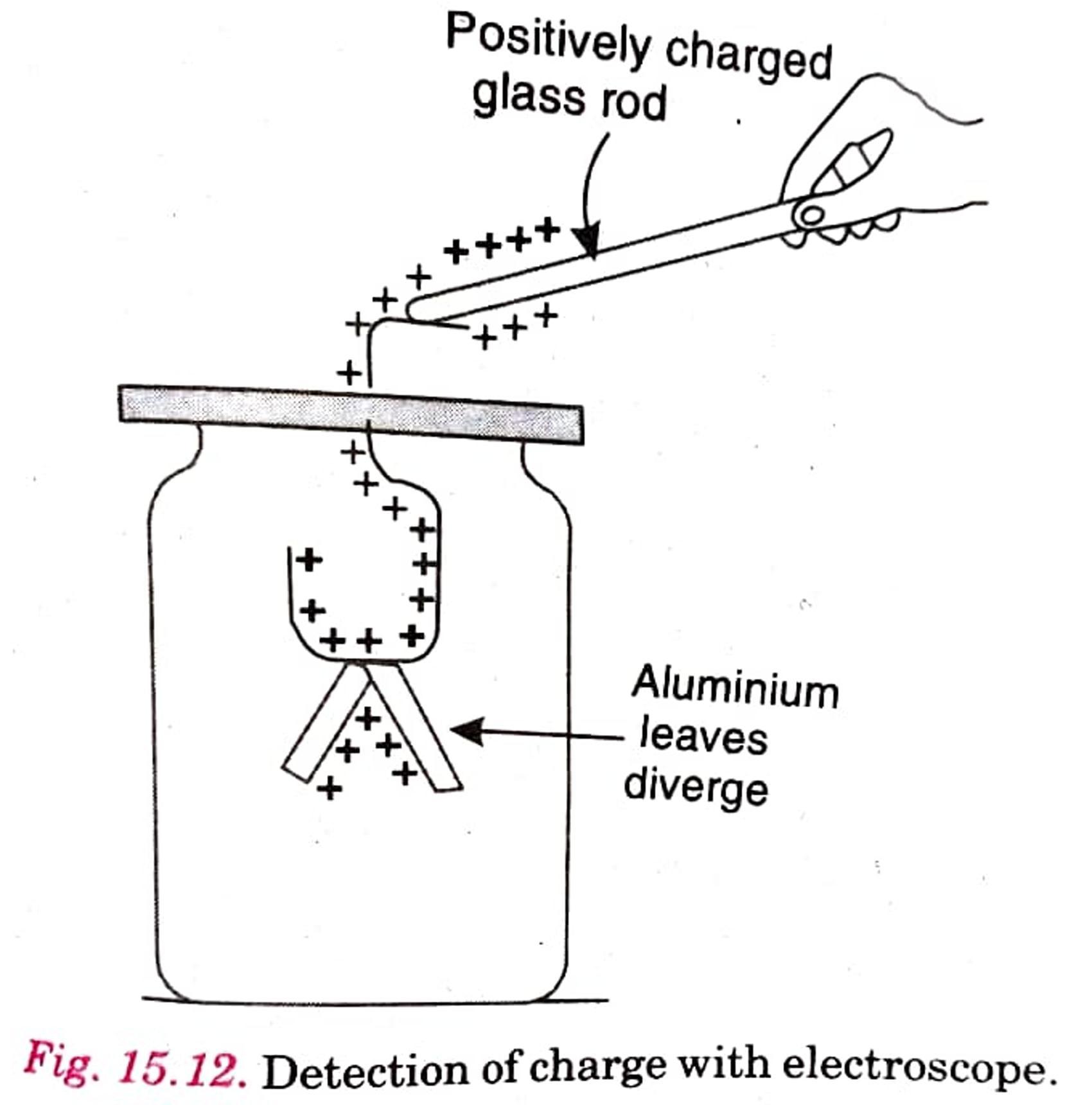
Q. 9. Describe with the help of a diagram an instrument which can be used to detect a charged body.
Ans. Electroscope is used to detect electric charges or kind of charge on a body. It works on the principle that like charges repel and while unlike charges attract each other.
Charge a glass rod by rubbing its one end with a piece of silk cloth. Touch the charged glass rod with the top end of metal strip. We will see that the two aluminium leaves move away from each other. The two aluminium leaves having similar charges (positive charges) repel each other due to which they
move apart.
Q. 10. List three states in India where earthquakes are more likely to strike.
Ans. (i) Kashmir.
(ii) Rajasthan.
(iii) Gujarat.
Q. 11. Suppose you are outside your home and an earthquake strikes. What precautions would you take to protect yourself?
Ans. (i) We should move to an open space.
(ii) We should not take shelter under trees or buildings.
(iii) If we are driving, we should slow down the vehicle and move slowly away that area to a clear spot
Q. 12. The weather department has predicted that a thunder storm is likely to occur on a certain day. Suppose you have to go out on that day. Would you carry an umbrella? Explain.
Ans. No, we will not take an umbrella at the time of thunder storm. The taking of umbrella will increase the risk of lightning. The metal objects are more prone to lightning strike.
