Amanda – Class 10 English Chapter 8 Complete Question Answers and Solutions | ASSEB / SEBA
Class 10 English Chapter 8 – Amanda (Poem) Complete Question Answers and Exam Solutions (ASSEB / SEBA Assam)
The eighth chapter of the Class 10 English ‘First Flight’ textbook, the poem ‘Amanda’ written by Robin Klein, is a highly important chapter. For the upcoming HSLC 2027 examination, the complete question answers for this poem have been prepared based on the new ASSEB (Assam State School Education Board) syllabus and the latest National Education Policy (NEP) blueprint. This special collection includes Very Short Answers (VSA / MCQ), Short Questions, Long Answers, and literary device analysis, along with a detailed solution of Previous Years’ Board Exam Questions (PYQ). At Ospin Academy, these solutions are provided in a simple, accurate, and completely exam-oriented manner.
This poem beautifully highlights child psychology, focusing on a young girl named Amanda who is constantly instructed, corrected, and nagged by her mother. To escape this constant restriction, Amanda drifts into her own imaginary world where she envisions herself as a free-roaming mermaid, a wandering orphan, and the solitary Rapunzel. It is essential for HSLC candidates to understand the core theme, the contrast between reality and imagination, and the significance of this poem. Our Question Bank covers not only the textbook exercises but also includes extra probable board questions and answers to ensure 100% preparation for the students.
What you will learn and get from this chapter:
- Detailed analysis of the poem’s theme, parental control, and Amanda’s yearning for freedom.
- Word meanings, perfect answers for 1-mark objective (VSA), and 2-3 marks short questions.
- Easy and standard solutions for descriptive questions explaining Amanda’s imaginary escapes (Mermaid, Orphan, Rapunzel).
- Identification and explanation of poetic devices and the use of parentheses.
- Pattern analysis of frequently asked board questions and solutions to the latest MCQ models.
Special Features by Ospin Academy for HSLC 2027 Exam:
- Complete Question Bank prepared based on the latest ASSEB blueprint for HSLC 2027.
- Detailed solutions for the Previous 10 Years’ Questions (PYQ) and 27 Districts Pre-Board Exam Papers (2026).
- 100% accurate, high-quality notes written in simple English for easy memorization.
- Specially designed PDF format for last-minute quick revision before the exams.
- A curated list of 100% common board suggestions and expected questions from this poem.
Ospin Academy offers this specialized course keeping in mind the academic growth of the students. Start your HSLC 2027 preparation now and step towards securing the highest marks in the English subject.
Class 10 English Question Bank ASSEB HSLC 2027 | Complete Chapter-wise Solutions PDF
Save Up To 50% OFF – Instant Download!
(For ASSEB, HSLC 2027)
Get the ultimate preparation toolkit for Class 10 English (First Flight & Supplementary) with this comprehensive Question Bank PDF.
Includes 2400+ practice questions, 2026 Pre-Board Papers from 27 Districts, Solved PYQs, and Complete Grammar updated as per the new ASSEB syllabus Blueprint and New Education Policy.
Perfect for mastering Assertion-Reasoning, Sequencing, and scoring top marks in HSLC 2027!
 Class 10th English
HSLC Board Previous Year MCQs with Answers
1. “What emotion dominates Amanda’s thought throughout the poem “Amanda !”? {2026}
(A) Joy and excitement
(B) Desire for escape
(C) Sadness and loneliness
(D) Fear and anxiety”
Answer: B
2. ‘Stop that slouching and sit up straight’ – Identify the literary device used in this line from Amanda !’ {2026}
(A) Metaphor
(B) Anaphora
(C) Assonance
(D) Alliteration”
Answer: D
3. “Why does Amanda wish to be an orphan in Robin Klein’s poem “Amanda!”? {2026}
(A) To be free from her mother’s nagging
(B) To wander the streets barefooted
(C) To be adopted by a caring mother
(D) To get rid of her homework”
Answer: A
4. “There is a languid, emerald sea,
where the sole inhabitant is me.. “
Choose the correct synonym for the underlined word – {2025}
(A) dynamic
(B) relaxed
(C) animated
(D) spirited
Answer: B
5. In the poem Amanda, what is Amanda’s primary desire? {2025}
(A) to become a mermaid
(B) to be alone and free
(C) to become an artist
(D) to travel around the world
Answer: B
6. In the poem ‘Amanda’, the mother asks her daughter not to {2024}
(A) eat her food
(B) wear a red ribbon
(C) bite her nails
(D) go out and plays
Answer: C
7. In her imaginary world, Amanda plays the role of {2024}
(A) A queen and a mermaid
(B) An orphan and princess
(C) A mermaid and an orphan
(D) A queen and an orphan
Answer: C
8. Chocolate was harmful for Amanda’s ______. {2023}
(A) nails
(B) hair
(C) Acne
(D) tummy
Answer: C
Common Pre-Board MCQs (2025–26) with Answers
1. Which following suggests the speaker’s concern about Amanda’s health? {Bajali}
(A) Amanda is asked to clean her shoes
(B) Amanda is asked to sit up straight
(C) Amanda is forbidden to eat chocolates
(D) Amanda is forbidden to raise her shoulders
Answer: C
2. “Anyone would think I’m lagged at you” – what attitude of the speaker does this statement to Amanda convey? {Bajali}
(A) Self-unawareness
(B) Self-awareness
(C) Lack of consciousness
(D) Depthness of knowledge
Answer: B
3. “Will you please look at me when I’m speaking to you, Amanda!” Why is Amanda not looking at the speaker? {Baksa}
(A) Amanda is listening to music
(B) Amanda is playing
(C) Amanda is sleeping
(D) Amanda is lost in her own thoughts.
Answer: D
4. Life in a tower is tranquil and rare; — what do the words tranquil rare signify? {Baksa}
(A) Music and excitement
(B) Peace and no nagging
(C) Freedom and peace
(D) Pleasant surrounding
Answer: C
5. What is the speaker’s tone towards Amanda throughout the poem? {Barpeta}
(A) Loving and gentle
(B) Caring and encouraging
(C) Nagging and critical
(D) Indifferent and unconcerned
Answer: C
6. Read the following lines and the question to choose the correct option: {Bongaigaon}
“I am an orphan, roaming the street.
I pattern soft dust with my hushed, bare feet.
The silence is golden, the freedom is sweet.”
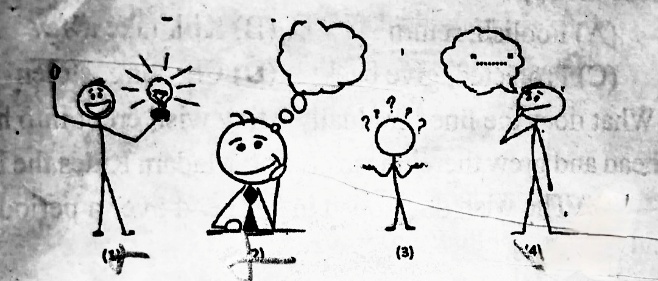
Which image corresponds to what Amanda is doing in this extract?
(A) Option 1
(B) Option 2
(C) Option 3
(D) Option 4
Answer: D
7. Amanda imagines different roles mainly to – {Bongaigaon}
(A) Entertain her parents
(B) Escape from constant scolding
(C) Prepare for acting
(D) Impress her friends
Answer: B
8. The poem suggests that too much nagging – {Bongaigaon}
(A) Improves discipline
(B) Strengthens confidence
(C) Affects a child’s creativity
(D) Makes children obedient happily
Answer: C
9. From your reading of the poem ‘Amanda’ which word given below is not an attribute of Amanda’s characters. {Cachar}
(A) Swift
(B) Day dreamer
(C) Escapist
(D) Introvert
Answer: A
10. The literary device used in the line – ” stop that slouching and sit up straight” {Cachar}
(A) Anaphora
(B) Assonance
(C) Metaphor
(D) Alliteration.
Answer: D
11. What does Amanda’s desire to be an orphan reveal about her life? {Charaideo}
(A) She wants to experience poverty and hardship
(B) She wants to have more freedom and autonomy
(C) She feels suffocated by her mother’s love and care
(D) She wants to escape her responsibilities
Answer: B
12. What type of question is ‘What is the meaning of the word ‘sulking’ in the poem ‘Amanda’ ? {Charaideo}
(A) Vocabulary based
(B) Critical thinking
(C) Inferential based
(D) Simple recall
Answer: A
13. “There is a languid emerald sea, Where the sole inhabitant is me” Here ’emerald sea’ means {Darrang}
(A) sea with clear water
(B) calm sea without waves
(C) sea filled with emerald gemstone
(D) sea that appears vibrant and rich green colour
Answer: D
14. “I am Rapunzel, I have not a care”. Amanda wants to be Rapunzel because {Darrang}
(A) She wants to have long hair
(B) She wants a prince to save her
(C) She wants to lead a carefree life
(D) She wants to be a princess
Answer: C
15. “I am an orphan.” The underlined word from the poem “Amanda” symbolises – {Dhubri}
(A) Freedom
(B) Valour
(C) Painful life
(D) Sorrow
Answer: A
16. Amanda is supposed to look at her mother when {Golaghat}
(A) She is making tea.
(B) She is talking to Amanda.
(C) She is wiping the dress.
(D) she is working.
Answer: B
17. Amanda uses the words ‘without a care’, ‘tranquil and rare’ to describe a life like- {Golaghat}
(A) a mermaid
(B) Rapunzel.
(C) an orphan
(D) a princess
Answer: B
18. “I am an Orphan, roaming the strect. I pattern soft dust with my hused, bare feet”. Choose the correct antonym of the following word:- {Hailakandi}
(A) Parented
(B) Wealthy
(C) Sheltered
(D) housed
Answer: A
19. What is Amanda instructed not to eat in the poem?{Hailakandi}
(A) Chocolates
(B) Tea
(C) Coffee
(D) Fruits
Answer: A
20. Why does Amanda imagine herself as a mermaid or an orphan in the poem?{Hailakandi}
(A) She wants to become famous
(B) She dislikes her home
(C) She wants to live in the sea.
(D) She longs for freedom and peace, away from constant instructions.
Answer: D
21. What message does the poem “Amanda” convey?{Hojai}
(A) Children must always obey their parents.
(B) Parents should never correct their children.
(C) Excessive control and nagging can suppress a child’s imagination and individuality.
(D) Imagination is harmful for growing children.
Answer: C
22. In her imaginary world, Amanda plays the role of _____.{Hojai}
(A) a queen and a mermaid.
(B) an orphan and a princess.
(C) a mermaid and an orphan.
(D) a queen and an orphan.
Answer: C
23. In the poem “Amanda!”, what is Amanda’s primary desire?
{Jorhat}
(A) To become a mermaid
(B) To be alone and free
(C) To become an artist
(D) To travel around the world
Answer: B
24. Select the most appropriate option from your reading of the poem “Amanda!” Amanda’s mother is continuously ____ Amanda. {Jorhat}
(A) motivating
(B) disapproving
(C) encouraging
(D) appreciating
Answer: B
25. “There is languid, emerald sea, where the sole inhabitant is me…” Choose the correct synonym for the underlined word (languid). {Kamrup R}
(A) dynamic
(B) animated
(C) relaxed
(D) spirited
Answer: C
26. In the poem ‘Amanda’, Amanda is asked not to _____. {Kamrup R}
(A) eat her food
(B) wear a red ribbon
(C) bite her nails
(D) go out and play
Answer: C
27. In her imaginary world, Amanda plays the role of _____. {Kamrup R}
(A) a queen and a mermaid
(B) an orphan and a princess
(C) a mermaid and an orphan
(D) a queen and an orphan
Answer: C
28. Amanda yearned for _____. {Kamrup R}
(A) friendship
(B) freedom
(C) love
(D) respect
Answer: B
29. Select the option that fits with the following from the poem, “Amanda.
Amanda: escape :: parents : _______. {Kamrup M}
(A) dreams
(B) silence
(C) control
(D) fear
Answer: C
30. What made Amanda sulky and become moody? {Kamrup M}
(A) When she has to clean her shoes.
(B) When her mother gives her too many instructions.
(C) When she has to complete her homework.
(D) When she has to tidy her room.
Answer: B
31. ‘You are always so moody’ -Amanda is so moody because -{Kokrajhar}
(A) Her parents do not love her
(B) She is being indulged
(C) She is a teenager
(D) She feels that her freedom is curtailed
Answer: D
32. Don’t bite your nails, Amanda! / Don’t hunch your shoulders, Amanda! / Stop that slouching and sit up straight, Amanda! What is the purpose of the speaker’s words in the given extract of the poem “Amanda”. {Kokrajhar}
(A) Show the speaker’s power over the listener.
(B) Make the listener a better human being.
(C) Advise the listener as an elder.
(D) Improve the listener’s posture and habit’s
Answer: D
33. Amanda wants to be Rapunzel because- {Kokrajhar}
(A) She likes to keep long hair
(B) She likes to live in a tower
(C) She likes to have a free life
(D) She wants to be a princess
Answer: C
34. The line “Don’t hunch your shoulders, sit up straight” suggests: (Hint: Amanda by Robin Klein) {Lakhimpur}
(A) The speaker is trying to control every minor action of Amanda
(B) Amanda is being told to correct her posture repeatedly
(C) The speaker is focusing strictly on Amanda’s physical behaviour
(D) Amanda is being instructed in a very detailed and rigid manner
Answer: B
35. Match the characters with Amanda’s Imagined worlds. {Lakhimpur}
Column A
(a) Mermaid
(b) Orphan
(c) Rapunzel
(d) Amanda (real)
Column B
(i) Lives alone in a tower
(ii) Lives peacefully in the sea
(iii) Walks freely without restrictions
(iv) Receives constant instructions
Options:
(A) (a-ii), (b-iii), (c-i), (d-iv)
(B) (a-iii), (b-ii), (c-iv), (d-i)
(C) (a-ii), (b-iv), (c-iii), (d-i)
(D) (a-i), (b-iii), (c-ii), (d-iv)
Answer: A
36. Find the synonym of the underlined word. “Stop that slouching and sit up straight” {Udalguri}
(A) Upright
(B) hunch
(C) erect
(D) hustler
Answer: B
37. Identify the literary device used in the underlined sentences and choose the correct option from the following. {Udalguri}
“The silence is growth
Freedom is sweet
A mermaid
I am an orphan
I am a Rapunzel”
(A) Simile
(B) Metaphor
(C) Alliteration
(D) Assonance
Answer: B
38. Statement 1: Amanda wanted to be a free girl living her dream life. {Udalguri}
Statement 2: Amanda was allowed to eat Chocolate to get rid of her acne.
Choose the correct option with reference to Amanda.
(A) Statement 1 is true and Statement 2 is false
(B) Statement 1 is false and Statement 2 is true
(C) Both Statement 1 and Statement 2 are true
(D) Both Statement 1 and Statement 2 are false
Answer: A
39. Match the column ‘A’ with column ‘B’ and choose the correct answer from the options given below: (Hints: Amanda) {Tamulpur}
Column A / Column B
inhabitant / (i) calm
ache / (ii) relax
languid / (iii) resident
Tranquil / (iv) a skin condition.
(A) 1-iii, 2-iv, 3-ii, 4-i
(B) 1-i, 2-ii, 3-iii, 4-iv
(C) 1-iii, 2-iv, 3-i, 4-ii
(D) 1-iv, 2-ii, 3-iii, 4-i
Answer: A
40. Identify the literary device used in the line form “Amanda” “Stop that slouching and sit up straight”. {Tamulpur}
(A) Alliteration
(B) Simile
(C) Assonance
(D) Metaphor.
Answer: A
41. In the poem, “Amanda”, how does the mother asks her daughter to sit up? {SSM}
(A) Sit up straight
(B) Sit up bend
(C) Sit up “U” type
(D) Sit up “V” shape
Answer: A
42. If Amanda is an orphan, what will she do? {SSM}
(A) She will tease everyone in the streets
(B) She will roam about in the streets.
(C) She will not complete her homework
(D) She has to clean her shoes.
Answer: B
43. Read the statements 1 and 2 given below, and choose the option that correctly evaluates these statements. {Sribhumi}
Statement 1 : Amanda is a little girl who is often scolded by her mother.
Statement 2 : Amanda is always happy to follow her mother’s instructions.
(A) Statement 1 is true and Statement 2 is false.
(B) Statement 1 is false and Statement 2 is true.
(C) Both Statement 1 and Statement 2 are true.
(D) Both Statement 1 and Statement 2 are false.
Answer: A
44. If Amanda is an orphan, what will she do? {Sribhumi}
(A) She will roam about in the streets.
(B) She will tease everyone in the streets.
(C) She will not complete her homework.
(D) All of the above.
Answer: A
45. The last advice to Amanda from her mother is {Sonitpur}
(A) Not to eat chocolate
(B) To stop sulking
(C) To Tidy her room
(D) To finish her homework.
Answer: B
46. The poet of the poem “Amanda” is {Sonitpur}
(A) Ogded Nash
(B) Leslie Norris
(C) Walt whitman
(D) Robin Klein
Answer: D
47. “I’ll certainly never let down my bright hair” This is an extract from the poem “Amanda”. Who is ‘I’ here? {Sibsagar}
(A) Rapunzel.
(B) Amanda.
(C) Mermaid.
(D) Orphan.
Answer: A
48. In which stanzas does the speaker want to control Amanda? {Sibsagar}
(A) 1st, 3rd, 5th and 6th.
(B) 2nd, 4th, 6th and 7th.
(C) 1st, 3rd, 5th and 7th.
(D) 2nd, 3rd, 4th and 7th.
Answer: C
49. Amanda is always daydreaming because- {Nalbari}
(A) She is lazy and careless
(B) She does not like studying
(C) She enjoys sleeping
(D) She wants to escape from constant scolding
Answer: D
50. Which of the following words rhyme with ‘feet’? {Nalbari}
(A) Free
(B) Sweat
(C) Seat
(D) Street
Answer: D
51. “Don’t bite your nails, Amanda! … Stop that slouching and sit up straight, Amanda!” The repeated instructions in the extract mainly suggest that: {Nalbari}
(A) Amanda enjoys being guided
(B) The speaker is deeply affectionate
(C) Amanda is constantly monitored
(D) Amanda is careless by nature
Answer: C
52. Which of the following words rhyme with ‘feet’? (Hint: Amanda) {Morigaon}
(A) Free
(B) Sweat
(C) Seat
(D) Street
Answer: D
53. The line “Stop that slouching and sit up straight” shows that the speaker is concerned about – {Majuli}
(A) Amanda’s behavior
(B) Amanda’s posture and manners
(C) Amanda’s school performance
(D) Amanda’s facial expression
Answer: B
54. Identify the poetic device used in this line: {Majuli}
“I am an orphan, roaming the street.”
(A) Metaphor
(B) Simile
(C) Personification
(D) Onomatopoeia
Answer: A
50 Most Important Model MCQs for HSLC 2027
1. Why does the poet enclose Amanda’s thoughts within parentheses (brackets)?
(A) To indicate that Amanda is speaking very loudly.
(B) To visually separate Amanda’s silent, internal fantasy world from her mother’s loud, external nagging.
(C) To show that these lines are less important to the poem.
(D) To represent the mother’s inner thoughts.
Answer: B
2. What is the central theme conveyed through Amanda’s imagination of being an orphan, a mermaid, and Rapunzel?
(A) The importance of discipline in a child’s life
(B) The desire for freedom and escape from constant nagging
(C) The joy of living in a fantasy world forever
(D) The need for children to listen to their parents
Answer: B
3. “Stop that slouching and sit up straight, Amanda!”
What is the tone of the speaker in this line?
(A) Loving and affectionate
(B) Frustrated and instructive
(C) Joyful and playful
(D) Sad and apologetic
Answer: B
4. How does Amanda imagine moving through the emerald sea?
(A) Swimming rapidly
(B) Drifting blissfully
(C) Drowning helplessly
(D) Sailing on a boat
Answer: B
5. What is the mother’s tone when she says, “I thought I told you to clean your shoes, Amanda!”?
(A) Apologetic and kind
(B) Irritated and accusatory
(C) Joyful and proud
(D) Confused and forgetful
Answer: B
6. What does the repetition of” Amanda!” at the end of each live reflect?
(A) It describes who the speaker is talking to.
(B) It represent the absent-mindedness of the listener.
(C) It shows the frustration of the speaker.
(D) It helps to create a rhyme scheme.
Answer: C
7. Life in tranquil and rare. Which word suits the best for “tranquil”
(A) Haunting
(B) Noisy
(C) Dangerous
(D) Calm
Answer: D
8. In the poem’ Amanda,’ how does the poet show the contrast between Amanda’s internal world in her external environment?
(A) By using vivid descriptions of nature versus dull tasks.
(B) By comparing Amanda’s behavior to that of her peers.
(C) Through the use of historical reference and analogies.
(D) By alternating between Amanda’s thoughts and her parent’s instructions.
Answer: D
9. In the Rapunzel stanza, what does Amanda pledge she will “certainly never” do?
(A) Cut her long hair
(B) Let down her bright hair
(C) Sing a song from the tower
(D) Talk to her mother again
Answer: B
10. Why does Amanda vow never to let her hair down, unlike the original Rapunzel?
(A) Because her hair is too short.
(B) Because she doesn’t want anyone, not even a prince, to climb up and disturb her perfect isolation.
(C) Because she is afraid her hair will get dirty.
(D) Because her mother strictly forbade her to do so.
Answer: B
11. What specific physical reaction does the mother associate with Amanda’s moodiness?
(A) Crying loudly
(B) Sulking
(C) Stomping her feet
(D) Biting her lips
Answer: B
12. “Anyone would think that I nagged at you.” What is the mother primarily concerned about in this concluding line?
(A) Amanda’s mental health
(B) Her own public image and what society will think of her parenting
(C) The cleanliness of the house
(D) Amanda’s physical posture
Answer: B
13. Which of the following is NOT a question asked by the mother in the second stanza?
(A) Did you finish your homework?
(B) Did you tidy your room?
(C) Did you eat your lunch?
(D) Did you clean your shoes?
Answer: C
14. What word is repeatedly used at the end of almost every line spoken by the mother?
(A) Stop
(B) Please
(C) Don’t
(D) Amanda!
Answer: D
15. The constant repetition of Amanda’s name by her mother serves to highlight:
(A) How much the mother loves her daughter’s name
(B) The continuous, relentless, and commanding nature of the mother’s scolding
(C) The mother’s bad memory
(D) Amanda’s deafness
Answer: B
16. What is the overarching irony in the mother telling Amanda to “Stop that sulking at once”?
(A) The mother is actually the one sulking.
(B) The mother’s constant nagging is exactly what causes Amanda to sulk and withdraw.
(C) Amanda is actually laughing, not sulking.
(D) The mother wants Amanda to cry instead.
Answer: B
17. What does the word “blissfully” mean in the context of the poem?
(A) With extreme sadness
(B) With a feeling of supreme happiness and peace
(C) With a loud noise
(D) With great speed
Answer: B
18. How does Amanda view her physical existence in the real world?
(A) As an exciting adventure
(B) As a restrictive burden filled with endless rules
(C) As a beautiful fairy tale
(D) As a deeply religious experience
Answer: B
19. Why does Amanda find the life of an orphan appealing?
(A) She wants to live in an orphanage with other children.
(B) She believes orphans have the ultimate freedom to roam without parental supervision and nagging.
(C) She wants to wear torn clothes.
(D) She hates her house and wants to live on the streets permanently.
Answer: B
20. What does the absence of parentheses in the final stanza of the poem indicate?
(A) Amanda has finally agreed with her mother.
(B) Amanda’s internal retreat has been completely overpowered by her mother’s harsh nagging, leaving her silent and trapped.
(C) Amanda has run away from home.
(D) The mother has stopped scolding Amanda.
Answer: B
21. “Remember your acne, Amanda!” Why is this instruction particularly harsh for a teenager?
(A) Because it points out a physical insecurity to enforce control over her diet.
(B) Because Amanda is proud of her acne.
(C) Because acne is a rare and dangerous disease.
(D) Because Amanda has forgotten to wash her face.
Answer: A
22. What does the word “drifting” suggest about Amanda’s desired pace of life?
(A) She wants a highly structured, scheduled life.
(B) She wants a slow, unhurried, and peaceful life without any forced direction.
(C) She wants to participate in fast-paced water sports.
(D) She wants to constantly travel from city to city.
Answer: B
23. Which body part is NOT mentioned by the mother while correcting Amanda’s posture?
(A) Shoulders
(B) Nails
(C) Back
(D) Knees
Answer: D
24. The poem “Amanda!” primarily explores the theme of:
(A) The importance of eating healthy food
(B) The struggles of growing up and the clash between parental control and a child’s yearning for freedom
(C) The beauty of the ocean and marine life
(D) The historical architecture of high towers
Answer: B
25. When the mother says, “Will you please look at me when I’m speaking to you,” what is Amanda most likely doing?
(A) Staring out the window or looking down, lost in her own daydreams
(B) Reading a comic book
(C) Watching television
(D) Playing a video game
Answer: A
26. What does “roaming the street” symbolize for Amanda?
(A) Extreme poverty and hunger
(B) A lack of boundaries, routines, and forced tidiness
(C) A dangerous environment
(D) A desire to go shopping
Answer: B
27. In the context of the poem, the mother’s instructions can be best described as:
(A) Constructive criticism
(B) Micro-management
(C) Gentle guidance
(D) Occasional advice
Answer: B
28. What is Amanda’s primary defense mechanism against her mother’s nagging?
(A) Yelling back at her mother
(B) Escaping into a rich, silent, imaginary world
(C) Doing exactly what she is told immediately
(D) Complaining to her father
Answer: B
29. What does the word “sole” mean in the phrase “sole inhabitant”?
(A) The bottom of a shoe
(B) A type of fish
(C) Only; single; without anyone else
(D) A spiritual entity
Answer: C
30. Which poetic device is used in the phrase “Silence is golden”?
(A) Simile
(B) Personification
(C) Metaphor
(D) Hyperbole
Answer: C
31. The poem implies that a constant barrage of instructions can make a child feel:
(A) Loved and protected
(B) Suffocated and rebellious
(C) Highly disciplined and successful
(D) Eager to communicate
Answer: B
32. The word “slouching” means:
(A) Sitting or standing in a lazy, drooping way
(B) Running very fast
(C) Speaking rudely to elders
(D) Chewing loudly
Answer: A
33. What does Amanda’s use of fairy tale and mythical creatures (mermaid, Rapunzel) reveal about her?
(A) She is very childish and uneducated.
(B) She has a vivid, creative imagination that serves as her sanctuary.
(C) She watches too many movies.
(D) She actually believes these creatures are real.
Answer: B
34. How does the poem view the concept of “silence”?
(A) The mother sees it as sulking, while Amanda sees it as a precious treasure.
(B) Both Amanda and the mother hate silence.
(C) The mother loves silence, but Amanda hates it.
(D) Silence is portrayed as terrifying and lonely.
Answer: A
35. Who wrote the poem “Amanda!”?
(A) Robert Frost
(B) Leslie Norris
(C) Robin Klein
(D) Walt Whitman
Answer: C
36. Assertion (A): The poet uses parentheses to enclose Amanda’s thoughts.
Reason (R): The parentheses visually separate Amanda’s quiet, internal fantasy world from the loud, continuous nagging of her mother.
(A) Both Assertion (A) and Reason (R) are true, and (R) is the correct explanation of (A).
(B) Both Assertion (A) and Reason (R) are true, but (R) is not the correct explanation of (A).
(C) Assertion (A) is true, but Reason (R) is false.
(D) Assertion (A) is false, but Reason (R) is true.
Answer: A
37. Assertion (A): Amanda wishes she were an orphan roaming the streets.
Reason (R): She despises her parents and wants them to die.
(A) Both Assertion (A) and Reason (R) are true, and (R) is the correct explanation of (A).
(B) Both Assertion (A) and Reason (R) are true, but (R) is not the correct explanation of (A).
(C) Assertion (A) is true, but Reason (R) is false.
(D) Assertion (A) is false, but Reason (R) is true.
Answer: C
38. Assertion (A): Amanda promises that she will never let down her bright hair from the tower.
Reason (R): She wants to ensure that her isolation remains absolutely unbroken and no prince comes to “rescue” her.
(A) Both Assertion (A) and Reason (R) are true, and (R) is the correct explanation of (A).
(B) Both Assertion (A) and Reason (R) are true, but (R) is not the correct explanation of (A).
(C) Assertion (A) is true, but Reason (R) is false.
(D) Assertion (A) is false, but Reason (R) is true.
Answer: A
39. Assertion (A): The mother tells Amanda to stop eating chocolates.
Reason (R): Amanda is allergic to cocoa and it makes her severely ill.
(A) Both Assertion (A) and Reason (R) are true, and (R) is the correct explanation of (A).
(B) Both Assertion (A) and Reason (R) are true, but (R) is not the correct explanation of (A).
(C) Assertion (A) is true, but Reason (R) is false.
(D) Assertion (A) is false, but Reason (R) is true.
Answer: C
40. Assertion (A): The mother is highly concerned about Amanda’s sulking and moodiness.
Reason (R): She genuinely cares deeply about Amanda’s mental health and internal happiness.
(A) Both Assertion (A) and Reason (R) are true, and (R) is the correct explanation of (A).
(B) Both Assertion (A) and Reason (R) are true, but (R) is not the correct explanation of (A).
(C) Assertion (A) is true, but Reason (R) is false.
(D) Assertion (A) is false, but Reason (R) is true.
Answer: C
41. Assertion (A): Amanda patterns the soft dust with her hushed, bare feet.
Reason (R): She enjoys the tactile sensation of quiet, unbothered, and unstructured play.
(A) Both Assertion (A) and Reason (R) are true, and (R) is the correct explanation of (A).
(B) Both Assertion (A) and Reason (R) are true, but (R) is not the correct explanation of (A).
(C) Assertion (A) is true, but Reason (R) is false.
(D) Assertion (A) is false, but Reason (R) is true.
Answer: A
42. Assertion (A): The mother constantly repeats the name “Amanda!” at the end of her sentences.
Reason (R): The repetition creates a sense of authoritative dominance and relentless nagging.
(A) Both Assertion (A) and Reason (R) are true, and (R) is the correct explanation of (A).
(B) Both Assertion (A) and Reason (R) are true, but (R) is not the correct explanation of (A).
(C) Assertion (A) is true, but Reason (R) is false.
(D) Assertion (A) is false, but Reason (R) is true.
Answer: A
43. Assertion (A): In the final stanza of the poem, there are no lines enclosed in parentheses.
Reason (R): Amanda’s mother has finally realized her mistake and stops nagging her daughter.
(A) Both Assertion (A) and Reason (R) are true, and (R) is the correct explanation of (A).
(B) Both Assertion (A) and Reason (R) are true, but (R) is not the correct explanation of (A).
(C) Assertion (A) is true, but Reason (R) is false.
(D) Assertion (A) is false, but Reason (R) is true.
Answer: C
44. Assertion (A): Amanda imagines herself as a mermaid drifting in a languid emerald sea.
Reason (R): The calm, slow, and lonely environment of the sea directly contrasts with the fast-paced, stressful instructions she receives at home.
(A) Both Assertion (A) and Reason (R) are true, and (R) is the correct explanation of (A).
(B) Both Assertion (A) and Reason (R) are true, but (R) is not the correct explanation of (A).
(C) Assertion (A) is true, but Reason (R) is false.
(D) Assertion (A) is false, but Reason (R) is true.
Answer: A
45. Assertion (A): Amanda’s silence is described as “golden.”
Reason (R): Amanda is extremely wealthy and owns a lot of golden jewelry.
(A) Both Assertion (A) and Reason (R) are true, and (R) is the correct explanation of (A).
(B) Both Assertion (A) and Reason (R) are true, but (R) is not the correct explanation of (A).
(C) Assertion (A) is true, but Reason (R) is false.
(D) Assertion (A) is false, but Reason (R) is true.
Answer: C
46. What does the stark contrast between the mother’s syntax (exclamation marks, short commands) and Amanda’s syntax (flowing sentences, descriptive adjectives) reveal?
(A) The mother is poorly educated, while Amanda is highly literate.
(B) It highlights the psychological clash between the mother’s rigid, anxious control and Amanda’s deep desire for fluid, peaceful autonomy.
(C) It shows that they are speaking two different languages.
(D) It proves that Amanda is not listening at all.
Answer: B
47. The mother states, “Anyone would think that I nagged at you.” What psychological concept does this expose about the mother’s parenting style?
(A) She is highly empathetic to Amanda’s feelings.
(B) She is obsessed with social validation and external appearances over her child’s actual emotional well-being.
(C) She suffers from short-term memory loss.
(D) She wants society to praise Amanda for being well-behaved.
Answer: B
48. Why is the fantasy of being an “orphan” the most heartbreaking and ironic escapist thought in the poem?
(A) Because orphans usually have a lot of money to spend on chocolates.
(B) Because it demonstrates that the child feels so suffocated by parental “care” that the ultimate tragic state of having no parents seems like a better alternative.
(C) Because Amanda wants to live in an orphanage with her friends.
(D) Because orphans are allowed to eat whatever they want.
Answer: B
49. How does the poet use the dual interpretation of “silence” to emphasize the generational gap?
(A) The mother thinks silence means Amanda is sleeping, while Amanda uses it to study.
(B) For the mother, silence is “sulking” and a sign of rebellion; for Amanda, it is “golden” and her only source of peace.
(C) Both the mother and Amanda use silence as a weapon to hurt each other.
(D) The mother loves silence, but Amanda constantly breaks it by talking.
Answer: B
50. By choosing to alter the traditional Rapunzel narrative (where Rapunzel lets down her hair for a prince), what is the poet signifying about Amanda’s state of mind?
(A) She is waiting for a better prince to come along.
(B) Her desire for escapism is so absolute that she rejects any form of human connection or rescue, preferring total, unbroken isolation.
(C) She is afraid that her hair will break if someone climbs it.
(D) She wants her mother to climb the tower instead.
Answer: B
SEBA HSLC Previous Year Questions (1/2/3 Marks)
1. “Amanda was blamed for a number of things. Mention any two of them.” {2026}
2. In the first stanza of the poem ‘Amanda’, what is Amanda told not to do? {2023}
3. Is Amanda a student? How do you know? {2020}
4. How old is Amanda? How do you know it? {2019}
Common Pre-Board 2 Mark Questions (2025–26)
1. What are the adolescent characteristics Amanda shows? {Barpeta}
2. What is a mermaid? Why does Amanda want to be a mermaid? {Darrang}
3. Do you think that Amanda is an obedient girl? Give reasons according to your answer. {Dhubri}
4. Why does Amanda imagine herself as a mermaid or an orphan in the poem “Amanda” by Robin Klein?{Hailakandi}
5. Give antonyms of the words ‘sorrowful’ and ‘solitary’.
6. Is Amanda an orphan? Why does she say so? {Kamrup R}
7. Do you feel Amanda is a disrespectful child? Justify your answer. {Kokrajhar}
8. “There is a languid, emerald sea, Where the sole inhabitant is me- A mermaid, drifting blissfully.” Why is Amanda imagining herself drifting? What feeling does the word “blissfully” express? {Lakhimpur}
9. Do you think that constantly nagging a child by their parents makes them a disciplined person in future? Give reasons to justify your answer. 10. Would you call Amanda a disrespectful child? Provide reasons to justify your opinion. {Sribhumi}
11. Amanda was blamed for a number of things. mention any two. {Sonitpur}
12. Why does the speaker instruct Amanda not to be so moody? {Sibsagar}
13. What kind of life does Amanda want? {Nalbari}
14. Fill in the blanks with he words used in the poem ‘Amanda’. ‘Don’t eat that , Amanda. Remember your, Amanda. {Morigaon}