Class 7 Science Chapter 7 Measurement of Time And Motion Solutions | ASSEB Assam | English Medium
Class 7 Science (Amar Bijan) Chapter 7 – Measurement of Time And Motion Complete Textual Question Answers and Solutions (ASSEB Assam – English Medium)
The seventh chapter of the Class 7 Science (English Medium) syllabus, ‘Measurement of Time And Motion,’ is a fundamental and highly practical topic in physics. Based on the new ASSEB (Assam State School Education Board) guidelines and the latest National Education Policy (NEP) framework according to the current syllabus, we have prepared comprehensive textual question answers for this chapter. This special guide includes very short answers (VSA), short questions, long descriptive answers, multiple-choice questions (MCQs), and additional questions. Brought to you by Ospin Academy, these solutions are accurate, easy to understand, and highly exam-oriented.
In ‘Measurement of Time And Motion’, students learn about the concept of speed, the difference between uniform and non-uniform motion, and how time is measured using periodic motion, such as in a simple pendulum. The chapter also teaches the essential skill of drawing and interpreting distance-time graphs. Understanding these foundational physics concepts is crucial for exam preparation. Our textual solutions not only cover the textbook exercises but also provide extra important questions and MCQs to ensure students have a thorough grasp of the topic.
What you will learn and get from these textual solutions:
- Clear definitions of speed, uniform motion, and periodic motion.
- 1-mark objective questions (VSA), MCQs, and detailed 2-3 mark short questions tailored for exams.
- Step-by-step explanations for 4-5 mark long questions, including numerical problems on calculating speed and time periods.
- A wide range of additional questions and MCQs specifically designed according to the new syllabus pattern.
- Comprehensive insights into plotting and reading distance-time graphs, explained in simple English.
Special Features of Ospin Academy’s Notes:
- Prepared strictly according to the new ASSEB syllabus and current educational guidelines.
- 100% accurate and written in simple, easy-to-memorize English (Class 7 Science Notes).
- Includes quick revision formulas for speed and distance, highly beneficial for last-minute exam preparation.
- Exclusive compilation of extra important questions and MCQs to maximize your scores.
Aiming for academic excellence, Ospin Academy provides these comprehensive textual solutions to aid students in their studies. Start your preparation today and secure the highest marks in Class 7 Science.

Class 7 Science (English Medium) PDF Solutions 2026-27 | SEBA Assam
Get Class 7 Science Solutions (SEBA Assam) in a PDF format, covering Part I & II with chapter-wise answers, MCQs, and explanations. Perfect for exam preparation and concept clarity.
Out of stock
SCERT Assam, Class 7: Science
Measurement Of Time And Motion
EXERCISE
1. Darken the circle of correct answer
(i) Speed of a car that covers 300 m distance in 30 s is
(a) 10 m/s
(b) 20 m/s
(c) 30 m/s
(d) 40 m/s
Answer: (a)
(ii) Speed 72 km/h can be expressed as –
(a) 40 m/s
(b) 60 m/s
(c) 10 m/s
(d) 20 m/s
Answer: (d)
(iii) SI unit of average speed is
(a) km/s
(b) m/h
(c) m/s
(d) mm/s
Answer: (c)
(iv) Smallest time interval that can be measured in a normal wall clock is
(a) 1 Hour
(b) 1 Minute
(c) Half an hour
(d) 1 Second
Answer: (d)
2. Fill up the blanks
(a) An object moving along a straight line with a constant speed is said to be in _______ motion.
Answer: (a) Uniform linear
(b) If the speed of an object moving along a straight line keeps changing, it is said to be in _______ motion.
Answer: Non-uniform linear
3. A bus travels at a speed of 20 m/s and covers a distance of 288 km. How much time does it take? Find the answer in hour, minute and second.
Answer: In hour : Speed =20m/s
=2036001000km/h
=72km/h
Distance =288km.
∴ Time taken =Distance Speed
=28872 h
=4 h
In minute
Time taken = 460 min
= 240 min
In second :
Time taken =24060 s
=14,400 s
4. Write three examples of non-uniform motion from your daily life.
Answer: (i) Motion of a car moving on a busy road.
(ii) Motion of an athlete taking part in a race.
(iii) Motion of an object thrown upwards.
5. Why is uniform motion over a long distance considered an ideal case? Explain with examples.
Answer: In our daily life, we rarely see objects moving at the exact same speed for a long time or over a long distance without any fluctuation, which is why uniform linear motion is considered an ideal case. For example, when we walk or run, fatigue, terrain, or obstacles prevent us from maintaining a perfectly constant speed. Similarly, a car cannot move with a constant speed on the roads due to traffic, turns, speed breakers, and varying road conditions.
6. Make list of 5 animals or objects and compare their speed with average walking and running speed of human.
Answer:
Average Human Walking Speed: ~ 5 km/h
Average Human Running Speed: ~ 15 km/h
|
Animal/Object |
Speed |
Comparison with Human |
|
Snail |
~ 0.05 km/h |
Much slower than walking |
|
Dog |
~ 30 km/h |
Faster than running |
|
Cheetah |
~ 110 km/h |
Much faster than running |
|
Bicycle |
~ 20 km/h |
Faster than running |
|
Aeroplane |
~ 900 km/h |
Extremely faster than running |
7. Assertion: A car moving through crowded city streets often has non-uniform motion.
Reason: In non-uniform motion, an object travels unequal distances in equal intervals of time.
Choose the correct option:
(a) Both Assertion and Reason are true, and Reason is the correct explanation of Assertion.
(b) Both Assertion and Reason are true, but Reason is not the correct explanation of Assertion.
(c) Assertion is true, but Reason is false.
(d) Assertion is false, but Reason is true.
Answer: (a) Both Assertion and Reason are true, and Reason is the correct explanation of Assertion.
8. Choose any track and field event, such as the 100 m, 200 m, or 400 m race. Using the Internet, find the current national record and the Olympic record for the same event. Compare the timings.
|
Event |
National record |
Oplymic rerord |
Difference |
|
100m |
10.18 sec. |
9.63 sec. |
0.55 sec |
|
200m |
20.32 sec. |
19.30 sec. |
1.02 sec |
|
400m |
45.12 sec. |
43.03 sec. |
2.09 sec |
9. A train travels 120 km in the first two hours, 150 km in the next two hours, and 100 km in the last hour. Is the motion uniform? Justify your answer. Also, calculate the train’s average speed.
Answer: The motion is not uniform. Because the train travels unequal distances in equal intervals of time. (In the first two hours it travels 120 km, meaning 60 km/h, but in the next two hours it travels 150 km, meaning 75 km/h).
The train’s average speed = Total distance travelledTotal time taken
= (120 + 150 + 100) km(2 + 2 + 1) h
= 3705
= 74km/h
10. Partha decides to visit his friend in a nearby town 60 km away. He starts his journey on his scooter at 8:00 a.m. and rides at a speed of 40 km/h for the first 30 km. Due to traffic, he slows down and covers the next 20 km at 30 km/h. For the last 10 km, the road is clear, and he increases his speed to 60 km/h.
(i) At what time did Partha complete the entire journey?
(ii) What is the total distance travelled by Partha?
(iii) Calculate the average speed of Partha for the whole journey.
(iv) Was Partha’s motion uniform or non-uniform? Justify your answer.
(v) If Partha has travelled the entire 60 km at a constant speed of 40 km/h, how much time would he have saved or lost compared to the actual time taken?
Answer: For the first 30 km
Time taken = Distance Speed
=3040h
=34h
For the next 20 km
Time taken =2030h=23h
For the last 10 km
Time taken =1060h=16h
∴ Total time taken to complete the entire journey
=34+23+16h
=9+8+212h
=1912h
=1712h
=1h+71260 min
=1h+35 min
=1h 35 min
(i) Partha completed the entire journey after 1 h 35 min. at 9:35 a.m.
(ii) Total distance travelled by Partha = 60km
(iii) Average speed of Partha =60 km19/12 h
=601219 km/h
=37.89 km/h
(iv) Partha’s motion was non-uniform. Because he kept changing his speed (from 40 to 30 to 60 km/h) over different segments of the journey.
(v) For a constant speed of 40km/h
Time taken =Distance Speed
= 6040h
=32h
=1.5h
=1h 30 min
∴ Amount of time he would have saved compared to the actual time taken. =1912−32h
=19−1812h
=112h
=11260 min
=5 min
11. Complete the concept map. 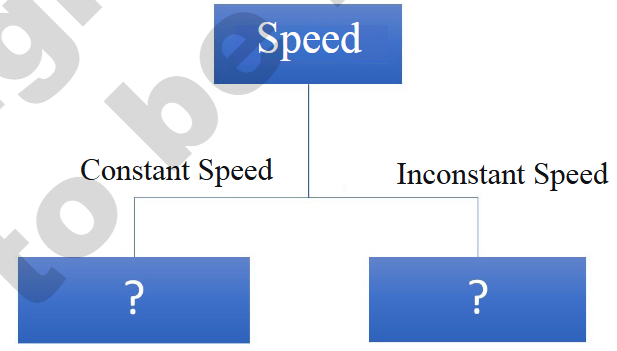
Answer:
Constant Speed → Uniform motion
Inconstant Speed → Non-uniform motion
12. A spacecraft moving at a constant speed of 36,000 km/h in space, then complete the table.
|
Time (s) |
0 |
2 |
4 |
6 |
8 |
10 |
|
Distance(m) |
0 |
? |
40000 |
? |
80000 |
? |
Answer:
|
Time (s) |
0 |
2 |
4 |
6 |
8 |
10 |
|
Distance (m) |
0 |
20000 |
40000 |
60000 |
80000 |
100000 |
13. The table given below shows the time and distance travelled by a car. Using the data provided, identify the type of motion exhibited by the car. Also, determine during which part of the journey was the car moving at the fastest speed and during which part was moving at the slowest speed. Finally, calculate the average speed of the car for the entire journey.
|
Time (s) |
0 |
10 |
20 |
30 |
40 |
50 |
|
Distance (m) |
0 |
500 |
800 |
1500 |
1700 |
3000 |
Answer: The type of motion exhibited by the car is non-uniform because it covers unequal distances in equal time intervals of 10s.
To find fastest/slowest parts, let’s look at the distance covered in each 10s interval:
0-10s: 500m
10-20s: 300m
20-30s: 700m
30-40s: 200m
40-50s: 1300m
The part of the journey during which the car was moving at the fastest speed was between 40 s and 50 s (covered 1300m).
The part of the journey during which the car was moving at the slowest speed was between 30 s and 40 s (covered only 200m).
Average speed of the car = Total DistanceTotal Time
=3000 m50 s
= 60 m / s
Multiple Choice Questions (MCQs)
1. The distance moved by an object in a unit time is called its:
(A) Velocity
(B) Acceleration
(C) Speed
(D) Displacement
Answer: (C)
2. The basic unit of speed is:
(A) km/min
(B) m/min
(C) km/h
(D) m/s
Answer: (D)
3. A car moves with a speed of 40 km/h for 15 minutes and then with a speed of 60 km/h for the next 15 minutes. The total distance covered by the car is:
(A) 100 km
(B) 25 km
(C) 15 km
(D) 10 km
Answer: (B)
4. Which of the following relations is correct?
(A) Speed = Distance × Time
(B) Speed = Distance / Time
(C) Speed = Time / Distance
(D) Speed = 1 / (Distance × Time)
Answer: (B)
5. An object moving along a straight line covers equal distances in equal intervals of time. Its motion is called:
(A) Uniform motion
(B) Non-uniform motion
(C) Circular motion
(D) Oscillatory motion
Answer: (A)
6. A device used to measure the distance moved by a vehicle is called an:
(A) Speedometer
(B) Odometer
(C) Thermometer
(D) Barometer
Answer: (B)
7. The speedometer of a vehicle measures the speed in:
(A) m/s
(B) m/min
(C) km/h
(D) km/s
Answer: (C)
8. To convert a speed from km/h to m/s, we multiply it by:
(A) 5/18
(B) 18/5
(C) 1000/60
(D) 60/1000
Answer: (A)
9. A cyclist covers a distance of 15 km in 2 hours. Calculate his speed.
(A) 30 km/h
(B) 7.5 km/h
(C) 15 km/h
(D) 7.5 m/s
Answer: (B)
10. The time interval between one sunrise and the next was called a:
(A) Month
(B) Year
(C) Day
(D) Hour
Answer: (C)
11. What distance will an aeroplane flying at 900 km/h cover in 2 hours?
(A) 450 km
(B) 900 km
(C) 1800 km
(D) 2700 km
Answer: (C)
12. Why is uniform motion over a long distance considered an ideal case?
(A) Because it is seen everyday
(B) Because it is only possible at night
(C) Because it is practically impossible to maintain a constant speed continuously
(D) Because vehicle speed cannot be measured
Answer: (C)
13. What is the formula to calculate average speed?
(A) Total distance / Total time
(B) Total time / Total distance
(C) Total distance × Total time
(D) Initial speed + Final speed
Answer: (A)
14. If a person gets tired while walking, what can their motion be called?
(A) Uniform motion
(B) Non-uniform motion
(C) Fast motion
(D) Continuous motion
Answer: (B)
15. If a car’s speedometer continuously shows the same digit, what is the motion of the car?
(A) Non-uniform motion
(B) Uniform motion
(C) Motionless
(D) Variable motion
Answer: (B)
16. 10 m/s speed is equal to how many km/h?
(A) 36 km/h
(B) 18 km/h
(C) 54 km/h
(D) 72 km/h
Answer: (A)
17. What is the SI unit of distance?
(A) Kilometer
(B) Centimeter
(C) Meter
(D) Foot
Answer: (C)
18. If a bus covers 30 km in the first hour and 50 km in the next hour, what is its average speed?
(A) 30 km/h
(B) 40 km/h
(C) 50 km/h
(D) 80 km/h
Answer: (B)
19. What is the smallest unit of time that can be measured by a normal wall clock?
(A) Hour
(B) Minute
(C) Second
(D) Microsecond
Answer: (C)
20. An object starts from rest and covers 20 meters in 10 seconds. What is its average speed?
(A) 2 m/s
(B) 0.5 m/s
(C) 20 m/s
(D) 200 m/s
Answer: (A)
Long Questions with Answers
1. Explain the difference between uniform and non-uniform motion with suitable examples.
Answer: Uniform motion occurs when an object travels along a straight line and covers exactly equal distances in equal intervals of time, regardless of how small the time intervals are. In this case, the speed remains perfectly constant. For example, a car driving steadily at exactly 60 km/h on an empty, straight highway without changing speed.
Non-uniform motion occurs when an object’s speed keeps changing over time, meaning it covers unequal distances in equal intervals of time. This is the most common type of motion. For example, a bus driving through a busy city street—it slows down for traffic, speeds up on empty stretches, and stops at traffic lights, constantly changing its speed.
2. Define Average Speed. Why do we mostly use average speed rather than constant speed in our daily lives?
Answer: Average speed is defined as the total distance traveled by an object divided by the total time taken to cover that distance (Average Speed = Total Distance / Total Time).
In daily life, perfectly uniform motion (constant speed) is extremely rare. Vehicles or people constantly have to slow down, stop, or speed up due to traffic, road conditions, turns, or fatigue. Since the speed fluctuates continuously, it is impractical to state a single speed for the whole journey. Therefore, we use average speed to get a practical overall measure of how fast the journey was completed.
3. What are odometers and speedometers? What is the basic difference in the information they provide?
Answer: An odometer and a speedometer are both essential dashboard instruments found in vehicles like cars and motorcycles.
A speedometer is an instrument that measures and displays the instantaneous speed of the vehicle in real-time, usually in kilometers per hour (km/h). It tells the driver exactly how fast the car is moving at that exact moment.
An odometer, on the other hand, is an instrument that measures and records the total cumulative distance the vehicle has traveled over its lifetime or a specific trip, usually in kilometers.
The key difference is that the speedometer gives instantaneous speed (km/h), while the odometer gives total distance traveled (km).
4. A car travels a distance of 180 km from City A to City B in 3 hours. On the return journey, due to heavy rain, it takes 4.5 hours to travel the same distance. Calculate the average speed of the car for the onward journey, the return journey, and the entire round trip.
Answer:
For the onward journey
Distance = 180 km
Time = 3 hours
Average Speed = Distance / Time = 180 / 3 = 60 km/h
For the return journey
Distance = 180 km
Time = 4.5 hours
Average Speed = Distance / Time = 180 / 4.5 = 40 km/h
For the entire round trip
Total Distance = 180 km (onward) + 180 km (return) = 360 km
Total Time = 3 hours + 4.5 hours = 7.5 hours
Average Speed for round trip = Total Distance / Total Time
= 360 / 7.5 = 48 km/h
5. What is motion? What is the main difference between uniform and non-uniform motion?
Ans: The change of position of an object with time is called motion. The main difference between uniform and non-uniform motion lies in the relationship between distance and time. If an object moves in a straight line and covers perfectly equal distances in equal intervals of time, it is called uniform motion. On the other hand, if an object covers unequal distances in equal intervals of time, meaning its speed keeps changing, it is called non-uniform motion.
6. Explain the necessity of average speed.
Ans: In our daily lives, it is practically impossible for any vehicle or person to cover long distances at a perfectly constant speed (uniform motion). Due to traffic, turns, and road conditions, the speed of vehicles constantly changes. Since the speed fluctuates throughout the journey, it is not possible to state a single specific speed to represent the entire journey. Therefore, average speed is needed to indicate the overall fastness of the journey.
7. What can we learn about a car’s journey using an odometer and a speedometer?
Ans: An odometer and a speedometer are two important instruments in a car. Using an odometer, we can find out the total distance covered by the car during its journey, which is usually expressed in kilometers. On the other hand, a speedometer helps us know the instantaneous speed or velocity of the moving car at any specific moment, shown in kilometers per hour (km/h).
8. Why does a car moving through a city exhibit non-uniform motion?
Ans: While driving a car through a city, one has to face various obstacles like traffic congestion, traffic lights, pedestrians, road curves, and speed breakers. Due to these obstacles, the driver frequently has to slow down, sometimes stop, and accelerate when the road is clear. As a result, the car covers unequal distances in equal intervals of time.
9. An athlete is participating in a 100-meter race. Explain with logic whether his motion will be uniform or non-uniform.
Ans: The athlete’s motion will generally be non-uniform. At the beginning of the race, he starts from a state of rest and then gradually increases his speed. During the middle of the race, his speed might be at its maximum, and towards the end or due to fatigue, his speed might change. Since his speed does not remain constant during the race, his motion will be non-uniform.
10. What did people use in ancient times to measure time intervals, and what do they use presently?
Ans: In ancient times, people relied on natural events to measure time intervals. For instance, the time from one sunrise to the next was considered a day. Presently, in the modern era, we use wall clocks, wristwatches, digital clocks, and stopwatches to measure time accurately.