Class 7 Science Chapter 8 Concept of Metals and Non – Metals Solutions | ASSEB Assam | English Medium
Class 7 Science (Amar Bijan) Chapter 8 – Concept of Metals and Non – Metals Complete Textual Question Answers and Solutions (ASSEB Assam – English Medium)
The eighth chapter of the Class 7 Science (English Medium) syllabus, ‘Concept of Metals and Non – Metals,’ is a core chemistry topic that introduces students to the materials that make up our world. Based on the new ASSEB (Assam State School Education Board) guidelines and the latest National Education Policy (NEP) framework according to the current syllabus, we have prepared comprehensive textual question answers for this chapter. This special guide includes very short answers (VSA), short questions, long descriptive answers, multiple-choice questions (MCQs), and additional questions. Brought to you by Ospin Academy, these solutions are accurate, easy to understand, and highly exam-oriented.
In ‘Concept of Metals and Non – Metals’, students learn about the distinct physical properties such as malleability, ductility, sonorousness, and conductivity that differentiate metals from non-metals. The chapter also covers their chemical properties and everyday applications. Understanding these material characteristics is crucial for building a strong foundation in science and for exam preparation. Our textual solutions not only cover the textbook exercises but also provide extra important questions and MCQs to ensure students have a thorough grasp of the topic.
What you will learn and get from these textual solutions:
- Clear explanations of physical properties like malleability, ductility, and luster.
- 1-mark objective questions (VSA), MCQs, and detailed 2-3 mark short questions tailored for exams.
- Step-by-step explanations for 4-5 mark long questions, detailing the differences between metals and non-metals.
- A wide range of additional questions and MCQs specifically designed according to the new syllabus pattern.
- Comprehensive insights into the real-world uses of various metals and non-metals, explained in simple English.
Special Features of Ospin Academy’s Notes:
- Prepared strictly according to the new ASSEB syllabus and current educational guidelines.
- 100% accurate and written in simple, easy-to-memorize English (Class 7 Science Notes).
- Includes quick revision tables comparing metals and non-metals, highly beneficial for last-minute exam preparation.
- Exclusive compilation of extra important questions and MCQs to maximize your scores.
Aiming for academic excellence, Ospin Academy provides these comprehensive textual solutions to aid students in their studies. Start your preparation today and secure the highest marks in Class 7 Science.
Class 7 Science (English Medium) PDF Solutions 2026-27 | SEBA Assam
Get Class 7 Science Solutions (SEBA Assam) in a PDF format, covering Part I & II with chapter-wise answers, MCQs, and explanations. Perfect for exam preparation and concept clarity.
Out of stock
SCERT Assam, Class 7: Science
Concepts of Metals And Non-Metals
EXERCISE
Q.1. Darken the circle of correct answer
(i) Which of the following is not applicable to iron?
(a) sonorous
(b) dull
(c) malleable
(d) ductile
Answer: (b)
(ii) Which of the following metal reacts vigorously with water and then catch fire?
(a) magnesium
(b) copper
(c) sodium
(d) uranium
Answer: (c)
(iii) Which metal is commonly used to make food packaging materials as it is cheaper, and its thin sheets can be folded easily into any shape?
(a) Aluminium
(b) Copper
(c) Iron
(d) Gold
Answer: (a)
(iv) Which of the following is formed when the residue obtained on burning sulphur is mixed with water?
(a) sulphuric acid
(b) sulphurous acid
(c) sulphonic acid
(d) sulphur dioxide
Answer: (b)
(v) Bronze is an alloy of:
(a) copper and zinc
(b) copper and iron
(c) tin and zinc
(d) tin and copper
Answer: (d)
Q. 2. Fill up the blanks
(i) The non-metal that is used as an antiseptic in skin ointments is _______.
Answer: iodine
(ii) The metals present in bell metal are ____________ and ____________.
Answer: copper, tin
(iii) ____________ is a metal which is liquid at room temperature.
Answer: mercury
(iv) A non-metal that is a good conductor of heat and electricity is _______.
Answer: graphite
(v) The property of a metal which is useful in making tin sheets is _________.
Answer: malleability
Q. 3. State with reasons whether the following statements are true or false. (i) Aluminium and copper are examples of non-metals used for making utensils and statues.
Answer: False, because aluminium and copper are well-known examples of metals, not non-metals.
(ii) Metals form oxides when combined with oxygen, the solution of which turns blue litmus paper to red.
Answer: False, because metallic oxides generally form basic solutions in water, and bases turn red litmus paper blue, not the other way around.
(iii) Oxygen is a non-metal essential for respiration.
Answer: True, oxygen is a vital non-metallic gas that all living organisms inhale to break down food and produce essential energy during respiration.
(iv) Copper vessels are used for boiling water because they are good conductors of electricity.
Answer: False. While copper does conduct electricity, it is used to make boiling vessels specifically because it is an excellent conductor of heat, allowing water to boil faster.
(v) School bell is made of bell metal because this metal is ductile.
Answer: False. Bells are made from bell metal primarily because of its sonorous property (it produces a loud, ringing sound when struck), not its ductility (ability to be drawn into wires).
(vi) The black part present in hard pencil is a metal that conducts electricity.
Answer: False. The black core of a pencil is made of graphite. Although it remarkably conducts electricity, graphite is a non-metal (a form of carbon), not a metal.
Q.4. Match Column I with Column II
|
Column I |
Column II |
|
1. Malleable |
(a) Can be transformed into wire |
|
2. Ductile |
(b) For making crackers |
|
3. Oxygen |
(c) Give sheets on hammering |
|
4. Copper |
(d) For disinfecting water |
|
5. Sulphur |
(e) All living beings inhale during breathing |
|
6. Diamond |
(f) For making electric wires |
|
7. Sonority |
(g) For making rails |
|
8. Iron |
(h) Hardest non-metal |
|
9. Chlorine |
(i) Ringing of bells |
|
10. Platinum |
(j) Used in making ornaments |
Answer:
|
Column I |
Column II |
|
1. Malleable |
(c) Give sheets on hammering |
|
2. Ductile |
(a) Can be transformed into wire |
|
3. Oxygen |
(e) All living beings inhale during breathing |
|
4. Copper |
(f) For making electric wires |
|
5. Sulphur |
(b) For making crackers |
|
6. Diamond |
(h) Hardest non-metal |
|
7. Sonority |
(i) Ringing of bells |
|
8. Iron |
(g) For making rails |
|
9. Chlorine |
(d) For disinfecting water |
|
10. Platinum |
(j) Used in making ornaments |
5. Match the uses of metals and non-metals given in Column I with the jumbled names of metals and non-metals given in Column II.
|
Column I |
Column II |
|
(i) Used in electrical wiring |
(a) ENXYGO |
|
(ii) Most malleable and ductile |
(b) NECOHIRL |
|
(iii) Living organisms cannot survive without it. |
(c) PEPORC |
|
(iv) Plants grow healthy when fertilisers containing it are added to the soil |
(d) TENGOINR |
|
(v) Used in water purification |
(e) OGDL |
Answer:
|
Column I |
Column II |
|
(i) Used in electrical wiring |
(c) PEPORC |
|
(ii) Most malleable and ductile |
(e) OGDL |
|
(iii) Living organisms cannot survive without it. |
(a) ENXYGO |
|
(iv) Plants grow healthy when fertilisers containing it are added to the soil |
(d) TENGOINR |
|
(v) Used in water purification |
(b) NECOHIRL |
6. Complete the following flowchart.
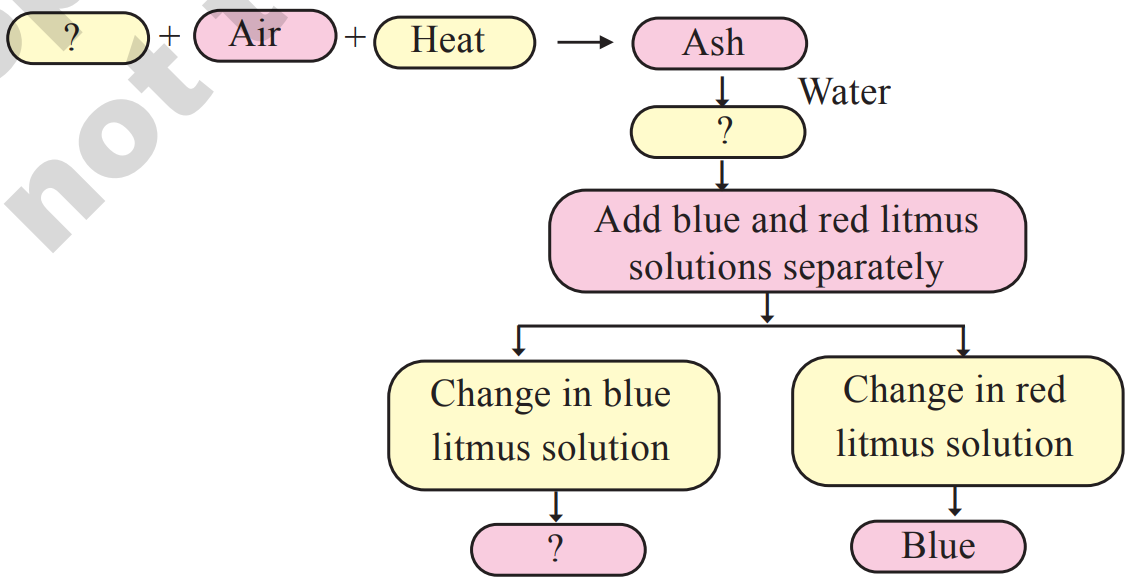
Answer:
1. Magnesium
2. Red
7. Explain the following terms
(i) Malleability
(ii) Corrosion
(iii) Galvanization
Answer: (i) Malleability is the distinctive physical property of metals that allows them to be hammered, rolled, or pressed into extremely thin sheets without cracking or breaking. Gold and aluminium are highly malleable. (ii) Corrosion is a gradual, destructive natural process where refined metals deteriorate and degrade over time due to prolonged chemical reactions with moisture (water), oxygen in the air, or other environmental chemicals. Rusting of iron is the most common example.
(iii) Galvanization is an industrial rust-prevention technique where a thin, protective coating of zinc is applied over iron or steel objects. This zinc layer acts as a barrier, preventing oxygen and water from reaching the underlying iron.
8. Write the differences between metals and non-metals.
Answer:
|
Metals |
Non-metals |
|
(a) They possess a natural shine known as metallic lustre. |
(a) They are generally dull in appearance and lack lustre. |
|
(b) They are highly malleable (can be beaten into sheets). |
(b) They are brittle and not malleable. |
|
(c) They are highly ductile (can be drawn into wires). |
(c) They are not ductile. |
|
(d) They are sonorous (produce a ringing sound). |
(d) They are not sonorous. |
|
(e) They are excellent conductors of both heat and electricity. |
(e) They are generally poor conductors (insulators) of heat and electricity. |
9. Mention some applications of non-metals in everyday life.
Answer: Non-metals play crucial roles in various fields:
(i) Oxygen is an essential non-metal continuously inhaled by all living beings for respiration and survival.
(ii) Plants absorb Carbon dioxide during photosynthesis to manufacture their food.
(iii) Nitrogen is extensively used to produce fertilizers, significantly enhancing soil fertility and plant growth.
(iv) Chlorine is widely utilized as a powerful disinfectant in water purification plants to kill harmful bacteria.
(v) Graphite is commonly used to make the central writing core (lead) of pencils.
10. You are provided with three iron nails, each dipped in oil, water and damped soil. Which iron nail will not rust, and why?
Answer: The iron nail completely submerged in oil will not rust. Rusting is a chemical reaction that specifically requires the simultaneous presence of both oxygen (from the air) and water. The thick layer of oil acts as an impenetrable barrier, completely cutting off the nail’s contact with both air and moisture, thereby preventing rust formation.
11. Metals are used for making electric wires. Can you mention two properties which make them suitable for this purpose?
Answer: Metals are ideal for electric wires primarily due to two properties:
1. Ductility: This allows the metal to be easily stretched and pulled into long, continuous, thin wires without snapping.
2. High Electrical Conductivity: This permits electric current to flow through the wires smoothly with minimal resistance.
12. What properties of gold make it precious?
Answer: Gold is considered highly precious due to a combination of distinct properties:
(i) It possesses an exceptionally brilliant, attractive, and enduring yellow lustre that does not fade over time.
(ii) It is a highly unreactive ‘noble’ metal; it does not tarnish, corrode, or rust even after prolonged exposure to air or water.
(iii) It is incredibly rare in nature, and its limited availability significantly drives up its economic value.
13. What product is formed when Magnesium reacts with air? What is the nature of the product? Is it acidic, basic or neutral?
Answer: When magnesium vigorously burns and reacts with oxygen in the air, a white, powdery residue called magnesium oxide (MgO) is formed. When this magnesium oxide is dissolved in water, it forms a solution that is basic in nature. We know it is basic because it will turn red litmus paper blue, not acidic or neutral.
Multiple Choice Questions (MCQs)
1. Which of the following is a characteristic property of metals?
(A) Brittleness
(B) Poor conductivity of heat
(C) Malleability
(D) Dull appearance
Answer: (C)
2. The property that allows metals to be drawn into thin wires is called:
(A) Conductivity
(B) Malleability
(C) Sonority
(D) Ductility
Answer: (D)
3. Which of the following non-metals is a good conductor of electricity?
(A) Sulphur
(B) Graphite
(C) Phosphorus
(D) Nitrogen
Answer: (B)
4. Which metal is liquid at standard room temperature?
(A) Sodium
(B) Iron
(C) Mercury
(D) Aluminium
Answer: (C)
5. What happens when a metal reacts with oxygen?
(A) A metal hydroxide is formed
(B) A metal oxide is formed
(C) Oxygen gas is released
(D) A non-metal oxide is formed
Answer: (B)
6. The nature of non-metallic oxides is generally:
(A) Acidic
(B) Basic
(C) Neutral
(D) Amphoteric
Answer: (A)
7. Which gas is produced when metals react with dilute acids?
(A) Oxygen
(B) Nitrogen
(C) Carbon dioxide
(D) Hydrogen
Answer: (D)
8. Which non-metal is commonly used in water purification processes?
(A) Iodine
(B) Chlorine
(C) Carbon
(D) Sulphur
Answer: (B)
9. Galvanization is the process of coating iron with:
(A) Tin
(B) Zinc
(C) Copper
(D) Silver
Answer: (B)
10. An alloy is a homogeneous mixture of:
(A) Two or more non-metals
(B) A metal and water
(C) Two or more metals, or a metal and a non-metal
(D) A metal and an acid
Answer: (C)
11. What is aluminium foil generally used for?
(A) Making electric wires
(B) Packaging food items
(C) Making ornaments
(D) Purifying water
Answer: (B)
12. What is formed when sulphur dioxide is dissolved in water?
(A) Sulphuric acid
(B) Sulphurous acid
(C) Hydrochloric acid
(D) Sulphonic acid
Answer: (B)
13. Why are copper vessels convenient for boiling water?
(A) It is cheap
(B) It is a good conductor of electricity
(C) It is a good conductor of heat
(D) It does not dissolve in water
Answer: (C)
14. What is mixed with copper to make bell metal?
(A) Zinc
(B) Tin
(C) Iron
(D) Aluminium
Answer: (B)
15. Which non-metal is used in antiseptic ointments applied to the skin?
(A) Iodine
(B) Chlorine
(C) Sulphur
(D) Carbon
Answer: (A)
16. What is the chemical name of rust?
(A) Iron sulphide
(B) Magnesium oxide
(C) Hydrated iron oxide
(D) Copper oxide
Answer: (C)
17. Which gas is released when metals react with acids, burning with a ‘pop’ sound?
(A) Oxygen
(B) Carbon dioxide
(C) Hydrogen
(D) Nitrogen
Answer: (C)
18. Which of the following metals does not react easily with oxygen at room temperature?
(A) Sodium
(B) Potassium
(C) Magnesium
(D) Gold
Answer: (D)
19. What is the black inner part of a wooden pencil made of?
(A) Iron
(B) Graphite
(C) Coal
(D) Lead
Answer: (B)
20. What metal is coated on iron in the galvanization process?
(A) Tin
(B) Zinc
(C) Silver
(D) Chromium
Answer: (B)
Long Questions with Answers
1. Explain the meaning of the malleability and ductility properties of metals.
Answer: The specific property of metals due to which they can be beaten or pressed into extremely thin sheets without breaking is called malleability. For example, gold and aluminium are highly malleable metals. On the other hand, the property by which metals can be drawn or stretched into long, thin wires without breaking is called ductility. Copper and gold are highly ductile metals.
2. Why is aluminium foil used for food packaging?
Answer: Aluminium is a highly malleable metal. Therefore, it can be easily and inexpensively converted into very thin sheets or foils. Moreover, since these foils can be easily folded into any shape, they are very convenient for wrapping or packaging food items.
3. What changes are observed when a magnesium ribbon is burned, and what is the nature of the product formed?
Answer: When a magnesium ribbon is burned in the air, it burns with a very bright light and produces a white ash called magnesium oxide. The nature of this magnesium oxide is basic. This is because when this ash is dissolved in water and tested with red litmus paper, it turns the red litmus paper blue.
4. What is bell metal? Why is it used to make school bells?
Answer: Bell metal or bronze is a homogeneous mixture or alloy of copper and tin metals. It is used to make school bells because of its high sonority property. That means, when struck with a hard object, this metal produces a very loud and ringing sound, which is necessary for a bell.
5. What is corrosion? Give an example.
Answer: The natural gradual destructive process where the surface of a metal deteriorates and degrades over time due to continuous chemical reactions with oxygen, moisture (water vapor), and other environmental chemicals is called corrosion. The rusting of iron is a very common example of corrosion.
6. Why is gold considered a highly precious metal?
Answer: Gold is considered highly precious because it has a natural, exceptionally attractive, and enduring yellow lustre that never fades. It is a chemically highly unreactive metal, meaning it never corrodes or rusts when exposed to air or water. Also, its availability in nature is very limited.
7. Copper is used for making electrical wires, but why is coal not used?
Answer: Copper is a metal that is an excellent conductor of electricity and is ductile, which allows it to be easily drawn into thin wires through which electricity can flow smoothly. On the other hand, coal is a non-metal made of carbon. It is a poor conductor of electricity and is brittle, so it cannot be drawn into wires.
8. Mention any four physical properties of non-metals.
Answer: Four physical properties of non-metals are: (1) They are generally dull in appearance and lack natural lustre. (2) They are not malleable, rather they are brittle. (3) They are not ductile, meaning they cannot be drawn into wires. (4) They are generally poor conductors of heat and electricity (except graphite).
9. What is galvanization and why is it necessary?
Answer: The industrial process of applying a thin protective coating of zinc metal over iron or steel objects to prevent rusting is called galvanization. It is necessary because this zinc layer acts as a barrier, preventing external air and moisture from coming into contact with the iron, thereby protecting the iron from rust and making it long-lasting.
10. Prove with the help of an experiment that non-metallic oxides are acidic in nature.
Answer: Take some sulphur powder (non-metal) in a spoon and burn it. As soon as it starts burning, collect the produced sulphur dioxide gas in a glass jar. Then add some water to it and shake well to dissolve the gas in water. Now, if this solution (sulphurous acid) is tested with blue litmus paper, it will be seen that the blue litmus paper turns red. This proves that non-metallic oxides are acidic in nature.
11. Describe an activity to show that metallic oxides are basic in nature, whereas non-metallic oxides are acidic.
Answer:
To show metallic oxides are basic: Burn a piece of magnesium ribbon (a metal) in the air. It burns to form a white powdery ash called magnesium oxide. Collect this ash, dissolve it in a little water, and test the solution with red and blue litmus papers. The red litmus paper turns blue, while the blue one remains unchanged. This proves that the metallic oxide (magnesium oxide) is basic.
To show non-metallic oxides are acidic: Burn some sulphur powder (a non-metal) in a deflagrating spoon. As it burns, introduce it into a covered glass jar to collect the gas produced (sulphur dioxide). Add a little water to the jar, shake it well to dissolve the gas, and test the resulting solution (sulphurous acid) with litmus papers. The blue litmus paper turns red. This proves that the non-metallic oxide is acidic.
12. Why is sodium kept stored in kerosene oil?
Answer: Sodium is a highly reactive and unstable alkali metal. If left exposed to the open air, it reacts violently and instantaneously with the oxygen and moisture (water vapor) present in the atmosphere. This reaction is highly exothermic, meaning it releases so much heat that the sodium can immediately catch fire and explode. Kerosene oil contains no oxygen or moisture and does not react with sodium. Therefore, storing sodium submerged in kerosene cuts off its contact with air and water, preventing dangerous fires and keeping the metal safe.
13. What are alloys? Why are they made? Give two examples with their components.
Answer: An alloy is a homogeneous, solid mixture made by melting and combining two or more metals, or sometimes a metal with a small amount of a non-metal.
Alloys are intentionally created to enhance and modify the specific properties of the base metals. For instance, alloying can increase the metal’s mechanical strength, make it significantly harder, vastly improve its resistance to corrosion and rusting, or change its melting point.
Examples:
(i) Steel: An alloy of Iron (metal) and Carbon (non-metal). It is much harder and stronger than pure iron.
(ii) Bronze: An alloy primarily consisting of Copper (metal) and Tin (metal). It is tough and highly resistant to corrosion.
14. Explain the process of rusting of iron. How can it be prevented?
Answer: Rusting is a specific type of chemical corrosion that affects iron. When an iron object is exposed to a damp environment over an extended period, it reacts simultaneously with both oxygen gas and moisture (water) present in the air. This continuous reaction forms a flaky, reddish-brown substance on the surface of the iron, chemically known as hydrated iron oxide. This flaky substance is called rust, and the process progressively eats away at the iron, weakening the object.
Rusting can be prevented by isolating the iron from oxygen and water. Common methods include:
(a) Painting or Greasing/Oiling: Applying a physical coat of paint, grease, or oil blocks air and moisture from reaching the metal surface.
(b) Galvanization: Coating the iron object with a thin, protective layer of a more reactive metal like zinc, which corrodes instead of the iron.
(c) Alloying: Mixing iron with chromium and nickel to create stainless steel, an alloy that does not rust at all.