Class 7 Science Chapter 10 Life Processes in Animals Solutions | ASSEB Assam | English Medium
Class 7 Science (Amar Bijan) Chapter 10 – Life Processes in Animals Complete Textual Question Answers and Solutions (ASSEB Assam – English Medium)
The tenth chapter of the Class 7 Science (English Medium) syllabus, ‘Life Processes in Animals,’ is a core biology topic focusing on how living organisms survive. Based on the new ASSEB (Assam State School Education Board) guidelines and the latest National Education Policy (NEP) framework according to the current syllabus, we have prepared comprehensive textual question answers for this chapter. This special guide includes very short answers (VSA), short questions, long descriptive answers, multiple-choice questions (MCQs), and additional questions. Brought to you by Ospin Academy, these solutions are accurate, easy to understand, and highly exam-oriented.
In ‘Life Processes in Animals’, students explore essential biological functions such as nutrition, respiration, circulation, and excretion. The chapter explains how different animals, from simple organisms like amoeba to complex human beings, take in food, release energy, transport vital nutrients, and remove waste products. Understanding these processes is crucial for biology students and exam preparation. Our textual solutions not only cover the textbook exercises but also provide extra important questions and MCQs to ensure students have a thorough grasp of the topic.
What you will learn and get from these textual solutions:
- Clear explanations of nutrition, digestion, respiration, and excretion in animals.
- 1-mark objective questions (VSA), MCQs, and detailed 2-3 mark short questions tailored for exams.
- Step-by-step explanations for 4-5 mark long questions, including the human digestive and circulatory systems.
- A wide range of additional questions and MCQs specifically designed according to the new syllabus pattern.
- Comprehensive insights into how different organisms adapt to carry out their life processes, explained in simple English.
Special Features of Ospin Academy’s Notes:
- Prepared strictly according to the new ASSEB syllabus and current educational guidelines.
- 100% accurate and written in simple, easy-to-memorize English (Class 7 Science Notes).
- Includes quick revision summaries of human body systems, highly beneficial for last-minute exam preparation.
- Exclusive compilation of extra important questions and MCQs to maximize your scores.
Aiming for academic excellence, Ospin Academy provides these comprehensive textual solutions to aid students in their studies. Start your preparation today and secure the highest marks in Class 7 Science.
Class 7 Science (English Medium) PDF Solutions 2026-27 | SEBA Assam
Get Class 7 Science Solutions (SEBA Assam) in a PDF format, covering Part I & II with chapter-wise answers, MCQs, and explanations. Perfect for exam preparation and concept clarity.
Out of stock
SCERT Assam, Class 7: Science
Life Processes in Animals
EXERCISE
1. Trace the path of air through the respiratory system by filling the boxes with the correct parts.
Air → Nose → [ ] → [ ] → [ ] → Alveoli
Answer:
Air → Nose → Nasel passages → Wind pipe → Branches of wind pipe → Alveoli
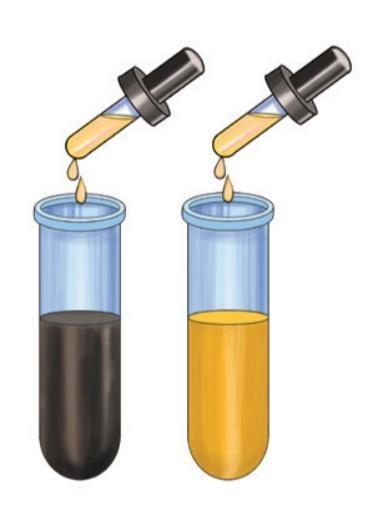
2. Rita added iodine solution to three test tubes A, B, and C containing wheat flour, sugar, and boiled potato respectively. What results will she get in each case? Give reasons.
Answer: Upon adding the iodine solution, the contents of test tube A (wheat flour) and test tube C (boiled potato) will change to a blue-black colour. This reaction occurs because both wheat flour and potatoes contain starch, and iodine acts as an indicator that turns blue-black in the presence of starch. Conversely, the sugar solution in test tube B will not exhibit any colour change when iodine is added, simply because sugar does not contain starch and therefore does not chemically react with iodine.
3. Darken the circle of correct answer :
(i) What is the primary role of the large intestine?
(a) Absorption of nutrients
(b) Absorption of water and salts
(c) Digestion of proteins
(d) Production of enzymes
Answer: (b)
(ii) What is the function of alveoli in the lungs?
(a) To pump air into the lungs
(b) To filter dust from inhaled air
(c) To exchange oxygen and carbon dioxide
(d) To store carbon dioxide
Answer: (c)
(iii) Which gas do we inhale during respiration?
(a) Carbon dioxide
(b) Nitrogen
(c) Oxygen
(d) Hydrogen
Answer: (c)
(iv) Which muscle helps in breathing?
(a) Diaphragm
(b) Heart
(c) Rib cage
(d) Stomach
Answer: (a)
4. Fill up the blanks
(a) The first part of alimentary canal where digestion begins is the ______
Answer: mouth
(b) The food pipe that connects the mouth to the stomach is called the ______
Answer: oesophagus
(c) The ______ stores and churns food while mixing it with digestive juices.
Answer: stomach
5. Match the following
|
Column A |
Column B |
|
(i) Oxygen |
(a) Waste gas exhaled from the body |
|
(ii) Carbon dioxide |
(b) Site of gaseous exchange in lungs |
|
(iii) Alveoli |
(c) Helps in breathing by contracting and relaxing |
|
(iv) Diaphragm |
(d) Process of taking in oxygen and giving out carbon dioxide |
|
(v) Breathing |
(e) Gas required for respiration |
Answer:
|
Column A |
Column B |
|
(i) Oxygen |
(e) Gas required for respiration |
|
(ii) Carbon dioxide |
(a) Waste gas exhaled from the body |
|
(iii) Alveoli |
(b) Site of gaseous exchange in lungs |
|
(iv) Diaphragm |
(c) Helps in breathing by contracting and relaxing |
|
(v) Breathing |
(d) Process of taking in oxygen and giving out carbon dioxide |
6. Ananya says to her classmate Madhurjya that all animals breathe through lungs. What question(s) can her friend Madhurjya ask to make her understand that some animals use gills or skin for breathing?
Answer: To correct Ananya’s misconception, Madhurjya could pose the following questions:
(i) If all animals use lungs, how do aquatic creatures like fish and frog tadpoles manage to breathe underwater?
(ii) When adult frogs are submerged in water for long periods, how do they respire without using their lungs?
(iii) Since earthworms live in the soil and lack lungs entirely, what organ do they use to take in oxygen?
7. Read the following statements and state whether they are correct or not. Support your answer.
Statements:
(a) Chewing food is not necessary for proper digestion.
(b) The small intestine is the main site for absorption of nutrients.
Answer: (a) This statement is Incorrect. Chewing is a vital first step in digestion because it physically breaks down large pieces of food into much smaller particles. This mechanical breakdown significantly increases the surface area of the food, allowing digestive enzymes and juices to work much more efficiently.
(b) This statement is Correct. The inner wall of the small intestine is specially adapted for absorption. It is densely lined with millions of microscopic, finger-like structures known as villi. These villi massively expand the internal surface area, making the small intestine the primary and most efficient site for absorbing digested nutrients into the bloodstream.
8. We often cough when we inhale smoke from fire. What can be the possible explanation for this?
Answer: Smoke produced by fire is a mixture of gases and numerous microscopic unburnt carbon particles and chemical pollutants. When we accidentally inhale this smoke, these tiny, irritating particles enter our sensitive respiratory tract. The body’s natural defense mechanism reacts instantly to expel these foreign irritants from the airways, resulting in the sudden reflex action of coughing.
9. Sita sets up an experiment to check the action of saliva on carbohydrates. She added rice flour and water to two test tubes, M and N. She added saliva to test tube N and left both for 35 minutes. After adding iodine to both test tube solution, she observed the colour change. What do you think Sita wanted to test?
Answer: By conducting this experiment, Sita aimed to investigate the digestive properties of human saliva. Specifically, she wanted to observe and prove whether the enzymes present in saliva are capable of breaking down complex carbohydrates (like the starch present in the rice flour) into simpler forms like sugar.
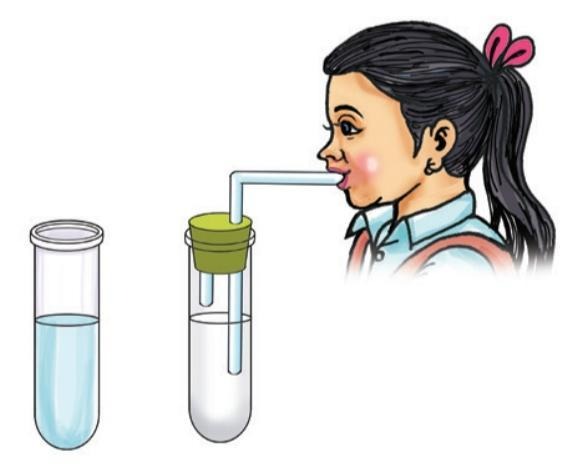
10. A student filled two test tubes with lime water. He blew air from his lungs into one tube and allowed the other to remain with just room air passing through. After some time, he saw a difference. What concept is being tested and how can he be sure of his conclusion?
Answer: The core scientific concept being tested in this experiment is the difference in gas composition between inhaled and exhaled air; specifically, proving that the air we exhale from our lungs has a significantly higher concentration of carbon dioxide compared to the normal atmospheric air we inhale.
He can confidently verify this conclusion through the visual reaction of the lime water. Carbon dioxide reacts with lime water to turn it milky white. The test tube receiving the exhaled breath from his lungs will rapidly turn milky, distinctly indicating a high carbon dioxide presence. In contrast, the test tube exposed only to regular room air will show little to no change, confirming the lower carbon dioxide levels in the surrounding air.
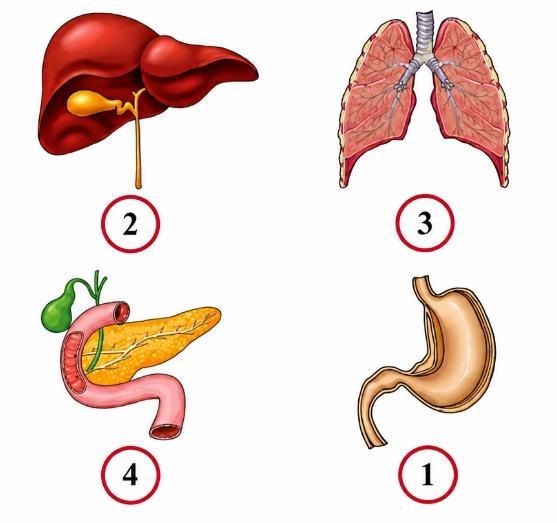
11. Match the organ with their respective names ? 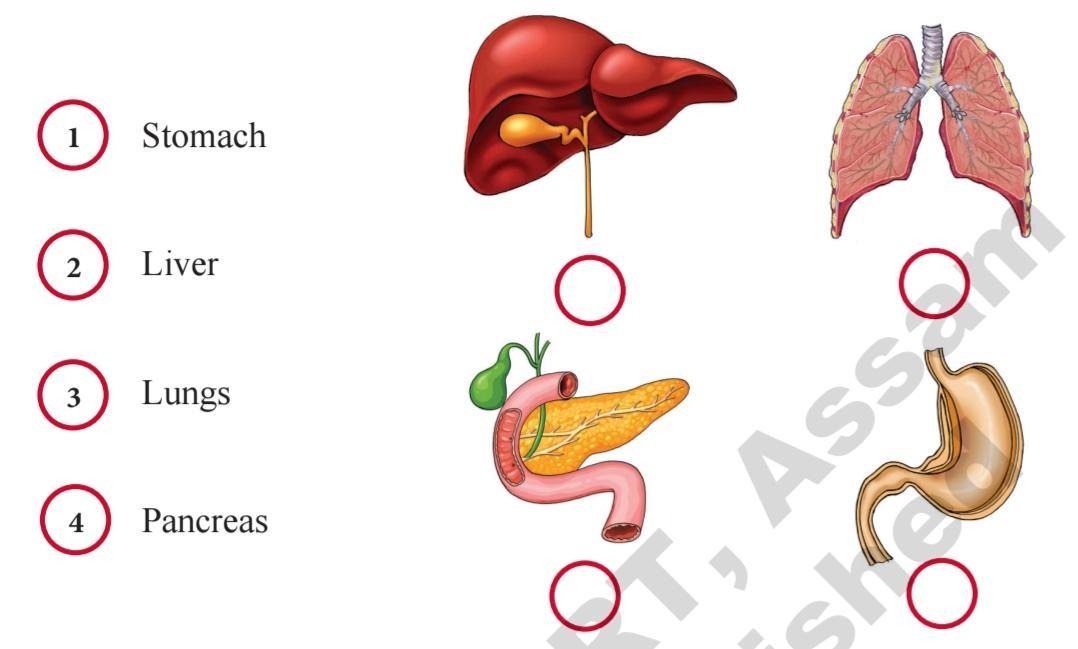
Answer:
A. 20 MCQs with Answers
1. Where does air go first after entering through the nose?
(A) Stomach
(B) Nasal passages
(C) Large intestine
(D) Liver
Answer: (B) Nasal passages
2. What is the main function of alveoli?
(A) Storing food
(B) Exchange of oxygen and carbon dioxide
(C) Absorbing water
(D) Chewing food
Answer: (B) Exchange of oxygen and carbon dioxide
3. Which gas do we inhale during respiration?
(A) Oxygen
(B) Carbon dioxide
(C) Nitrogen
(D) Hydrogen
Answer: (A) Oxygen
4. Which muscle helps in breathing?
(A) Heart
(B) Diaphragm
(C) Liver
(D) Stomach
Answer: (B) Diaphragm
5. What is another name for the food pipe?
(A) Wind pipe
(B) Oesophagus
(C) Large intestine
(D) Small intestine
Answer: (B) Oesophagus
6. Which is the first part of the alimentary canal where digestion begins?
(A) Mouth
(B) Stomach
(C) Small intestine
(D) Large intestine
Answer: (A) Mouth
7. What does saliva do to carbohydrates?
(A) Changes them into fats
(B) Breaks them into simpler sugars
(C) Changes them into proteins
(D) Changes them into water
Answer: (B) Breaks them into simpler sugars
8. What colour does iodine give in the presence of starch?
(A) Red
(B) Green
(C) Blue-black
(D) Yellow
Answer: (C) Blue-black
9. What happens when iodine is added to wheat flour and boiled potato?
(A) No colour change
(B) Turns blue-black
(C) Turns red
(D) Turns green
Answer: (B) Turns blue-black
10. What happens when iodine is added to sugar?
(A) Turns blue-black
(B) No colour change
(C) Turns white
(D) Turns dark blue
Answer: (B) No colour change
11. What is the main function of the large intestine?
(A) Absorption of nutrients
(B) Absorption of water and salts
(C) Chewing food
(D) Absorption of oxygen
Answer: (B) Absorption of water and salts
12. What are the tiny finger-like projections in the inner wall of the small intestine called?
(A) Villi
(B) Alveoli
(C) Muscles
(D) Nasal passages
Answer: (A) Villi
13. Which organ stores and churns food?
(A) Mouth
(B) Stomach
(C) Lungs
(D) Nose
Answer: (B) Stomach
14. How do fish usually breathe?
(A) Lungs
(B) Skin
(C) Gills
(D) Stomach
Answer: (C) Gills
15. What do earthworms use for breathing?
(A) Skin
(B) Gills
(C) Nose
(D) Lungs
Answer: (A) Skin
16. Why do we cough when we inhale smoke?
(A) Smoke digests food
(B) Smoke contains irritating particles
(C) Smoke increases blood
(D) Smoke produces water
Answer: (B) Smoke contains irritating particles
17. Which gas is present in larger amount in exhaled air?
(A) Oxygen
(B) Carbon dioxide
(C) Nitrogen
(D) Hydrogen
Answer: (B) Carbon dioxide
18. What happens when lime water reacts with carbon dioxide?
(A) Stays unchanged
(B) Turns dark blue
(C) Turns milky
(D) Turns green
Answer: (C) Turns milky
19. Through the alimentary canal, food moves from:
(A) Nose to lungs
(B) Mouth to the lower parts
(C) Liver to stomach
(D) Kidney to heart
Answer: (B) Mouth to the lower parts
20. Why are respiration and digestion important?
(A) Only for movement
(B) For energy and survival
(C) Only for sleep
(D) Only to store water
Answer: (B) For energy and survival
B. 15 Long Questions and Answers
1. Describe the path of air through the respiratory system.
Answer: Air enters through the nose, passes through the nasal passages, windpipe, branches of the windpipe, and finally reaches the alveoli. Gas exchange occurs in the alveoli.
2. What is the function of alveoli and why are they important?
Answer: Alveoli exchange oxygen and carbon dioxide. They are important because the body needs oxygen and must remove carbon dioxide.
3. Explain the role of the diaphragm in breathing.
Answer: The diaphragm is a special muscle that helps in breathing. When it contracts, air enters the lungs; when it relaxes, air leaves the lungs.
4. How does saliva help in digestion?
Answer: Saliva moistens and softens food. Its enzyme starts breaking carbohydrates or starch into simpler sugars.
5. How is the presence of starch identified using the iodine test?
Answer: If iodine turns the food blue-black, starch is present. If there is no colour change, starch is absent.
6. Why is the small intestine the main site for absorption of nutrients?
Answer: The inner wall of the small intestine has many villi that increase surface area, allowing digested nutrients to be absorbed into the blood efficiently.
7. Briefly describe the function of the large intestine.
Answer: The large intestine absorbs water and salts from undigested food, helping form solid waste.
8. Why do not all animals breathe through lungs? Explain with examples.
Answer: Not all animals have the same breathing orgAnswer: Fish breathe through gills, earthworms through skin, and many land animals through lungs.
9. Why does smoke cause coughing?
Answer: Smoke contains tiny particles and harmful gases that irritate the respiratory tract, causing the body to cough them out.
10. How can it be proved that exhaled air contains more carbon dioxide?
Answer: If exhaled air is passed through lime water, it turns milky. This proves that exhaled air contains more carbon dioxide.
11. Why is chewing food necessary?
Answer: Chewing breaks food into smaller pieces, increasing surface area so digestive juices can work more effectively.
12. Why is it important that the food pipe and windpipe are separate organs?
Answer: The food pipe carries food to the stomach and the windpipe carries air to the lungs. If they were not separate, food could enter the windpipe and cause danger.
13. What is the role of the stomach in digestion?
Answer: The stomach stores food and churns it with digestive juices, preparing it for further digestion.
14. Why can Madhurjya ask Ananya about earthworms not having lungs?
Answer: Earthworms live in soil and do not have lungs. They breathe through their skin, showing that not all animals use lungs.
15. Why are both respiration and digestion necessary for our body?
Answer: Digestion breaks food into usable substances, and respiration helps release energy from them. Both are essential for energy, growth, and survival.
I have prepared the chapter in bilingual format from the attached document. The next step can be to turn it into a clean PDF-ready layout or to make it more exam-oriented with marking scheme and section headers.