Class 7 Science Chapter 11 Life Processes of Plants Solutions | ASSEB Assam | English Medium
Class 7 Science (Amar Bijan) Chapter 11 – Life Processes of Plants Complete Textual Question Answers and Solutions (ASSEB Assam – English Medium)
The eleventh chapter of the Class 7 Science (English Medium) syllabus, ‘Life Processes of Plants,’ is a fascinating botany topic focusing on how plants survive, grow, and reproduce. Based on the new ASSEB (Assam State School Education Board) guidelines and the latest National Education Policy (NEP) framework according to the current syllabus, we have prepared comprehensive textual question answers for this chapter. This special guide includes very short answers (VSA), short questions, long descriptive answers, multiple-choice questions (MCQs), and additional questions. Brought to you by Ospin Academy, these solutions are accurate, easy to understand, and highly exam-oriented.
In ‘Life Processes of Plants’, students discover the vital mechanisms that sustain plant life, such as photosynthesis for nutrition, the transportation of water and minerals through the xylem, and the distribution of food via the phloem. The chapter also provides a detailed look at respiration and various modes of reproduction (both vegetative and sexual) in plants. Understanding these processes is crucial for biology students and essential for exam preparation. Our textual solutions not only cover the textbook exercises but also provide extra important questions and MCQs to ensure students have a thorough grasp of the topic.
What you will learn and get from these textual solutions:
- Clear explanations of plant nutrition, photosynthesis, and respiration.
- 1-mark objective questions (VSA), MCQs, and detailed 2-3 mark short questions tailored for exams.
- Step-by-step explanations for 4-5 mark long questions, including the structure and function of xylem and phloem.
- A wide range of additional questions and MCQs specifically designed according to the new syllabus pattern.
- Comprehensive insights into sexual and asexual reproduction in plants, explained in simple English.
Special Features of Ospin Academy’s Notes:
- Prepared strictly according to the new ASSEB syllabus and current educational guidelines.
- 100% accurate and written in simple, easy-to-memorize English (Class 7 Science Notes).
- Includes quick revision summaries of plant biology concepts, highly beneficial for last-minute exam preparation.
- Exclusive compilation of extra important questions and MCQs to maximize your scores.
Aiming for academic excellence, Ospin Academy provides these comprehensive textual solutions to aid students in their studies. Start your preparation today and secure the highest marks in Class 7 Science.

Class 7 Science (English Medium) PDF Solutions 2026-27 | SEBA Assam
Get Class 7 Science Solutions (SEBA Assam) in a PDF format, covering Part I & II with chapter-wise answers, MCQs, and explanations. Perfect for exam preparation and concept clarity.
Out of stock
SCERT Assam, Class 7: Science
Life Processes of Plants
পাঠভিত্তিক প্রশ্নোত্তৰ
EXERCISE
1. Darken the circle of correct answer :
(i) Which part of the plant takes in carbon dioxide from the air for
photosynthesis?
(a) Root hair
(b) Leaf veins
(c) Stomata
(d) Sepals
Answer: (c)
(ii) The green colour of leaves of plants is due to
(a) Chlorophyll
(b) Xylem
(c) Phloem
(d) Stomata
Answer: (a)
(iii) How many guard cells are present around the stoma?
(a) 4
(b) 3
(c) 2
(d) 5
Answer: (c)
(iv) Raw materials used by plants during photosynthesis include—
(a) Nitrogen and oxygen
(b) Carbon dioxide and water
(c) Oxygen, hydrogen and carbon dioxide
(d) Water and minerals
Answer: (b)
2. Fill up the blanks
(a) Plants use energy from the ______ to make ______.
Answer: solar energy, nourishment (সূৰ্যৰ পোহৰ, আহাৰ)
(b) During photosynthesis, plants take in ______ and release ______.
Answer: CO₂, O₂
3. State whether the following statements are true or false?
(a) The product of photosynthesis is not a protein.
Answer: Correct
(b) A plant having red leaves cannot perform photosynthesis.
Answer: Incorrect
4. Two statements are given below; one is Assertion and other is
Reason.
Assertion : The green pigment present in the leaves of plant is called
chlorophyll
Reason : This green pigment is responsible for the green colour of
most of the plants.
Choose the appropriate answer from the following options:
(a) Both Assertion and Reason are true and Reason is the correct
explanation of A.
(b) Both Assertion and Reason are true but Reason is not the correct
explanation of A.
(c) Assertion is true but Reason is false.
(d) Assertion is false but Reason is true.
Answer: (a)
4. Match the followings :
|
Column-I |
Column-II |
|
(i) Chlorophyll |
(a) xylem |
|
(ii) Stomata |
(b) leaf |
|
(iii) Photosynthesis |
(c) guard cell |
|
(iv) Transport of water |
(d) starch |
Answer:
|
Column-I |
Column-II |
|
(i) Chlorophyll |
(b) leaf |
|
(ii) Stomata |
(c) guard cell |
|
(iii) Photosynthesis |
(d) starch |
|
(iv) Transport of water |
(a) xylem |
5. Two statements are given below; one is Assertion and other is Reason
Assertion: The green pigment present in the leaves of plant is called chlorophyll
Reason: This green pigment is responsible for the green colour of most of the plants.
Choose the appropriate answer from the following options:
(a) Both Assertion and Reason are true and Reason is the correct explanation of A.
(b) Both Assertion and Reason are true but Reason is not the correct explanation of A.
(c) Assertion is true but Reason is false.
(d) Assertion is false but Reason is true.
Answer: (a)
6. Answer the following questions briefly.
(a) Name the sugar produced during photosynthesis.
Answer: The synthesized carbohydrate is known as Glucose.
(b) What is the function of phloem in plants?
Answer: The phloem tissues are responsible for distributing the synthesized nutrients from the foliage to the entire plant structure.
(c) What is the role of stomata in the leaf for production of food?
Answer: Stomata function as tiny pores that allow the plant to absorb atmospheric carbon dioxide, which is an essential raw material for synthesizing food.
(d) How would you test the presence of starch in leaves?
Answer: To detect starch, first immerse a freshly plucked green leaf in a beaker of boiling water for approximately five minutes. Once removed, place the leaf inside a test tube, submerging it completely in alcohol. Gently heat this test tube in a hot water bath until the alcohol boils, which extracts the green chlorophyll and renders the leaf pale. Take the leaf out, rinse it with clean water, and spread it flat on a petriplate. Add a couple of drops of diluted iodine solution onto its surface. If the leaf develops a dark blue-black hue, it confirms that starch is present.
(e) Write an experiment to show that oxygen is released during photosynthesis.
Answer: Submerge a few freshly cut sprigs of an aquatic plant like Hydrilla inside a large beaker filled with water. Introduce a small quantity of soda water to supply carbon dioxide. Invert a glass funnel over the plant cuttings so they are enclosed. Next, take a test tube entirely filled with water and carefully invert it over the narrow stem of the funnel. Ensure the cut ends of the Hydrilla are pointing upwards within the funnel. 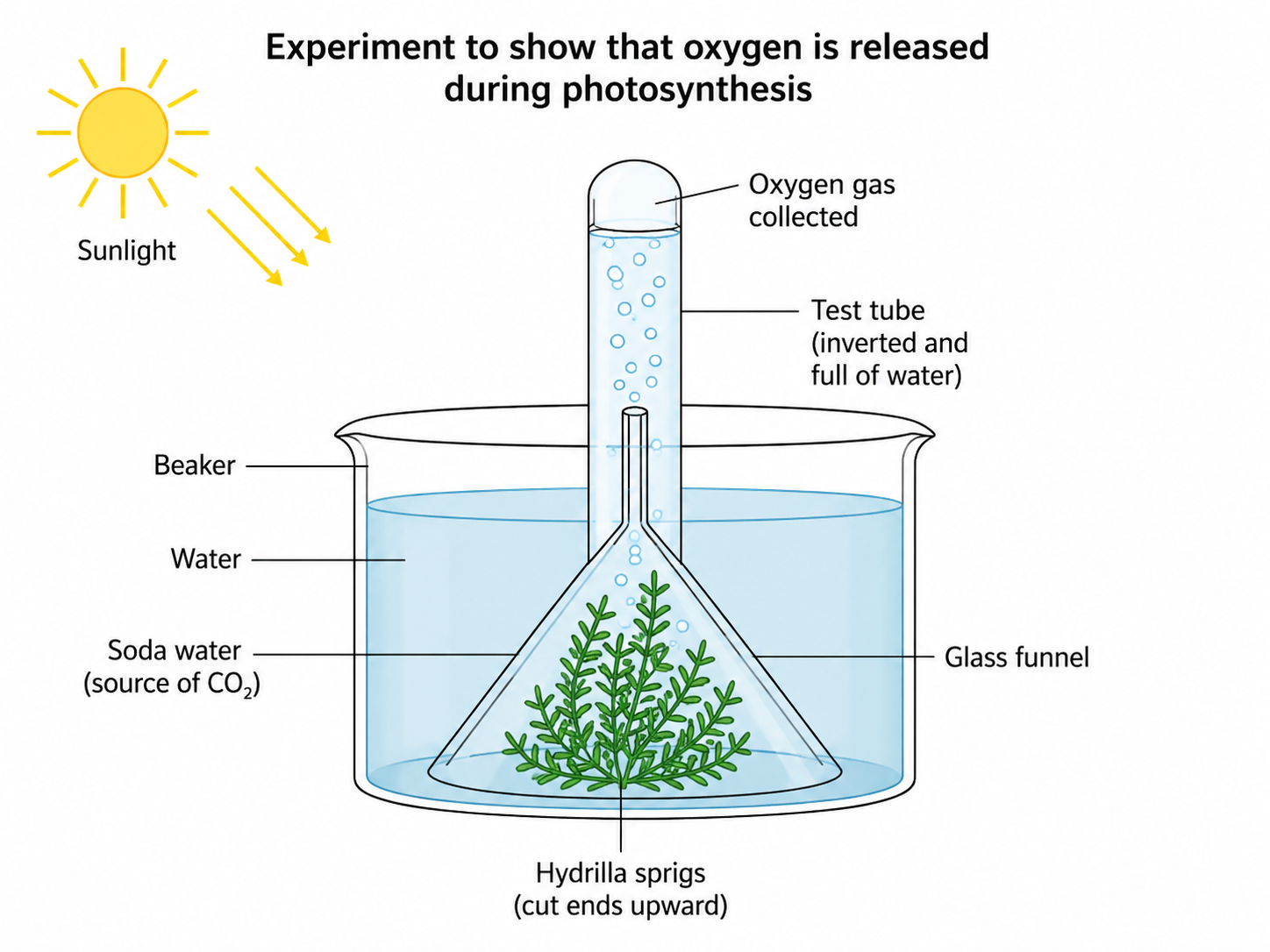
Leave this entire arrangement out in bright sunlight for about three hours. Under the light, you will observe tiny gas bubbles emerging from the cut stems, rising and collecting at the top of the test tube by displacing the water downwards. Carefully remove the test tube and bring a glowing splint near its mouth; the gas will ignite it into a bright flame. This confirms that the collected gas is primarily oxygen, proving its release during the photosynthetic process.
(f) Write the word equation of photosynthesis and respiration.
Answer:
Word equation outlining photosynthesis:

Word equation outlining respiration :
Glucose + Oxygen Carbon dioxide + Water + Energy
7. Imagine a situation where all the plants, and tiny green organisms that perform photosynthesis suddenly disappeared from the Earth. What impact would it have on the air we breathe and the living organisms on the Earth?
Answer: Photosynthesis is the primary mechanism that replenishes oxygen in our atmosphere. Without photosynthetic flora and microorganisms, the atmospheric oxygen essential for our breathing would rapidly deplete. Consequently, all aerobic life forms on Earth would face extinction, as they strictly depend on oxygen to carry out respiration for survival.
8. Which side of the leaf shown in the Fig. 11.14 may contain more stomata? 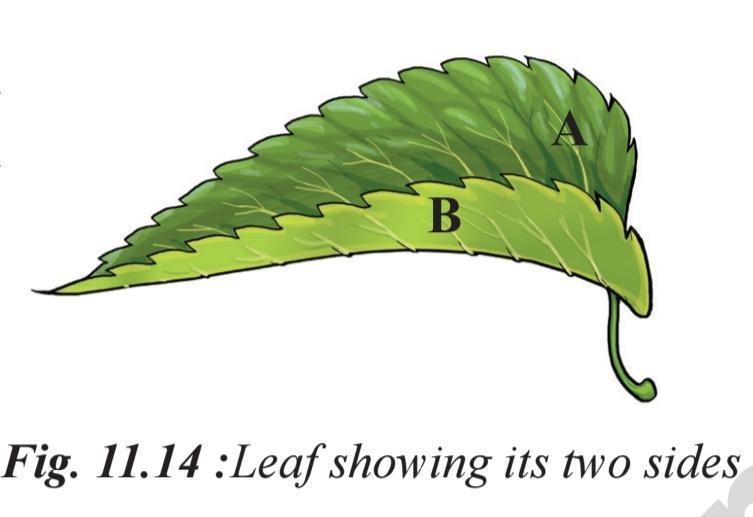
Answer: Side B usually possesses a higher number of stomata.
9. Look at the following pictures carefully. In Fig. 11.15 (a) the life process of a potato plant is shown and in Fig 11.15 (b) an experiment conducted on a slice of potato is shown. 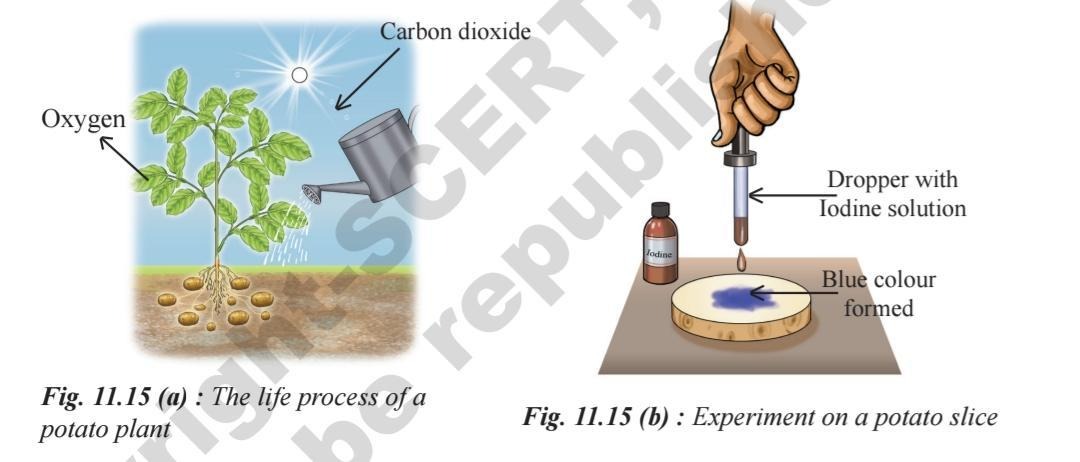
Answer the following questions:
(i) What does this colour change tell us about the substance stored in the potato?
Answer: The bluish-black discoloration indicates that starch is the primary reserve material within the tuber.
(ii) This stored substance is not produced in the potato itself. Where does this substance in potatoes come from?
Answer: The starch found inside the tuber is actually transported down from the foliage above.
(iii) In which part of the plant food is synthesised? Name the process of synthesis of food in the plant.
Answer: The foliage or leaves act as the food-producing factories for the plant. This biological manufacturing process is termed photosynthesis.
(iv) Describe the journey of the food from the place of its synthesise to the place where it is stored (potato). Name the structure that carries this food.
Answer: After being manufactured in the leaves, the nutrients travel downwards to the underground tuber through a network of specialized vascular tubes. The vascular tissue responsible for moving this food is known as the phloem.
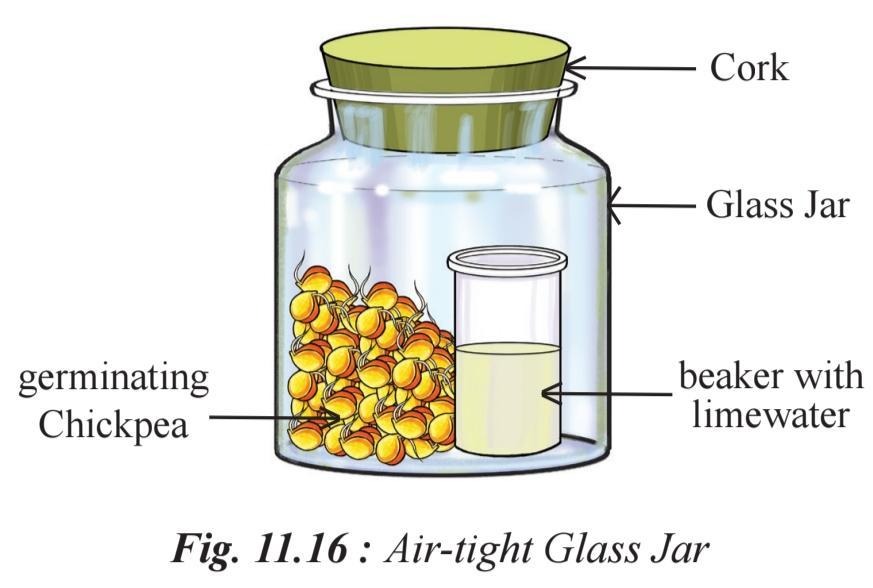
10. Ritu set up an experiment with sprouted chickpea seeds in an air-tight closed glass jar (Fig. 11.16). After a few days, she noticed that the limewater turned milky.
Answer the questions :
(i) What idea might she be investigating through this experiment?
Answer: Ritu is most likely testing the hypothesis that germinating plants exhale carbon dioxide as a byproduct of respiration.
(ii) What does this change in limewater show?
Answer: The milky appearance of the limewater confirms the generation of carbon dioxide within the enclosed jar.
(iii) Which life process carried out by the germinating chickpeas is responsible for this change?
Answer: The physiological process of cellular respiration occurring in the sprouting seeds drives this chemical change.
(iv) If Ritu had used dry seeds instead of sprouted ones, would the result be the same? Give reason to your answer?
Answer: Using completely dry seeds would yield a different outcome. Dry seeds have a negligible rate of respiration compared to germinating ones. Thus, the minuscule volume of carbon dioxide emitted would be insufficient to turn the limewater milky.
(v) During the experiment, if the limewater did not turn milky even after a few days, list two possible errors in the setup.
Answer: Two potential flaws in the experimental arrangement could be:
(a) The seal on the glass jar might not be completely airtight, allowing the evolved CO₂ to leak out into the surroundings.
(b) The enclosed jar might have lacked an adequate initial supply of oxygen to support robust respiration by the seeds.
(vi) How does this experiment help us understand the role of respiration in plant growth?
Answer: The experiment demonstrates that respiration facilitates the breakdown of glucose utilizing oxygen, which yields carbon dioxide, water, and vital energy. Plants harness this liberated energy to fuel essential growth processes, including cellular replication, nutrient absorption, tissue regeneration, and the synthesis of structural molecules.
20 Multiple Choice Questions (MCQs) with Answers
1. Which component is directly responsible for absorbing light energy during photosynthesis?
(A) Xylem
(B) Chlorophyll
(C) Phloem
(D) Stomata
Answer: (B)
2. What is the ultimate source of energy for all living organisms?
(A) Soil
(B) Water
(C) Sun
(D) Air
Answer: (C)
3. The process by which plants synthesize their own food is called:
(A) Digestion
(B) Respiration
(C) Photosynthesis
(D) Transpiration
Answer: (C)
4. Which gas is taken in by plants during photosynthesis?
(A) Oxygen
(B) Carbon dioxide
(C) Nitrogen
(D) Hydrogen
Answer: (B)
5. Which gas is released as a byproduct during photosynthesis?
(A) Carbon dioxide
(B) Methane
(C) Nitrogen
(D) Oxygen
Answer: (D)
6. Water and minerals are absorbed from the soil through the:
(A) Leaves
(B) Roots
(C) Flowers
(D) Stems
Answer: (B)
7. What transports water and minerals from the roots to the leaves?
(A) Phloem
(B) Stomata
(C) Xylem
(D) Root hair
Answer: (C)
8. Carbohydrates produced by photosynthesis primarily consist of:
(A) Carbon, hydrogen, oxygen
(B) Carbon, nitrogen, oxygen
(C) Nitrogen, hydrogen, oxygen
(D) Carbon, iron, oxygen
Answer: (A)
9. The presence of starch in leaves can be tested using:
(A) Alcohol
(B) Iodine solution
(C) Water
(D) Acid
Answer: (B)
10. Stomata are enclosed by how many guard cells?
(A) One
(B) Two
(C) Three
(D) Four
Answer: (B)
11. The food synthesized by plants is stored as:
(A) Protein
(B) Fat
(C) Starch
(D) Vitamin
Answer: (C)
12. What is the main function of phloem tissue?
(A) To transport water
(B) To transport minerals
(C) To transport synthesized food
(D) To absorb sunlight
Answer: (C)
13. In which part of a potato plant is starch generally stored?
(A) Leaves
(B) Stem/Tuber
(C) Roots
(D) Flowers
Answer: (B)
14. The tiny pores on the surface of leaves are called:
(A) Chloroplasts
(B) Xylem
(C) Stomata
(D) Veins
Answer: (C)
15. Respiration in germinating seeds produces:
(A) Oxygen
(B) Carbon dioxide
(C) Glucose
(D) Starch
Answer: (B)
16. Limewater turns milky due to the presence of:
(A) Oxygen
(B) Nitrogen
(C) Carbon dioxide
(D) Carbon monoxide
Answer: (C)
17. Which of these is essential for a plant to undergo photosynthesis?
(A) Darkness
(B) Chlorophyll
(C) Oxygen
(D) Fungi
Answer: (B)
18. The word equation for photosynthesis includes water and what other reactant?
(A) Oxygen
(B) Carbon dioxide
(C) Sunlight
(D) Glucose
Answer: (B)
19. Energy is released during which biological process?
(A) Photosynthesis
(B) Transpiration
(C) Respiration
(D) Absorption
Answer: (C)
20. What color indicates the presence of starch when tested with iodine?
(A) Red
(B) Green
(C) Yellow
(D) Blue-black
Answer: (D)
B. 15 Long Questions with Answers
1. Explain the process of photosynthesis in plants.
Answer: Photosynthesis is the biological process by which green plants manufacture their own nourishment. Using sunlight absorbed by chlorophyll, plants convert atmospheric carbon dioxide (taken through stomata) and water (absorbed by roots) into glucose. Oxygen is released into the atmosphere as a byproduct during this reaction.
2. Why is chlorophyll important for a plant?
Answer: Chlorophyll is crucial because it acts as the primary pigment that captures light energy from the sun. Without this captured energy, the chemical reaction of combining water and carbon dioxide to form glucose cannot occur, halting the food synthesis process.
3. Describe the structure and function of stomata.
Answer: Stomata are microscopic openings generally located on the undersurface of leaves. Each stoma is surrounded by two specialized guard cells that regulate its opening and closing. Their primary function is to facilitate gas exchange, allowing carbon dioxide to enter for photosynthesis and oxygen to exit.
4. Differentiate between xylem and phloem.
Answer: Xylem is the vascular tissue responsible for transporting water and dissolved minerals upwards from the roots to the leaves. In contrast, phloem is the tissue that distributes the synthesized food (glucose) downwards from the leaves to all other living parts of the plant, including roots and storage organs.
5. How do plants ensure their roots get the energy they need?
Answer: Even though roots are underground and cannot photosynthesize, they receive energy via the phloem. The food produced in the sunlit leaves travels through the phloem pathways down into the root system, where it is broken down through cellular respiration to release energy.
6. What is the significance of the iodine test in plant experiments?
Answer: The iodine test is a standard biochemical procedure used to detect the presence of starch. When applied to a decolorized leaf, iodine reacts with any stored starch to form a distinct blue-black compound, visually proving that photosynthesis has taken place and food was synthesized.
7. Explain the relationship between photosynthesis and respiration.
Answer: Photosynthesis and respiration are complementary biological cycles. Photosynthesis stores solar energy in glucose molecules and releases oxygen. Respiration essentially reverses this, consuming oxygen to break down glucose, which releases the stored energy for cellular activities while emitting carbon dioxide and water back into the environment.
8. Why does a plant die if its leaves are completely coated in thick oil?
Answer: Coating leaves in oil blocks the stomata, which completely halts gas exchange. Without carbon dioxide entering, the plant cannot photosynthesize. Furthermore, trapped oxygen and an inability to release water vapor disrupt normal metabolic functions, leading to starvation and eventually the death of the plant.
9. What would happen if the phloem tissue in a plant stem gets completely severed?
Answer: If the phloem is severed, the downward transport of food from the leaves stops. The roots, starved of essential nutrients and energy, would eventually perish. Once the root system dies and fails to absorb water, the entire plant will wither and die shortly after.
10. Describe an experiment to prove that seeds respire while germinating.
Answer:
Place a handful of sprouting chickpea seeds inside a tightly sealed glass jar alongside a small beaker containing fresh limewater. Let the setup sit undisturbed for a couple of days. The limewater will gradually turn a milky white hue, demonstrating that the germinating seeds are actively respiring and producing carbon dioxide gas.
11. Why is photosynthesis vital for maintaining the balance of nature?
Answer:
Photosynthesis acts as the planet’s primary air purifier and food source. It removes carbon dioxide, a greenhouse gas, from the atmosphere while continuously replenishing the oxygen supply that all animals need to breathe. Additionally, it forms the foundation of almost all ecological food chains.
12. In what way do the raw materials for photosynthesis reach the leaves?
Answer:
Carbon dioxide enters directly into the leaves from the ambient air via tiny pores called stomata. Meanwhile, water and essential minerals are drawn from the soil by root hairs and pulled upwards against gravity through the continuous capillary-like tubes of the xylem system.
13. Explain the transformation of energy during photosynthesis.
Answer:
During photosynthesis, light energy emitted by the sun is captured by chlorophyll molecules in plant cells. This solar energy undergoes a transformation and is ultimately stored as chemical potential energy within the atomic bonds of newly synthesized glucose molecules.
14. Why can’t humans or animals perform photosynthesis?
Answer:
Animals and humans lack chloroplasts, the specialized cellular organelles that contain chlorophyll. Without this specific pigment, our cells are completely incapable of capturing and utilizing sunlight to drive the chemical reaction necessary for manufacturing glucose from water and carbon dioxide.
15. How is respiration different in germinating seeds compared to dry seeds?
Answer:
Germinating seeds require massive amounts of energy to fuel rapid cellular division and active physical growth, so their respiration rate is extremely high. Dry, dormant seeds require almost no energy just to remain alive, so their cellular respiration rate is extremely slow and barely detectable.