Class 7 Science Chapter 12 Earth Moon and The Sun Solutions | ASSEB Assam | English Medium
Class 7 Science (Amar Bijan) Chapter 12 – Earth Moon and The Sun Complete Textual Question Answers and Solutions (ASSEB Assam – English Medium)
The twelfth chapter of the Class 7 Science (English Medium) syllabus, ‘Earth Moon and The Sun,’ is a captivating astronomy topic that takes students on a journey through our solar system. Based on the new ASSEB (Assam State School Education Board) guidelines and the latest National Education Policy (NEP) framework according to the current syllabus, we have prepared comprehensive textual question answers for this chapter. This special guide includes very short answers (VSA), short questions, long descriptive answers, multiple-choice questions (MCQs), and additional questions. Brought to you by Ospin Academy, these solutions are accurate, easy to understand, and highly exam-oriented.
In ‘Earth Moon and The Sun’, students explore the movements of celestial bodies and how they affect our daily lives. The chapter details the rotation and revolution of the Earth causing day, night, and seasons, the fascinating phases of the moon, and the alignment required for solar and lunar eclipses. Understanding these cosmic phenomena is essential for building a strong scientific foundation. Our textual solutions not only cover the textbook exercises but also provide extra important questions and MCQs to ensure students have a thorough grasp of the topic.
What you will learn and get from these textual solutions:
- Clear explanations of Earth’s rotation and revolution, and how they cause day, night, and seasons.
- 1-mark objective questions (VSA), MCQs, and detailed 2-3 mark short questions tailored for exams.
- Step-by-step explanations for 4-5 mark long questions, including the scientific reasons behind solar and lunar eclipses.
- A wide range of additional questions and MCQs specifically designed according to the new syllabus pattern.
- Comprehensive insights into the changing phases of the moon and its orbit, explained in simple English.
Special Features of Ospin Academy’s Notes:
- Prepared strictly according to the new ASSEB syllabus and current educational guidelines.
- 100% accurate and written in simple, easy-to-memorize English (Class 7 Science Notes).
- Includes quick revision diagrams and summaries of celestial events, highly beneficial for last-minute exam preparation.
- Exclusive compilation of extra important questions and MCQs to maximize your scores.
Aiming for academic excellence, Ospin Academy provides these comprehensive textual solutions to aid students in their studies. Start your preparation today and secure the highest marks in Class 7 Science.
V
Class 7 Science (English Medium) PDF Solutions 2026-27 | SEBA Assam
Get Class 7 Science Solutions (SEBA Assam) in a PDF format, covering Part I & II with chapter-wise answers, MCQs, and explanations. Perfect for exam preparation and concept clarity.
Out of stock
SCERT Assam, Class 7: Science
Earth Moon and The Sun
EXERCISE
1. Fill up the blanks
(i) The Earth rotates from ________ direction to ________ direction.
Answer: the west, the east
(ii) The movement of an object around another object is called the ________.
Answer: orbiting or revolution
(iii) The imaginary line on which the Earth rotates is called ________.
Answer: rotational axis
3. State whether the following statements are true or false?
(i) Rotation refers to an object spinning around its own axis. (True/False)
Answer: True
(ii) The Earth’s axis of rotation is upright with respect to the orbit. (True/False)
Answer: False
(iii) Solar eclipse happens in every year. (True/False)
Answer: False
(iv) A “diamond ring” is seen after a lunar eclipse. (True/False)
Answer: False
3. Jonaki notices a group of stars at the midnight in the winter solstice. Will she notice the same group of stars at midnight in the winter solstice next year on the same day?
Answer: She will indeed see the same star cluster on that specific day next year.
4. Why do you think plants move eastward even though the Earth rotates from West to East?
Answer: Yes, I do believe planets travel eastward, much like Earth. This shared directional movement is a result of their common origin from an enormous, spinning disc composed of cosmic dust and gases during the formation of the solar system.
5. What differences would happen if the Earth was not tilted on its axis?
Answer: Had Earth maintained a perfectly vertical axis without any tilt, the phenomenon of changing seasons would not exist on our planet.
6. A friend says, “Solar eclipses occur during New Moon. Then why don’t eclipses occur every New Moon?” How would you respond to him using your understanding from the chapter?
Answer: A solar eclipse does not happen every New Moon because the lunar orbit has a tilt of approximately 5º compared to the Earth’s orbit around the Sun. Consequently, the Moon, Earth, and Sun do not align perfectly in a single plane during every New Moon phase.
7. Darken the circle of correct answer :
(i) In which phase of the Moon, does a solar eclipse occur?
(a) New Moon
(b) Full Moon
(c) First quarter
(d) Last quarter
Answer: (a)
(ii) What is the order of the Sun, Earth and Moon during a solar eclipse?
(a) Earth Sun Moon
(b) Sun Moon Earth
(c) Earth Moon Sun
(d) Moon Sun Earth
Answer: (b)
(iii) One morning, Madhurjya was talking with his cousin who was in United States of America (USA), his cousin was about to sleep as it was night-time there. What is the main reason behind this time difference?
(a) The USA is farther from the Sun
(b) The Moon blocks sunlight from reaching the USA
(c) The Earth’s revolution causes day and night.
(d) The Earth’s rotation causes different areas to face the Sun at different times.
Answer: (d)
(iv) Teacher asked, “Why do the places near the Poles experience long days in summer and long nights in winter”? Four students answered. Who do you think answered correctly?
(a) The Sun moves closer to the Poles in summer.
(b) The Sun moves farther from the Poles during winter.
(c) The Earth spins on its axis near the Poles.
(d) The tilt of Earth’s axis affects sunlight during revolution.
Answer: (d)
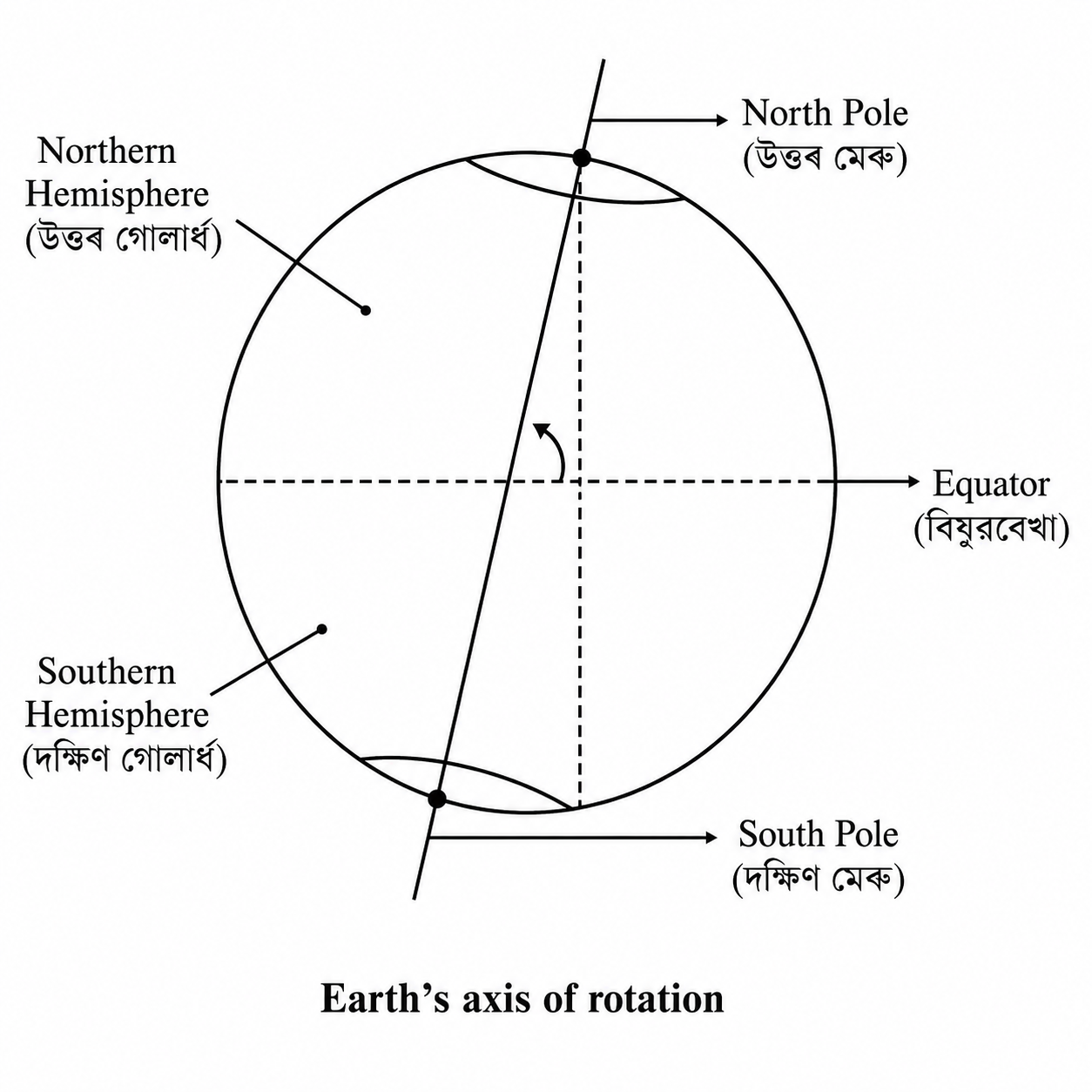
8. Label the followings in the given figure of the Earth.
North Pole and South Pole
Northern Hemisphere
Southern Hemisphere
Equator
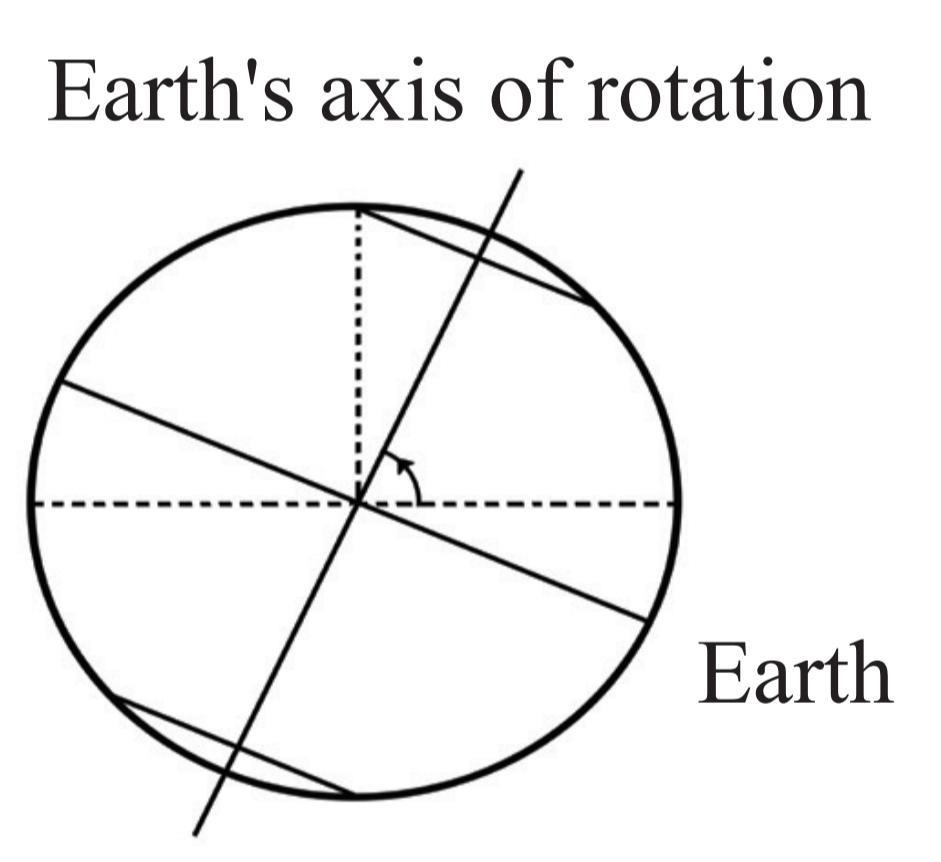
Answer:
9. Draw and label the diagram:
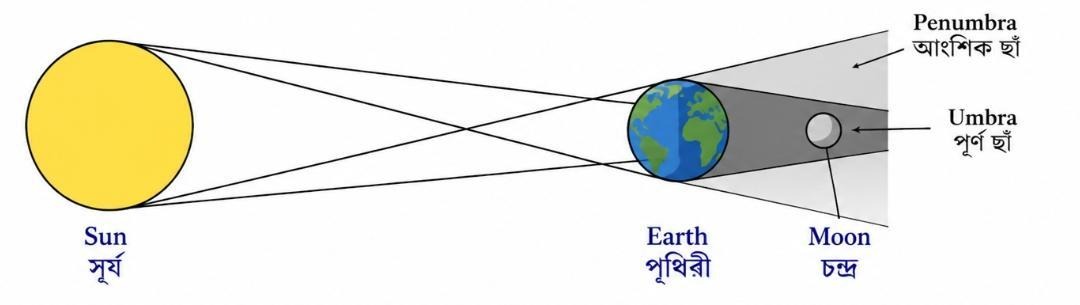
(a) Lunar eclipse
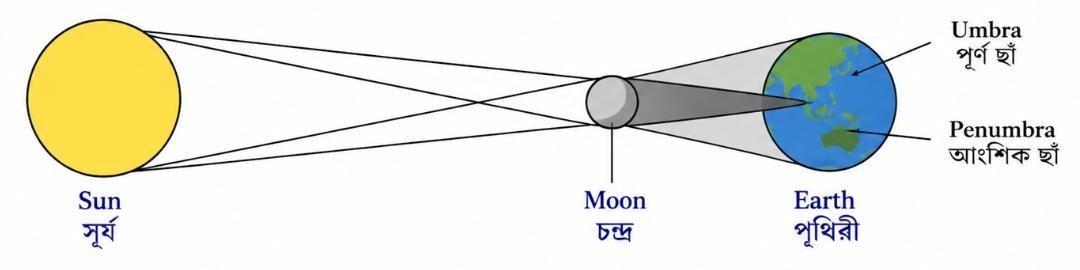
(b) Solar eclipse
Answer: (a) Lunar eclipse (চন্দ্ৰগ্ৰহণ)
(b) Solar eclipse (সূৰ্যগ্ৰহণ)
10. How do you keep yourself safe if you want to see the solar eclipse?
Answer: To ensure absolute safety while watching a solar eclipse, one must utilize certified eclipse glasses or designated solar viewing filters. Looking at a solar eclipse with the naked eye, through ordinary sunglasses, or via unfiltered magnification devices like binoculars or telescopes is highly dangerous and should be avoided.
11. If you are 11 years old, what will be your age after the Earth completes one revolution around the Sun. Explain.
Answer: Once Earth makes a full orbital trip around the Sun, my age will increase to 12 years. The reason for this is that it takes Earth approximately 36514 days to complete a single orbit around the Sun, a duration that constitutes exactly one year.
12. Find the odd one out and justify your answer
(a) Moon, Mercury, Venus
(b) Day, Year, Month, Eclipse
Answer: (a) Moon. The odd one out is the Moon, primarily because it serves as Earth’s natural satellite, while both Mercury and Venus are classified as planets orbiting the Sun.
(b) Eclipse. Here, Eclipse is the odd term since it represents a specific astronomical event in space. Conversely, Day, Month, and Year are standard measurements used to calculate time.
13. Match the following
|
Column A |
Column B |
|
(i) Seasons |
|
|
(ii) Solar eclipse |
|
|
(iii) Day and night |
|
|
(iv) Lunar eclipse |
Answer:
|
Column A |
Column B |
|
(i) Seasons |
(b) Caused by Earth’s tilt and revolution |
|
(ii) Solar eclipse |
(a) Moon blocks sunlight |
|
(iii) Day and night |
(d) Caused by earth’s rotation |
|
(iv) Lunar eclipse |
(c) Earth blocks the moon |
20 Multiple Choice Questions (MCQs) with Answers
1. From which direction to which direction does the Earth rotate on its axis?
(A) East to West
(B) North to South
(C) West to East
(D) South to North
Answer: (C)
2. What is the path followed by the Earth around the Sun called?
(A) Axis
(B) Orbit
(C) Equator
(D) Hemisphere
Answer: (B)
3. What astronomical event occurs when the Earth comes between the Sun and the Moon?
(A) Solar Eclipse
(B) Lunar Eclipse
(C) Full Moon
(D) Meteor Shower
Answer: (B)
4. How long does the Earth take to complete one rotation on its axis?
(A) 12 hours
(B) 24 hours
(C) 365 days
(D) 1 month
Answer: (B)
5. The imaginary line dividing the Earth into Northern and Southern Hemispheres is called:
(A) Axis
(B) Orbit
(C) Equator
(D) Pole
Answer: (C)
6. Why do we experience changes in seasons?
(A) Due to Earth’s rotation
(B) Due to the Moon’s revolution
(C) Due to Earth’s tilt and revolution
(D) Due to solar eclipses
Answer: (C)
7. During which lunar phase does a lunar eclipse occur?
(A) New Moon
(B) Full Moon
(C) Crescent Moon
(D) First Quarter
Answer: (B)
8. What causes day and night on Earth?
(A) Revolution of the Earth
(B) Tilt of the Earth’s axis
(C) Rotation of the Earth
(D) Revolution of the Moon
Answer: (C)
9. About how many days does it take for Earth to complete one revolution around the Sun?
(A) 365 days
(B) 36514 days
(C) 366 days
(D) 364 days
Answer: (B)
10. The angle of tilt of the Earth’s axis relative to its orbital plane is approximately:
(A) 23.5
(B) 66.5
(C) 90
(D) 0
Answer: (B)
11. Which celestial body is a natural satellite of the Earth?
(A) Sun
(B) Venus
(C) Mars
(D) Moon
Answer: (D)
12. The time period Earth takes to travel once around the Sun is defined as a:
(A) Day
(B) Month
(C) Year
(D) Century
Answer: (C)
13. Why don’t solar eclipses occur every month?
(A) The Earth is too far from the Sun
(B) The Moon’s orbit is tilted
(C) The Moon is too small
(D) The Sun is too bright
Answer: (B)
14. In a solar eclipse, what is the position of the Moon?
(A) Behind the Sun
(B) Behind the Earth
(C) Between the Sun and the Earth
(D) At the North Pole
Answer: (C)
15. The top point of the imaginary axis around which Earth rotates is known as the:
(A) South Pole
(B) Equator
(C) North Pole
(D) Orbit
Answer: (C)
16. What is the safest way to view a solar eclipse?
(A) Using binoculars
(B) Using ordinary sunglasses
(C) With naked eyes
(D) Using certified solar filters
Answer: (D)
17. Which is an example of a celestial phenomenon?
(A) Day
(B) Month
(C) Eclipse
(D) Year
Answer: (C)
18. As the Earth rotates, the half facing away from the Sun experiences:
(A) Summer
(B) Winter
(C) Day
(D) Night
Answer: (D)
19. The bottom point of the Earth’s axis is the:
(A) Equator
(B) South Pole
(C) North Pole
(D) Orbit
Answer: (B)
20. If it is summer in the Northern Hemisphere, what season is it in the Southern Hemisphere?
(A) Summer
(B) Winter
(C) Spring
(D) Autumn
Answer: (B)
B. 15 Long Questions with Answers
1. Explain the difference between rotation and revolution of the Earth.
Answer: Rotation refers to the Earth spinning continuously on its own imaginary axis, taking approximately 24 hours to complete one full turn, which creates the cycle of day and night. Revolution, conversely, is the Earth’s orbital journey around the Sun, requiring roughly 36514 days for a full circuit, a movement that, combined with the axial tilt, results in the changing seasons.
2. How do day and night occur on Earth?
Answer: As our planet rotates on its tilted axis from west to east, different parts of its surface are exposed to the Sun. The half of the globe facing the solar rays experiences daytime, while the opposite half, hidden in the planet’s shadow, goes through nighttime. This continuous spinning guarantees the steady succession of day into night across the world.
3. Describe the alignment of celestial bodies during a solar eclipse.
Answer: A solar eclipse manifests exclusively during the New Moon phase when the Moon happens to pass directly between the Sun and the Earth. In this precise alignment, the Moon obstructs the solar light, casting its dark shadow onto specific regions of the Earth’s surface and temporarily plunging them into daytime darkness.
4. Why does a lunar eclipse not happen during every Full Moon?
Answer: While a lunar eclipse requires a Full Moon phase with the Earth positioned between the Sun and the Moon, it does not happen monthly because the Moon’s orbit is tilted at a 5-degree angle relative to Earth’s orbital plane. Consequently, during most Full Moons, the Moon is positioned slightly above or below the Earth’s shadow.
5. What causes the changing of seasons on Earth?
Answer: The progression of seasons is driven by two main factors: Earth’s annual revolution around the Sun and its axial tilt of roughly 23.5 degrees. Because of this permanent slant, the Northern and Southern Hemispheres alternately lean toward or away from the Sun, varying the intensity and duration of sunlight they receive throughout the year.
6. Explain the concept of a Leap Year.
Answer: A standard calendar year spans 365 days, but Earth actually takes 36514 days to complete one orbit. To compensate for this discrepancy, the extra quarter days are accumulated over four years to form one full additional day, which is appended to the month of February, creating a 366-day Leap Year.
7. What safety precautions are essential while observing a solar eclipse?
Answer: Viewing a solar eclipse necessitates strict precautions to prevent permanent retinal damage. Observers must exclusively use ISO-certified solar viewing glasses or specialized solar filters on viewing equipment. It is critical to never look directly at the eclipsed Sun with unprotected eyes, standard sunglasses, or unfiltered optical devices like telescopes or cameras.
8. Why is it hotter in summer compared to winter?
Answer: Summer occurs in a hemisphere when it is tilted towards the Sun, causing solar rays to strike the surface more directly and for extended daylight hours, delivering concentrated heat. In contrast, during winter, the hemisphere tilts away, receiving slanted rays over shorter days, resulting in less intense thermal energy.
9. What would happen if the Earth stopped rotating?
Answer: If the Earth’s rotation abruptly halted, the cycle of day and night would cease. The side permanently facing the Sun would experience perpetual, scorching daylight, while the opposite side would be trapped in an endless, freezing night, making the planet largely inhospitable for current life forms.
10. Describe the alignment during a lunar eclipse.
Answer: A lunar eclipse transpires only during a Full Moon when the Earth is precisely situated between the Sun and the Moon. In this configuration, our planet blocks the direct sunlight from illuminating the lunar surface, causing the Moon to pass directly through Earth’s extensive shadow in space.
11. What is the Equator and how does it divide the Earth?
Answer: The Equator is an imaginary horizontal circle drawn around the widest central part of the Earth, lying completely perpendicular to the rotational axis. It serves as a geographic baseline, splitting the planet into two equal symmetrical halves: the Northern Hemisphere located above it, and the Southern Hemisphere located below.
12. Why do the poles experience about six months of continuous day and six months of night?
Answer: Because of the Earth’s extreme axial tilt of 23.5 degrees, as it revolves, one pole is constantly tilted towards the Sun for half the orbit, experiencing non-stop daylight. Conversely, the opposite pole remains tilted away in the planet’s shadow for those same six months, enduring continuous darkness.
13. How does the time of day vary across different parts of the Earth?
Answer: Since the Earth is spherical and continuously rotating eastward, solar illumination reaches different geographic longitudes at different moments. While regions facing the Sun experience midday, locations on the opposite curve are in midnight, creating varying time zones and local times globally.
14. Identify the Moon phases necessary for solar and lunar eclipses to occur.
Answer: For a solar eclipse to happen, the Moon must be in its New Moon phase, as it needs to be located between the Earth and the Sun. A lunar eclipse, however, strictly requires a Full Moon phase, because the Earth must be positioned centrally between the Sun and the Moon.
15. Why does the Sun appear to rise in the east and set in the west?
Answer: The Sun’s apparent daily movement across our sky is an optical illusion created by our planet’s rotation. Because the Earth spins from west to east on its axis, it makes stationary celestial bodies like the Sun appear as though they are rising over the eastern horizon and settling behind the western one.