The Tale of Custard the Dragon – Class 10 English Chapter 10 Complete Question Answers and Solutions | ASSEB / SEBA
Class 10 English Chapter 10 – The Tale of Custard the Dragon (Poem) Complete Question Answers and Exam Solutions (ASSEB / SEBA Assam)
The tenth chapter of the Class 10 English ‘First Flight’ textbook, the poem ‘The Tale of Custard the Dragon’ written by Ogden Nash, is a highly important chapter. For the upcoming HSLC 2027 examination, the complete question answers for this poem have been prepared based on the new ASSEB (Assam State School Education Board) syllabus and the latest National Education Policy (NEP) blueprint. This special collection includes Very Short Answers (VSA / MCQ), Short Questions, Long Answers, and literary device analysis, along with a detailed solution of Previous Years’ Board Exam Questions (PYQ). At Ospin Academy, these solutions are provided in a simple, accurate, and completely exam-oriented manner.
This poem is a light-hearted, humorous ballad about a little girl named Belinda and her unusual pets: a black kitten (Ink), a grey mouse (Blink), a yellow dog (Mustard), and a cowardly dragon (Custard). While everyone boasts about their bravery and mocks Custard for his cowardice, it is Custard who bravely fights and gobbles up a fearsome pirate who attacks their house. It is essential for HSLC candidates to understand the core theme, the irony of the situation, and the significance of this poem. Our Question Bank covers not only the textbook exercises but also includes extra probable board questions and answers to ensure 100% preparation for the students.
What you will learn and get from this chapter:
- Detailed analysis of the poem’s theme, the characters of Belinda and her pets, and the humorous irony.
- Word meanings, perfect answers for 1-mark objective (VSA), and 2-3 marks short questions.
- Easy and standard solutions for descriptive questions explaining the pirate’s attack and Custard’s bravery.
- Identification and explanation of poetic devices (like simile, metaphor, and repetition).
- Pattern analysis of frequently asked board questions and solutions to the latest MCQ models.
Special Features by Ospin Academy for HSLC 2027 Exam:
- Complete Question Bank prepared based on the latest ASSEB blueprint for HSLC 2027.
- Detailed solutions for the Previous 10 Years’ Questions (PYQ) and 27 Districts Pre-Board Exam Papers (2026).
- 100% accurate, high-quality notes written in simple English for easy memorization.
- Specially designed PDF format for last-minute quick revision before the exams.
- A curated list of 100% common board suggestions and expected questions from this poem.
Ospin Academy offers this specialized course keeping in mind the academic growth of the students. Start your HSLC 2027 preparation now and step towards securing the highest marks in the English subject.
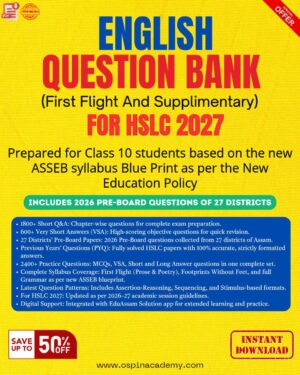
Class 10 English Question Bank ASSEB HSLC 2027 | Complete Chapter-wise Solutions PDF
Save Up To 50% OFF – Instant Download!
(For ASSEB, HSLC 2027)
Get the ultimate preparation toolkit for Class 10 English (First Flight & Supplementary) with this comprehensive Question Bank PDF.
Includes 2400+ practice questions, 2026 Pre-Board Papers from 27 Districts, Solved PYQs, and Complete Grammar updated as per the new ASSEB syllabus Blueprint and New Education Policy.
Perfect for mastering Assertion-Reasoning, Sequencing, and scoring top marks in HSLC 2027!
 Class 10th English
The Tale of Custard the Dragon
HSLC Board Previous Year MCQs with Answers
1. “The following statements provide descriptions of the dragon in the poem, “The Tale of Custard the Dragon.” Choose the most accurate description: {2026}
(a) He had sharp teeth, red mouth and fair skin.
(b) He had a long tail, fiery mouth and smooth skin.
(c) He had sharp teeth, spikes above and scales beneath.
(d) He had leathery wings and a spiky tail with giant claws.”
Answer: C
2. “In the poem “The Tale of Custard The Dragon”, the colours of the kitten, mouse and dog are clearly mentioned. Find the right colours from the following options: {2026}
(a) Ink, the yellow kitten, Blink, the black mouse, Mustard, the grey dog.
(b) Ink, the grey kitten, Blink, the yellow mouse, Mustard, the black dog.
(c) Ink, the black kitten, Blink, the grey mouse, Mustard, the yellow dog.
(d) Ink, the black kitten, Blink, the yellow mouse, Mustard, the grey dog.”
Answer: C
3. In The Tale of Custard the Dragon how is Custard potrayed before the arrival of the pirates {2025}
(A) as a cowardly and timid dragon.
(B) as a fierce and intimidating dragon.
(C) as a clumsy and lazy dragon.
(D) as an intelligent and cunning dragon.
Answer: A
4. From your reading of “The Tale of Custard the Dragon’, choose the correct option.{2024}
(A) Dog: Black, Kitten: Yellow
(B) Kitten: Grey, Dog: Black
(C) Dog: Black, Mouse: Grey
(D) Kitten: Black, Mouse: Grey
Answer: D
5. Custard was the name of a.. {2023}
(A) dragon
(B) dog
(C) cat
(D) biscuit
Answer: A
Common Pre-Board MCQs (2025–26) with Answers
1. Identify the literary device used in the following line from ‘The Tale of Custard the Dragon’. “But jumped Custard, snorting like an engine” {Bajali}
(A) Oxymoron
(B) Simile
(C) Alliteration
(D) Metaphor
Answer: B
2. Ink and Blink in glee did gyrate. What does the word ‘gyrate’ mean? {Baksa}
(A) Faint
(B) Circular movements
(C) Dance
(D) Steady
Answer: B
3. Based on the poem “The Tale of Custard the Dragon”, match column A with column B and choose the correct answer from the options given below: {Barpeta}
Column A Column B
1. Dragon’s Toes (i) Mouse’s giggling
2. Furious tiger (ii) Daggers
3. Weeck (iii) Trickled down
4. Ink (iv) Mustard
(A) 1 – (ii), 2 – (iv), 3 – (iii), 4 – (i)
(B) 1 – (iv), 2 – (iii), 3 – (ii), 4 – (i)
(C) 1 – (ii), 2 – (iii), 3 – (i), 4 – (iv)
(D) 1 – (iii), 2 – (ii), 3 – (i), 4 – (iv)
Answer: A
4. The poem “The Tale of Custard the Dragon” shows irony because those who boasted of being brave – Ink, Blink, and Mustard – failed to act when danger appeared, whereas Custard, mocked as a coward, displayed ______. {Bongaigaon}
(A) The true essence of bravery
(B) Fear hidden behind courage
(C) Clever tricks to escape
(D) Hesitation and confusion
Answer: A
5. What kind of a poem is “The Tale of Custard the Dragon” {Cachar}
(A) sonnet
(B) religious
(C) ironical ballad
(D) humorous ballad.
Answer: D
6. Pick the option that doesn’t display simile from the poem ‘The tale of Custard the dragon’. {Charaideo}
(A) … Custard snorting like an engine
(B) … trickled down to the bottom
(C) … at the pirate like a Robin at a worm
(D) … dashed his tail like irons
Answer: B
7. “And custard gobbled him every bit”. Here ‘gobble’ means – {Darrang}
(A) attack
(B) eat greedily
(C) bite
(D) throw
Answer: B
8. Assertion (A): While Belinda was in danger Custard came up to save her from her pirate enemy. {Darrang}
Reason (R) : Custard wanted to prove his might and bravery
(A) Both A and R are true, R is the correct explanation of A
(B) Both A and R are true, R is not the correct explanation of A
(C) A is true but R is false
(D) A is false but R is true
Answer: C
9. “They chased lions down the stairs.” Who are ‘they’ referred to here? {Darrang}
(A) Custard and Mustard
(B) Ink and Blink
(C) Belinda and Custard
(D) Belinda and Mustard
Answer: B
10. The poem “The Tale of Custard the Dragon” is written in the style of {Dhubri}
(A) Sonnet
(B) Free verse
(C) Lyric
(D) Ballad
Answer: D
11. Match the following and choose the correct option: {Dhubri}
A. Spikes / i. Custard
B. Wooden leg / ii. Pirate
C. Red wagon / iii. Mouse
D. Belinda
(A) A–i, B–ii, C–iii
(B) A–i, B–iii, C–ii
(C) A–ii, B–iii, C–i
(D) A–ii, B–i, C–iii
Answer: A
12. In the poem “The Tale of Custard the Dragon” Custard silently listened to all the pets and agreed that everyone was_ {Golaghat}
(A) weaker than him.
(B) braver than him.
(C) more cowardly than him.
(D) generous like him
Answer: B
13. If you were to create an alternative ending to “The Tale of Custard the Dragon” by Ogden Nash, that reinforces the poem’s central message, which of the following endings would be most appropriate?{Hailakandi}
(A) Custard continues. to be mocked by Belinda even after saving everyone, and he decides to leave the house forever.
(B) Custard refuses to fight the pirate, proving that his fear is stronger than his courage.
(C) Belinda and her pets publicly acknowledge Custard’s bravery and change the way they judge courage thereafter.
(D) The pirate defeats Custard, and Ink and Mustard become the new heroes of the house.
Answer: C
14. From your reading of “The Tale of Custard the Dragon.” Choose the correct option.{Hojai}
(A) Dog: Black, Kitten: Yellow
(B) Kitten: Grey, Dog: Black
(C) Dog: Black, Mouse: Grey
(D) Kitten: Black, Mouse: Grey
Answer: D
15. Ballad is _____.{Hojai}
(A) A 14-line poem with specific rhyming scheme.
(B) A long narrative poetry describing a hero.
(C) A song or poem that tells a story.
(D) Nature based poetry.
Answer: C
16. In “The Tale of Custard the Dragon”, how is Custard portrayed before the arrival of the pirate?{Hojai}
(A) As a cowardly and timid dragon.
(B) As a fierce and intimidating dragon.
(C) As a clumsy and lazy dragon.
(D) As an intelligent and cunning dragon.
Answer: A
17. If Custard had not killed the pirate, what would have most likely happened? {Jorhat}
(A) Belinda would have escaped.
(B) The pirate would have won.
(C) The animals would have attacked together.
(D) The house would have collapsed.
Answer: B
18. Identify the literary device used in the following line from “The Tale of Custard the Dragon”: “And he held in his teeth a cutlass bright.” {Jorhat}
(A) Simile
(B) Metaphor
(C) Alliteration
(D) Assonance
Answer: C
19. The poem, “The Tale of Custard, the Dragon”, is a _______ ballad.{ Kamrup M}
(A) tragi-comedy
(B) fearful
(C) humorous
(D) tragic
Answer: C
20. In the poem, “The Tale of Custard, the Dragon”, the word rhyming with ‘squirm’ is {Kamrup M}
(A) affirm
(B) worm
(C) germ
(D) confirm
Answer: B
21. ‘Ink and mustard rudely asked his age’ -the underlined word rhymes with-{Kokrajhar}
(A) Face
(B) Niece
(C) Rage
(D) Guess
Answer: C
22. “Mouth like a fire place, chimney for a nose” -what is the literary device used in the underlined phrase -{Kokrajhar}
(A) Simile
(B) Metaphor
(C) Personification
(D) Alliteration
Answer: A
23. Match the characters with their description with reference to your reading of the poem ‘The tale of custard the dragon’ by Ogden Nash: {Lakhimpur}
Column A
A. Custard
B. Belinda
C. Ink
D. Mustard
Column B
1. Little yellow dog
2. Brave in words, not in action
3. Real hero who fights the pirate
4. Mistress of the house
Options:
(A) A-3, B-4, C-1, D-2
(B) A-2, B-3, C-4, D-1
(C) A-4, B-2, C-1, D-3
(D) A-1, B-2, C-3, D-4
Answer: A
24. Suppose the pirate in the poem ‘The tale of custard the dragon’ by Ogden Nash had not appeared. How would the pets continue their behaviour? {Lakhimpur}
(A) They would praise Custard daily
(B) They would still mock him regularly
(C) They would leave the house
(D) They would stop talking to Custard
Answer: B
25. Find the literary device from the following sentence– “Belinda is as brave as a barrel full of bears” {Udalguri}
(A) Idiom
(B) Simile
(C) Metaphor
(D) Alliteration
Answer: B
26. Which of the following does Belinda not have as a pet? {Tamulpur}
(A) A yellow dog
(B) A grey mouse
(C) A red wagon
(D) A black kitten.
Answer: C
27. “Belinda paled, and she cried Help! Help!” The exclamatory mark conveys : (Hint: The Tale of Custard the Dragon) {Sribhumi}
(A) a feeling of anticipation.
(B) a feeling of excitement.
(C) a feeling of sorrow.
(D) some thoughtful moments.
Answer: C
28. Pick out the option that does not display a simile from the poem “The tale of custard the Dragon.” {Sonitpur}
(A) Dog was as sharp as mustard.
(B) mouth like an fire place.
(C) Snorting like an engine.
(D) The dragon had big sharp teeth.
Answer: D
29. Read the statements and choose the correct option. {Sonitpur}
Statement 1: While Belinda was in danger Custard came up to save her from the pirate.
Statement 2: Custrad wanted to prove his might and bravery.
(A) Statement 1 is false and Statement 2 is true
(B) Statement 1 is true and Statement 2 is false
(C) Statement 1 and Statement 2 are true
(D) Both Statement 1 and Statement 2 are false.
Answer: B
30. What message does the poem “The Tale of Custard the Dragon” indirectly convey? {Sibsagar}
(A) Appearance reflects bravery.
(B) Dragon are big in size.
(C) Courage is proven only through action.
(D) Dragons are always brave.
Answer: C
31. The poetic device used in the line “Belinda was as brave as a barrel full of bears” is…. {Sibsagar}
(A) Simile.
(B) Metaphor.
(C) Assonance.
(D) Personification.
Answer: A
32. The name of the little black kitten was ___ {Nalbari}
(A) Ink
(B) Blink
(C) Mustard
(D) Custard
Answer: A
33. “Belinda paled, and she cried Help! Help!” What was the situation that made Belinda cry for help? {Nalbari}
(A) Custard cried for a nice safe cage
(B) Blink said weeck! Which is giggling for a mouse
(C) There was a pirate, climbing in the window
(D) Ink and Blink were moving in circles
Answer: C
34. Choose the correct comparisons from the given options : {Nalbari}
(A) Belinda: Bears; Ink: Tiger
(B) Mustard: Lion; Custard : Percival
(C) Blink: Lion; Belinda: Bears
(D) Ink: Tiger; Blink: Lion
Answer: A
35. What lesson can be learnt from Custard’s character? {Nalbari}
(A) Appearance is attractive.
(B) Bravery is only for the strong.
(C) True bravery is displayed in unexpected moments.
(D) Cowardice is the best policy.
Answer: C
36. Who is the poet of the poem ‘Animals’? (Note: Question asks for ‘Animals’ poet but options include Ogden Nash, poet of Custard. Walt Whitman is poet of Animals). {Nalbari}
(A) Walt Whitman
(B) Ogden Nash
(C) John Berryman
(D) Robin Klein
Answer: A
37. Choose the correct comparisons from the given options : (Hint : The Tale of Custard the Dragon) {Morigaon}
(A) Belinda : Bears ; Ink : Tiger
(B) Mustard : Lion ; Custard : Percival
(C) Blink : Lion ; Belinda : Bears
(D) Ink : Tiger ; Blink : Lion
Answer: A
38. What lesson can be learnt from Custard’s character? {Morigaon}
(A) Appearance is attractive.
(B) Bravery is only for the strong.
(C) True bravery is displayed in unexpected moments.
(D) Cowardice is the best policy.
Answer: C
39. When Belinda and the pets ran and hid, they were experiencing- {Majuli}
(A) guilt
(B) bravery
(C) fear and panic
(D) curiosity
Answer: C
40. What colour was Mustard, the dog? {Majuli}
(A) Black
(B) Yellow
(C) Grey
(D) Brown
Answer: B
50 Most Important Model MCQs for HSLC 2027
1. Where did Belinda and her pets live?
(A) In a dark cave
(B) In a little white house
(C) In a tall stone tower
(D) In a dense green forest
Answer: B
2. What was the color of the little wagon that Belinda owned?
(A) Yellow
(B) Black
(C) Grey
(D) Red
Answer: D
3. What did Custard the dragon have underneath his body?
(A) Soft fur
(B) Scales
(C) Spikes
(D) A golden pouch
Answer: B
4. How are Custard’s toes described in the poem?
(A) Like sharp knives
(B) Like daggers
(C) Like velvet pads
(D) Like iron hooks
Answer: B
5. What specific feature of Custard’s face is compared to a chimney?
(A) His mouth
(B) His ears
(C) His nose
(D) His eyes
Answer: C
6. Why did Belinda tickle Custard “unmercifully”?
(A) Because he enjoyed being tickled.
(B) Because she wanted to mock his cowardly nature.
(C) Because it was a game they played every morning.
(D) Because he was angry and she wanted to calm him down.
Answer: B
7. While sitting together and mocking Custard, where did Belinda and her pets usually gather?
(A) In the living room
(B) In the little red wagon
(C) On the roof of the white house
(D) Down the stairs
Answer: B
8. Which legendary historical/literary figure did Belinda and her pets ironically compare Custard to?
(A) King Arthur
(B) Hercules
(C) Percival
(D) Robin Hood
Answer: C
9. How is the sound of Belinda’s laughter described in the poem?
(A) She laughed until she cried.
(B) She laughed until she shook the house.
(C) She laughed as softly as a mouse.
(D) She laughed like a roaring engine.
Answer: B
10. What specific word does the poet use to describe the sound of a mouse giggling?
(A) Squeak
(B) Weeck
(C) Meow
(D) Roar
Answer: B
11. What suddenly interrupted the pets while they were busy teasing Custard?
(A) A loud thunderstorm
(B) A nasty sound
(C) A knock at the door
(D) The ringing of a bell
Answer: B
12. When the nasty sound was heard, what was Mustard the dog’s immediate reaction before seeing the pirate?
(A) He barked bravely.
(B) He growled.
(C) He hid under the sofa.
(D) He ran away.
Answer: B
13. What was the pirate holding in both of his hands?
(A) A cutlass
(B) Pistols
(C) A bottle of grog
(D) Gold coins
Answer: B
14. What did the pirate hold between his teeth?
(A) A cigar
(B) A gold coin
(C) A cutlass bright
(D) A small dagger
Answer: C
15. Which of the following describes a physical disability of the pirate?
(A) He had a hook for a hand.
(B) He was blind in one eye.
(C) He had one wooden leg.
(D) He had no teeth.
Answer: C
16. What was the pirate’s intention upon entering the house?
(A) He came to ask for food.
(B) It was clear that his meaning was “no good” (he meant harm).
(C) He came to steal the dragon.
(D) He was lost and needed directions.
Answer: B
17. What did Mustard do the moment he actually saw the pirate?
(A) He bit the pirate’s leg.
(B) He fled with a terrified yelp.
(C) He barked fiercely.
(D) He chased the pirate down the stairs.
Answer: B
18. Where did Ink the kitten go to hide from the pirate?
(A) Under the bed
(B) Trickled down to the bottom of the household
(C) Inside the red wagon
(D) Up a tall tree
Answer: B
19. How did Blink the mouse secure himself from the pirate’s threat?
(A) He strategically mouseholed.
(B) He ran outside the house.
(C) He hid in Belinda’s pocket.
(D) He jumped out the window.
Answer: A
20. The sound of Custard’s tail clashing is compared to what?
(A) Thunder in the sky
(B) Irons in a dungeon
(C) A massive earthquake
(D) A falling tree
Answer: B
21. “With a clatter and a clank and a jangling squirm.” What is the poet describing here?
(A) The sound of the pirate’s weapons dropping
(B) The noise of the pets running away
(C) The terrifying and metallic sounds of Custard charging at the pirate
(D) Belinda crying for help
Answer: C
22. In the simile “He went at the pirate like a robin at a worm,” who or what represents the “worm”?
(A) Custard
(B) Belinda
(C) The Pirate
(D) Mustard
Answer: C
23. What was the pirate’s immediate reaction when Custard charged at him?
(A) He ran away.
(B) He begged for mercy.
(C) He gaped at the dragon and gulped some grog.
(D) He dropped his pistols.
Answer: C
24. Where did the pirate keep his alcoholic drink (grog)?
(A) In a glass bottle
(B) In a pocket flagon
(C) In a wooden barrel
(D) In a small pouch
Answer: B
25. How many bullets did the pirate fire at Custard?
(A) One
(B) Two
(C) Three
(D) None
Answer: B
26. What was the outcome of the bullets fired by the pirate?
(A) They injured Custard’s tail.
(B) They hit the wall behind Custard.
(C) They didn’t hit Custard at all.
(D) They scared the dragon away.
Answer: C
27. What did Custard leave behind of the pirate after eating him?
(A) His wooden leg
(B) His cutlass
(C) His pistols
(D) Nothing, he gobbled him “every bit”
Answer: D
28. After the pirate was eaten, how did Mustard show his appreciation for Custard?
(A) He brought him a bone.
(B) He licked him.
(C) He bowed down to him.
(D) He hugged him.
Answer: B
29. After the pirate was dead, what did Ink and Blink do to celebrate?
(A) They sang a song.
(B) They shared a bowl of milk.
(C) In glee they did gyrate around the dragon.
(D) They chased lions again.
Answer: C
30. Did anyone in the house mourn for the pirate victim?
(A) Yes, Belinda felt sorry for him.
(B) Yes, the pets buried him.
(C) No one mourned for him.
(D) Custard regretted eating him.
Answer: C
31. Once the danger had passed, what excuse did Mustard give for running away?
(A) He said he went to get help from the police.
(B) He claimed he would have been twice as brave if he hadn’t been flustered.
(C) He said his leg was injured.
(D) He said he was protecting the red wagon.
Answer: B
32. What did Ink and Blink claim they would have been, after Mustard made his excuse?
(A) Twice as brave
(B) Three times as brave
(C) Four times as brave
(D) Ten times as brave
Answer: B
33. What does Custard completely agree with at the end of the poem?
(A) That he is the bravest dragon in the world.
(B) That everybody is braver than him.
(C) That the pirate was very scary.
(D) That Belinda is a bad owner.
Answer: B
34. Why does Ogden Nash repeat the entire first and second stanzas at the very end of the poem?
(A) He forgot how to end the poem.
(B) To show that Custard finally ran away.
(C) To emphasize the irony that despite the life-saving event, the boastful illusions returned and absolutely nothing changed in the household.
(D) To show that a new pirate was coming.
Answer: C
35. Who is the poet of “The Tale of Custard the Dragon”?
(A) Walt Whitman
(B) Robert Frost
(C) Leslie Norris
(D) Ogden Nash
Answer: D
36. Assertion (A): The pets ironically called the dragon “Percival” while tickling him in the red wagon.
Reason (R): Percival was a legendary and brave Knight of King Arthur’s court, highlighting the contrast with Custard’s supposed cowardice.
(A) Both Assertion (A) and Reason (R) are true, and (R) is the correct explanation of (A).
(B) Both Assertion (A) and Reason (R) are true, but (R) is not the correct explanation of (A).
(C) Assertion (A) is true, but Reason (R) is false.
(D) Assertion (A) is false, but Reason (R) is true.
Answer: A
37. Assertion (A): Belinda, Mustard, Ink, and Blink fiercely attacked the pirate the moment he entered through the window.
Reason (R): Their boasted bravery vanished completely in the face of genuine danger, causing them all to run and hide.
(A) Both Assertion (A) and Reason (R) are true, and (R) is the correct explanation of (A).
(B) Both Assertion (A) and Reason (R) are true, but (R) is not the correct explanation of (A).
(C) Assertion (A) is true, but Reason (R) is false.
(D) Assertion (A) is false, but Reason (R) is true.
Answer: D
38. Assertion (A): The pirate’s meaning was clearly “no good” when he broke into the house.
Reason (R): He was heavily armed with pistols in both hands and a bright cutlass in his teeth.
(A) Both Assertion (A) and Reason (R) are true, and (R) is the correct explanation of (A).
(B) Both Assertion (A) and Reason (R) are true, but (R) is not the correct explanation of (A).
(C) Assertion (A) is true, but Reason (R) is false.
(D) Assertion (A) is false, but Reason (R) is true.
Answer: A
39. Assertion (A): The pirate successfully killed Custard the dragon.
Reason (R): The pirate fired two bullets from his pistols directly at the dragon.
(A) Both Assertion (A) and Reason (R) are true, and (R) is the correct explanation of (A).
(B) Both Assertion (A) and Reason (R) are true, but (R) is not the correct explanation of (A).
(C) Assertion (A) is true, but Reason (R) is false.
(D) Assertion (A) is false, but Reason (R) is true.
Answer: D
40. Assertion (A): Custard is described as having a “chimney for a nose.”
Reason (R): Dragons are mythologically known to breathe fire, so the smoke exhaled through the nostrils resembles a smoking chimney.
(A) Both Assertion (A) and Reason (R) are true, and (R) is the correct explanation of (A).
(B) Both Assertion (A) and Reason (R) are true, but (R) is not the correct explanation of (A).
(C) Assertion (A) is true, but Reason (R) is false.
(D) Assertion (A) is false, but Reason (R) is true.
Answer: A
41. Assertion (A): Custard gobbled up the pirate completely, leaving absolutely nothing behind.
Reason (R): The pirate had a wooden leg and a black beard.
(A) Both Assertion (A) and Reason (R) are true, and (R) is the correct explanation of (A).
(B) Both Assertion (A) and Reason (R) are true, but (R) is not the correct explanation of (A).
(C) Assertion (A) is true, but Reason (R) is false.
(D) Assertion (A) is false, but Reason (R) is true.
Answer: B
42. Assertion (A): After the pirate’s death, Mustard proudly claimed he would have been twice as brave if he hadn’t been flustered.
Reason (R): Mustard wanted to cover up his earlier cowardice and quickly restore his falsely inflated ego.
(A) Both Assertion (A) and Reason (R) are true, and (R) is the correct explanation of (A).
(B) Both Assertion (A) and Reason (R) are true, but (R) is not the correct explanation of (A).
(C) Assertion (A) is true, but Reason (R) is false.
(D) Assertion (A) is false, but Reason (R) is true.
Answer: A
43. Assertion (A): The poem ends exactly how it began, with Belinda and her pets living in the little white house.
Reason (R): Custard’s heroic act permanently transformed him into an arrogant and boastful dragon who bullied the other pets.
(A) Both Assertion (A) and Reason (R) are true, and (R) is the correct explanation of (A).
(B) Both Assertion (A) and Reason (R) are true, but (R) is not the correct explanation of (A).
(C) Assertion (A) is true, but Reason (R) is false.
(D) Assertion (A) is false, but Reason (R) is true.
Answer: C
44. Assertion (A): The pirate gaped at Custard and drank grog from his pocket flagon.
Reason (R): He was utterly shocked and terrified by the sudden, terrifying charge of the supposedly cowardly dragon.
(A) Both Assertion (A) and Reason (R) are true, and (R) is the correct explanation of (A).
(B) Both Assertion (A) and Reason (R) are true, but (R) is not the correct explanation of (A).
(C) Assertion (A) is true, but Reason (R) is false.
(D) Assertion (A) is false, but Reason (R) is true.
Answer: A
45. Assertion (A): Belinda cried “Help! Help!” and turned pale when she saw the pirate.
Reason (R): She was bravely calling for the town guards to come and arrest the intruder.
(A) Both Assertion (A) and Reason (R) are true, and (R) is the correct explanation of (A).
(B) Both Assertion (A) and Reason (R) are true, but (R) is not the correct explanation of (A).
(C) Assertion (A) is true, but Reason (R) is false.
(D) Assertion (A) is false, but Reason (R) is true.
Answer: C
46. What psychological human trait does the behavior of Mustard, Ink, and Blink immediately after the battle primarily satirize?
(A) The tendency to remain grateful to saviors forever.
(B) The tendency of cowards to make immediate, ridiculous excuses to falsely inflate their own courage after a crisis has safely passed.
(C) The trauma that small animals face after seeing violence.
(D) The joy of dancing after a long day.
Answer: B
47. The juxtaposition of Custard’s terrifying physical description (“mouth like a fireplace”, “daggers on his toes”) with his constant demand for a “nice safe cage” serves to create:
(A) A deep sense of tragedy and sorrow
(B) Comic relief through deliberate anti-climax and subversion of expectations
(C) A frightening horror story for children
(D) A scientific explanation of dragon anatomy
Answer: B
48. Why is the name “Percival” a deeply ironic and stinging insult in the context of the poem’s first half?
(A) Because Percival was a famous pirate who lost his ship.
(B) Because Percival was a legendary Knight of the Round Table known for immense bravery, whereas the pets view Custard as a supreme coward.
(C) Because Percival means “yellow dog” in an ancient language.
(D) Because Belinda had a previous dragon named Percival who was very strong.
Answer: B
49. The consistent rhythm and strict AABB rhyme scheme of the poem primarily contribute to its:
(A) Melancholic and depressing atmosphere
(B) Lighthearted, musical, and whimsical tone, which is highly characteristic of a comic ballad
(C) Complex and confusing structure
(D) Aggressive and violent undertones
Answer: B
50. What is the ultimate, profound message regarding “courage” presented hidden beneath Ogden Nash’s humorous poem?
(A) Dragons are inherently better than dogs and cats.
(B) Physical appearance is the only true indicator of a creature’s bravery.
(C) True courage is not about loud boasting in times of safety, but about stepping up to act decisively during moments of genuine, life-threatening peril.
(D) If you are scared, you should always hide in a mousehole until the danger passes.
Answer: C
SEBA HSLC Previous Year Questions (1/2/3 Marks)
1. “How did Belinda and her pets behave when they saw the pirate in from the window as described in the poem “The Tale of Custard the Dragon”?” {2026}
2. Do you consider Custard a brave dragon? give reasons. {2025}
3. By what names were Belinda’s pets known? {2024}
4. Name the pets that Belinda had besides the dragon. {2023}
6. Choose from the box given below the words that rhyme with the following:
{2022}
wagon, ink, cannon, dragon, ring, blink, king
7. Why did Custard cry for a new cage? {2022}
8. How did Custard the Dragon attack the pirate? {2022}
9. Where did Belinda live? {2022}
10. How did Cartard the Dragon save Belinda from the pirate? {2020}
11. How did Belinda and her pets behave when they saw the Pirate climbing the window? {2019}
12. Give a dsecription of the fight between Custard dragon and the Pirate.
{2019}
Common Pre-Board 2 Mark Questions (2025–26)
1. ‘The pirate enterer Belinda’s house with wicked intention – justify your answer. {Bajali}
2. “Belinda tickled him, she tickled him unmercifully” why? {Baksa}
3. Explain the meaning of “A friend in need is a friend indeed” in the context of “The Tale of Custard the Dragon.” {Barpeta}
4. Describe the physical appearance of Custard, the dragon. {Bongaigaon}
5. What message does the poem ‘A tale of Custard the Dragon’ convey about judging others? {Charaideo}
6. Describe the appearance of the pirate in the poem “The Tale of Custard the Dragon”. {Darrang}
7. What did Belinda and her pets do when they saw the Pirate? {Dhubri}
8. Having seen the Pirate, Belinda cried for help. How did Custard help her as mentioned in the poem “The Tale of Custard the Dragon”? {Golaghat}
9. Why did Belinda and the other animals think that Custard was a coward in the poem “The Tale of Custard the Dragon” by Ogden Nash ? {Hailakandi}
10. How did Custard the Dragon attacked the pirate? What was the outcome? {Hojai}
11. How did Custard prove that true bravery is shown in action?{ Jorhat}
12. How did the animals and Belinda make fun of the dragon, in the poem, “The Tale of custard the Dragon.”? {Kamrup M}
13. “But Custard cried for a nice safe cage.
Belinda was as brave as a barrel full of bears
And Ink and Blink chased lions down the stairs.”
What did Custard wish for? How does the poet describe Belinda’s bravery? {Lakhimpur}
14. “Ink and Blink in glee did gyrate”. Explain in brief what do you understand from the above sentence? {Udalguri}
15. “Belinda paled” — why? {Tamulpur}
16. Do you consider Custard is really cowardly dragon? Give reason. {SSM}
17. State the reason you think the poet named the animals Ink, Blink, Mustard and Custard. {Sribhumi}
18. Describe the physical apperance of curtard, the dragon. {Sonitpur}
19. Do you find “The Tale of Custard The Dragon” to be a serious or a light hearted poem? Give reasons to support your answer. {Sibsagar}
20. Describe Custard’s encounter with the pirate. {Nalbari}
21. Why did Belinda and her pets tease custard in the peom ‘The Tale of Custard the Dragon’? {Morigaon}
22. Describe the pirate as presented in the poem “The Tale of Custard the Dragon.” {Majuli}
Class 10 English Chapter 10 (The Tale of Custard the Dragon) – Frequently Asked Questions (FAQs)
 Class 10th English
The Tale of Custard the Dragon
HSLC Board Previous Year MCQs with Answers
1. “The following statements provide descriptions of the dragon in the poem, “The Tale of Custard the Dragon.” Choose the most accurate description: {2026}
(a) He had sharp teeth, red mouth and fair skin.
(b) He had a long tail, fiery mouth and smooth skin.
(c) He had sharp teeth, spikes above and scales beneath.
(d) He had leathery wings and a spiky tail with giant claws.”
Answer: C
2. “In the poem “The Tale of Custard The Dragon”, the colours of the kitten, mouse and dog are clearly mentioned. Find the right colours from the following options: {2026}
(a) Ink, the yellow kitten, Blink, the black mouse, Mustard, the grey dog.
(b) Ink, the grey kitten, Blink, the yellow mouse, Mustard, the black dog.
(c) Ink, the black kitten, Blink, the grey mouse, Mustard, the yellow dog.
(d) Ink, the black kitten, Blink, the yellow mouse, Mustard, the grey dog.”
Answer: C
3. In The Tale of Custard the Dragon how is Custard potrayed before the arrival of the pirates {2025}
(A) as a cowardly and timid dragon.
(B) as a fierce and intimidating dragon.
(C) as a clumsy and lazy dragon.
(D) as an intelligent and cunning dragon.
Answer: A
4. From your reading of “The Tale of Custard the Dragon’, choose the correct option.{2024}
(A) Dog: Black, Kitten: Yellow
(B) Kitten: Grey, Dog: Black
(C) Dog: Black, Mouse: Grey
(D) Kitten: Black, Mouse: Grey
Answer: D
5. Custard was the name of a.. {2023}
(A) dragon
(B) dog
(C) cat
(D) biscuit
Answer: A
Common Pre-Board MCQs (2025–26) with Answers
1. Identify the literary device used in the following line from ‘The Tale of Custard the Dragon’. “But jumped Custard, snorting like an engine” {Bajali}
(A) Oxymoron
(B) Simile
(C) Alliteration
(D) Metaphor
Answer: B
2. Ink and Blink in glee did gyrate. What does the word ‘gyrate’ mean? {Baksa}
(A) Faint
(B) Circular movements
(C) Dance
(D) Steady
Answer: B
3. Based on the poem “The Tale of Custard the Dragon”, match column A with column B and choose the correct answer from the options given below: {Barpeta}
Column A Column B
1. Dragon’s Toes (i) Mouse’s giggling
2. Furious tiger (ii) Daggers
3. Weeck (iii) Trickled down
4. Ink (iv) Mustard
(A) 1 – (ii), 2 – (iv), 3 – (iii), 4 – (i)
(B) 1 – (iv), 2 – (iii), 3 – (ii), 4 – (i)
(C) 1 – (ii), 2 – (iii), 3 – (i), 4 – (iv)
(D) 1 – (iii), 2 – (ii), 3 – (i), 4 – (iv)
Answer: A
4. The poem “The Tale of Custard the Dragon” shows irony because those who boasted of being brave – Ink, Blink, and Mustard – failed to act when danger appeared, whereas Custard, mocked as a coward, displayed ______. {Bongaigaon}
(A) The true essence of bravery
(B) Fear hidden behind courage
(C) Clever tricks to escape
(D) Hesitation and confusion
Answer: A
5. What kind of a poem is “The Tale of Custard the Dragon” {Cachar}
(A) sonnet
(B) religious
(C) ironical ballad
(D) humorous ballad.
Answer: D
6. Pick the option that doesn’t display simile from the poem ‘The tale of Custard the dragon’. {Charaideo}
(A) … Custard snorting like an engine
(B) … trickled down to the bottom
(C) … at the pirate like a Robin at a worm
(D) … dashed his tail like irons
Answer: B
7. “And custard gobbled him every bit”. Here ‘gobble’ means – {Darrang}
(A) attack
(B) eat greedily
(C) bite
(D) throw
Answer: B
8. Assertion (A): While Belinda was in danger Custard came up to save her from her pirate enemy. {Darrang}
Reason (R) : Custard wanted to prove his might and bravery
(A) Both A and R are true, R is the correct explanation of A
(B) Both A and R are true, R is not the correct explanation of A
(C) A is true but R is false
(D) A is false but R is true
Answer: C
9. “They chased lions down the stairs.” Who are ‘they’ referred to here? {Darrang}
(A) Custard and Mustard
(B) Ink and Blink
(C) Belinda and Custard
(D) Belinda and Mustard
Answer: B
10. The poem “The Tale of Custard the Dragon” is written in the style of {Dhubri}
(A) Sonnet
(B) Free verse
(C) Lyric
(D) Ballad
Answer: D
11. Match the following and choose the correct option: {Dhubri}
A. Spikes / i. Custard
B. Wooden leg / ii. Pirate
C. Red wagon / iii. Mouse
D. Belinda
(A) A–i, B–ii, C–iii
(B) A–i, B–iii, C–ii
(C) A–ii, B–iii, C–i
(D) A–ii, B–i, C–iii
Answer: A
12. In the poem “The Tale of Custard the Dragon” Custard silently listened to all the pets and agreed that everyone was_ {Golaghat}
(A) weaker than him.
(B) braver than him.
(C) more cowardly than him.
(D) generous like him
Answer: B
13. If you were to create an alternative ending to “The Tale of Custard the Dragon” by Ogden Nash, that reinforces the poem’s central message, which of the following endings would be most appropriate?{Hailakandi}
(A) Custard continues. to be mocked by Belinda even after saving everyone, and he decides to leave the house forever.
(B) Custard refuses to fight the pirate, proving that his fear is stronger than his courage.
(C) Belinda and her pets publicly acknowledge Custard’s bravery and change the way they judge courage thereafter.
(D) The pirate defeats Custard, and Ink and Mustard become the new heroes of the house.
Answer: C
14. From your reading of “The Tale of Custard the Dragon.” Choose the correct option.{Hojai}
(A) Dog: Black, Kitten: Yellow
(B) Kitten: Grey, Dog: Black
(C) Dog: Black, Mouse: Grey
(D) Kitten: Black, Mouse: Grey
Answer: D
15. Ballad is _____.{Hojai}
(A) A 14-line poem with specific rhyming scheme.
(B) A long narrative poetry describing a hero.
(C) A song or poem that tells a story.
(D) Nature based poetry.
Answer: C
16. In “The Tale of Custard the Dragon”, how is Custard portrayed before the arrival of the pirate?{Hojai}
(A) As a cowardly and timid dragon.
(B) As a fierce and intimidating dragon.
(C) As a clumsy and lazy dragon.
(D) As an intelligent and cunning dragon.
Answer: A
17. If Custard had not killed the pirate, what would have most likely happened? {Jorhat}
(A) Belinda would have escaped.
(B) The pirate would have won.
(C) The animals would have attacked together.
(D) The house would have collapsed.
Answer: B
18. Identify the literary device used in the following line from “The Tale of Custard the Dragon”: “And he held in his teeth a cutlass bright.” {Jorhat}
(A) Simile
(B) Metaphor
(C) Alliteration
(D) Assonance
Answer: C
19. The poem, “The Tale of Custard, the Dragon”, is a _______ ballad.{ Kamrup M}
(A) tragi-comedy
(B) fearful
(C) humorous
(D) tragic
Answer: C
20. In the poem, “The Tale of Custard, the Dragon”, the word rhyming with ‘squirm’ is {Kamrup M}
(A) affirm
(B) worm
(C) germ
(D) confirm
Answer: B
21. ‘Ink and mustard rudely asked his age’ -the underlined word rhymes with-{Kokrajhar}
(A) Face
(B) Niece
(C) Rage
(D) Guess
Answer: C
22. “Mouth like a fire place, chimney for a nose” -what is the literary device used in the underlined phrase -{Kokrajhar}
(A) Simile
(B) Metaphor
(C) Personification
(D) Alliteration
Answer: A
23. Match the characters with their description with reference to your reading of the poem ‘The tale of custard the dragon’ by Ogden Nash: {Lakhimpur}
Column A
A. Custard
B. Belinda
C. Ink
D. Mustard
Column B
1. Little yellow dog
2. Brave in words, not in action
3. Real hero who fights the pirate
4. Mistress of the house
Options:
(A) A-3, B-4, C-1, D-2
(B) A-2, B-3, C-4, D-1
(C) A-4, B-2, C-1, D-3
(D) A-1, B-2, C-3, D-4
Answer: A
24. Suppose the pirate in the poem ‘The tale of custard the dragon’ by Ogden Nash had not appeared. How would the pets continue their behaviour? {Lakhimpur}
(A) They would praise Custard daily
(B) They would still mock him regularly
(C) They would leave the house
(D) They would stop talking to Custard
Answer: B
25. Find the literary device from the following sentence– “Belinda is as brave as a barrel full of bears” {Udalguri}
(A) Idiom
(B) Simile
(C) Metaphor
(D) Alliteration
Answer: B
26. Which of the following does Belinda not have as a pet? {Tamulpur}
(A) A yellow dog
(B) A grey mouse
(C) A red wagon
(D) A black kitten.
Answer: C
27. “Belinda paled, and she cried Help! Help!” The exclamatory mark conveys : (Hint: The Tale of Custard the Dragon) {Sribhumi}
(A) a feeling of anticipation.
(B) a feeling of excitement.
(C) a feeling of sorrow.
(D) some thoughtful moments.
Answer: C
28. Pick out the option that does not display a simile from the poem “The tale of custard the Dragon.” {Sonitpur}
(A) Dog was as sharp as mustard.
(B) mouth like an fire place.
(C) Snorting like an engine.
(D) The dragon had big sharp teeth.
Answer: D
29. Read the statements and choose the correct option. {Sonitpur}
Statement 1: While Belinda was in danger Custard came up to save her from the pirate.
Statement 2: Custrad wanted to prove his might and bravery.
(A) Statement 1 is false and Statement 2 is true
(B) Statement 1 is true and Statement 2 is false
(C) Statement 1 and Statement 2 are true
(D) Both Statement 1 and Statement 2 are false.
Answer: B
30. What message does the poem “The Tale of Custard the Dragon” indirectly convey? {Sibsagar}
(A) Appearance reflects bravery.
(B) Dragon are big in size.
(C) Courage is proven only through action.
(D) Dragons are always brave.
Answer: C
31. The poetic device used in the line “Belinda was as brave as a barrel full of bears” is…. {Sibsagar}
(A) Simile.
(B) Metaphor.
(C) Assonance.
(D) Personification.
Answer: A
32. The name of the little black kitten was ___ {Nalbari}
(A) Ink
(B) Blink
(C) Mustard
(D) Custard
Answer: A
33. “Belinda paled, and she cried Help! Help!” What was the situation that made Belinda cry for help? {Nalbari}
(A) Custard cried for a nice safe cage
(B) Blink said weeck! Which is giggling for a mouse
(C) There was a pirate, climbing in the window
(D) Ink and Blink were moving in circles
Answer: C
34. Choose the correct comparisons from the given options : {Nalbari}
(A) Belinda: Bears; Ink: Tiger
(B) Mustard: Lion; Custard : Percival
(C) Blink: Lion; Belinda: Bears
(D) Ink: Tiger; Blink: Lion
Answer: A
35. What lesson can be learnt from Custard’s character? {Nalbari}
(A) Appearance is attractive.
(B) Bravery is only for the strong.
(C) True bravery is displayed in unexpected moments.
(D) Cowardice is the best policy.
Answer: C
36. Who is the poet of the poem ‘Animals’? (Note: Question asks for ‘Animals’ poet but options include Ogden Nash, poet of Custard. Walt Whitman is poet of Animals). {Nalbari}
(A) Walt Whitman
(B) Ogden Nash
(C) John Berryman
(D) Robin Klein
Answer: A
37. Choose the correct comparisons from the given options : (Hint : The Tale of Custard the Dragon) {Morigaon}
(A) Belinda : Bears ; Ink : Tiger
(B) Mustard : Lion ; Custard : Percival
(C) Blink : Lion ; Belinda : Bears
(D) Ink : Tiger ; Blink : Lion
Answer: A
38. What lesson can be learnt from Custard’s character? {Morigaon}
(A) Appearance is attractive.
(B) Bravery is only for the strong.
(C) True bravery is displayed in unexpected moments.
(D) Cowardice is the best policy.
Answer: C
39. When Belinda and the pets ran and hid, they were experiencing- {Majuli}
(A) guilt
(B) bravery
(C) fear and panic
(D) curiosity
Answer: C
40. What colour was Mustard, the dog? {Majuli}
(A) Black
(B) Yellow
(C) Grey
(D) Brown
Answer: B
50 Most Important Model MCQs for HSLC 2027
1. Where did Belinda and her pets live?
(A) In a dark cave
(B) In a little white house
(C) In a tall stone tower
(D) In a dense green forest
Answer: B
2. What was the color of the little wagon that Belinda owned?
(A) Yellow
(B) Black
(C) Grey
(D) Red
Answer: D
3. What did Custard the dragon have underneath his body?
(A) Soft fur
(B) Scales
(C) Spikes
(D) A golden pouch
Answer: B
4. How are Custard’s toes described in the poem?
(A) Like sharp knives
(B) Like daggers
(C) Like velvet pads
(D) Like iron hooks
Answer: B
5. What specific feature of Custard’s face is compared to a chimney?
(A) His mouth
(B) His ears
(C) His nose
(D) His eyes
Answer: C
6. Why did Belinda tickle Custard “unmercifully”?
(A) Because he enjoyed being tickled.
(B) Because she wanted to mock his cowardly nature.
(C) Because it was a game they played every morning.
(D) Because he was angry and she wanted to calm him down.
Answer: B
7. While sitting together and mocking Custard, where did Belinda and her pets usually gather?
(A) In the living room
(B) In the little red wagon
(C) On the roof of the white house
(D) Down the stairs
Answer: B
8. Which legendary historical/literary figure did Belinda and her pets ironically compare Custard to?
(A) King Arthur
(B) Hercules
(C) Percival
(D) Robin Hood
Answer: C
9. How is the sound of Belinda’s laughter described in the poem?
(A) She laughed until she cried.
(B) She laughed until she shook the house.
(C) She laughed as softly as a mouse.
(D) She laughed like a roaring engine.
Answer: B
10. What specific word does the poet use to describe the sound of a mouse giggling?
(A) Squeak
(B) Weeck
(C) Meow
(D) Roar
Answer: B
11. What suddenly interrupted the pets while they were busy teasing Custard?
(A) A loud thunderstorm
(B) A nasty sound
(C) A knock at the door
(D) The ringing of a bell
Answer: B
12. When the nasty sound was heard, what was Mustard the dog’s immediate reaction before seeing the pirate?
(A) He barked bravely.
(B) He growled.
(C) He hid under the sofa.
(D) He ran away.
Answer: B
13. What was the pirate holding in both of his hands?
(A) A cutlass
(B) Pistols
(C) A bottle of grog
(D) Gold coins
Answer: B
14. What did the pirate hold between his teeth?
(A) A cigar
(B) A gold coin
(C) A cutlass bright
(D) A small dagger
Answer: C
15. Which of the following describes a physical disability of the pirate?
(A) He had a hook for a hand.
(B) He was blind in one eye.
(C) He had one wooden leg.
(D) He had no teeth.
Answer: C
16. What was the pirate’s intention upon entering the house?
(A) He came to ask for food.
(B) It was clear that his meaning was “no good” (he meant harm).
(C) He came to steal the dragon.
(D) He was lost and needed directions.
Answer: B
17. What did Mustard do the moment he actually saw the pirate?
(A) He bit the pirate’s leg.
(B) He fled with a terrified yelp.
(C) He barked fiercely.
(D) He chased the pirate down the stairs.
Answer: B
18. Where did Ink the kitten go to hide from the pirate?
(A) Under the bed
(B) Trickled down to the bottom of the household
(C) Inside the red wagon
(D) Up a tall tree
Answer: B
19. How did Blink the mouse secure himself from the pirate’s threat?
(A) He strategically mouseholed.
(B) He ran outside the house.
(C) He hid in Belinda’s pocket.
(D) He jumped out the window.
Answer: A
20. The sound of Custard’s tail clashing is compared to what?
(A) Thunder in the sky
(B) Irons in a dungeon
(C) A massive earthquake
(D) A falling tree
Answer: B
21. “With a clatter and a clank and a jangling squirm.” What is the poet describing here?
(A) The sound of the pirate’s weapons dropping
(B) The noise of the pets running away
(C) The terrifying and metallic sounds of Custard charging at the pirate
(D) Belinda crying for help
Answer: C
22. In the simile “He went at the pirate like a robin at a worm,” who or what represents the “worm”?
(A) Custard
(B) Belinda
(C) The Pirate
(D) Mustard
Answer: C
23. What was the pirate’s immediate reaction when Custard charged at him?
(A) He ran away.
(B) He begged for mercy.
(C) He gaped at the dragon and gulped some grog.
(D) He dropped his pistols.
Answer: C
24. Where did the pirate keep his alcoholic drink (grog)?
(A) In a glass bottle
(B) In a pocket flagon
(C) In a wooden barrel
(D) In a small pouch
Answer: B
25. How many bullets did the pirate fire at Custard?
(A) One
(B) Two
(C) Three
(D) None
Answer: B
26. What was the outcome of the bullets fired by the pirate?
(A) They injured Custard’s tail.
(B) They hit the wall behind Custard.
(C) They didn’t hit Custard at all.
(D) They scared the dragon away.
Answer: C
27. What did Custard leave behind of the pirate after eating him?
(A) His wooden leg
(B) His cutlass
(C) His pistols
(D) Nothing, he gobbled him “every bit”
Answer: D
28. After the pirate was eaten, how did Mustard show his appreciation for Custard?
(A) He brought him a bone.
(B) He licked him.
(C) He bowed down to him.
(D) He hugged him.
Answer: B
29. After the pirate was dead, what did Ink and Blink do to celebrate?
(A) They sang a song.
(B) They shared a bowl of milk.
(C) In glee they did gyrate around the dragon.
(D) They chased lions again.
Answer: C
30. Did anyone in the house mourn for the pirate victim?
(A) Yes, Belinda felt sorry for him.
(B) Yes, the pets buried him.
(C) No one mourned for him.
(D) Custard regretted eating him.
Answer: C
31. Once the danger had passed, what excuse did Mustard give for running away?
(A) He said he went to get help from the police.
(B) He claimed he would have been twice as brave if he hadn’t been flustered.
(C) He said his leg was injured.
(D) He said he was protecting the red wagon.
Answer: B
32. What did Ink and Blink claim they would have been, after Mustard made his excuse?
(A) Twice as brave
(B) Three times as brave
(C) Four times as brave
(D) Ten times as brave
Answer: B
33. What does Custard completely agree with at the end of the poem?
(A) That he is the bravest dragon in the world.
(B) That everybody is braver than him.
(C) That the pirate was very scary.
(D) That Belinda is a bad owner.
Answer: B
34. Why does Ogden Nash repeat the entire first and second stanzas at the very end of the poem?
(A) He forgot how to end the poem.
(B) To show that Custard finally ran away.
(C) To emphasize the irony that despite the life-saving event, the boastful illusions returned and absolutely nothing changed in the household.
(D) To show that a new pirate was coming.
Answer: C
35. Who is the poet of “The Tale of Custard the Dragon”?
(A) Walt Whitman
(B) Robert Frost
(C) Leslie Norris
(D) Ogden Nash
Answer: D
36. Assertion (A): The pets ironically called the dragon “Percival” while tickling him in the red wagon.
Reason (R): Percival was a legendary and brave Knight of King Arthur’s court, highlighting the contrast with Custard’s supposed cowardice.
(A) Both Assertion (A) and Reason (R) are true, and (R) is the correct explanation of (A).
(B) Both Assertion (A) and Reason (R) are true, but (R) is not the correct explanation of (A).
(C) Assertion (A) is true, but Reason (R) is false.
(D) Assertion (A) is false, but Reason (R) is true.
Answer: A
37. Assertion (A): Belinda, Mustard, Ink, and Blink fiercely attacked the pirate the moment he entered through the window.
Reason (R): Their boasted bravery vanished completely in the face of genuine danger, causing them all to run and hide.
(A) Both Assertion (A) and Reason (R) are true, and (R) is the correct explanation of (A).
(B) Both Assertion (A) and Reason (R) are true, but (R) is not the correct explanation of (A).
(C) Assertion (A) is true, but Reason (R) is false.
(D) Assertion (A) is false, but Reason (R) is true.
Answer: D
38. Assertion (A): The pirate’s meaning was clearly “no good” when he broke into the house.
Reason (R): He was heavily armed with pistols in both hands and a bright cutlass in his teeth.
(A) Both Assertion (A) and Reason (R) are true, and (R) is the correct explanation of (A).
(B) Both Assertion (A) and Reason (R) are true, but (R) is not the correct explanation of (A).
(C) Assertion (A) is true, but Reason (R) is false.
(D) Assertion (A) is false, but Reason (R) is true.
Answer: A
39. Assertion (A): The pirate successfully killed Custard the dragon.
Reason (R): The pirate fired two bullets from his pistols directly at the dragon.
(A) Both Assertion (A) and Reason (R) are true, and (R) is the correct explanation of (A).
(B) Both Assertion (A) and Reason (R) are true, but (R) is not the correct explanation of (A).
(C) Assertion (A) is true, but Reason (R) is false.
(D) Assertion (A) is false, but Reason (R) is true.
Answer: D
40. Assertion (A): Custard is described as having a “chimney for a nose.”
Reason (R): Dragons are mythologically known to breathe fire, so the smoke exhaled through the nostrils resembles a smoking chimney.
(A) Both Assertion (A) and Reason (R) are true, and (R) is the correct explanation of (A).
(B) Both Assertion (A) and Reason (R) are true, but (R) is not the correct explanation of (A).
(C) Assertion (A) is true, but Reason (R) is false.
(D) Assertion (A) is false, but Reason (R) is true.
Answer: A
41. Assertion (A): Custard gobbled up the pirate completely, leaving absolutely nothing behind.
Reason (R): The pirate had a wooden leg and a black beard.
(A) Both Assertion (A) and Reason (R) are true, and (R) is the correct explanation of (A).
(B) Both Assertion (A) and Reason (R) are true, but (R) is not the correct explanation of (A).
(C) Assertion (A) is true, but Reason (R) is false.
(D) Assertion (A) is false, but Reason (R) is true.
Answer: B
42. Assertion (A): After the pirate’s death, Mustard proudly claimed he would have been twice as brave if he hadn’t been flustered.
Reason (R): Mustard wanted to cover up his earlier cowardice and quickly restore his falsely inflated ego.
(A) Both Assertion (A) and Reason (R) are true, and (R) is the correct explanation of (A).
(B) Both Assertion (A) and Reason (R) are true, but (R) is not the correct explanation of (A).
(C) Assertion (A) is true, but Reason (R) is false.
(D) Assertion (A) is false, but Reason (R) is true.
Answer: A
43. Assertion (A): The poem ends exactly how it began, with Belinda and her pets living in the little white house.
Reason (R): Custard’s heroic act permanently transformed him into an arrogant and boastful dragon who bullied the other pets.
(A) Both Assertion (A) and Reason (R) are true, and (R) is the correct explanation of (A).
(B) Both Assertion (A) and Reason (R) are true, but (R) is not the correct explanation of (A).
(C) Assertion (A) is true, but Reason (R) is false.
(D) Assertion (A) is false, but Reason (R) is true.
Answer: C
44. Assertion (A): The pirate gaped at Custard and drank grog from his pocket flagon.
Reason (R): He was utterly shocked and terrified by the sudden, terrifying charge of the supposedly cowardly dragon.
(A) Both Assertion (A) and Reason (R) are true, and (R) is the correct explanation of (A).
(B) Both Assertion (A) and Reason (R) are true, but (R) is not the correct explanation of (A).
(C) Assertion (A) is true, but Reason (R) is false.
(D) Assertion (A) is false, but Reason (R) is true.
Answer: A
45. Assertion (A): Belinda cried “Help! Help!” and turned pale when she saw the pirate.
Reason (R): She was bravely calling for the town guards to come and arrest the intruder.
(A) Both Assertion (A) and Reason (R) are true, and (R) is the correct explanation of (A).
(B) Both Assertion (A) and Reason (R) are true, but (R) is not the correct explanation of (A).
(C) Assertion (A) is true, but Reason (R) is false.
(D) Assertion (A) is false, but Reason (R) is true.
Answer: C
46. What psychological human trait does the behavior of Mustard, Ink, and Blink immediately after the battle primarily satirize?
(A) The tendency to remain grateful to saviors forever.
(B) The tendency of cowards to make immediate, ridiculous excuses to falsely inflate their own courage after a crisis has safely passed.
(C) The trauma that small animals face after seeing violence.
(D) The joy of dancing after a long day.
Answer: B
47. The juxtaposition of Custard’s terrifying physical description (“mouth like a fireplace”, “daggers on his toes”) with his constant demand for a “nice safe cage” serves to create:
(A) A deep sense of tragedy and sorrow
(B) Comic relief through deliberate anti-climax and subversion of expectations
(C) A frightening horror story for children
(D) A scientific explanation of dragon anatomy
Answer: B
48. Why is the name “Percival” a deeply ironic and stinging insult in the context of the poem’s first half?
(A) Because Percival was a famous pirate who lost his ship.
(B) Because Percival was a legendary Knight of the Round Table known for immense bravery, whereas the pets view Custard as a supreme coward.
(C) Because Percival means “yellow dog” in an ancient language.
(D) Because Belinda had a previous dragon named Percival who was very strong.
Answer: B
49. The consistent rhythm and strict AABB rhyme scheme of the poem primarily contribute to its:
(A) Melancholic and depressing atmosphere
(B) Lighthearted, musical, and whimsical tone, which is highly characteristic of a comic ballad
(C) Complex and confusing structure
(D) Aggressive and violent undertones
Answer: B
50. What is the ultimate, profound message regarding “courage” presented hidden beneath Ogden Nash’s humorous poem?
(A) Dragons are inherently better than dogs and cats.
(B) Physical appearance is the only true indicator of a creature’s bravery.
(C) True courage is not about loud boasting in times of safety, but about stepping up to act decisively during moments of genuine, life-threatening peril.
(D) If you are scared, you should always hide in a mousehole until the danger passes.
Answer: C
SEBA HSLC Previous Year Questions (1/2/3 Marks)
1. “How did Belinda and her pets behave when they saw the pirate in from the window as described in the poem “The Tale of Custard the Dragon”?” {2026}
2. Do you consider Custard a brave dragon? give reasons. {2025}
3. By what names were Belinda’s pets known? {2024}
4. Name the pets that Belinda had besides the dragon. {2023}
6. Choose from the box given below the words that rhyme with the following:
{2022}
wagon, ink, cannon, dragon, ring, blink, king
7. Why did Custard cry for a new cage? {2022}
8. How did Custard the Dragon attack the pirate? {2022}
9. Where did Belinda live? {2022}
10. How did Cartard the Dragon save Belinda from the pirate? {2020}
11. How did Belinda and her pets behave when they saw the Pirate climbing the window? {2019}
12. Give a dsecription of the fight between Custard dragon and the Pirate.
{2019}
Common Pre-Board 2 Mark Questions (2025–26)
1. ‘The pirate enterer Belinda’s house with wicked intention – justify your answer. {Bajali}
2. “Belinda tickled him, she tickled him unmercifully” why? {Baksa}
3. Explain the meaning of “A friend in need is a friend indeed” in the context of “The Tale of Custard the Dragon.” {Barpeta}
4. Describe the physical appearance of Custard, the dragon. {Bongaigaon}
5. What message does the poem ‘A tale of Custard the Dragon’ convey about judging others? {Charaideo}
6. Describe the appearance of the pirate in the poem “The Tale of Custard the Dragon”. {Darrang}
7. What did Belinda and her pets do when they saw the Pirate? {Dhubri}
8. Having seen the Pirate, Belinda cried for help. How did Custard help her as mentioned in the poem “The Tale of Custard the Dragon”? {Golaghat}
9. Why did Belinda and the other animals think that Custard was a coward in the poem “The Tale of Custard the Dragon” by Ogden Nash ? {Hailakandi}
10. How did Custard the Dragon attacked the pirate? What was the outcome? {Hojai}
11. How did Custard prove that true bravery is shown in action?{ Jorhat}
12. How did the animals and Belinda make fun of the dragon, in the poem, “The Tale of custard the Dragon.”? {Kamrup M}
13. “But Custard cried for a nice safe cage.
Belinda was as brave as a barrel full of bears
And Ink and Blink chased lions down the stairs.”
What did Custard wish for? How does the poet describe Belinda’s bravery? {Lakhimpur}
14. “Ink and Blink in glee did gyrate”. Explain in brief what do you understand from the above sentence? {Udalguri}
15. “Belinda paled” — why? {Tamulpur}
16. Do you consider Custard is really cowardly dragon? Give reason. {SSM}
17. State the reason you think the poet named the animals Ink, Blink, Mustard and Custard. {Sribhumi}
18. Describe the physical apperance of curtard, the dragon. {Sonitpur}
19. Do you find “The Tale of Custard The Dragon” to be a serious or a light hearted poem? Give reasons to support your answer. {Sibsagar}
20. Describe Custard’s encounter with the pirate. {Nalbari}
21. Why did Belinda and her pets tease custard in the peom ‘The Tale of Custard the Dragon’? {Morigaon}
22. Describe the pirate as presented in the poem “The Tale of Custard the Dragon.” {Majuli}