Class 10 English Poem 3 – A Tiger in the Zoo – All Textual Solutions | ASSEB Assam (English Medium)
Class 10 English Poem 3 – A Tiger in the Zoo Complete Textual Question Answers and Solutions (ASSEB / SEBA Assam – English Medium)
The third poem of the Class 10 English textbook ‘First Flight’, titled ‘A Tiger in the Zoo’ by the acclaimed poet Leslie Norris, is a deeply moving and thought-provoking piece. Based on the latest guidelines of the new ASSEB (Assam State School Education Board) syllabus and the New Education Policy (NEP) for upcoming board exams, we have prepared complete textual question answers and solutions for this poem. This special compilation includes very short answers (VSA), short questions, long answers, and poetic device explanations. At Ospin Academy, these solutions are provided in an easy, accurate, and completely exam-oriented format.
This poem beautifully contrasts the life of a majestic tiger in its natural habitat (the jungle) with its miserable life imprisoned in a zoo. It highlights the wild animal’s suppressed anger, sheer helplessness, and profound longing for freedom as it paces behind concrete bars, ignoring the visitors. For board candidates, understanding the contrasting settings, the tone of the poem, and its central message regarding animal rights and freedom is extremely important. Our textual solutions cover not only the textbook exercise questions but also extra important questions and answers that may appear in the exams, helping students prepare thoroughly.
What you will learn and get from these textual solutions:
- Detailed summary and analysis of the poem’s central theme regarding animal freedom versus captivity.
- Perfect answers for 1-mark very short questions (VSA objective type) and 2-3 mark short questions.
- Simple and standard solutions for 4-5 mark long questions and extract-based stanza explanations.
- Proper knowledge of poetic devices like personification, imagery, oxymoron, and enjambment used in the poem.
- Solutions for the latest pattern MCQ questions along with important questions according to the new syllabus.
Special benefits of these Ospin Academy solutions:
- Complete textual solutions prepared on the basis of the latest ASSEB new syllabus.
- 100% accurate, high-quality notes written in simple English that are easy for students to memorize (Class 10 English Notes).
- Specially curated easy-to-understand answers for quick revision before exams.
- A special collection of extra important questions from ‘A Tiger in the Zoo’ for the board examinations.
Keeping in mind the academic upliftment of the students, Ospin Academy has brought forward these special textual solutions. Start your board exam preparation now and step forward towards scoring the highest marks in English.

Class 10 English (First Flight & Footprints) PDF Solutions 2026-27 | SEBA Assam
Download Class 10 English (First Flight & Footprints) PDF with textbook solutions, MCQs, and extra exercises for SEBA Assam 2025-26.
Chapter 3
A Tiger in the Zoo
Thinking about the Poem
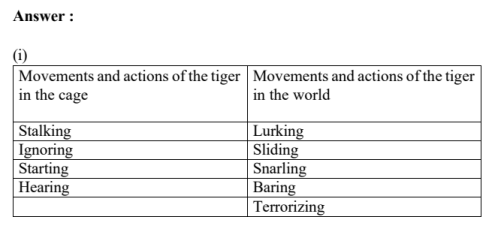
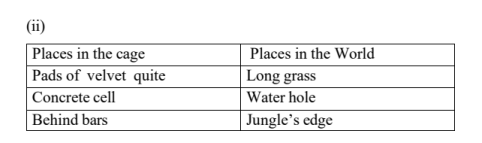
Q.1 Read the poem again, and work in pairs or groups to do the following tasks.
(i) Find the words that describe the movements and actions of the tiger in the cage and in the wild. Arrange them in two columns.
(ii) Find the words that describes the two places, and arrange them in two columns.
Now try to share ideas about how the poet uses words and images to contrast the two situations.
Q.2 Notice the use of the word repeated in lines such as these:
(i) On pads of velvet quite, In his quite rage.
(ii) And stares with his brilliant eyes At the brilliant stars.
What do you think is the effect of this repetition?
Ans.: (i) The word ‘quite’ has been repeated in these lines. The repetition of the word expressesthe intensity of the tiger’s action.
(ii) ‘Brilliant’ word has been repeated in these lines.
It expresses both the anger and brightness in the eyes of the tiger. It creates an effect of intensity of the action.
Q.3 Read the following two poems – one about a tiger and other about a panther. Then discuss:
Are zoos necessary for the protection or conversation of some species of animals ? Are they useful for educating the public ? Are there alternatives to zoos?
The Tiger
The Tiger behind the bars of his cage growls,
The Tiger behind the bars of his cage snarls,
The Tiger behind the bars of his cage roars,
Then he thinks.
It would be nice not to behind all the bars all The
Time Because they spoil my view
I wish I were wild, not on show.
But if I were wild, hunters might shoot me,
But if I were wild, food might poison me,
But if I were wild, water might
drown me. Then he stops thinking
And…..
The Tiger behind the bars of his cage
growls , The Tiger behind the bars of
his cage snarls,
The Tiger behind the bars of his cage roars,
-Peter Niblett
The Panther
His vision, from the constantly passing bars, has grown so weary that it cannot hold anything else. It seems to him there are a thousand bars; and behind the bars, no world.
As he paces in cramped circles, over and over,
The movement of his powerful soft strides is like a ritual dance around a center in which a mighty will stands paralysed. Only at times, the curtain of the pupils lifts, quietly. An image enters in, rushes down through the tensed, arrested muscles, plunges into the heart and is gone.
-Rainer Maria Rilke
Ans.: Through these two poems, it is clear to all us that freedom is very important for everyone. Not only human beings, but also animals like it deeply. Without freedom, no one can feel happy. Animals in the cage are taken care of. They are given food several times, yet they lead a very pitiable life. They do not like to be caged. They like to move freely, to chase their hunt. They are very powerful, but in the cage, they cannot find proper atmosphere for running and hunting. So, it is very difficult to live in prison.
Although zoos are necessary for the protection or conservation of some species of animals. The dangerous dip in the number of animals in wild has increased the need for the zoos at many places.
Q.4 Take a point of view for or against zoos, or even consider both points of view and write a couple of paragraphs or speak about the topic for a couple of minutes in a class.
Ans.: Zoos are both necessary and as unnecessary. The reasons in favor are more than its opposite idea. That’s why the number of zoos are increasing throughout the world.
Day-by-day the number of many species is decreasing rapidly. So, zoos are important to protect and conserve them. Many species of wild animals have already become extinct. Animals too are very important for this earth and needed to be taken care of.
There are many reasons to say that there are no apparent alternatives of zoos in the current scenario.
Note: Students may add their own ideas to it.
The Greater Cats
The Greater cats with golden eyes Stare out between the bars. Deserts are there, and different skies,
And night with different stars
-Victoria Sackville-West