Class 10 Science Chapter 15 – Our Environment – All Textual Solutions | ASSEB Assam (English Medium)
Class 10 Science Chapter 15 – Our Environment Complete Textual Solutions (ASSEB / SEBA Assam – English Medium)
The fifteenth chapter of the Class 10 Science curriculum, ‘Our Environment’, is a crucial and highly scoring part of the Environmental Science section. These complete textual solutions (Class 10 Science Chapter 15 Textual Question Answer) have been prepared based on the latest ASSEB (Assam State School Education Board) syllabus and the newest guidelines of the National Education Policy (NEP) for the upcoming board exams. This comprehensive collection includes Very Short Answers (VSA), Short Questions, Long Answers, and detailed ecological explanations. At Ospin Academy, these solutions are provided in a simple, accurate, and completely exam-oriented format.
This chapter explores the delicate balance of our ecosystem, detailing food chains, food webs, trophic levels, and the flow of energy in the environment. It also addresses critical global issues such as ozone layer depletion and solid waste management (biodegradable and non-biodegradable wastes). It is highly essential for matric candidates to clearly understand these environmental concepts. Our textual solutions cover all textbook exercise questions, in-text questions, and additional exam-focused questions to ensure students are fully equipped for their examinations.
What you will learn and get from these textual solutions:
- Clear, step-by-step explanations of ecosystems and their various abiotic and biotic components.
- Flawless answers for 1-mark VSA (objective type) and 2-3 mark short questions regarding food chains and the 10% law of energy transfer.
- Standard and easy-to-understand solutions detailing the causes and effects of ozone layer depletion (CFCs).
- Detailed information on effective garbage disposal methods and the differences between biodegradable and non-biodegradable substances.
- Solutions to all important questions along with the latest pattern MCQ questions as per the new syllabus.
Special features of these textual solutions by Ospin Academy:
- Complete textual solutions prepared strictly according to the latest ASSEB new syllabus.
- 100% accurate, high-quality notes written in simple English, making it easy for students to understand and memorize (Class 10 Science Notes).
- Simplified answers specially designed for Quick Revision right before the examinations.
- A special compilation of extra important conceptual questions that are highly likely to appear in the board exams.
Keeping in mind the academic upliftment of students, Ospin Academy has brought forward these special textual solutions. Start your matric exam preparation now and step forward towards scoring the highest marks in Science.
Class 10 Science (English Medium) PDF Solutions 2026-27 | SEBA Assam
Download Class 10 Science (English Medium) PDF with detailed solutions, MCQs, and extra practice questions for SEBA Assam 2025-26.

Class 10 Science
Our Environment
Textual Questions and Answers
1. Why are some substances biodegradable and some non- biodegradable?
Answer: Substances are classified as biodegradable or non-biodegradable based on their ability to be broken down by microorganisms such as bacteria and decomposers like fungi. Natural materials such as wood, paper, and food waste can be decomposed by these organisms. However, synthetic materials like plastics and metals are resistant to this process. This distinction determines why some substances are biodegradable and others are not.
2. Give any two ways in which biodegradable substances would affect the environment.
Answer:
(i) Biodegradable substances break down through the action of microorganisms, and the nutrients released are returned to the soil via natural cycles, maintaining ecological balance.
(ii) Biodegradable waste like kitchen scraps and plant materials can be composted to produce organic fertilizer, enriching the soil and promoting plant growth.
3. Give any two ways in which non-biodegradable substances would affect the environment.
Answer: Non-biodegradable substances affect the environment in the following ways:
(i) They contaminate soil and water resources as they cannot be decomposed by micro-organisms.
(ii) These substances, when accidentally eaten by stray animals, can harm them and can even cause their death.
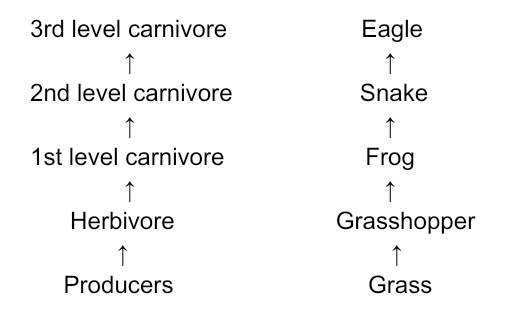
4. What are trophic levels? Give an example of a good chain and state the different trophic levels in it.
Answer: Trophic level is the fundamental level occupied by an organism in the food chain. Trophic literally means feeding, so trophic levels are the levels or positions at which species feed. Examples of trophic Levels include ‘herbivores’ and ‘decomposers’
An example of a food chain depicting various trophic levels is as follows:
5. What is the role of decomposers in an ecosystem?
Answer: Following is the role of a decomposer in the ecosystem:
(i) They act as a cleansing agent of the environment by decomposing the dead plants and animals.
(ii) They help in recycling the nutrients.
(iii) They provide space for new beings in the biosphere by decomposing the dead.
(iv) They help in putting back the various elements into water, soil and air for the reuse of producers like crop plants.
6. What is ozone and how does it affect any ecosystem?
Answer: The stratospheric layer of the atmosphere contains an ozone layer
1. It acts as a protective shield to the earth from harmful UV- radiation.
2. Excess exposure to UV rays can lead to skin cancer and cataracts.
3. Thus the presence of ozone layer is essential to block the entry of harmful UV rays.
7. How can you help in reducing the problem of waste disposal? Give any two methods.
Answer: The excessive waste material disposal due to modern industrialisation is becoming the major reason behind the current pollution which is ruining our environment.
We have to control this excessive amount of waste material disposal, in order to save our environment.
Some of the prevention measures are:
1. Using recyclable objects to generate the minimum possible waste materials. Recyclable materials are also eco-friendly, that’s why it also reduces pollution.
2. We can use biodegradable waste materials for the biogas production which can be used as our domestic fuel. This will also save our money which we generally spend on purchasing household fuel substances such as LPG, Kerosine etc.
1. Which of the following groups contain only biodegradable items?
Exercise Questions and Answers
(a) Grass, flowers and leather.
(b) Grass, wood and plastic.
(c) Fruit-peels, cake and lime-juice.
(d) Cake, wood and grass.
Answer: (c) fruit-peels, cake and lime-juice.
2. Which of the following constitute a food-chain?
(a) Grass, wheat and mango.
(b) Grass, goat and human.
(c) Goat, cow and elephant.
(d) Grass, fish and goat.
Answer: (b) Grass, goat and human.
3. Which of the following are environment-friendly practices?
(a) Carrying cloth-bags to put purchases in while shopping.
(b) Switching off unnecessary lights and fans.
(c) Walking to school instead of getting your mother to drop you on her scooter.
(d) All of the above.
Answer: (d) All of the above.
4. What will happen if we kill all the organisms in one trophic level?
Answer: If all organisms in a trophic level are eliminated, energy transfer to the next level will cease. This would lead to overpopulation of species in the previous trophic level, while organisms in higher trophic levels would face starvation and eventually die. This disruption would cause an imbalance in the entire ecosystem.
5. Will the impact of removing all the organisms in a trophic level be different for different trophic levels? Can the organisms of any trophic level be removed without causing any damage to the ecosystem?
Answer: The impact of removing all the organisms from a trophic level will be different for different trophic levels. If producers are removed from the ecosystem, herbivores will not survive due to lack of food and the entire ecosystem will collapse. If herbivores are removed, the number of producers will increase, but carnivores will not get food and may die. If carnivores are removed, the number of herbivores will increase to an unsustainable level and they will overuse the producers. If decomposers are removed, waste materials and dead remains of plants and animals will accumulate, and nutrients will not be recycled back to the soil for producers.
Therefore, removing organisms from any trophic level will definitely cause damage to the ecosystem. However, removing producers or decomposers would have the most serious effect because without plants the sun’s energy cannot be converted into chemical energy, and without decomposers nutrients cannot be recycled and made available again to producers.
6. What is biological magnification? Will the level of this magnification be different at different levels of the y ecosystem?
Answer: Biological Magnification is a phenomenon which explains the increasing concentration of harmful chemicals like DDT with each increase in trophic level. From the soil the chemicals are absorbed by the plants. The primary consumers eat these plants and the harmful chemicals come to reside in their bodies. As these chemicals are not degradable, they accumulate in the bodies of the organisms and the top level of the food chain gets the highest concentration of these harmful chemicals.
Most of the plant products which we eat are grown in fields in which pesticides and fertilisers have been used. These are absorbed by the plants and cannot be removed by washing or other means. As humans are at the top level of the food chain these chemicals get accumulated in our bodies and cause various disorders.
The level of biological magnification is different for different trophic levels of an ecosystem.
7. What are the problems caused by the non-biodegradable wastes that we generate?
Answer: The non-biodegradable wastes that we generate create several environmental problems. One major problem is biological magnification. Non-biodegradable wastes such as pesticides enter the food chain and their concentration increases at higher trophic levels, which harms living organisms.
These pesticides and chemicals also decrease soil fertility when they seep into the soil, making the soil either too acidic or too alkaline. Non-biodegradable materials like plastics or polythene bags, when burned by incineration, release toxic chemicals into the environment and thus cause air pollution.
8. If all the waste we generate is biodegradable, will this have no impact on the environment?
Ans: Even if all the waste we generate is biodegradable, it will have an impact on the environment. This is because too much biodegradable waste can not be broken down into harmless simpler substances by decomposing like micro-organisms at the right time.
9. Why is damage to the ozone layer a cause for concern? What steps are being taken to limit this damage?
Answer: Damage to the ozone layer is a serious concern because it increases the exposure of the Earth to harmful ultraviolet (UV) rays, which can cause skin cancer, early ageing of the skin, and eye diseases such as cataracts in humans. It also affects aquatic ecosystems by damaging phytoplankton and thus contributes to global warming.
To reduce this problem, several steps are being taken. The use of CFCs is being reduced by replacing them with environmentally friendly alternatives in refrigerants and fire extinguishers. Governments and international organizations are also implementing regulations to control industrial emissions of ozone-depleting substances.