Class 10 Science Chapter 7 – Control and Coordination – All Textual Solutions | ASSEB Assam (English Medium)
Class 10 Science Chapter 7 – Control and Coordination Complete Textual Solutions (ASSEB / SEBA Assam – English Medium)
The seventh chapter of the Class 10 Science curriculum, ‘Control and Coordination’, is a fascinating and highly conceptual part of the Biology section. These complete textual solutions (Class 10 Science Chapter 7 Textual Question Answer) have been prepared based on the latest ASSEB (Assam State School Education Board) syllabus and the newest guidelines of the National Education Policy (NEP) for the upcoming board exams. This comprehensive collection includes Very Short Answers (VSA), Short Questions, Long Answers, and detailed biological explanations. At Ospin Academy, these solutions are provided in a simple, accurate, and completely exam-oriented format.
This chapter explores how living organisms respond to their environment. It covers the human nervous system, the anatomy and functions of the human brain, reflex actions, chemical coordination through hormones in animals, and the tropic movements and hormones in plants. It is highly essential for matric candidates to clearly understand these regulatory systems. Our textual solutions cover all textbook exercise questions, in-text questions, and additional exam-focused questions to ensure students are fully equipped for their examinations.
What you will learn and get from these textual solutions:
- Clear, step-by-step explanations of the human nervous system and the transmission of nerve impulses across synapses.
- Flawless answers for 1-mark VSA (objective type) and 2-3 mark short questions regarding reflex arcs and tropic movements in plants.
- Standard and easy-to-memorize solutions for 4-5 mark long questions, including necessary diagrams like the structure of a neuron and the human brain.
- Detailed information on the functions of various plant hormones (auxin, gibberellin, cytokinin, abscisic acid) and human endocrine glands.
- Solutions to all important questions along with the latest pattern MCQ questions as per the new syllabus.
Special features of these textual solutions by Ospin Academy:
- Complete textual solutions prepared strictly according to the latest ASSEB new syllabus.
- 100% accurate, high-quality notes written in simple English, making it easy for students to understand and memorize complex biological terms (Class 10 Science Notes).
- Simplified answers specially designed for Quick Revision right before the examinations.
- A special compilation of extra important questions that are highly likely to appear in the board exams from this biology chapter.
Keeping in mind the academic upliftment of students, Ospin Academy has brought forward these special textual solutions. Start your matric exam preparation now and step forward towards scoring the highest marks in Science.
Class 10 Science (English Medium) PDF Solutions 2026-27 | SEBA Assam
Download Class 10 Science (English Medium) PDF with detailed solutions, MCQs, and extra practice questions for SEBA Assam 2025-26.

Class 10 Science
Control and coordination
Textual Questions and Answers
1. What is the difference between a reflex action and walking?
Answer: Difference between reflex action and walking:
Reflex action: It is an involuntary, automatic response to a stimulus that occurs at an unconscious level without thinking.
Walking: It is a voluntary action that requires conscious effort and is under our control.
2. What happens at the synapse between two neurons.
Answer: A synapse is a gap between the two neurons. At the synapse, the electrical signals are converted into chemicals that can easily cross over the gap and pass on to the next neurons where it is again converted into an electrical signal.
3. Which part of the brain maintains posture and equilibrium of body?
Answer: Cerebellum. This is the back of the brain. It coordinates voluntary muscle movements and helps to maintain posture, balance, and equilibrium.
4. How do we detect the smell of an agarbatti (incense sticks)?
Answer: Smell of an incense stick is detected by the olfactory receptors present in the nose. The information is transmitted to the olfactory lobe located in the fore brain which interprets the information.
5. What is the role of the brain in reflex action?
Answer: In a reflex action, the brain plays no part. The spinal cord, which reacts without thinking about how to respond to stimuli, is in charge of these automatic actions.
They receive information from all parts of the body and integrate it.
6. What are plant hormones?
Answer: Plant hormones are chemical compounds present in very low concentration in plants. Plant hormones help to co – ordinate growth, development and responses to the environment.
7. How is the movement of leaves of sensitive plants different from movement of a short towards light?
Answer: The type of movement of leaves of the sensitive plant is known as a nastic movement. But the movement of the shot is directional towards light.
This type of movement does not depend on the direction of stimuli. The movement of the school towards light is due to growth controlled by growth hormone.
8. Given an example of plant hormone that promotes growth.
Answer: Auxin: Auxin is a plant hormone that promotes growth.
9. How do auxins promote growth of a tendril around a support .
Answer: In plants like the pea plant, tendrils are sensitive to touch. When a tendril touches a support, auxins accumulate on the opposite side of the contact. This causes faster cell growth on that side, making the tendril bend and coil around the support, helping the plant cling to it.
10. Design an experiment to demonstrate hydrotropism.
Answer: Growth movements in response to the stimulus of moisture are termed as hydrotropic movements.
Place some ready to germinate seeds of pea in moist sawdust in a shallow box whose bottom has been replaced by a wire gauze.
Keep the apparatus undisturbed for 2-3 days. Keep the sawdust moist. After some time radicals will pass through the sieves. Then the radicles curve upwards again to enter into the moist sawdust. The roots are positively hydrotropic and the curvature is more than that due to the entropic effect.
11. How does chemical coordination take place in animals?
Answer: Chemical coordination takes place in animals with the help of chemical messengers called hormones. They are secreted by endocrine glands. The hormones are carried by the blood to the site of action. The hormones are consumed during their action. Hormones regulate the growth, development and homeostasis of the animals.
12. Why is the use of iodised salt advisable?
Answer: Iodine is essential for the thyroid gland to produce thyroxine hormone. Thyroxin regulates carbohydrate, protein and fat metabolism in the body so as to provide the best balance for growth. Iodine is essential for the synthesis of thyroxin. In case iodine is deficient in our diet, there is a possibility that we might suffer from goitre.
This deficiency disease is known as goiter. Therefore iodized salt is advised.
13. How does our body respond when adrenaline is secreted into the blood?
Answer: When secreted in large amounts it speeds up the heartbeat and hence supplies more oxygen to the muscles. The breathing rate also increases due to contractions of diaphragm and rib muscles. It also increases blood pressure. All these responses enable the body to deal with any stress or emergency.
14. What are some patients of diabetes treated by giving injections of insulin?
Answer: Insulin is a hormone which is produced by the pancreas and helps in regulating blood sugar levels. If it is not secreted in proper amounts the sugar level in the blood rises causing many harmful effects.
Exercise Questions and Answers
1. Which of the following is a plant hormone?
(a) Insulin.
(b) Thyroxin.
(c) Oestrogen.
(d) Cytokinin.
Answer: (d) Cytokinin.
2. The gap between two neurons is called a
(a) Dendrite.
(b) Synapse.
(c) Axon.
(d) Impuls.
Answer: (b) Synapse.
3. The brain is responsible for
(a) Thinking.
(b) Regulating the heart beat.
(c) Balancing the body.
(d) All of the above.
Answer: (d) All of the above.
4. What is the function of receptors in our body? Think of a situation where receptors do not work properly. What problems are likely to arise?
Answer: Receptors are present in all parts of the body for example in the skin, eyes, nose tongue, etc.
The function of receptors is to detect information from the environment.
If receptors do not detect the information there will not be any co – ordination. It may lead to accidents. Body response will not be there.
5. Draw a structure of a neuron and explain its function:
Answer: Structure of neuron:
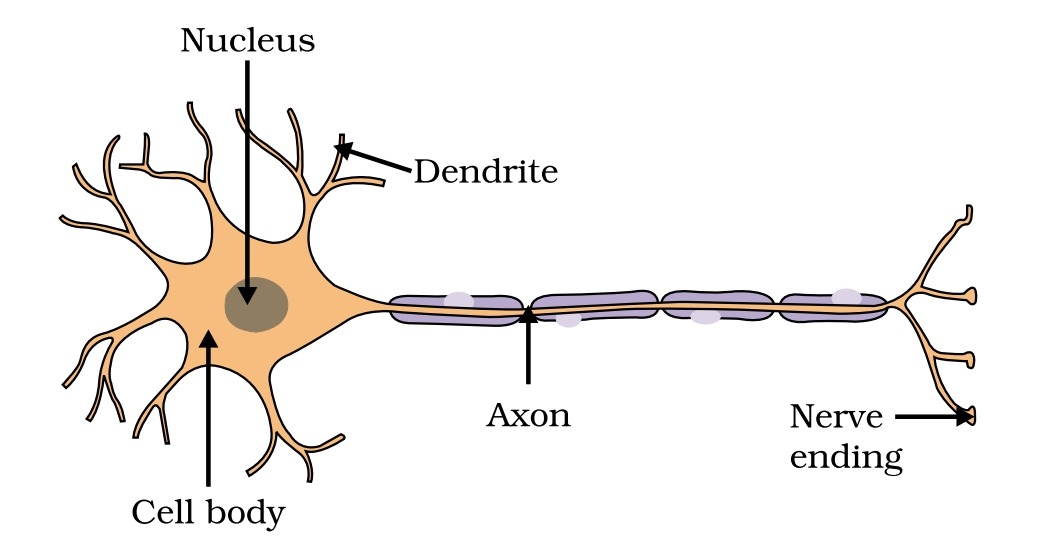
Function:
(i) Dendrites of a neuron collect information from the receptor.
(ii) Axon conducts information as an electrical impulse.
(iii) Terminal arborization passes the information as chemical stimulus at synapse for onward transmission.
6. How does phototropism occur in plants?
Answer: Phototropism is the directional response of a plant that allows the plant to grow towards or in some cases away from the light. These directional or tropic movements can be either towards the stimulus, or away from it, so, in two different kinds of phototropic movement, shoots respond by bending towards light while roots respond by bending away from it.
7. Which signals will get disrupted in case of a spinal cord injury?
Answer: Reflex action will be disturbed because reflex arcs are located in the spinal cord. So, the quick responses needed to safeguard the body will not take place. The delayed responses may cause harm to the body.
As both of these signals meet in a bundle in the spinal cord, so, if there is any spinal cord injury then both of these signals will be disrupted.
8. How does chemical coordination occur in plants?
Answer: Chemical coordination occurs in plants with the help of phytohormones or plant hormones secreted by plants. Auxin, cytokinin, gibberellin, and abscisic acid are plant hormones. These hormones regulate the growth and development of the plants.
They also regulate various metabolic activities in the plants. All growth processes are regulated by one or more phytohormones acting synergistically or antagonistically.
9. What is the need for a system of control and co-ordination in an organism?
Answer: An organism needs control and coordination system for the following functions:
(i) To save the body of the organisms from the harmful changes in the environment.
(ii) To control the speed of voluntary and involuntary actions.
(iii) To have the capability to think and learn to respond to any stimuli.
10. How are involuntary actions and reflex actions different from each other?
Answer: Reflex actions are the spontaneous responses by voluntary organs but involuntary actions are by the involuntary organs
The difference between involuntary actions and reflex actions are:
|
Involuntary actions |
Reflex actions |
|
Involuntary actions are movements that operate without the control of our conscious will. |
Reflex actions are abrupt, spontaneous reactions triggered by a specific event. |
|
They function naturally without needing any external stimulus to initiate. |
They strictly depend on an external stimulus to take place. |
|
The brain is primarily responsible for governing these activities. |
The spinal cord manages and controls these responses. |
|
Skeletal muscles do not participate in these internal movements. |
Skeletal muscles are actively engaged during these actions. |
|
These physiological processes occur continuously over the course of an individual’s life. |
These reactions are specifically generated to handle sudden, emergency situations. |
|
The pace of these actions can vary from rapid to gradual. |
Reflex actions are consistently instantaneous. |
|
For example: The rhythmic pumping of the heart is an involuntary process. Another instance is the secretion of saliva upon taking food into the mouth. |
For example: The prompt pulling away of a hand after touching a scalding hot teacup. Shutting the eyelids rapidly when exposed to a glaring light. |
11. Compare and contrast the nervous and hormonal mechanism for control and coordination in animals.
Answer:
|
Nervous system |
Hormonal system |
|
This system comprises both the central nervous system (CNS) and the peripheral nervous system (PNS). |
This system is composed entirely of various endocrine glands. |
|
The nervous system utilizes an extensive web of interconnected nerves distributed across the entire body. |
The hormonal system operates without this kind of interconnected physical network. |
|
Responses transmitted by nerve impulses are extremely rapid but remain for a brief duration. |
The biological impacts of hormones develop gradually but persist for a prolonged period. |
12. What is the difference between the manner in which movement takes place in a sensitive plant and the First movement in our legs?
Answer:
|
Aspect |
Movement in a Sensitive Plant |
Movement in Our Legs |
|
Type of Movement |
These actions are strictly involuntary. |
These actions are completely voluntary. |
|
Cause |
It is initiated by external environmental stimuli, such as physical touch. |
It is driven by intentional signals generated by the brain. |
|
Mechanism |
This occurs due to an alteration in the turgor pressure within the plant’s cells. |
This is executed through the coordinated contraction and relaxation of muscles. |
|
Control |
The entire process is managed autonomously by the plant cells. |
The process is directed and supervised by the central nervous system. |