Class 10 Science Chapter 8 – How Do Organisms Reproduce? – All Textual Solutions | ASSEB Assam (English Medium)
Class 10 Science Chapter 8 – How Do Organisms Reproduce? Complete Textual Solutions (ASSEB / SEBA Assam – English Medium)
The eighth chapter of the Class 10 Science curriculum, ‘How Do Organisms Reproduce?’, is a core biological topic that holds significant weightage for students. These complete textual solutions (Class 10 Science Chapter 8 Textual Question Answer) have been prepared based on the latest ASSEB (Assam State School Education Board) syllabus and the newest guidelines of the National Education Policy (NEP) for the upcoming board exams. This comprehensive collection includes Very Short Answers (VSA), Short Questions, Long Answers, and detailed biological explanations. At Ospin Academy, these solutions are provided in a simple, accurate, and completely exam-oriented format.
This chapter explores the fundamental mechanisms of life continuation, detailing both asexual and sexual modes of reproduction in plants and animals. It also covers the human reproductive systems, the process of fertilization, and crucial concepts surrounding reproductive health and contraception. It is highly essential for matric candidates to clearly understand these processes. Our textual solutions cover all textbook exercise questions, in-text questions, and additional exam-focused questions to ensure students are fully equipped for their examinations.
What you will learn and get from these textual solutions:
- Clear, step-by-step explanations of asexual reproduction methods like fission, fragmentation, regeneration, and vegetative propagation.
- Flawless answers for 1-mark VSA (objective type) and 2-3 mark short questions regarding reproductive health and STDs.
- Standard and easy-to-memorize solutions for 4-5 mark long questions, including necessary diagrams like the human male and female reproductive systems, and the longitudinal section of a flower.
- Detailed information on sexual reproduction in flowering plants, pollination, and fertilization.
- Solutions to all important questions along with the latest pattern MCQ questions as per the new syllabus.
Special features of these textual solutions by Ospin Academy:
- Complete textual solutions prepared strictly according to the latest ASSEB new syllabus.
- 100% accurate, high-quality notes written in simple English, making it easy for students to understand and memorize complex biological concepts (Class 10 Science Notes).
- Simplified answers specially designed for Quick Revision right before the examinations.
- A special compilation of extra important questions that are highly likely to appear in the board exams from this biology chapter.
Keeping in mind the academic upliftment of students, Ospin Academy has brought forward these special textual solutions. Start your matric exam preparation now and step forward towards scoring the highest marks in Science.
Class 10 Science (English Medium) PDF Solutions 2026-27 | SEBA Assam
Download Class 10 Science (English Medium) PDF with detailed solutions, MCQs, and extra practice questions for SEBA Assam 2025-26.

Class 10 Science
How do Organism Reproduction system
Textual Questions and Answers
1. What is the importance of DNA copying in reproduction?
Answer: DNA (Dioxyribo Nucleic acid) is the genetic material found in chromosomes which are present in nucleus of a cell.
DNA copying is an essential part of reproduction:
(i) It brings about variation in sexual reproduction which leads to evolution over generations.
(ii) The chromosome in the nucleus of a cell contains specific features from both the parents.
(iii) It codes for proteins and the required body structure of an individual. 4. Error in DNA copying led to evolution of species
2. Why is variation beneficial to the species but not necessarily for the individual?
Answer: Variation is beneficial to the species but not necessarily for the individual because it lets a species adapt to the changing environment. Variations at individual level will not help in evolving, but would result in ageing, so variation from any source in an individual can be harmful. At species level, these variations make differences in generation which leads to evolution
3. How does binary fission differ from multiple-fission?
Answer:
|
Binary fission |
Multiple-fission |
|
Binary fission nucleus divides into to 2 new individuals nuclei |
Multiple nucleus divide into many parts and the cytoplasm does not divide after each nuclear division. |
|
It occurs in normal condition |
It occurs during unfavourable condition like Encysted sage |
|
Binary fission reproduction occurs in Amoeba. |
Multiple fission reproduction occurs in Plasmodium. |
4. How will an organism be benefitted if it reproduces through spores?
Answer: Plants reproduce by Spores. If an organism reproduces through spore, it is advantageous to the organism. This is because Spores survive unfavorable conditions and they remain alive until favorable conditions appear. They survive in unfavorable conditions with the help of their protective hard covering. Under favorable conditions, they spread through water, air or animals and grow to produce new plants.
5. Can you think of reasons why more complex organisms cannot give rise to new individuals through regeneration?
Answer: In regeneration a particular type of cell can give rise to its own kind of cell only. In complex organisms, different tissues and organs have different structure; regeneration of a different kind of tissue from one kind of cell is not possible in complex organisms. Therefore, complex organisms do not give rise to individuals through regeneration.
6. Why is vegetative propagation practiced for growing some types of plants?
Answer: Vegetative propagation is a type of asexual reproduction in plants where the offspring formed is due to one parent. Also, the
offspring by vegetative propagation is genetically identical to the parent.
It has the following advantages which makes it suitable for growing some types of plants-
(a) Characteristics of the plant can be preserved.
(b) Several plants in a short time can be produced quickly by vegetative propagation.
(c) With the help of vegetative propagation it is possible to propagate plants that have lost the capability to produce viable seeds.
(d) Only one parent is needed to produce offspring
(e) The fruit trees grown by vegetative propagation methods start producing fruits earlier.
7. Why is DNA copying an essential part of the process of reproduction?
Answer: DNA is the genetic material found in chromosomes which are present in the nucleus of a cell. DNA copying is an essential part of reproduction because it transmits characteristics from parents to its offspring and brings about variation in sexual reproduction.
8. How is the process of pollination different from fertilization?
Answer:
|
Pollination |
Fertilization |
|
It is the process of transfer of pollen from anther to stigma. |
It is the fusion of male gamete in pollen with the female egg in ovule to form a zygote. |
|
Agents that bring about pollination can be air, water, birds or insects. |
It occurs inside the ovule. |
9. What is the role of seminal vesicles and prostate gland?
Answer: Found in male reproductive system, seminal vesicles and prostate glands secrete some secretions that lubricate the sperms and make their transport easier. These secretions are released into the vas deferens.
Their secretions also provide nutrition in the form of calcium and some enzymes which nourish the sperm.
10. What are the changes seen in girls at the time of puberty?
Answer: Changes seen in girls at the time of puberty are –
(i) Increase in the size of breasts.
(ii) Widening of hips.
(iii) Growth of hair under the armpits and in the genital region.
(iv) Beginning of the menstrual cycle (the uterus and ovaries enlarge, and the ovaries start releasing eggs).
(v) Pimples appear on the skin due to increased secretion of oil from the skin.
11. How does the embryo get nourishment inside the mother’s body?
Answer: There are two structures that provide nourishment to the embryo inside the mother’s body –
Villi – These are finger-like projections present on the outer tissue of the embryo in the uterus. Villi provides a large surface area for the exchange of nutrients and oxygen.
Placenta – It is embedded in the uterine wall and supplies the embryo with oxygen and nutrients from the mother’s blood. The placenta also helps in removing nitrogenous waste materials produced by the embryo.
12. If a woman is using a copper-T, will it help in protecting her from sexually transmitted diseases?
Answer: No; Use of copper-T will not help in protecting a woman from sexually transmitted diseases. Copper-T is an Intrauterine device that only prevents the implantation of embryos in the uterus. It will not prevent the entry of sperms and thus will not protect from sexually transmitted diseases.
Exercise Questions and Answers
1. Asexual reproduction takes place through budding in:
A. Amoeba
B. Yeast
C. Plasmodium
D. Leishmania
Answer: B. Yeast
2. Which of the following is not a part of the female reproductive system in human beings?
A. Ovary
B. Uterus
C. Vas deferens
D. Fallopian tube
Answer: C. Vas deferens
3. The anther contains:
A. Sepals
B. Ovules
C. Carpel
D. Pollen grains
Answer: D. Pollen grains
4. What are the advantages of sexual reproduction over asexual reproduction?
Answer:
(a) Sexual reproduction results in new genetic variations which promotes diversity of characters which is not possible in case of asexual reproduction.
(b) Sexual reproduction plays an important role in the origin of new species having different characteristics which is again not possible in case of asexual reproduction.
(c) It introduces variability, which leads to continual evolution of various species to form better organisms. Evolution is not possible in case of asexual reproduction.
5. What are the functions performed by testes in human beings?
Answer: Testes perform two main functions in human beings, specifically in males (testes are a part of the male reproductive system and are located outside the abdominal cavity in the scrotum).
(i) They produce male gametes or sex cells called sperms.
(ii) They also produce the male sex hormone testosterone, which is responsible for the development of secondary sexual characteristics in boys such as beard, moustache, deep voice, etc.
6. Why does menstruation occur?
Answer: Menstruation is a process of regular discharge of blood and mucosal tissues that occurs monthly in females.
It occurs because the ovary produces one egg every month, so simultaneously the walls of the uterus thicken, get supplied by blood and the uterus is prepared to receive and nourish the egg if fertilized by the sperm. However, if the egg does not get fertilized by the sperm then this inner wall of the uterus which thickened earlier to receive the fertilized egg, breaks down gradually and is released externally from the vagina in the form of blood and mucosal tissues.
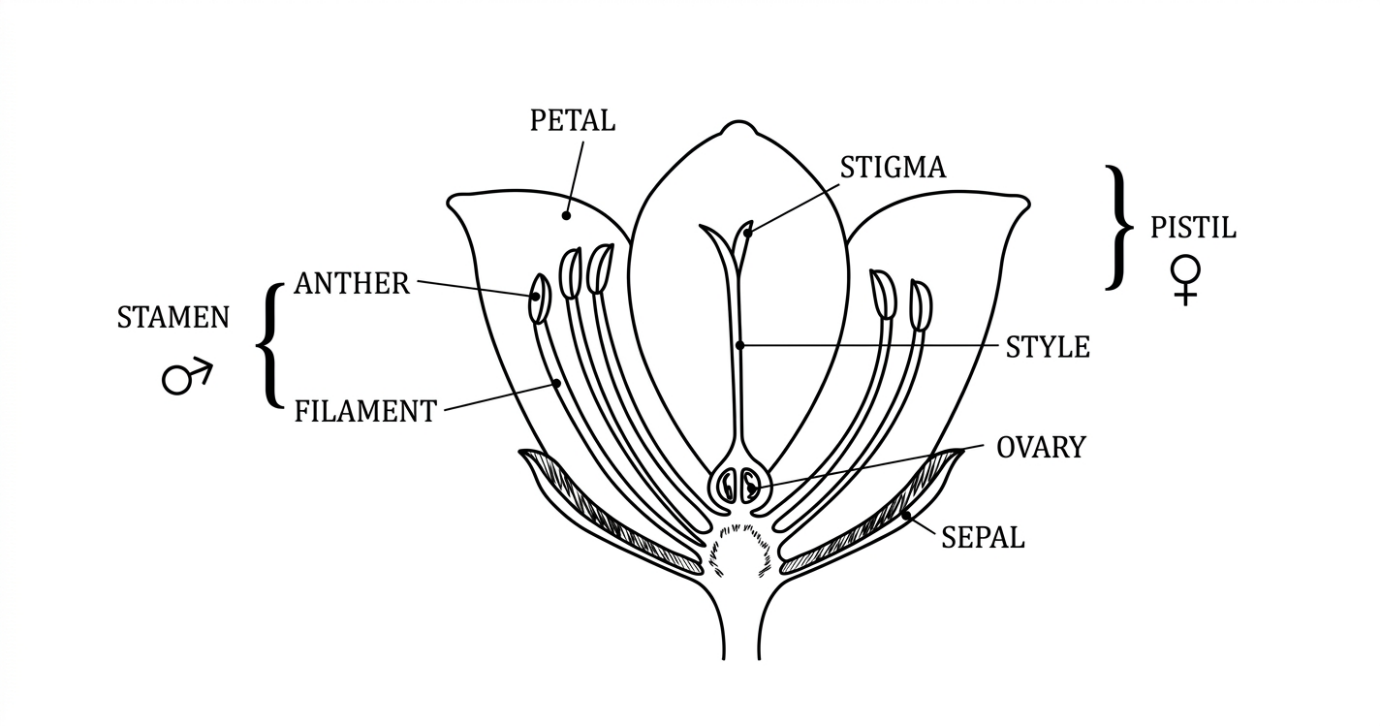
7. Draw a labelled diagram of the longitudinal section of a flower. Answer: Labelled diagram of longitudinal section of a flower.
8. What are the different methods of contraception?
Answer: Contraception refers to the use of methods or devices to prevent pregnancy in women. There are various methods used to avoid pregnancy.
(i) Barrier methods – These include the use of condoms, diaphragm, and cervical caps. Condoms are used by men to prevent the transfer of sperm from the penis to the uterus, thereby preventing fertilization. Diaphragms are used by females to cover the cervix. Cervical caps are also used by females for the same purpose.
(ii) Surgical methods – These include vasectomy and tubectomy. Vasectomy is performed in males in which a small part of the vas deferens is removed or tied, which prevents sperms from coming out. Tubectomy is performed in females in which a small part of the fallopian tube is removed and the ends are tied. This prevents the transfer of eggs into the oviduct.
(iii) Oral contraceptive pills – These pills contain hormones such as progesterone or a combination of progesterone and estrogen, which prevent the ovaries from releasing eggs.
(iv) Intrauterine devices (IUDs) – These devices release copper ions which reduce sperm motility. Loop and Copper-T are two such devices.
9. How are the modes of reproduction different in unicellular and multicellular organisms?
Answer: Unicellular organisms are the single-celled organism. These organisms reproduce by asexual mode of reproduction i.e by the process of binary fission, multiple fission, budding, or cyst formation. In this case the reproduction nucleus gets divided into two equal parts.
Multicellular organisms are a complex organism which has function specific organs like plants, mammals etc. Complex multicellular organisms reproduce sexually that involve fusion of gamete/ sex cells from parents. e.g. pollination in plants.
10. How does reproduction help in providing stability to populations of species?
Answer: Every species has to constantly struggle for its survival. Natural predators keep on removing a large section of the population of a particular species. Also, the natural cycle of life and death also removes a section of the population. Reproduction is giving birth to individuals of same species, hence it way to prevent the members of
population from being lost. Thus, it provides stability to the population of species.
11. What could be the reasons for adopting contraceptive method? 11. What could be the reasons for adopting contraceptive method?
Answer: The reasons for adopting contraceptive methods may be –
(i) To prevent unwanted pregnancies.
(ii) To prevent the transmission of sexually transmitted diseases (STDs).
(iii) To control the number of children a couple wants to have, that is, for family planning.
(iv) Contraceptive methods are also used to maintain a gap of a few years between two consecutive children.