Class 8 Science Chapter 4 – Coal and Petroleum – All Textual Solutions | ASSEB Assam (English Medium)
Class 8 Science Chapter 4 – Coal and Petroleum Complete Textual Questions and Answers (ASSEB / SEBA Assam – English Medium)
Chapter 4 of the Class 8 Science curriculum, ‘Coal and Petroleum’, is a highly important chapter focusing on energy resources. These complete textual question-answer solutions (Class 8 Science Chapter 4 Textual Solutions) have been meticulously prepared based on the latest guidelines of the new ASSEB (Assam State School Education Board) syllabus and the National Education Policy (NEP). This comprehensive compilation includes textbook-based Very Short Answers (VSA), Short Questions, Long Answers, explanations, and key scientific definitions. Ospin Academy provides these solutions in a simple, accurate, and completely exam-oriented format.
The chapter ‘Coal and Petroleum’ provides an in-depth understanding of inexhaustible and exhaustible natural resources. It explores the formation of fossil fuels like coal, petroleum, and natural gas from the dead remains of living organisms over millions of years. Students will learn about the products obtained from processing coal (coke, coal tar, and coal gas), the process of petroleum refining, and the vital tips provided by PCRA for conserving these limited resources. It is essential for students to thoroughly grasp these core concepts. Our textual solutions not only cover all the standard textbook exercises but also include important additional exam-oriented questions to ensure robust preparation.
What you will learn and get from these textual solutions:
- Clear explanations distinguishing between exhaustible and inexhaustible natural resources.
- Accurate, point-wise answers for 1-mark objective questions (VSA) and 2-3 mark short textual questions regarding fossil fuels.
- Standard and easy-to-understand explanations for 4-5 mark long descriptive questions, such as the formation of coal (carbonisation) and the refining of petroleum.
- Complete coverage of end-of-chapter exercises, fill-in-the-blanks, matching questions, and full forms (like CNG, LPG, and PCRA).
- Extra important questions aligned with the new syllabus structure alongside standard MCQ solutions.
Exclusive features of Ospin Academy’s solutions:
- Fully textbook-based answers formulated strictly according to the latest ASSEB new syllabus guidelines.
- 100% accurate, high-quality notes written in simple English language for effortless memorization and understanding.
- Concise summaries and targeted answers specifically designed for quick revision before examinations.
- A curated selection of highly probable extra questions to give students a competitive edge.
Committed to the academic excellence of students, Ospin Academy offers these high-quality textual solutions. Start your preparation today to master the concepts of Science and achieve top scores in your upcoming examinations.

Class 8 Science (English Medium) PDF Solutions 2026-27 | SCERT Assam
Get the Class 8 Science (English Medium) PDF with detailed solutions, MCQs, and extra practice questions for SCERT Assam 2025-26.
Class 8 Science
Chapter – 4 Ospin Academy
Coal and Petroleum
TEXTBOOK EXERCISES
Q. 1. What are the advantages of using CNG and LPG as fuels?
Ans. Advantages of LPG as fuel:
(i) LPG has a high calorific value. Its calorific value is about 50 kJ/g.
(ii) It burns with a smokeless flame and so does not cause any pollution.
(iii) LPG is easy to handle and convenient to store.
(iv) It undergoes complete combustion.
Advantages of CNG as fuel:
(i) It does not cause air pollution.
(ii) It leaves no ash on burning.
Q. 2. Name the petroleum product used for surfacing of roads.
Ans. Bitumen.
Q. 3. Describe how coal is formed from dead vegetation. What is this process called?
Ans. Formation of coal from dead vegetation: About 300 million years ago, there were dense forests in the wet lands that got buried under the surface of the earth due to some
environmental changes such as earthquakes, volcanoes and flooding. Gradually, they were covered with many layers of soil and got decomposed. The high pressure and intense heat ultimately converted the purified vegetable remains into coal.
The formation of coal from dead vegetation is known as carbonisation.
Q. 4. Fill in the blanks:
(a) Fossil fuels are _________, _________ and _________.
Ans. Coal, petroleum, natural gas.
(b) Process of separation of different constituents from petroleum is called __________.
Ans. Refining.
(c) Least polluting fuel for vehicles is __________.
Ans. CNG (compressed natural gas)
Q. 5. Tick True/False against the following statements:
(a) Fossil fuels can be made in the laboratory. (T/F)
Ans. False.
(b) CNG is more polluting fuel than petrol. (T/F)
Ans. False.
(c) Coke is almost pure form of carbon. (T/F)
Ans. True.
(d) Coal-tar is a mixture of various substances. (T/F)
Ans. True.
(e) Kerosene is not fossil fuel. (T/F)
Ans. False.
Q. 6. Explain why fossil fuels are exhaustible natural resources.
Ans. It took many hundred years to convert dead plants and animals into fossil fuels. Moreover, reserves fossil fuels are limited in quantity for the use of human activities. Hence, these fossil fuels are called exhaustible natural resources.
Q. 7. Describe the characteristics and uses of coke.
Ans. Characteristics of coke:
(i) It is a tough and porous black substance.
(ii) It is a pure form of carbon.
Uses of Coke
1. Coke is used as domestic fuel.
2. Coke is used as a reducing agent in metallurgical processes.
3. Coke is used for producing fuel gases such as water gas (CO + H₂) and producer gas (CO + N₂).
4. Coke is used for producing carbides such as calcium curbide (CaC2), silicon carbide (SiC) and aluminium carbide (Al4 C₂).
Calcium and aluminium carbides are very useful and cheap raw materials for petro chemical industry. Silicon carbide is very hard and used as an abrasive.
Q. 8. Explain the process of formation petroleum.
Ans. Formation of Petroleum: Petroleum is formed from the bacterial decomposition of remains of plants and animals which got buried under the sea. When these organisms died, they sank to the bottom of the sea and got covered with sand and clay. Due to high pressure, heat, action of bacteria and in the absence of air, the dead remains of tiny plants and animals were slowly converted into petroleum.
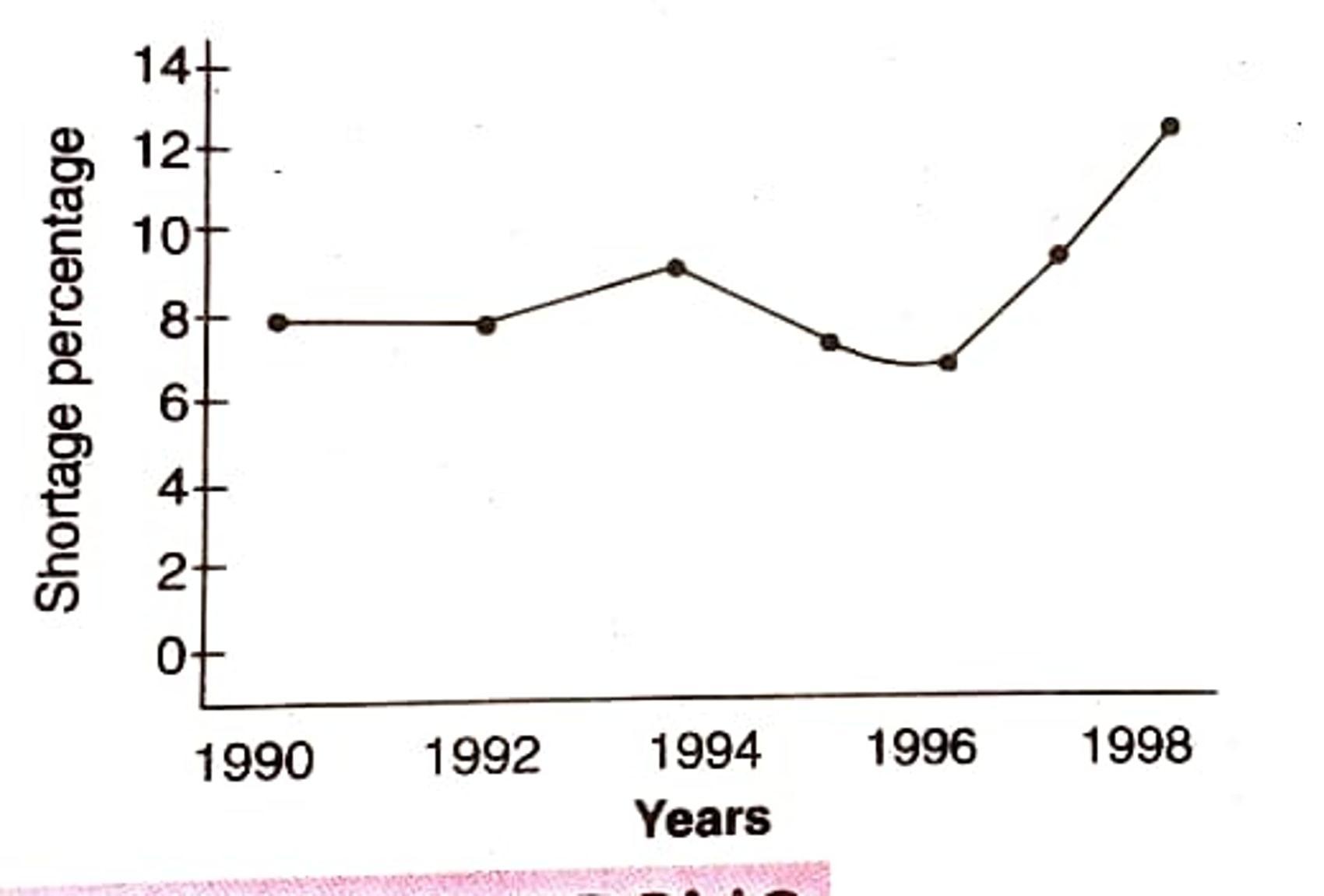
Q. 9. The following table shows the total power shortage in India from 1991-1997. Show the data in the form of a graph. Plot shortage percentage for the year on the Y-axis and the year on the X-axis.
Ans.
|
Year |
Shortage % |
|
|---|---|---|
|
1. |
1991 |
7.9 |
|
2. |
1992 |
7.8 |
|
3. |
1993 |
8.3 |
|
4. |
1994 |
7.4 |
|
5. |
1995 |
7.1 |
|
6. |
1996 |
9.1 |
|
7. |
1997 |
11.5 |