
Class 8 Social Science Chapter 17 – Mercantilism and Advent of the European Traders – All Textual Solutions | ASSEB Assam (English Medium)
Class 8 Social Science History Chapter 17 – Mercantilism and Advent of the European Traders Complete Textual Question Answers and Solutions (ASSEB / SEBA Assam – English Medium)
Chapter 17 of the Class 8 Social Science (History) curriculum, titled ‘Mercantilism and Advent of the European Traders’, is a foundational lesson that covers the transition of India into the modern historical era. Prepared strictly according to the current syllabus of the ASSEB (Assam State School Education Board) and the guidelines of the National Education Policy (NEP), these comprehensive textual solutions cover every textbook exercise in detail. This essential study resource includes Very Short Answers (VSA), Short Questions, Long Answers, and extra exam-oriented study notes. Brought to you strictly by Ospin Academy, these solutions are designed to be historically accurate, highly structured, and perfectly optimized for school examinations.
This chapter details the economic philosophy of Mercantilism that drove European nations to explore new sea routes to the East. It covers the pivotal discovery of the sea route to India by Vasco da Gama in 1498, followed by the systematic arrival of the Portuguese, Dutch, British (East India Company), and French traders. It also explains the fierce commercial rivalries, such as the Carnatic Wars, which ultimately led to the establishment of British political supremacy in India. Understanding these historical shifts is crucial for Class 8 students as it sets the stage for the colonial era. Our expertly crafted study notes present complex timelines and treaties in simple, point-wise formats to ensure effortless learning and excellent exam preparation.
What you will learn and find in these Textual Solutions:
- Detailed breakdown of the concept of Mercantilism and how trade monopolies fueled European global expansion.
- Flawless answers for 1-mark objective questions (VSA) and concise historical notes for 2-3 mark short questions.
- Comprehensive, step-by-step point-wise solutions for 4-5 mark descriptive questions detailing the establishment of key trading factories and forts.
- Analysis of the Anglo-French rivalry (Carnatic Wars) and the strategic factors that led to the ultimate success of the British East India Company.
- Important extra practice questions and multiple-choice questions (MCQs) aligned directly with the current syllabus evaluation patterns.
Key Benefits of Ospin Academy’s Chapter 17 Solutions:
- 100% authentic and strictly mapped to the latest ASSEB/SEBA History syllabus guidelines.
- Written in highly accessible, straightforward English language ensuring students easily grasp underlying trade dynamics and score high marks.
- Systematically organized study notes ideal for completing daily assignments and executing rapid revisions before examinations.
- Includes frequently asked and highly probable examination questions curated specifically to boost student confidence.
Ospin Academy is dedicated to providing superior educational resources that make studying history engaging and straightforward. Master your Class 8 Social Science History syllabus today with our expertly structured solutions and achieve outstanding academic success.

Class 8 Social Science (English Medium) PDF Solutions 2026-27 | SCERT Assam
Download Class 8 Social Science (English Medium) PDF with chapter-wise MCQs, textbook answers, and extra questions for SCERT Assam 2025-26.
Class 8 Social Science
Chapter – 17 Ospin Academy
Mercantilism and Advent of the European traders of India
|
Exercise |
|---|
1. Write short answers.
(a) In which year was the East India Company formed?
Ans: The East India Company was formed in the year 1600.
(b) Who first discovered the sea route to India?
Ans: The sea route to India was first discovered by Vasco da Gama.
(c) In which place of India did the Dutch first build their fort?
Ans: The Dutch first built their fort in India at Pulicat.
(d) To whom did Charles II lease out Bombay (Mumbai)?
Ans: Charles II leased out Bombay (Mumbai) to the British East India Company.
(e) Who issued farman to British East India company?
Ans: The farman to the British East India Company was issued by Mughal Emperor Farrukhsiyar.
2. Match the following:
|
Group A |
Group B |
|---|---|
|
Columbus |
Portuguese sailor |
|
William Hawkins |
Portuguese princess |
|
Vasco Da Gama |
Dutch |
|
Charles II |
English mediator |
|
Pulicat |
America |
Ans:
|
Group A |
Group B |
|---|---|
|
Columbus |
America |
|
William Hawkins |
English mediator |
|
Vasco Da Gama |
Portuguese sailor |
|
Charles II |
Portuguese princess |
|
Pulicat |
Dutch |
3. Fill in the blanks:
(a) In __________ A.D. British East India obtained the royal permission of Queen Elizabeth I to trade with the countries of the east.
Ans: 1600.
(b) By ________ the economic activity of a country was controlled by the government.
Ans: The early 17th century.
(c) In 1661 A.D. Charles II leased ________ to the East India Company.
Ans: Bombay (Mumbai).
(d) In 1715 A.D. emperor.__________ to trade with India. issued a farmaan permitting the East India Company.
Ans: Farrukhsiyar.
(e) ___________ was the main headquarters of the French.
Ans: Pondicherry.
4. State whether true or false.
(a) The Mughal Empire was strong in the 18th century.
Ans: False.
(b) The British East India Company was the only company to trade with India.
Ans: False.
(c) In 1492 A.D. Vasco Da Gama arrived at Calicut.
Ans: False.
(d) The indulgence of the employees of the British East India company apany in private business crippled the local industries.
Ans: True.
(e) Mercantilism encouraged colonialism. ER.
Ans: True.
5. Discuss in groups and prepare notes on the followings-
(a) The reasons behind the entry of the European merchants into India.
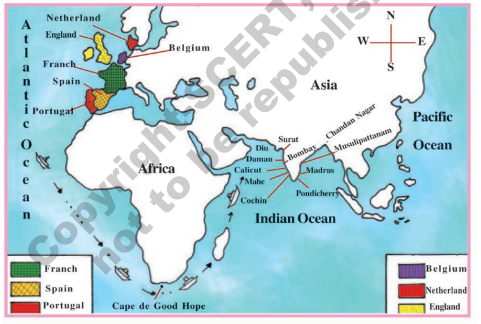
Ans: From the 16th to the end of the 18th century the economy of Europe was based on mercantilism. The European countries of those days laid stress on foreign trade. They gave Importance to earning gold and silver through easy and accessible trade to strengthen the economy and the army of their countries. But soon due to the influence of Mercantilism a situation arose where all the countries started to look for a market where they could sell their finished products. This type of economic activity is known as Mercantilism. Asa result, most of the European countries concentrated on colonial expansion to foreign lands to find a market for their trade. During that period the economic policy of Great Britain, Netherlands, Spain, Portugal, France, Denmark etc was mainly based don their Imperial policies.
(b) What do you understand by mercantilism? What is the relation between mercantilism and colonialism?
Ans: Mercantilism was a form of economic nationalism that sought to increase the prosperity and power of a nation through restrictive trade practices.
The relation between mercantilism and colonialism are mentioned below:
(i) Economic Motive: Mercantilism provided the economic rationale for colonial expansion. Colonies were seen as a means to increase national wealth by providing raw materials and serving as markets for manufactured goods.
(ii) Control and Regulation: The mercantilist belief in government control over the economy extended to colonies. Colonial economies were structured to serve the interests of the mother country, often through restrictive trade practices and monopolies.
(iii) Positive Balance of Trade: Colonies helped achieve a positive balance of trade by exporting raw materials and importing finished goods, ensuring that the wealth flowed back to the colonising country.
(c) The influence of the European traders on the social and economic life of India.
Ans: It had abundant resources which were famous and known throughout the world. Some resources such as Indian silk, muslin, indigo and spices were in great demand in European countries. This richness of the Indian economy and the abundance of resources compelled them to trade with our country.
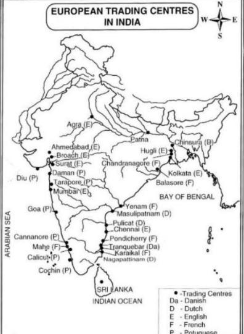
6. Draw a map of India and insert the trade centres of the Portuguese, Dutch, English and French.
Ans: The trade centres of the Portuguese, Dutch, English and French are mentioned below:
(i) The Portuguese.
(a) Portuguese travellers were the first Europeans to land in India. They established their commercial station in India first.
(b) They pushed the Arab traders away from Indian marketplaces with their superior ships and use of force.
(ii) The Dutch.
(a) In 1602, the Dutch East India Company was established with the intention of engaging in profitable spice commerce with India and the East.
(b) The Dutch built their factories at Cochin, Surat, and Masulipatnam.
(c) From India, they exported silk, cotton, and indigo.
The British
(iii) English trade.
(a) The East India Company was established in England in 1600 by a group of businessmen who also obtained a charter from Queen Elizabeth1, who was the country’s monarch at the time, giving them the exclusive right to trade with India in exchange for a cut of the profits.
(b) The East India Company was the only trade organisation in England that was permitted, according to the charter. As a result, the business didn’t worry about competition from other English trade firms.
(iv) The French.
(a) The French was the final European nation to invade India. In 1664, they established their trade enterprise.
(b) At Surat, Masulipatnam, Chandranagore, and Mahe, they established commercial hubs. In Surat, the first French factory was founded in 1668.
7. Make a list of the cottage industries that existed before the English entered India.
Ans: List of the cottage industries existed before the english entered india are mentioned below:
(i) Leather industry.
(ii) Cotton weaving.
(iii) Carpet making.
(iv) Metal handicrafts.
(v) Silk weaving industries.
8. “The period from the end of the 17th and the beginning of the 18th century played a significant role in Indian history.” Explain the significance of the sentence.
Ans: The period from the end of the 17th to the beginning of the 18th century was indeed pivotal in Indian history due to several key developments:
(i) Political Transitions: This era marked significant shifts in political power across India. The decline of the Mughal Empire, which had been the dominant force, led to the rise of regional powers such as the Marathas, Sikhs, and various other states. This fragmentation altered the political landscape of the subcontinent.
(ii) European Influence: The 17th and 18th centuries saw the establishment and expansion of European powers, particularly the British and French, in India. The British East India Company gained strength, securing trading posts and gradually expanding its influence over local rulers. This laid the groundwork for British colonial rule in the subsequent centuries.
(iii) Cultural and Social Changes: During this period, there were significant cultural and social transformations. The interaction between Indian and European cultures led to changes in art, architecture, literature, and social customs. Indian society experienced both continuity and adaptation in response to these influences.
(iv) Economic Impact: The emergence of European trading posts and colonial ambitions had profound economic consequences. The shift from purely mercantile activities to territorial control and exploitation of resources reshaped economic structures in India, paving the way for the eventual dominance of colonial economic policies.
(v) Military Dynamics: The decline of centralised Mughal authority created power vacuums that were filled by regional powers and European entities. This led to frequent conflicts and wars, both between Indian states and between Indians and Europeans, fundamentally altering military strategies and alliances.
