
Class 8 Science Chapter 17 – Synthetic Fibres and Plastics – All Textual Solutions | ASSEB Assam (English Medium)
Class 8 Science Chapter 17 – Synthetic Fibres and Plastics Complete Textual Questions and Answers (ASSEB / SEBA Assam – English Medium)
Chapter 17 of the Class 8 Science curriculum, ‘Synthetic Fibres and Plastics’, is a highly relevant chemistry lesson that explains the materials we use in our daily lives. These complete textual question-answer solutions (Class 8 Science Chapter 17 Textual Solutions) have been meticulously prepared based on the latest guidelines of the new ASSEB (Assam State School Education Board) syllabus and the National Education Policy (NEP). Ospin Academy provides these solutions in a clear, accurate, and completely exam-oriented format.
The chapter ‘Synthetic Fibres and Plastics’ provides an in-depth understanding of polymers and the different types of synthetic fibres like Rayon, Nylon, Polyester, and Acrylic. Students will learn about the characteristics of synthetic fibres, the classification of plastics into Thermoplastics and Thermosetting plastics, and their various uses. A significant part of the lesson focuses on the environmental impact of plastics, the difference between biodegradable and non-biodegradable materials, and the importance of the 5R principle (Reduce, Reuse, Recycle, Recover, and Refuse). It is essential for students to thoroughly grasp these core concepts for both academic success and environmental consciousness. Our textual solutions cover all standard textbook exercises and include additional important questions to ensure robust preparation.
What you will learn and get from these textual solutions:
- Detailed explanations of what synthetic fibres are and why they are called man-made fibres.
- Accurate, point-wise answers for 1-mark objective questions (VSA) and 2-3 mark short textual questions regarding the properties of Nylon and Rayon.
- Standard and easy-to-understand explanations for descriptive questions, such as the differences between Thermoplastics and Thermosetting plastics.
- Complete coverage of end-of-chapter exercises, fill-in-the-blanks, matching questions, and “give reason” type problems.
- Essential notes on the environmental hazards caused by plastics and the ways to minimize their use.
- Extra important questions aligned with the new syllabus structure alongside standard MCQ solutions.
Exclusive features of Ospin Academy’s solutions:
- Fully textbook-based answers formulated strictly according to the latest ASSEB new syllabus guidelines.
- 100% accurate, high-quality notes written in simple English language for effortless memorization.
- Concise summaries and targeted answers specifically designed for quick revision before examinations.
- Practical examples to help students understand the application of different types of plastics and fibres.
Committed to the academic excellence of students, Ospin Academy offers these high-quality textual solutions. Start your preparation today to master the concepts of Science and achieve top scores in your upcoming examinations.

Class 8 Science (English Medium) PDF Solutions 2026-27 | SCERT Assam
Get the Class 8 Science (English Medium) PDF with detailed solutions, MCQs, and extra practice questions for SCERT Assam 2025-26.
Class 8 Science
Chapter – 17 Ospin Academy
Synthetic Fibres and Plastics
TEXTBOOK EXERCISES
Q. 1. Explain why some fibres are called synthetic.
Ans. Some fibres are called synthetic because they do not occur naturally and are made by man using petrochemicals.
Q. 2. Mark (✓) the correct answer:
Rayon is different from synthetic fibre because:
(i) it has a silk like appearance.
(ii) it is obtained from wood pulp.
(iii) its fibres can also be woven like those of natural fibres.
Ans. (ii) it is obtained from wood pulp.
Q. 3. Fill in the blank with appropriate words:
(i) Synthetic fibres are also called _________ or __________ fibres.
Ans. man-made or artifical fibres.
(ii) Synthetic fibres are synthesized from raw material called __________.
Ans. petrochemicals.
(iii) Like synthetic fibres, plastic is also a __________.
Ans. polymer.
Q. 4. Give examples which indicate that nylon fibres are very strong.
Ans. Examples:
(i) They are used for making parachutes and ropes for rock climbing.
(ii) They are used in making seat-belts, fishing nets, tyre cord, strings for sports rackets and musical instruments.
Q. 5. Explain why plastic containers are favoured for storing food.
Ans. Plastic containers are favoured for storing food because:
(a) the plastics do not react with the food stored in them.
(b) the plastics are light weight and are strong.
(c) they are easy to handle and safe.
Q. 6. Explain the difference between the thermoplastic and thermosetting plastics.
Ans.
|
Thermoplastics |
Thermosetting plastics |
|---|---|
|
1. These are the plastics which get deformed easily on heating and can be bent easily. |
1. These are the plastics which when moulded once, cannot be softened by heating. |
|
2. These are used for manufacturing toys, combs, car grills and various types of containers. Examples: Polythene and PVC |
2. (i) Bakelites are used for making electrical switches, handles of various utensils etc. (ii) Melamines are used for making floor tiles, kitchen wares and fabrics which resist fire. Examples: Bakelite and Melamine. |
Q. 7. Explain why the following are made of thermosetting plastics:
(a) Saucepan handles.
Ans. The handles of saucepan are made of thermosetting plastics because it is a bad conductor of heat and do not get heated up while cooking.
(b) Electric plugs/ switches/plug boards.
Ans. Electric plugs/switches/plug boards are made of thermosetting plastic, because it is a bad conductor of electricity. The electric current does not pass through such plastics.
Q. 8. Categorize the materials of the following products into can be recycled and cannot be recycled”.
Telephone instruments, plastic toys, cooker handles, carry bags, ball point pens, plastic bowls, plastic covering on electric wires, plastic chairs, electrical switches.
Ans. Can be recycled: Plastic toys, carry bags, plastic bowls, ball point pen, plastic chairs, electric wire covering.
Cannot be recycled: Cooker handles, electric switches, telephone instruments.
Q. 9. Rana wants to buy shirts for summer. Should he buy cotton shirts or shirts made from synthetic material? Advise Rana, giving your reason.
Ans. Cotton clothes are preferred to Synthetic clothes in summers because cotton is a bad conductor of heat. It does not allow the outer heat to enter in our body, thus protects body from heat. It also has more capacity to hold moisture than the synthetic clothes. So, it retains the sweat of the body and keeps it cool. So, Rana should buy shirts made up of cotton.
Q. 10. Give examples to show that plastics are non-corrosive in nature.
Ans. Examples to show that plastics are non-corrosive in nature:
(i) They do not react with any substance.
(ii) Plastics do not react with air and water which are essential for corrosion.
(iii) They do not show any chemical reaction.
Q. 11. Should the handle and bristles of a brush be made of the same materials. Explain your answer.
Ans. No, the handle and bristles of a tooth brush should not be made of the same material because the bristles should be soft and the handle should be hard. So the bristles should be made up of soft material so that it does not harm the gums. The handles should be made up of hard materials so that it can give firm grip.
Q. 12. ‘Avoid plastics as far as possible’. Comment on this advice.
Ans. The articles made of plastics are non-biodegradable. So, the use of plastics has a bad effect on the environment. The plastics cannot be finally disposed off. Therefore, plastics should be avoided as for as possible.
Q. 13. Match the terms of column I correctly with the phrases given in column II
|
Column l |
Column II |
|---|---|
|
(i) Polyester |
(a) Prepared by using wood pulp |
|
(ii) Teflon |
(b) Used for making parachutes and stockings |
|
(iii) Rayon |
(c) Used to make non-stick cookwares |
|
(iv) Nylon |
(d) Fabrics do not wrinkle easily |
Ans.
|
Column l |
Column II |
|---|---|
|
(i) Polyester |
(d) Fabrics do not wrinkle easily |
|
(ii) Teflon |
(c) Used to make non-stick cookwares |
|
(iii) Rayon |
(a) Prepared by using wood pulp |
|
(iv) Nylon |
(b) Used for making parachutes and stockings |
Q. 14. ‘Manufacturing synthetic fibres is actually helping conservation of forests’. Comment.
Ans. Manufacturing synthetic fibres is actually helping conservation of forests because it does not require cutting plants and hunting animals to get the natural fibres. The synthetic fibres are made up of chemicals and these chemicals are not available in forests.
Q. 15. Describre an activity to show that Thermoplastic is a poor conductor of electricity.
Ans. 1. Arrange a circuit as shown in the figure given below.
2. Leave a gap (say AB) between two ends of the wire.
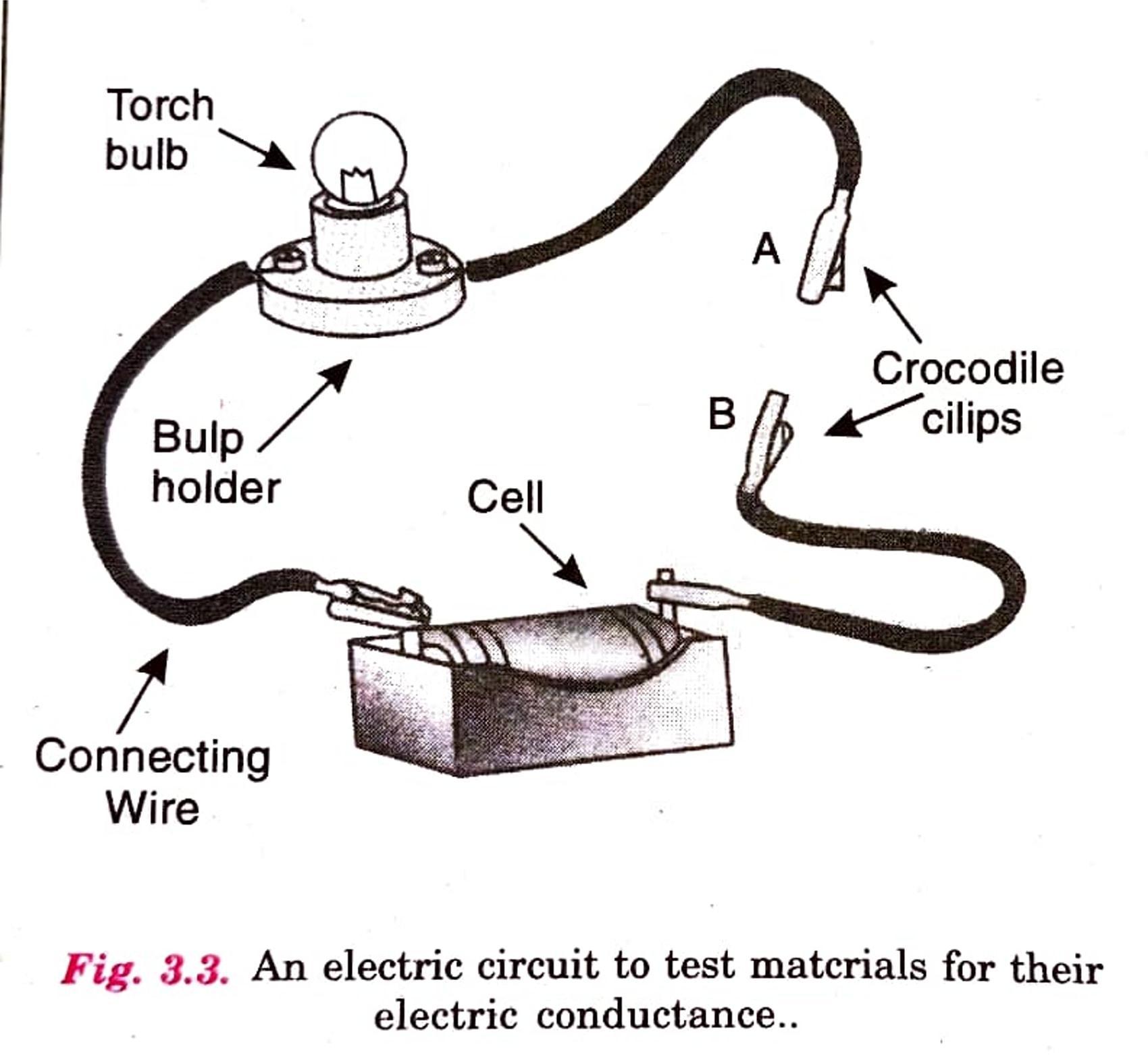
3. Place a piece of copper wire in the gap touching the points A and B.
4. The bulb starts glowing. This shows that the copper is a good conductor of electricity.
5. Now repeat the same experiment with plastic. The bulb does not glow. This shows that plastic is a poor conductor of electricity.
