Class 8 Science Chapter 18 – Stars and the Solar System – All Textual Solutions | ASSEB Assam (English Medium)
Class 8 Science Chapter 18 – Stars and the Solar System Complete Textual Questions and Answers (ASSEB / SEBA Assam – English Medium)
Chapter 18 of the Class 8 Science curriculum, ‘Stars and the Solar System’, is an inspiring astronomy lesson that takes students on a journey through the universe. These complete textual question-answer solutions (Class 8 Science Chapter 18 Textual Solutions) have been meticulously prepared based on the latest guidelines of the new ASSEB (Assam State School Education Board) syllabus and the National Education Policy (NEP). Ospin Academy provides these solutions in a simple, accurate, and completely exam-oriented format.
The chapter ‘Stars and the Solar System’ provides an in-depth understanding of celestial objects including the Moon and its phases, the stars, and various constellations like Ursa Major and Orion. Students will explore the Solar System in detail, learning about the Sun and the eight planets, their characteristics, and other members of the solar family such as asteroids, comets, meteors, and artificial satellites. It is essential for students to thoroughly grasp these core concepts for both academic success and general scientific knowledge. Our textual solutions cover all standard textbook exercises and include additional important questions to ensure robust preparation.
What you will learn and get from these textual solutions:
- Detailed explanations of the phases of the moon and why we always see only one side of the moon.
- Accurate, point-wise answers for 1-mark objective questions (VSA) and 2-3 mark short textual questions regarding the Pole Star.
- Standard and easy-to-understand explanations for descriptive questions, such as the differences between stars and planets.
- Complete coverage of end-of-chapter exercises, fill-in-the-blanks, matching questions, and “true or false” statements.
- Essential notes on constellations, the asteroid belt, and the significance of artificial satellites in communication.
- Extra important questions aligned with the new syllabus structure alongside standard MCQ solutions.
Exclusive features of Ospin Academy’s solutions:
- Fully textbook-based answers formulated strictly according to the latest ASSEB new syllabus guidelines.
- 100% accurate, high-quality notes written in simple English language for effortless memorization.
- Concise summaries and targeted answers specifically designed for quick revision before examinations.
- Clear, step-by-step descriptions to help students visualize the vast scale of our Solar System.
Committed to the academic excellence of students, Ospin Academy offers these high-quality textual solutions. Start your preparation today to master the concepts of Astronomy and achieve top scores in your upcoming examinations.

Class 8 Science (English Medium) PDF Solutions 2026-27 | SCERT Assam
Get the Class 8 Science (English Medium) PDF with detailed solutions, MCQs, and extra practice questions for SCERT Assam 2025-26.
Class 8 Science
Chapter – 18 Ospin Academy
Stars and The Solar System
TEXTBOOK EXERCISES
Choose the correct answer in Questions 1-3.
Q. 1. Which of the following is NOT a member of the solar system?
(a) An asteroid.
(b) A satellite.
(c) A constellation.
(d) A comete.
Ans. (c) A constellation.
Q. 2. Which of the following is NOT a planet of the sun?
(a) Sirius.
(b) Mercury.
(c) Saturn.
(d) Earth.
Ans. (a) Sirius.
Q. 3. Phases of the moon occur because:
(a) we can see only that part of the moon which reflects light towards us.
(b) our distance from the moon keeps changing.
(c) the shadow of the Earth covers only a part of the moon’s surface.
(d) the thickness of the moon’s atmosphere is not constant.
Ans. (c) the shadow of the Earth covers only a part of the moon’s surface.
Q. 4. Fill in the blanks:
(a) The planet which is farthest from the Sun is _________.
Ans. Neptune.
(b) The planet which appears reddish in colour is _________.
Ans. Mars.
(c) A group of stars that appear to form a pattern in the sky is known as a ___________.
Ans. Constellation.
(d) A celestial body that revolves around a planet is known as __________.
Ans. Satellite.
(e) Shooting stars are actually not _________.
Ans. Meteors.
(f) Asteroids are found between the orbits of _________ and _________.
Ans. Mars and Jupiter.
Q. 5. Mark the following statements as true (T) or false (F):
(a) Pole star is a member of the solar system.
Ans. False.
(b) Mercury is the smallest planet of the solar system.
Ans. False.
(c) Uranus is the farthest planet in our solar system.
Ans. False.
(d) INSAT is an artificial satellite.
Ans. True.
(e) There are nine planets in our solar system.
Ans. False.
(f) Constellation Orion can be seen only with the telescope.
Ans. False.
Q. 6. Match items in Column A with one or more items of Column B:
|
Column A |
Column B |
|---|---|
|
(i) Inner planets |
(a) Saturn |
|
(ii) Outer planets |
(b) Pole star |
|
(iii) Constellation |
(c) Great Bear |
|
(iv) Satellite of the Earth |
(d) Moon |
|
(e) Earth |
|
|
(f) Orion |
|
|
(g) Mars |
Ans.
|
Column A |
Column B |
|---|---|
|
(i) Inner planets |
(g) Mars |
|
(e) Earth |
|
|
(ii) Outer planets |
(a) Saturn |
|
(iii) Constellation |
(c) Great Bear |
|
(f) Orion |
|
|
(iv) Satellite of the Earth |
(d) Moon |
Q. 7. In which part of the sky can you find Venus if it is visible as an evening star?
Ans. In western sky.
Q. 8. Name the largest planet of the solar system.
Ans. Jupiter.
Q. 9. What is a constellation? Name any two constellations.
Ans. A group of stars in a recognizable shape is called a constellation. Orion and the Great Bear are constellations.
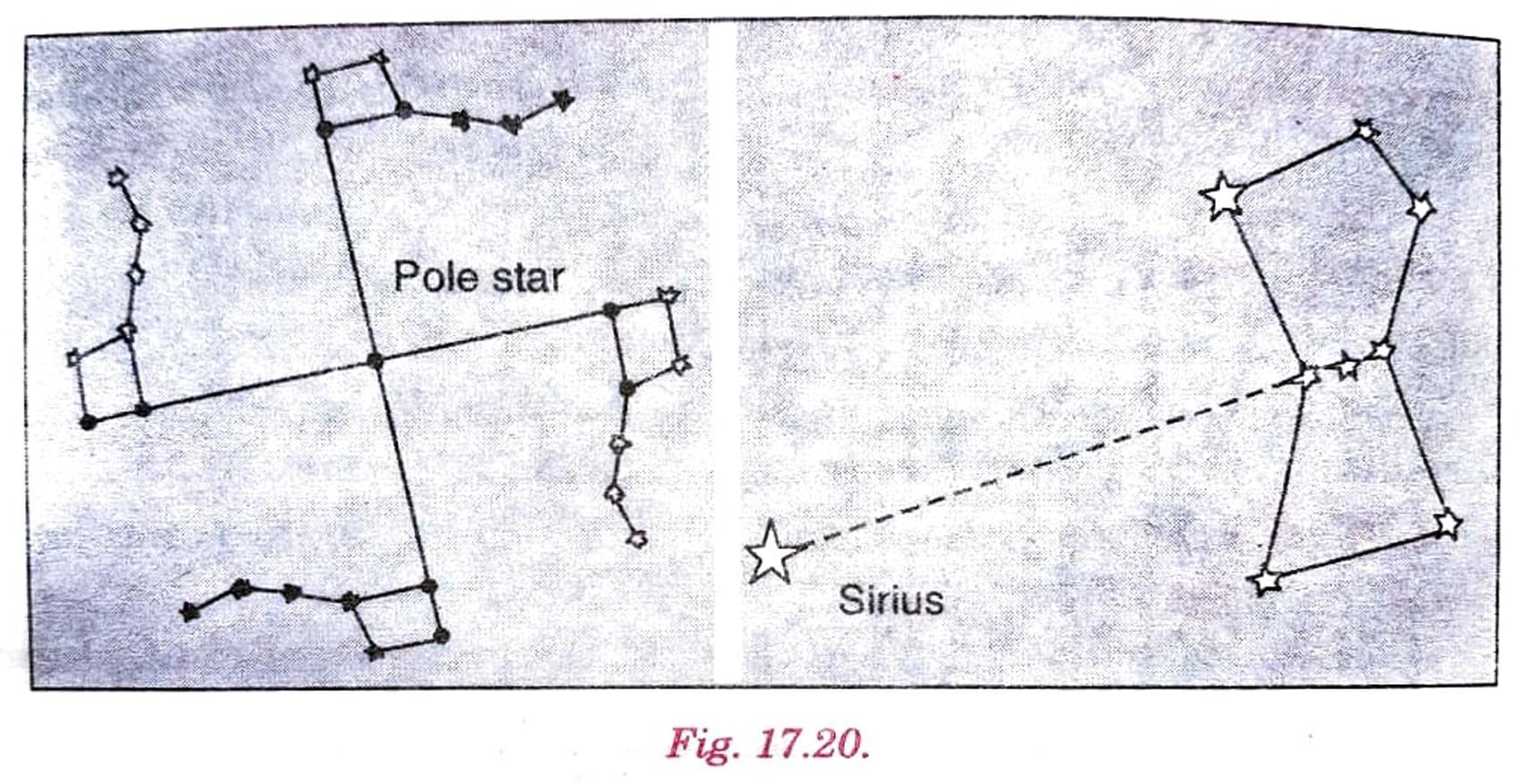
Q. 10. Draw sketches to show the relative positions of prominent stars in:
(i) Ursa Major and
(ii) Orion.
Ans. See Fig. 17.20.
Q. 11. Name two objects other than planets which are members of the solar system.
Ans. Meteors and Asteroids.
Q. 12. Explain how you can locate the Pole Star with the help of Ursa Major.
Ans. Pole star is situated at the end of the- Ursa Major. If a straight line starting from the last two stars is extended towards the north direction, it will lead to the Pole Star.
Q. 13. Do all the stars in the sky move? Explain.
Aus. All the stars in the sky do not move, but they appear to move from east to west. This is actually due to rotation of earth on its axis. Earth moves from west to east. So it appears as the stars are rising from east and as the day dawns they set in the west.
Q. 14. Why is the distance between stars expressed in light years? What do you understand by the statement that a star is eight light years away from the earth?
Ans. Stars are away from the earth millions of kilometres away. It is not convenient to express such a large distance in the units of km. So the distance of stars from the earth is expressed in time taken by light to travel in one year. Eight light years mean time taken by light to travel in eight years.
Q. 15. The radius of Jupiter is 11 time the radius of the earth. Calculate the ratio of the volumes of Jupiter and the earth How many Earths can Jupiter accommodate?
Ans. Let the radius of Earth = R units
Volume of Earth = 4/3 πR³ cubic units
Now, the radius of Jupiter = 11R units.
∴ Volume of Jupiter: 4 3 π(11R)³
= 4/3π(1331R³) cu. units.
Now the ratios of the volume of Jupiter and Earth
= Volume of Jupiter / Volume of the Earth
= 4/3π(1331R³) cu. units / 4/3πR³ cu. units
= 1331/1 = 1331:1
So 1331 Earths can be accommodated in one Jupiter.
Q. 16. Boojha made the solar system (Fig. 17.21). Is the sketch correct? If not, correct it.
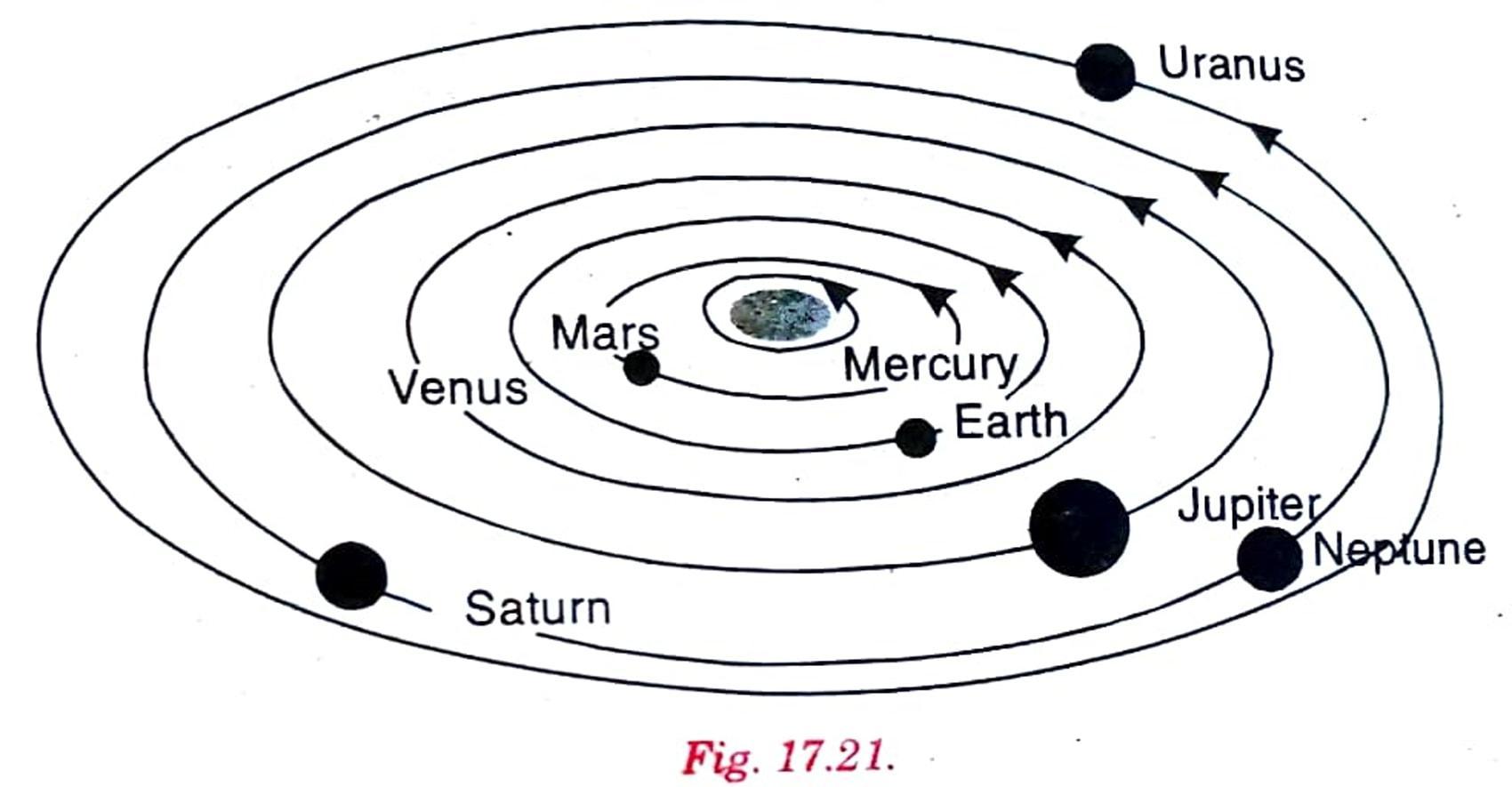
Ans. No, the given sketch is not correct. The following figure is correct.