Class 10 Science Chapter 10 – Light – Reflection and Refraction – All Textual Solutions | ASSEB Assam (English Medium)
Class 10 Science Chapter 10 – Light – Reflection and Refraction Complete Textual Solutions (ASSEB / SEBA Assam – English Medium)
The tenth chapter of the Class 10 Science curriculum, ‘Light – Reflection and Refraction’, marks the beginning of the Physics section and is one of the most numerical and diagram-heavy chapters. These complete textual solutions (Class 10 Science Chapter 10 Textual Question Answer) have been prepared based on the latest ASSEB (Assam State School Education Board) syllabus and the newest guidelines of the National Education Policy (NEP) for the upcoming board exams. This comprehensive collection includes Very Short Answers (VSA), Short Questions, Long Answers, and step-by-step mathematical problem solving. At Ospin Academy, these solutions are provided in a simple, accurate, and completely exam-oriented format.
This chapter explores the phenomena of light, covering the laws of reflection and refraction, image formation by spherical mirrors (concave and convex) and spherical lenses, refractive index, and the power of a lens. It is highly essential for matric candidates to clearly grasp these concepts and master the associated ray diagrams. Our textual solutions cover all textbook exercise questions, in-text questions, numerical problems, and additional exam-focused questions to ensure students are fully equipped for their examinations.
What you will learn and get from these textual solutions:
- Clear, step-by-step solutions to numerical problems using the mirror formula, lens formula, and magnification.
- Flawless answers for 1-mark VSA (objective type) and 2-3 mark short questions regarding the laws of reflection and refraction.
- Standard and easy-to-understand ray diagrams showing image formation by various mirrors and lenses at different object positions.
- Detailed explanations of refractive index, Snell’s Law, and the power of a lens.
- Solutions to all important questions along with the latest pattern MCQ questions as per the new syllabus.
Special features of these textual solutions by Ospin Academy:
- Complete textual solutions prepared strictly according to the latest ASSEB new syllabus.
- 100% accurate, high-quality notes written in simple English, making it easy for students to understand complex physics concepts (Class 10 Science Notes).
- Simplified answers and step-by-step numerical calculations specially designed for Quick Revision right before the examinations.
- A special compilation of extra important questions that are highly likely to appear in the board exams from this physics chapter.
Keeping in mind the academic upliftment of students, Ospin Academy has brought forward these special textual solutions. Start your matric exam preparation now and step forward towards scoring the highest marks in Science.
Class 10 Science (English Medium) PDF Solutions 2026-27 | SEBA Assam
Download Class 10 Science (English Medium) PDF with detailed solutions, MCQs, and extra practice questions for SEBA Assam 2025-26.

Class 10 Science
Light-Reflection and Refraction
Textual Questions and Answers
1. Define the principal focus of a concave mirror.
Answer: The principal focus of a concave mirror is a point on its principal axis to which all the parallel light rays which are close to the axis converge after reflection from the concave mirror.
2. The radius of curvature of a spherical mirror is 20cm. What is its focal length?
Answer: Given ,
Radius of curvature, R = 20 cm
Focal length (f) = ?
We know that ,
Radius of curvature of a spherical mirror = 2 x Focal Length
R = 2f
f =
f =
f = 10
Hence, the focal length of the given spherical mirror is 10 cm.
3. Name a mirror that can give an erect and enlarged image of an object.
Answer: Concave mirror.
4. Why do we prefer a convex mirror as a rear view mirror in vehicles?
Answer: Usually, we prefer a convex mirror as a rear-view mirror in vehicles. The major reason behind this is that it provides a wider field of view. This permits the driver to view most of the traffic that is behind his vehicle.
A convex mirror always creates a virtual image. When the object is far away from the convex mirror, the image that is created is upright as well as situated at the focal point. As the object arrives near the convex mirror, the image also comes near the mirror. Further, the image develops until its height becomes equal to that of the image. Convex mirrors form images that are smaller in comparison to the object.
However, the object becomes larger as it comes near the mirror.
5. Find the focal length of a convex mirror whose radius of curvature is 32 cm. Answer:
Radius of curvature,
Radius of curvature =
=16 cm
Hence, the focal length of the given convex mirror is 16 cm.
6. A concave mirror produces three times magnified (enlarged) real image of an object placed at 10 cm in front of it. Where is the image located?
Answer :
Magnification produced by a spherical mirror is given by the relation,
Let the height of the object,
Then, height of the image, (Image formed is real)
Object distance,
Here, the negative sign indicates that an inverted image is formed at a distance of 30 cm in front of the given concave mirror.
7. A ray of light travelling in air enters obliquely into water. Does the light ray bend towards the normal or away from the normal? Why? Answer: When a ray of light travelling in air enters obliquely into water, it bends towards the normal. This is because water is optically denser than air. On entering water, the speed of light decreases and the light bends towards normal.
8. Light enters from air to glass having refractive index 1.50. What is the speed of light in the glass? The speed of light in vacuum is 3×10⁸ m/s.
Answer :
Refractive index of a medium is given by:
Given:
Speed of light in vacuum,
Refractive index of glass,
Speed of light in the glass:
9. Find out from table 10.3 the medium having highest optical density. Also find the medium with lowest optical density.
Answer: The medium having the highest refractive index has the highest optical density. Therefore diamond has the highest optical density.
The medium having the lowest refractive index has the lowest optical density. Therefore air has the lowest optical density.
10. You are given kerosene, turpentine and water. In which of these the light travels fastest? Use the information given in Table on page 225.
Answer: Speed of light in a medium is given by the relation for refractive index . The relation is given as:
It can be inferred from the relation that:
• Light will travel slowest in the material with the highest refractive index
• Light will travel fastest in the material with the lowest refractive index
From Table 10.3, the refractive indices are:
• Kerosene: 1.44
• Turpentine: 1.47
• Water: 1.33
Therefore, light travels fastest in water (which has the lowest refractive index of 1.33).
11. The refractive index of diamond is 2.42. What is the meaning of this statement?
Answer: The refractive index of diamond is 2.42. This means that the speed of light in diamond will reduce by a factor of 2.42 as compared to its speed in air.
12. Define 1 dioptre of power of a lens.
Answer: Dioptre is the SI unit of power of a lens denoted by the letter D. 1 dioptre can be defined as the power of a lens of focal length 1 metre.
13. A convex lens forms a real and inverted image of a needle at a distance of 50 cm. from it. Where is the needle placed in front of the convex lens if the image is equal in size to the object? Also find the power of the lens.
Answer: It is given that the image of the needle is formed at a distance of 50 cm from the convex lens. Hence, the needle is placed in front of the lens at a distance of 50 cm.
Object distance, u = -50 cm
Image distance, v = 50 cm
Focal length, f = ?
According to the lens formula,
= 0.25 m
Power of the lens,
Hence, the power of the given lens is .
14. Find the power of a concave lens of focal length 2 m.
Answer: Focal length of concave lens,
Power of a lens,
= −0.5 D
Here, negative signs arise due to the divergent nature of concave lenses.
Hence, the power of the given concave lens is .
Exercise Questions and Answers
1. Which one of the following materials cannot be used to make a lens?
(a) Water
(b) Glass
(c) Plast
(d) Clay
Answer: (d) Clay
2. The image formed by a concave mirror is observed to be virtual, erect and larger than the object. Where should be the position of the object?
(a) Between the principal focus and the centre of curvature
(b) At the centre of curvature.
(c) Beyond the centre of curvature
(d) Between the pole of the mirror and its principal focus.
Answer: (d) Between the pole of the mirror and its principal focus.
3. Where should an object be placed in front of a convex lens to get a real image of the size of the object?
(a) At the principal focus of the lens.
(b) At twice the focal length.
(c) At infinity.
(d) Between the optical centre of the lens and its principal focus.
Answer: (b) At twice the focal length.
4. A spherical mirror and a thin spherical lens each have a focal length of – 15 cm. The mirror and the lens are likely to be
(a) Both concave.
(b) Both convex.
(c) The mirror is concave and the lens is convex.
(d) The mirror is convex, but the lens is concave.
Answer: (a) Both concave
5. No matter how far you stand from a mirror your image appears erect. The mirror is likely to be
(a) Plane.
(b) Concave.
(c) Convex.
(d) Either plane or convex.
Answer: (d) Either plane or convex.
6. Which of the following lenses would you prefer to use To which reading small letters found in a dictionary?
(a) A convex lens of focal length 50 cm.
(b) A concave lens of focal length 50 cm.
(c) A convex lens of focal length of 5 cm.
(d) A concave lens of focal length of 5 cm.
Answer: (c) A convex lens of focal length of 5 cm.
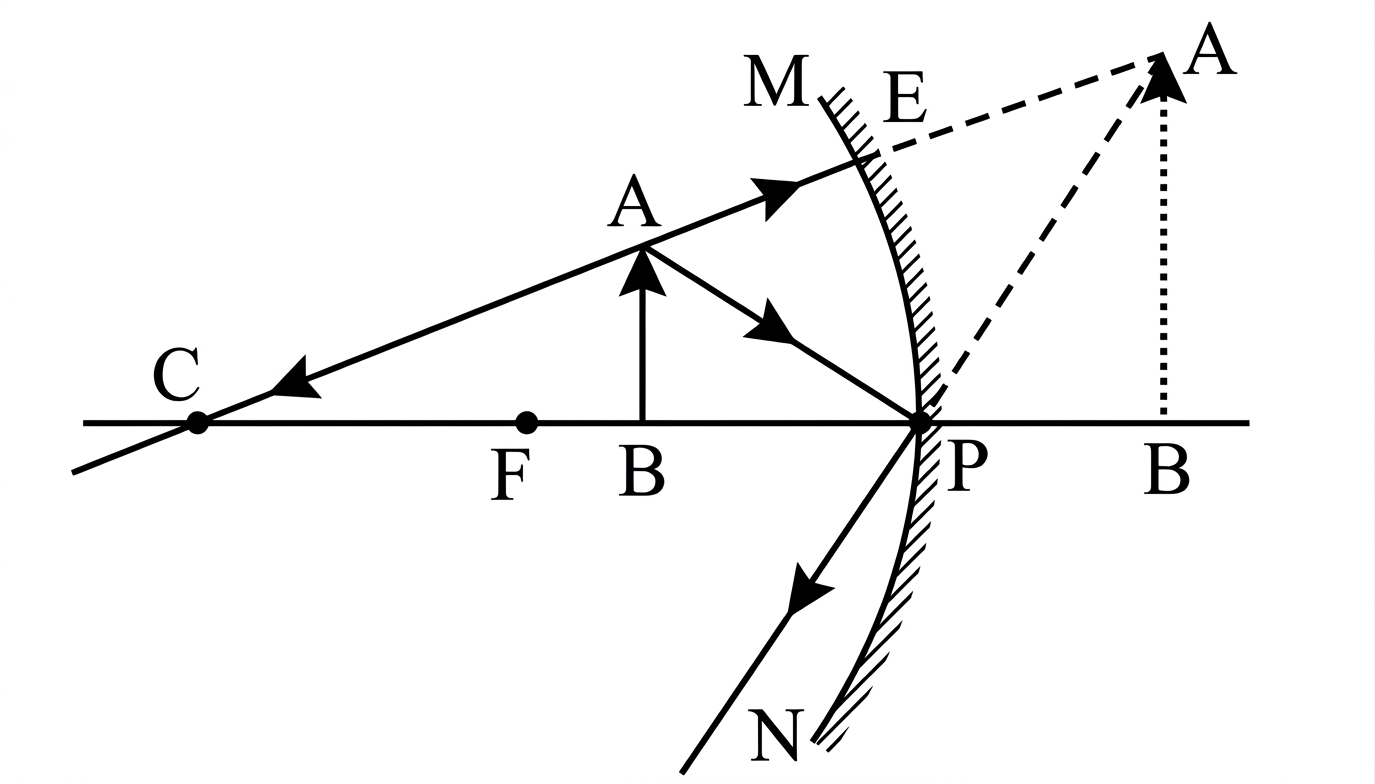
7. We wish to obtain an erect image of an object , using a concave mirror of focal length 15 cm. What should be the range of distance of the object from the mirror? What is the nature of the image? Is the image larger or smaller than the object? Draw a ray diagram to show the image formation in this case.
Answer: A concave mirror gives an erect image when the object is placed between the focus F and the pole P of the concave mirror, i.e., between 0 and 15 cm from the mirror. The image thus formed will be virtual, erect and larger than the object
8. Name the type of mirror used is the following situations:
(a) Head lights of a car.
Answer: Headlights of a car : concave mirror to give parallel beam of light after reflection from concave mirror.
(b) Side/rear – view mirror of a vehicle.
Answer: A convex mirror is used as a side/rear-view mirror of a vehicle because:
i) A convex mirror always forms an erect, virtual and diminished image of an object placed anywhere in front of it.
ii) A convex mirror has a wider field of view than a plane mirror of the same size.
(c) Solar furnace Support your answer with reason.
Answer: Solar furnace: concave mirror to concentrate sunlight to produce heat in solar furnace.
9. One – half of a convex lens is covered with a black paper. Will this lens produce a complete image of the object? Verify your answer experimentally. Explain your observations.
Answer:
The convex lens will form a complete image of an object, even if its one half is covered with black paper. It can be understood by the following two cases.
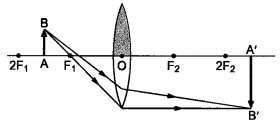
Case I
When the upper half of the lens is covered
In this case, a ray of light coming from the object will be refracted by the lower half of the lens. These rays meet at the other side of the lens to form the image of the given object, as
shown in the following figure.
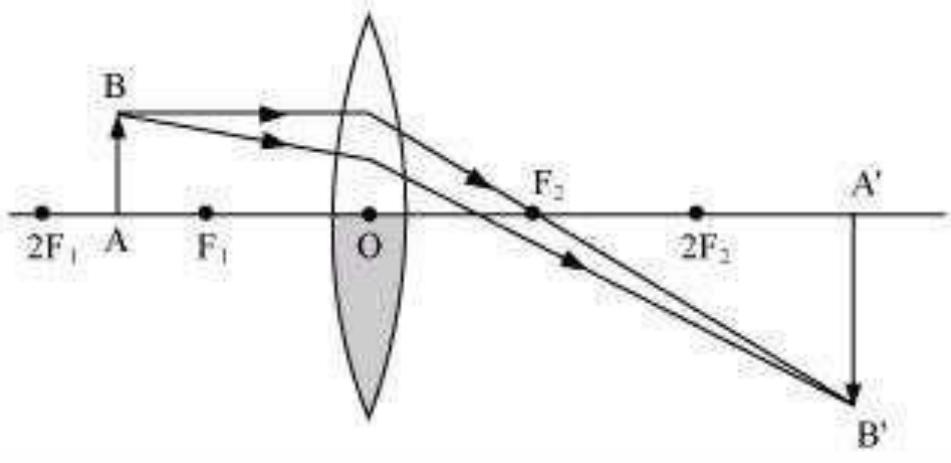
Case II
When the lower half of the lens is covered
In this case, a ray of light coming from the object is refracted by the upper half of the lens. These rays meet at the other side of the lens to form the image of the given object, as shown in the following figure.
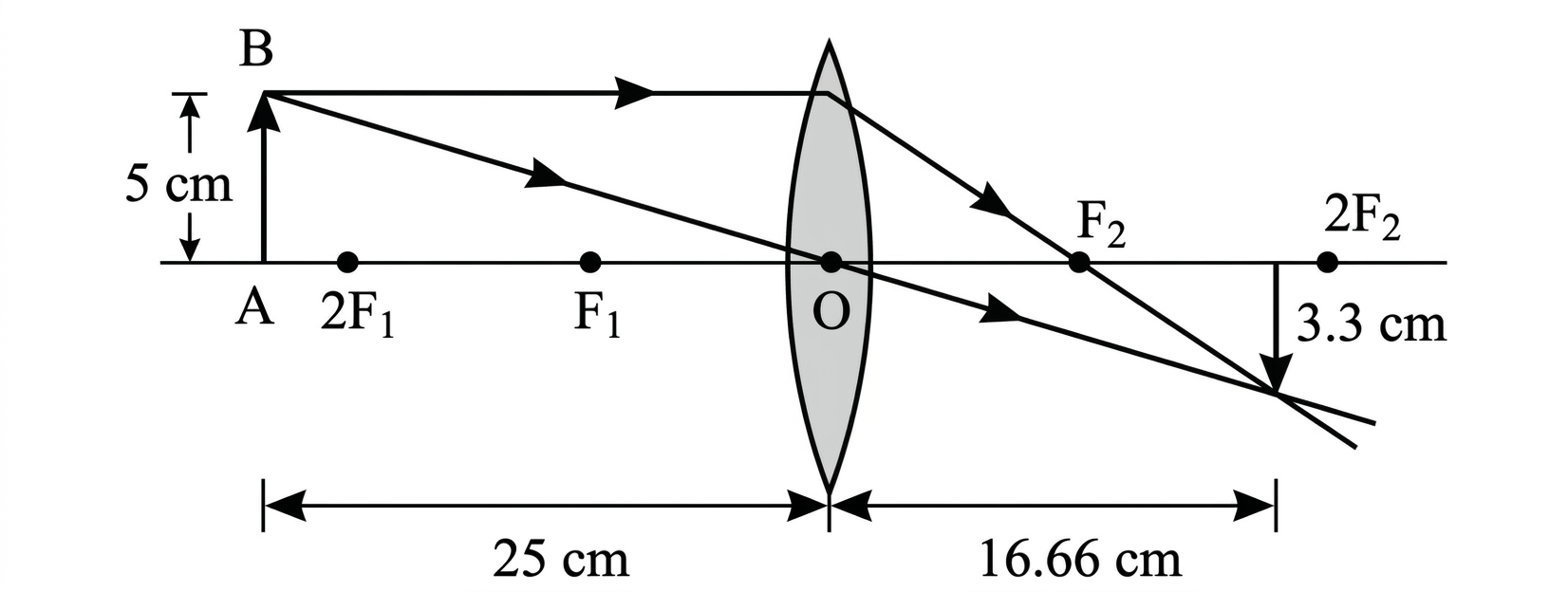
10. An object 5 cm. in length is held 25 cm away from a converging lens of focal length 10 cm. Draw the ray diagram and find the position, size and nature of the image formed.
Answer: Given,
Object distance,
Object height,
Focal length,
According to the lens formula,
16.66 cm
The positive value of shows that the image is formed at the other side of the lens.
= − 0.66
The negative sign shows that the image is real and inverted.
−3.3 cm
The negative value of image height indicates that the image formed is inverted. The position, size, and nature of the image are shown in the following ray diagram.
11. A concave lens of focal length 15 cm. forms an image 10 cm. from the lens. How far is the object from the lens? Draw the ray diagram.
Answer: Focal length of concave lens (OF₁),
Image distance,
According to the lens formula,
The negative value of indicates that the object is placed 30 cm in front of the lens. This is shown in the following ray diagram.
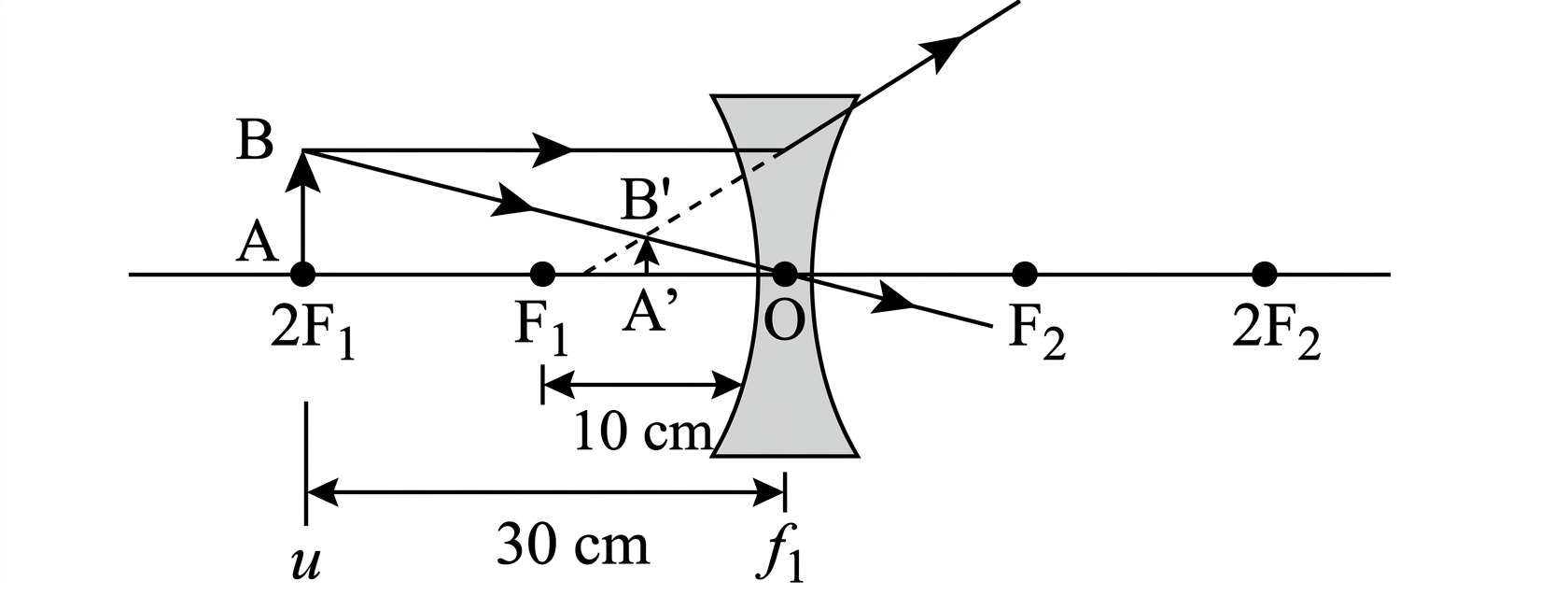
12. An object is placed at a distance of 10 cm from a convex mirror of focal length 15 cm. Find the position and nature of the image.
Answer :
Given,
Focal length of convex mirror,
Object distance,
According to the mirror formula,
The positive value of indicates that the image is formed behind the mirror.
The positive value of magnification indicates that the image formed is virtual and erect.
13. The magnification produced by a plane mirror is . What does this mean?
Answer: Magnification produced by a mirror is given by the relation
Magnification
The magnification produced by a plane mirror is . It shows that the image formed by the plane mirror is of the same size as that of the object. The positive sign shows that the image formed is virtual and erect.
14. An object 5.0 cm in length is placed at a distance of 20 cm in front of a convex mirror of radius of curvature 30 cm. Find the position of the image, its nature and size.
Answer: Given that,
Object distance, u = -20 cm
Object height, h = 5 cm.
Radius of curvature, R = 30 cm
Radius of curvature = 2 x Focal length
∵ R= 2f
∴ f = 15 cm
According to the mirror formula,
∴
The positive value of indicates that the image is formed behind the mirror.
The positive value of magnification indicates that the image formed is virtual.
The positive value of image height indicates that the image formed is erect.
Therefore, the image formed is virtual, erect, and smaller in size.
15. An object of size 7.0 cm is placed at 27 cm. in front of a concave mirror of focal length 18 cm. At what distance from the mirror should a screen be placed so that a sharp focussed image can be obtained? Find the size and nature of the image.
Answer: Given that,
Object distance,
Object height,
Focal length,
According to the mirror formula,
The screen should be placed at a distance of 54 cm in front of the given mirror.
The negative value of magnification indicates that the image formed is real.
m
The negative value of image height indicates that the image formed is inverted.
16. Find the focal length of a lens of power,-2.0D. What type of lens is this?
Answer: Given that,
Power of a lens,
A concave lens has a negative focal length.
Hence, it is a concave lens.
17. A doctor has prescribed a corrective line of power +1.5 D. Find the focal length of the lens. Is the prescribed lens diverging or converging?
Answer: Given that,
P = +1.5 D
f = ?
We have,
P =
+1.5 =
f = +
f = + 0.67 m
A convex lens has a positive focal length.
Hence, it is a convex lens or a converging lens.