Class 10 Science Chapter 11 – The Human Eye and the Colourful World – All Textual Solutions | ASSEB Assam (English Medium)
Class 10 Science Chapter 11 – The Human Eye and the Colourful World Complete Textual Solutions (ASSEB / SEBA Assam – English Medium)
The eleventh chapter of the Class 10 Science curriculum, ‘The Human Eye and the Colourful World’, beautifully connects physics concepts with natural phenomena. These complete textual solutions (Class 10 Science Chapter 11 Textual Question Answer) have been prepared based on the latest ASSEB (Assam State School Education Board) syllabus and the newest guidelines of the National Education Policy (NEP) for the upcoming board exams. This comprehensive collection includes Very Short Answers (VSA), Short Questions, Long Answers, and detailed reasoning explanations. At Ospin Academy, these solutions are provided in a simple, accurate, and completely exam-oriented format.
This chapter explores the structure and working of the human eye, common defects of vision (myopia, hypermetropia, presbyopia) and their corrections. It further explains fascinating optical phenomena in nature, such as the dispersion of white light by a glass prism, atmospheric refraction (twinkling of stars), and the scattering of light (blue colour of the sky, red colour of the sun at sunrise and sunset). It is highly essential for matric candidates to understand these real-world applications clearly. Our textual solutions cover all textbook exercise questions, in-text questions, and additional exam-focused questions to ensure students are fully equipped for their examinations.
What you will learn and get from these textual solutions:
- Clear, step-by-step explanations of the human eye structure and its various parts.
- Flawless answers and ray diagrams for vision defects (Myopia, Hypermetropia) and their corrections using lenses.
- Standard and easy-to-understand solutions explaining the dispersion of light through a prism and the formation of a rainbow.
- Detailed reasoning answers for phenomena caused by atmospheric refraction and scattering of light.
- Solutions to all important questions along with the latest pattern MCQ questions as per the new syllabus.
Special features of these textual solutions by Ospin Academy:
- Complete textual solutions prepared strictly according to the latest ASSEB new syllabus.
- 100% accurate, high-quality notes written in simple English, making it easy for students to understand and memorize (Class 10 Science Notes).
- Simplified answers specially designed for Quick Revision right before the examinations.
- A special compilation of extra important conceptual and diagram-based questions that are highly likely to appear in the board exams.
Keeping in mind the academic upliftment of students, Ospin Academy has brought forward these special textual solutions. Start your matric exam preparation now and step forward towards scoring the highest marks in Science.
Class 10 Science (English Medium) PDF Solutions 2026-27 | SEBA Assam
Download Class 10 Science (English Medium) PDF with detailed solutions, MCQs, and extra practice questions for SEBA Assam 2025-26.
 Class 10 Science
The Human Eye and the colourful World
Textual Questions and Answers
1. What is the meant by power of accommodation of the eye?
Answer: The power of accommodation is the ability of an eye to focus near and far objects clearly and make an image on the retina by adjusting its focal length.
2. A person with a myopic eye cannot see objects beyond 1.2 m distinctly. What should be the type of the corrective lens used to restore proper vision?
Answer: Concave Lens.
3. What is the far point and near point of the human eye with normal vision?
Answer: The far point of the human eye with normal vision is at infinity and the near point is 25 cm distance from the eye.
4. A student has difficulty reading the black board while sitting in the last row. What could be the defect the child is suffering from? How can it be corrected?
Answer: Since the child cannot see distant objects (like blackboard writing ) clearly, he is suffering from the defect of vision (or defect of eye ) called ‘myopia’ or ‘short – sightedness’. Myopia can be corrected by using spectacles containing concave lenses of suitable power.
Exercise Questions and Answers
1. The human eye can focus objects at different distances by adjusting the focal length of the eye lens. This is due to
(a) Presbyopia
(b) Accommodation
(c) Near-sightedness
(d) Far-sightedness
Answer: (b) Accommodation
2. The human eye forms the image of an object at its-
(a) Cornea.
(b) Iris.
(c) Pupil
(d) Retina.
Answer: (d) Retina
3. The least distance of distinct vision for a young adult with normal vision is about
(a) 25 m
(b) 2.5 cm
(c) 25 cm
(d) 2.5 m
Answer: (c) 25 cm.
4. The change in focal length of an eye lens is caused by the action of the
(a) Pupil.
(b) Retina.
(c) Ciliary muscles.
(d) Iris.
Answer: (c) Ciliary muscles.
5. A person needs a lens of power −5.5 dioptres for correcting his distant vision. For correcting his near vision he needs a lens of power +1.5 dioptre. What is the focal length of the lens required for correcting (i) distant vision, and (ii) near vision?
Answer: The power of a lens of focal length is given by the relation
(i) Power of the lens used for correcting distant vision = D
Focal length of the required lens,
The focal length of the lens for correcting distant vision is m.
(ii) Power of the lens used for correcting near vision = D
Focal length of the required lens,
The focal length of the lens for correcting near vision is m.
6. The far point of a myopic person is 80 cm in front of the eye. What is the nature and power of the lens required to correct the problem?
Answer: The person is suffering from an eye defect called myopia. In this defect, the image is formed in front of the retina. Hence, a concave lens is used to correct this defect of vision.
Object distance,
Image distance,
Focal length =
According to the lens formula,
We know,
Power,
A concave lens of power D is required by the person to correct his defect.
7. Make a diagram to show how hypermetropia is corrected. The near point of a hypermetropic eye is 1m. What is the power of the lens required to correct this defect? Assume that the near point of the normal eye is 25 cm.
Answer: Diagram:
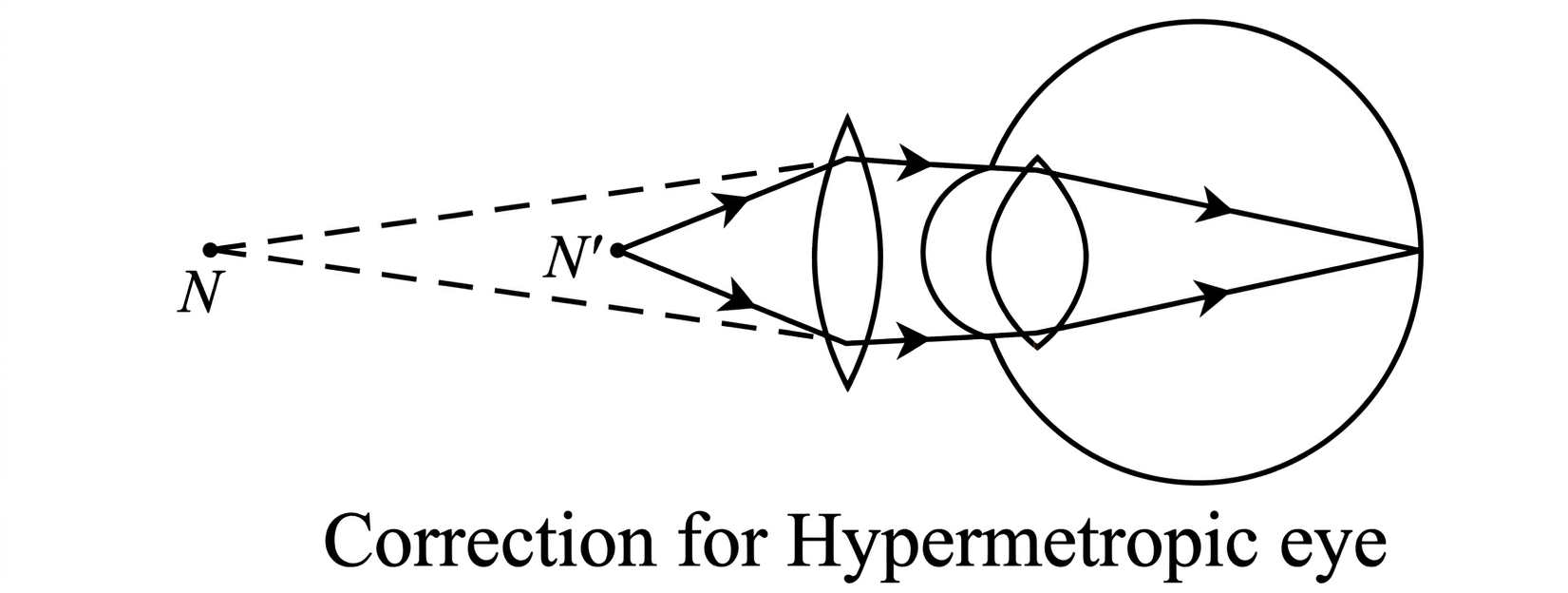
2nd part:
Given that,
Object distance
u = – 25 cm / For convex lenses.
Image distance
v = – 1m = – 100 cm
Focal length, f = ?
We have,
Power,
A convex lens of power +3.0 D is required to correct the defect.
8. Why is a normal eye not able to see clearly the objects explain placed closer than 25 cm?
Answer: Because the focal length of a normal eye is 25cm.
When any object placed closer than 25 cm then the image is FORMED behind the retina. Then objects seem blurred.
9. What happens to the image distance in the eye when we increase the distance of an object from the eye?
Answer: Since the size of eyes cannot increase or decrease, the image distance remains constant. When we increase the distance of an object from the eye, the image distance in the eye does not change. The increase in the object distance is compensated by the change in the focal length of the eye lens. The focal length of the eyes changes in such a way that the image is always formed at the retina of the eye.
10. Why do stars twinkle?
Answer: The stars seem to twinkle in the night sky due to the effects of the Earth’s atmosphere. When starlight enters the atmosphere, it is affected by winds in the atmosphere and areas with different temperatures and densities. This causes the light from the star to twinkle when seen from the ground.
Explanation:
(i) The twinkling of stars is due to atmospheric refraction of star-light. The refraction of light caused by the earth’s atmosphere having air layers of varying optical density is called atmospheric refraction.
(ii) The physical conditions of the atmosphere keep on changing continuously due to which density of air in different layers of atmosphere also keeps on changing.
As a result of this, the refractive index of the various layers of atmosphere also keeps on changing continuously. So, light coming from stars suffers multiple refractions and the amount of starlight reaching the eye also keeps changing and so, due to fluctuation of perceived brightness of the star, they appear like they are twinkling.
11. Explain why the planets do not twinkle.
Answer: The planets are much closer to the earth. A planet can be considered as a collection of a large number of point-sized sources of light. So the total variation in the amount of light entering our eye from all the individual point-sized sources will average out to zero thereby nullifying the twinkling effect. On the other hand stars twinkle because stars are point-sized sources of energy therefore the continuously changing atmosphere causes atmospheric refraction which causes variation in light.
12. Why does the Sun appear reddish early in the morning?
Answer: At sunrise, the rays of light coming from the Sun need to travel long distances in the Earth’s atmosphere before they reach our eyes. On this journey, shorter wavelengths of light are scattered and only longer wavelengths reach our eyes. Blue has a short wavelength and red has a long wavelength, so red reaches the eye after atmospheric scattering. Therefore, the sun looks reddish in the early morning.
13. Why does the sky appear dark instead of blue to an astronaut?
Answer: To an astronaut, the sky looks dark and black instead of blue because there is no atmosphere containing air in outer space to scatter sunlight. So, there is no scattered light to reach our eyes in outer space, therefore the sky looks dark and black there. Since there is no scattering of the blue component of white sunlight which can reach the eyes of an astronaut in outer space, therefore the sky appears dark to the astronaut instead of blue.