Class 10 Science Chapter 5 – Periodic Classification of Elements – All Textual Solutions | ASSEB Assam (English Medium)
Class 10 Science Chapter 5 – Periodic Classification of Elements Complete Textual Solutions (ASSEB / SEBA Assam – English Medium)
The fifth chapter of the Class 10 Science curriculum, ‘Periodic Classification of Elements’, is a fundamental and highly scoring topic for students. These complete textual solutions (Class 10 Science Chapter 5 Textual Question Answer) have been prepared based on the latest ASSEB (Assam State School Education Board) syllabus and the newest guidelines of the National Education Policy (NEP) for the upcoming board exams. This comprehensive collection includes Very Short Answers (VSA), Short Questions, Long Answers, and detailed explanations of periodic trends. At Ospin Academy, these solutions are provided in a simple, accurate, and completely exam-oriented format.
This chapter takes students through the historical journey of classifying elements, covering Dobereiner’s Triads, Newlands’ Law of Octaves, Mendeleev’s Periodic Table, and finally the Modern Periodic Table. It also explores the trends in physical and chemical properties across periods and down groups. It is highly essential for matric candidates to grasp these concepts clearly. Our textual solutions cover all textbook exercise questions, in-text questions, and additional exam-focused questions to ensure students are fully prepared for their examinations.
What you will learn and get from these textual solutions:
- Clear explanations of the early attempts at the classification of elements and their limitations.
- Flawless answers for 1-mark VSA (objective type) and 2-3 mark short questions regarding Mendeleev’s and the Modern Periodic Law.
- Standard and easy-to-understand solutions for understanding the position of elements in the Modern Periodic Table.
- Detailed explanations of periodic trends such as valency, atomic size, metallic, and non-metallic character.
- Solutions to all important questions along with the latest pattern MCQ questions as per the new syllabus.
Special features of these textual solutions by Ospin Academy:
- Complete textual solutions prepared strictly according to the latest ASSEB new syllabus.
- 100% accurate, high-quality notes written in simple English, making it easy for students to understand and memorize (Class 10 Science Notes).
- Simplified answers specially designed for Quick Revision right before the examinations.
- A special compilation of extra important questions that are highly likely to appear in the exam from this chapter.
Keeping in mind the academic upliftment of students, Ospin Academy has brought forward these special textual solutions. Start your matric exam preparation now and step forward towards scoring the highest marks in Science.

Class 10 Science (English Medium) PDF Solutions 2026-27 | SEBA Assam
Download Class 10 Science (English Medium) PDF with detailed solutions, MCQs, and extra practice questions for SEBA Assam 2025-26.

Class 10 Science
Periodic Classification of Elements
Textual Questions and Answers
1. Did Dobereiner’s triads also exist in the columns of Newlands Octaves? Compare and find out.
Answer: Yes, Dobereiner’s triads also exist in the columns of Newland’s octaves.
For example: Li, Na, k.
2. What were the limitations of Dobereiner’s classification?
Answer: Limitations of Dobereiner’s classification of elements:
It could identify only three triads from the elements which were known at that time. It failed to arrange all the elements which were known then in the form of triads of elements with the same chemical properties. So, his classification of elements was not much successful.
3. What were the limitations of Newland’s law of octaves?
Answer: The major limitations of Newland’s law of octaves are:
(i) Newlands ‘law of octaves was applicable to the classification of elements up to calcium only. After calcium every eight elements did not possess the properties similar to that of the first element. Thus Newlands’ law of octaves worked well with lighter elements only.
(ii) Newands’ assumed that only 56 elements existed in nature and no more elements would be discovered in the future. But later on, several new elements were discovered whose properties did not fit into Newlands, law of octaves.
(ii) In order to fit elements into his table, Newlands put even two elements together in one slot and that too in the column of unlike elements having very different properties.
(iv) Iron element which resembles cobalt and nickel elements in properties was placed far away from these elements.
4. Use Mendeleev’s periodic table to predict the formula for the oxides of the following elements:
K, C, AI, Si, Ba
Answer: Oxygen belongs to group VIA in Mendeleev’s periodic table and its valency is 2. In the same way, the valencies of the given elements can be determined from their respective groups. Using these valencies, the formulae of their oxides can be predicted.
(i) The element K is placed in group I of Mendeleev’s periodic table where the general formula of oxides is R₂O. Therefore, the formula of the oxide of K is K₂O.
(ii) The element C is in group IV of Mendeleev’s periodic table where the general formula of oxides is RO₂. Hence, the formula of the oxide of C is CO₂.
(iii) The element Al is in group III of Mendeleev’s periodic table where the general formula of oxides is R₂O₃. So, the formula of the oxide of Al is Al₂O₃.
(iv) The element Si is in group IV of Mendeleev’s periodic table where the general formula of oxides is RO₂. Therefore, the formula of the oxide of Si is SiO₂.
(v) The element Ba is in group II of Mendeleev’s periodic table where the general formula of oxides is RO. Hence, the formula of the oxide of Ba is BaO.
5. Besides gallium, which other elements have since been discovered that were left by Mendeleev in this periodic table? (any two)
Answer: Scandium and Germanium.
6. What were the criteria used by Mendeleev in creating his periodic table?
Answer: Mendeleev’s periodic table:
(i) Mendeleev arranged the elements in vertical columns and horizontal rows.
(ii) All the elements discovered at that time were included in his table.
Criteria of Mendeleev’s periodic table:
(i) Mendeleev’s periodic table was based on the atomic weights of the elements.
(ii) He arranged the elements in the increasing atomic weights as he considered that the physical and chemical properties of the elements are dependent on their atomic weights.
7. Why do you think the noble gases are placed in a separate group?
Answer: Noble gases like helium, neon and argon are chemically inert and are present in the atmosphere in extremely low concentrations. Thus owing to their similar inert behaviour and similar electronic configuration. They are justified to be placed in a separate group.
8. How could the Modern Periodic Table remove various anomalies of Mendeleev’s Periodic Table?
Answer: Mendeleev was unable to give fixed position to hydrogen and isotopes in the periodic table. In Mendeleev’s periodic table, the increasing manner of atomic mass of the elements is not always regular from one to its next. It was believed that a more fundamental property than atomic mass could explain periodic properties in a better manner.
It was Henry Moseley who demonstrated that the atomic number of an element could explain periodic properties in a better way than atomic mass of an element and arranged the elements in increasing order of their atomic numbers. Then it was found that the various anomalies of Mendeleev’s periodic table were removed by the modern periodic table.
9. Name two elements you would expect to show chemical reactions similar to magnesium. What is the basis of your choice?
Answer: Calcium (Ca) and strontium (Sr) are expected to show chemical reactions similar to magnesium (Mg). This is because the number of valence electrons (2) is the same in all these three elements. And since chemical properties are due to valence electrons, they show the same chemical reactions.
10. Name
(a) Three elements that have a single electron in their outermost shells.
(b) Two elements that have two electrons in their outermost shells.
(c) Three elements with filled outermost shells.
Answer:
(a) Lithium, sodium, potassium.
(b) Magnesium, calcium.
(c) Helium, Neon, Argon.
11. (a) Lithium, sodium, potassium are all metals that react with water to liberate hydrogen gas. Is there any similarity in the atoms of these elements?
(b) Helium is an unreactive gas and neon in a gas of extremely low reactivity. What, if anything, do their atoms have in common?
Answer: (a) The atoms of lithium, sodium, potassium all have only one electron in their outermost shells.
(b) The atoms of helium and neon have their outermost shell completely filled.
12. In the Modern Periodic Table, which are the metals among the first ten elements?
Answer: As, the metallic character decreases across the period so lithium and beryllium are the metals among the first ten elements in the Modern Periodic Table.
13. By considering their position in the periodic table , which one of the following elements would you expect to have maximum metallic characteristic?
Ga, Ge, As, Se, Be.
Answer: Be.
Exercise Questions and Answers
1. Which of the following statements is not a correct statement about the trends when going from left to right across the periods of Periodic table.
(a) The elements become less metallic in nature.
(b) The number of valence electrons increases.
(c) The atoms lose their electrons more easily.
(d) The oxides become more acidic.
Answer: (c) The atoms lose their electrons easily when going left to right is not correct.
2. Element X forms a chloride with the formula Xcl₂ which is solid with a high melting point. X would most likely be in the same group of the Periodic Table as
(a) Na
(b) Mg
(c) AI
(d) Si
Answer: (b) Mg
3. Which element has
(a) Two shells, both of which are completely filled with electrons?
(b) The electronic configuration 2, 8, 2?
(c) A total of three shells, with four electrons in its valence shell?
(d) A total of two shells, with three electrons in its valence shell?
(e) Twice as many electrons in its second shell as in its first shell?
Answer:
(a) Ne (2, 8)
(b) Mg
(c) Si (2, 8, 4)
(d) B (2, 3)
(e) C (2, 4)
4. (a) What property do all elements in the same column of the periodic table as born have in common?
(b) What property do all elements in the same column of the periodic table as fluorine have in common?
Answer:
(a) They have the same valence and are metalloids.
(b) They form acidic oxides and have seven electrons in their outermost shells.
5. An atom has electronic configuration 2, 8, 7.
(a) What is the atomic number of these elements?
(b) To which of the following elements would it be chemically similar? (Atomic numbers are given in parentheses) N (7) F (9) P (15) Ar (18)
Answer:
(a) The atomic number of the element = 2 + 8 + 7 = 17
(b) F (9) Because the no of electrons of the outermost shell of F is 7
6. The position of three elements A, B, and C in the Periodic Table are shown below:
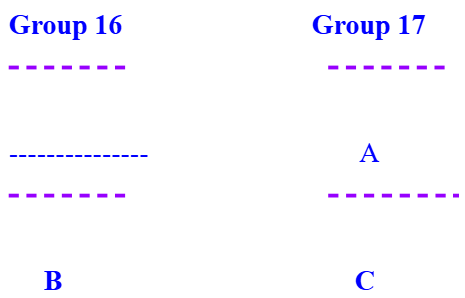
(a) State whether A is a metal Or non metal.
(b) State whether C is more reactive or less reactive than A.
(c) Will C be larger or smaller in size than B?
(d) Which type of ion , cation or anion will be formed by element A?
Answer:
(a) Element A is in group 17. Now , group 17 is on the right side or the periodic table where non – metals are placed. So, element A is a non – metal.
(b) In group 17 of halogens, the chemical reactivity decreases on going down in a group. Thus element C will be less reactive than element A.
(c) On going from left to right in a period , the size of atoms decreases. So, the atom of C will be smaller in size than an atom of B.
(d) Element A of group 17 has 7 valence electrons. So, it will accept 1 electron to form a negatively charged ion, A. The negatively charged ion is called anion. Thus, element A will form an anion.
7. Nitrogen (atomic number 7) and phosphorus (atomic number 15) belong to group 15 of the Periodic Table. Write the electronic configuration A these two elements. Which of these will be more electronegative? Why?
Answer: Electronic configuration of Nitrogen = 2,5 Electronic configuration of phosphorous = 2,8,5
Nitrogen will be more electronegative because the outermost shell is nearer to the nucleus.
8. How does the electronic configuration of an atom relate to its position in the Modern Periodic Table?
Answer: In the Modern Periodic Table, the electronic configuration of an element determines the number of valence electrons whereas the position of the atom is determined by the valence electrons.
9. In the Modern Periodic Table, Calcium (atomic number 20) is surrounded by elements with atomic numbers 12, 19, 21, and 38. Which of these have physical and chemical properties resembling calcium?
Answer:
The electronic configuration of calcium = 2,8,8,2
The electronic configuration of atomic number 12 = 2,8,2
The electronic configuration of atomic number 19 = 2,8,8,1
The electronic configuration of atomic number 21 = 2,8,8,3
The electronic configuration of atomic number 38 = 2,8,18,8,2
Elements with atomic number 12 38 will have similar physical and chemical properties as calcium.
10. Compare and contrast the arrangement of elements in Mendeleev’s Periodic Table and Modern Periodic Table.
Answer: From your chemistry lessons you have learned about the Mendeleev’s Periodic Table and its modification which is known as the Modern Periodic Table. Let us compare both of them in the tabular form.
|
(a) Mendeleev’s periodic table does not explain the reason for the periodicity in the properties of elements. |
(a) The modern periodic table says that since the electronic configurations of elements are repeated at regular intervals therefore , the properties of elements are also repeated at regular intervals. |
(a) Mendeleev’s periodic table does not explain the reason for the periodicity in the properties of elements. |
|
(b) There are nine vertical columns called groups . |
(b) There are eighteen vertical columns called groups. |
(b) There are nine vertical columns called groups . |
|
(c) Mendeliev’s periodic table had a number of defects . |
(c) There are no defeats in the modern periodic table . |
(c) Mendeliev’s periodic table had a number of defects . |